
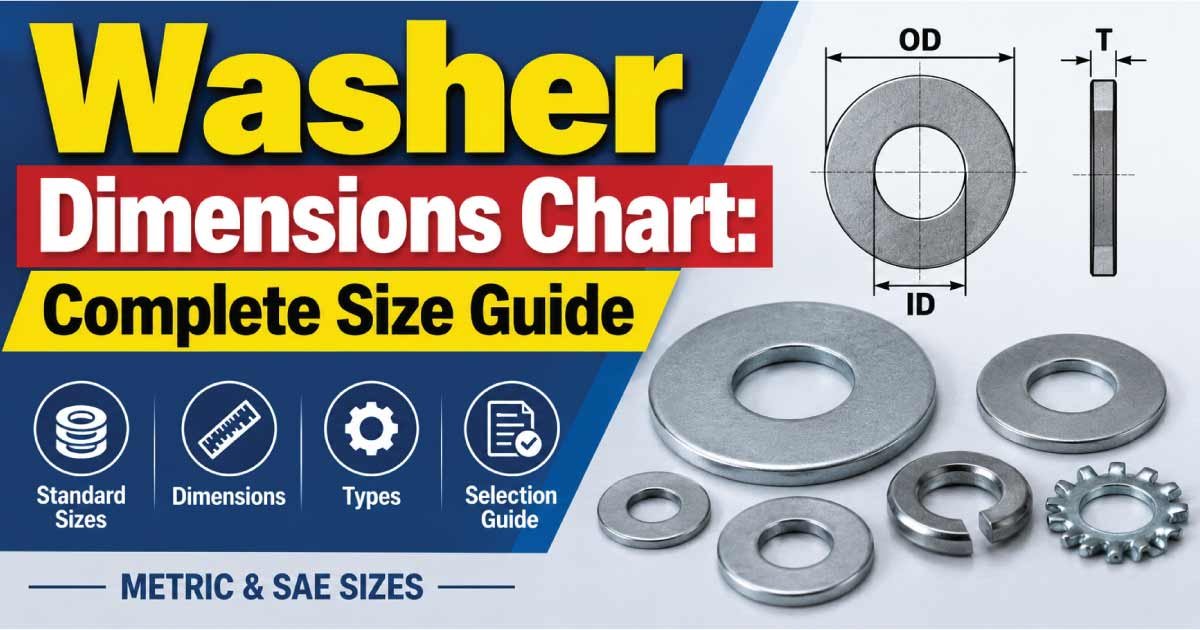
Washers are simple components, but choosing the correct one requires more than matching the bolt diameter. The washer dimensions—including inside diameter (ID), outside diameter (OD), and thickness—determine how well a washer fits and distributes load.
This complete washer dimensions chart covers common metric flat washers, standard inch washer sizes, key measurements, washer types, and practical selection tips. You will also learn how to measure a washer correctly and why two washers designed for the same bolt can have different outside diameters.
Whether you are working with machine screws, bolts, nuts, structural fasteners, automotive components, or general repairs, understanding washer dimensions helps you select the right part for the application.
What Are Washer Dimensions?
Washer dimensions describe the physical measurements that determine a washer’s size and compatibility. For a typical flat washer, the three most important dimensions are:
- Inside diameter (ID): The diameter of the central hole.
- Outside diameter (OD): The total diameter across the washer.
- Thickness: The thickness of the washer material.
A washer may also be identified by its nominal bolt or screw size, material, finish, washer series, and applicable standard.
For example, a common metric M8 flat washer may have an 8.4 mm inside diameter, 16 mm outside diameter, and 1.6 mm thickness under the DIN 125/ISO 7089-style dimensions shown in standard references.
The nominal size does not necessarily equal the actual hole diameter. An M8 washer, for instance, normally needs clearance around an M8 fastener, so its actual hole is larger than 8 mm.
Metric Washer Dimensions Chart
Metric washers are normally identified according to the nominal metric fastener size they are intended to fit. However, dimensions vary according to washer type and standard.
The following chart shows commonly used plain flat washer dimensions associated with DIN 125 Type A / ISO 7089-style dimensions. DIN 125 is a historical designation, while ISO 7089 is the related international standard used for normal-series plain washers. Always verify the specified standard when exact interchangeability matters.
| Washer Size | Inside Diameter (mm) | Outside Diameter (mm) | Thickness (mm) |
|---|---|---|---|
| M3 | 3.2 | 7 | 0.5 |
| M4 | 4.3 | 9 | 0.8 |
| M5 | 5.3 | 10 | 1.0 |
| M6 | 6.4 | 12 | 1.6 |
| M8 | 8.4 | 16 | 1.6 |
| M10 | 10.5 | 20 | 2.0 |
| M12 | 13.0 | 24 | 2.5 |
| M14 | 15.0 | 28 | 2.5 |
| M16 | 17.0 | 30 | 3.0 |
| M18 | 19.0 | 34 | 3.0 |
| M20 | 21.0 | 37 | 3.0 |
| M22 | 23.0 | 39 | 3.0 |
| M24 | 25.0 | 44 | 4.0 |
| M27 | 28.0 | 50 | 4.0 |
| M30 | 31.0 | 56 | 4.0 |
| M33 | 34.0 | 60 | 5.0 |
| M36 | 37.0 | 66 | 5.0 |
These nominal dimensions are widely published for DIN 125A / ISO 7089-style plain washers.
One important point is that washer size is not determined by outside diameter alone. An M12 washer, for example, has a nominal fastener size of 12 mm, but the actual hole is larger—13 mm in this standard configuration.
Common Metric Washer Sizes and Dimensions
Some metric washer sizes appear far more frequently in general hardware, machinery, automotive work, and DIY applications.
M3 Washer Dimensions
A standard M3 flat washer in the DIN 125A/ISO 7089 family has an approximately 3.2 mm ID, 7 mm OD, and 0.5 mm thickness. It is commonly used with small machine screws and light-duty assemblies.
M4 Washer Dimensions
An M4 washer commonly measures 4.3 mm inside diameter, 9 mm outside diameter, and 0.8 mm thickness. It provides a larger bearing surface than the M4 screw head or nut alone.
M5 Washer Dimensions
An M5 standard flat washer has approximately 5.3 mm ID, 10 mm OD, and 1 mm thickness. It is widely used in equipment, brackets, enclosures, machinery, and general hardware.
M6 Washer Dimensions
An M6 washer in this series measures approximately 6.4 mm ID, 12 mm OD, and 1.6 mm thickness. M6 fasteners are common in machinery, furniture hardware, automotive components, and equipment assemblies.
M8 Washer Dimensions
An M8 washer commonly measures 8.4 mm ID, 16 mm OD, and 1.6 mm thickness. This is one of the more frequently encountered metric washer sizes.
M10 and M12 Washer Dimensions
M10 and M12 washers provide progressively larger bearing surfaces. Typical DIN 125A/ISO 7089-style dimensions are:
| Size | ID (mm) | OD (mm) | Thickness (mm) |
|---|---|---|---|
| M10 | 10.5 | 20 | 2.0 |
| M12 | 13.0 | 24 | 2.5 |
| M14 | 15.0 | 28 | 2.5 |
| M16 | 17.0 | 30 | 3.0 |
| M20 | 21.0 | 37 | 3.0 |
These values illustrate why it is important to check the washer standard instead of assuming that every washer for a particular bolt has the same OD or thickness.
Washer Dimension Terminology Explained
Understanding the terminology makes washer size charts much easier to use.
Inside Diameter (ID)
The inside diameter is the distance across the washer’s central hole.
The ID needs to provide sufficient clearance for the fastener shank. It is normally slightly larger than the nominal bolt diameter.
For example, a standard M8 washer with an 8.4 mm nominal hole is designed to accommodate an M8 fastener.
Outside Diameter (OD)
The outside diameter is the measurement from one outer edge of the washer to the opposite outer edge.
OD is especially important when the washer is being used to spread load over a larger surface.
A washer with a larger OD generally covers more surface area, although the appropriate design depends on the material, load, hole size, and washer standard.
Thickness
Thickness is the material thickness measured through the washer.
Thickness affects the washer’s rigidity, bearing characteristics, stack height, and suitability for the application.
For precision applications, do not substitute a washer solely because its ID and OD appear correct. Its thickness and specified standard may also matter.
Nominal Washer Size
The nominal washer size usually refers to the compatible fastener size rather than the exact physical diameter of the washer.
Therefore:
M8 washer ≠ 8 mm outside diameter.
Instead, an M8 washer is intended for an M8 fastener, while its actual ID and OD depend on the washer type and standard.
Metric vs. SAE Washer Dimensions
Metric washers are normally identified using sizes such as M5, M6, M8, M10, and M12. Inch-series washers use fractional or numbered sizes such as 1/4, 5/16, 3/8, and 1/2 inch.
The two systems should not be treated as interchangeable simply because their nominal diameters appear close.
For example, an M8 fastener has a nominal diameter of 8 mm, while a 5/16-inch fastener has a nominal diameter of approximately 7.94 mm. Although these dimensions are close, their threads and associated hardware are not automatically interchangeable.
The same principle applies to washers. Match the washer to the fastener system and specified washer series, rather than choosing based only on approximate diameter.
SAE and USS Flat Washer Dimensions
In inch-series hardware, washer dimensions can vary significantly between series. Two common terms are SAE and USS.
SAE-style washers generally have a smaller outside diameter than USS washers for comparable fastener sizes. USS washers provide a larger bearing area and are commonly selected when greater surface coverage is desirable.
ASME B18.21.1 covers dimensional requirements for inch-series plain washers as well as other washer categories.
A representative Type A washer table illustrates how the dimensions are specified:
| Nominal Size | Series | Inside Diameter (in) | Outside Diameter (in) | Basic Thickness (in) |
|---|---|---|---|---|
| #0 | — | 0.078 | 0.188 | 0.020 |
| #2 | — | 0.094 | 0.250 | 0.020 |
| #4 | — | 0.125 | 0.312 | 0.032 |
| #6 | — | 0.156 | 0.375 | 0.049 |
| #8 | — | 0.188 | 0.438 | 0.049 |
| #10 | — | 0.219 | 0.500 | 0.049 |
| 1/4 | N | 0.281 | 0.625 | 0.065 |
| 1/4 | W | 0.312 | 0.734 | 0.065 |
| 5/16 | N | 0.344 | 0.688 | 0.065 |
| 5/16 | W | 0.375 | 0.875 | 0.083 |
| 3/8 | N | 0.406 | 0.812 | 0.065 |
The values above are based on the Type A plain-washer dimensions published for ASME B18.21.1.
Because inch-series washers can have different series and dimensional requirements, always identify the specific washer type before ordering replacement hardware.
Discover More:
Types of Washers and How Their Dimensions Differ
Not every washer is a standard flat washer. The design changes depending on the job.
Flat Washers
Flat washers are the most common type. They are generally used to distribute clamping force, protect surfaces, and provide a suitable bearing surface beneath a bolt head or nut.
Their critical dimensions are:
- Inside diameter
- Outside diameter
- Thickness
- Washer series or standard
Fender Washers
Fender washers have a relatively large outside diameter compared with the hole size.
They are useful when a larger surface area needs to be covered, particularly when fastening through thin or softer materials.
Lock Washers
Lock washers are designed differently from plain washers. Examples include split, toothed, and other locking designs.
Their dimensions should be taken from the appropriate standard or manufacturer’s specification because their geometry cannot be described adequately by a simple flat-washer chart.
Thrust Washers
Thrust washers are designed to accommodate axial loads and sliding or rotating components. Material, thickness, hardness, lubrication, and operating conditions can be particularly important.
Sealing Washers
Sealing washers may combine a metal washer with an elastomer or other sealing element. Their dimensions depend on both the fastener and sealing requirements.
How to Measure Washer Dimensions
If you have an unmarked washer and need to identify its size, measure the three basic dimensions.
1. Measure the Inside Diameter
Use a caliper to measure directly across the central hole.
Record the result in millimeters or inches.
Do not assume that a measured 8.4 mm hole automatically identifies the washer as M8. Check its OD and thickness as well.
2. Measure the Outside Diameter
Measure from one outer edge to the opposite edge through the center.
This determines how much bearing area the washer provides around the fastener hole.
3. Measure the Thickness
Use a caliper or suitable micrometer to measure the washer thickness.
Thickness can vary by washer series, size, material, manufacturing tolerance, and standard.
4. Identify the Standard or Type
Finally, compare the measurements with a reliable dimensional chart.
Consider whether the washer is:
- Metric or inch-series
- Flat or specialized
- Narrow, normal, or wide
- SAE, USS, or another series
- Made to a particular DIN, ISO, ASME, or manufacturer specification
This final step is important because two washers can have similar ID measurements while having substantially different ODs.
Discover More:
How to Choose the Correct Washer Size
Selecting a washer should start with the fastener and application rather than the washer itself.
Match the Fastener Diameter
First identify the bolt, screw, or stud.
For a metric assembly, determine whether it is M5, M6, M8, M10, M12, or another size.
For an inch assembly, identify the actual nominal size.
Check the Inside Diameter
The washer hole must provide appropriate clearance for the fastener.
A hole that is too small will not fit over the fastener. A hole that is excessively large may reduce the washer’s effectiveness or allow undesirable movement.
Check the Outside Diameter
Consider the material being clamped.
A larger OD can be beneficial when the fastener is being installed against a relatively thin, soft, or vulnerable surface.
Check Thickness
Thickness should be considered when the washer contributes to the mechanical design, stack height, clearance, or bearing requirements.
For ordinary repairs, a standard washer of the correct type may be sufficient. For engineered assemblies, follow the specified drawing or standard.
Check Material and Finish
The correct dimensions do not automatically make a washer suitable.
Also consider:
- Carbon steel
- Stainless steel
- Brass
- Corrosion-resistant finishes
- Plating
- Hardened washers
- Temperature and environmental exposure
The washer material should be compatible with the application and surrounding fasteners.
Discover More:
Why Washer Outside Diameter Matters
The outside diameter controls the approximate area over which the washer distributes the load.
For a flat washer, the bearing area is related to the annular region between the hole and outer edge. Increasing the OD increases this area.
This is particularly useful when fastening materials that could deform beneath a concentrated load.
For example, a small standard washer may be perfectly suitable for a steel bracket, while a larger washer may be preferable for a thin sheet or softer material.
However, larger is not automatically better. The washer must still fit within the available space and meet the requirements of the joint.
Common Washer Size Mistakes
Many washer-selection problems come from treating the nominal size as the complete specification.
Mistake 1: Assuming M8 Means an 8 mm Hole
An M8 washer does not necessarily have an 8.0 mm hole. Standard clearance dimensions are generally larger than the nominal fastener diameter.
Mistake 2: Choosing by Inside Diameter Alone
Two washers can have similar holes but very different outside diameters and thicknesses.
Always compare all three primary dimensions.
Mistake 3: Mixing Metric and Inch Hardware
M8 and 5/16-inch hardware have similar nominal diameters, but they belong to different fastening systems.
Do not substitute one for the other without confirming the complete assembly requirements.
Mistake 4: Ignoring the Washer Standard
A washer described simply as an “M10 washer” may not communicate its complete dimensions.
The applicable standard, series, type, material, and finish may all matter.
Mistake 5: Using Any Washer for a High-Load Joint
General-purpose flat washers are not automatically appropriate for every structural or high-strength application.
Follow the engineering specification when the joint has defined load, hardness, or washer requirements.
Washer Dimensions: Quick Reference
For everyday metric applications, this abbreviated chart provides a convenient reference for common sizes.
| Metric Size | ID (mm) | OD (mm) | Thickness (mm) |
|---|---|---|---|
| M3 | 3.2 | 7 | 0.5 |
| M4 | 4.3 | 9 | 0.8 |
| M5 | 5.3 | 10 | 1.0 |
| M6 | 6.4 | 12 | 1.6 |
| M8 | 8.4 | 16 | 1.6 |
| M10 | 10.5 | 20 | 2.0 |
| M12 | 13.0 | 24 | 2.5 |
| M14 | 15.0 | 28 | 2.5 |
| M16 | 17.0 | 30 | 3.0 |
| M20 | 21.0 | 37 | 3.0 |
These dimensions correspond to the commonly published DIN 125A / ISO 7089-style normal-series values.
Frequently Asked Questions About Washer Dimensions
What are the three main washer dimensions?
The three basic dimensions are inside diameter, outside diameter, and thickness. These measurements describe the washer’s hole, overall diameter, and material thickness.
Does washer size refer to the hole diameter?
Usually, the nominal washer size refers to the compatible fastener size. The actual hole is normally larger to provide clearance.
What size washer fits an M8 bolt?
A standard M8 flat washer in the DIN 125A/ISO 7089 family has a nominal 8.4 mm inside diameter, 16 mm outside diameter, and 1.6 mm thickness. Other washer types and standards can have different dimensions.
What is the difference between SAE and USS washers?
Both are inch-series washer designations, but their dimensions differ. USS washers generally provide a larger outside diameter than comparable SAE washers, giving greater surface coverage.
Can I use a larger washer than specified?
Sometimes, but not automatically. A larger OD may improve load distribution on suitable surfaces, but clearance, joint design, washer thickness, and applicable specifications must be considered.
How do I know what washer I have?
Measure its inside diameter, outside diameter, and thickness, then compare those measurements with a reliable dimensional chart. Also determine whether the hardware is metric or inch-series.
Are DIN 125 and ISO 7089 washers the same?
DIN 125 is an older/common designation associated with plain washers, while ISO 7089 is the related international standard. Published dimensional comparisons show matching normal-series values for common sizes, but the exact standard specified for a job should always be followed.
Conclusion
Correct washer dimensions are determined by more than nominal fastener size. The inside diameter must provide suitable clearance, the outside diameter must provide the required bearing area, and the thickness must suit the joint and application.
For common metric flat washers, dimensions such as M6: 6.4 × 12 × 1.6 mm, M8: 8.4 × 16 × 1.6 mm, and M10: 10.5 × 20 × 2.0 mm provide useful reference points for DIN 125A/ISO 7089-style washers.
For inch hardware, always distinguish between washer series such as SAE and USS. When the application is critical, verify the exact standard, material, dimensions, and manufacturer’s specifications before installation.
A good washer size chart is therefore a starting point—not a substitute for checking the complete fastener specification.