
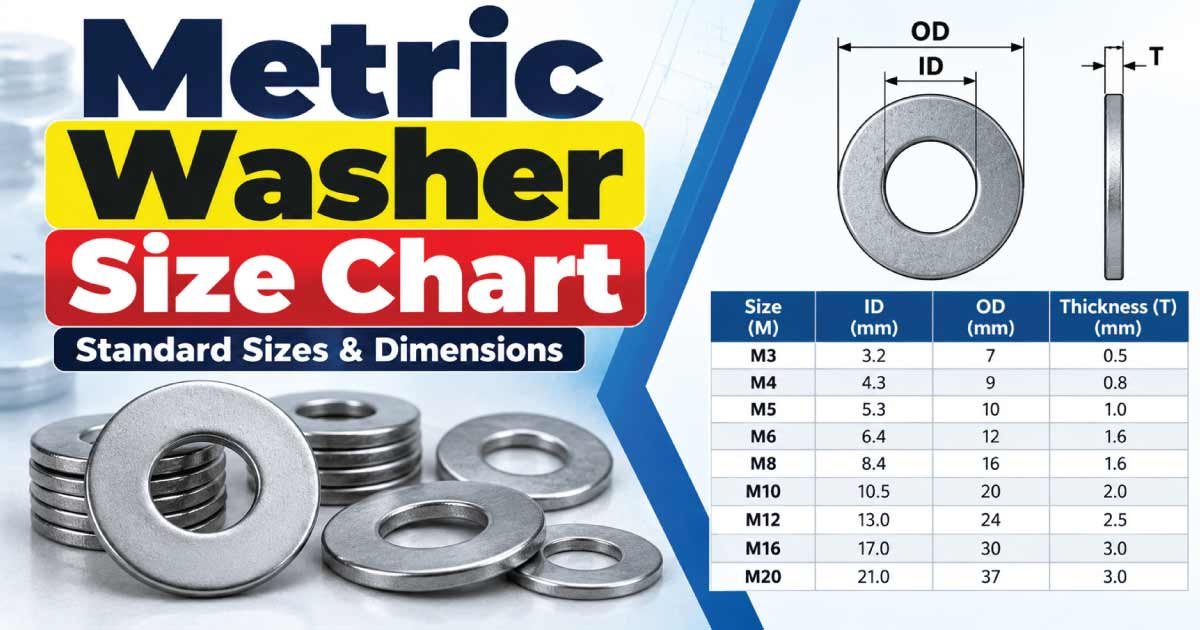
A metric washer size chart makes it easier to identify the correct washer for a metric bolt, screw, or threaded fastener. The washer must have a suitable inside diameter for the fastener while providing enough outside diameter and bearing area for the application.
Metric washers are commonly identified by nominal fastener size, such as M3, M4, M5, M6, M8, M10, M12, and M16. However, the nominal size alone does not describe every washer dimension. Inner diameter, outer diameter, thickness, washer type, and applicable standard can all affect the final specification.
This guide explains standard metric flat washer dimensions, how to read a washer chart, how to measure a washer accurately, and how to choose the right washer for different applications. The dimensions shown are based on commonly used ISO 7089-style plain washers; other standards and washer types can have different dimensions.
What Is a Metric Washer?
A metric washer is a flat or specially shaped component placed around a bolt, screw, or other fastener. Its primary purpose is to distribute the clamping load over a larger area than the fastener head or nut would provide by itself.
A typical flat washer has three important physical dimensions:
- Inside diameter (ID): The diameter of the central hole.
- Outside diameter (OD): The overall diameter across the washer.
- Thickness: The distance through the washer material.
For example, an M8 flat washer is designed for use with an approximately 8 mm nominal metric fastener. Its actual hole is larger than 8 mm to provide practical clearance.
Washers are available in many forms, including plain, large-diameter, narrow, spring, locking, sealing, and structural designs. Therefore, an M8 washer is not necessarily the same size or thickness as every other washer intended for an M8 bolt.
The standard and washer type should always be considered when exact dimensions matter.
Metric Flat Washer Size Chart
The following chart provides commonly used dimensions for plain metric washers based on ISO 7089 dimensions. Values are given in millimeters and represent standard nominal washer dimensions rather than every commercially available variant.
| Nominal Washer Size | Inside Diameter ID (mm) | Outside Diameter OD (mm) | Thickness (mm) |
|---|---|---|---|
| M3 | 3.2 | 7 | 0.5 |
| M4 | 4.3 | 9 | 0.8 |
| M5 | 5.3 | 10 | 1.0 |
| M6 | 6.4 | 12 | 1.6 |
| M8 | 8.4 | 16 | 1.6 |
| M10 | 10.5 | 20 | 2.0 |
| M12 | 13 | 24 | 2.5 |
| M14 | 15 | 28 | 2.5 |
| M16 | 17 | 30 | 3.0 |
| M18 | 19 | 34 | 3.0 |
| M20 | 21 | 37 | 3.0 |
| M22 | 23 | 44 | 4.0 |
| M24 | 25 | 44 | 4.0 |
These dimensions are useful for general identification and selection, but the applicable standard should be checked when a washer is part of a safety-critical, engineered, or tightly toleranced assembly.
How to Read a Metric Washer Size Chart
Washer charts can initially look confusing because the nominal washer designation does not always match the actual measured hole.
1. Nominal Washer Size
The designation, such as M6 or M10, generally corresponds to the nominal diameter of the compatible metric fastener.
An M10 washer, for example, is intended for an M10 bolt or screw.
It does not mean that the washer’s hole will measure exactly 10.00 mm. Clearance is normally provided so the washer can be installed easily over the fastener.
2. Inside Diameter
The inside diameter is the measurement across the washer’s central opening.
This is one of the most important dimensions because the washer needs to fit over the bolt or screw without being excessively loose.
For an ISO-style M8 plain washer, the listed inside diameter is 8.4 mm.
3. Outside Diameter
The outside diameter determines how much surface area the washer covers around the fastener.
A larger OD spreads the clamping force across a larger area. This can be particularly useful when fastening materials that are relatively soft or have larger holes.
4. Thickness
Thickness affects the washer’s overall strength, stiffness, and position within the joint.
Thin washers may be appropriate for ordinary light-duty fastening, while thicker washers may be selected when greater load distribution or increased rigidity is required.
Standard Metric Washer Dimensions Explained
Understanding the relationship between washer dimensions is more useful than memorizing individual numbers.
Inside Diameter vs. Bolt Diameter
The washer hole is generally slightly larger than the nominal bolt diameter.
For example:
- M6 fastener: washer ID is commonly 6.4 mm
- M8 fastener: washer ID is commonly 8.4 mm
- M10 fastener: washer ID is commonly 10.5 mm
- M12 fastener: washer ID is commonly 13 mm
This clearance allows the washer to slide over the fastener without requiring an interference fit.
Outside Diameter and Load Distribution
The OD controls the approximate area over which the washer transfers load into the surface.
A standard washer has a particular OD-to-ID relationship established by its dimensional standard. A large-diameter washer, however, has a substantially larger OD while retaining a hole suitable for the fastener.
Large washers are useful when:
- The material has a relatively large clearance hole.
- The surface is soft or easily damaged.
- Greater load distribution is desirable.
- A larger bearing surface is required.
Washer Thickness
Thickness varies by nominal size and washer standard.
Thickness is not simply a cosmetic dimension. It can affect:
- Joint stack-up
- Bearing behavior
- Washer stiffness
- Available thread engagement
- Clearance around components
For precision assemblies, use the manufacturer’s specified dimensions rather than selecting a washer based only on nominal bolt size.
Common Metric Washer Sizes
Some metric washer sizes appear particularly frequently in general mechanical, automotive, construction, maintenance, and DIY applications.
M3 and M4 Washers
M3 and M4 washers are relatively small and are often associated with compact assemblies, electronics hardware, small machinery, brackets, and light mechanical components.
Their smaller outside diameters make them suitable where installation space is limited.
M5 and M6 Washers
M5 and M6 washers are widely used for general-purpose fastening.
They can be found in machinery, equipment, furniture hardware, brackets, enclosures, automotive components, and many workshop applications.
An M6 standard washer has a 6.4 mm ID, 12 mm OD, and 1.6 mm thickness in the ISO 7089-style dimensions shown above.
M8 and M10 Washers
M8 and M10 are common general-purpose sizes for machinery, frames, mounting hardware, automotive work, and structural assemblies.
An M8 washer commonly measures 8.4 mm inside diameter and 16 mm outside diameter in the referenced standard.
An M10 washer commonly measures 10.5 mm ID and 20 mm OD.
M12 and Larger Washers
M12, M14, M16, M18, M20, and larger washers are often used for heavier mechanical fastening applications.
As fastener diameter increases, washers generally become larger and thicker within the relevant standard.
For heavy-duty joints, however, selecting the correct washer requires more than matching the nominal bolt size. Load requirements, material strength, joint design, and the applicable engineering standard should also be considered.
Metric Washer Types and Their Dimensions
Not every washer is a standard flat washer. Different designs provide different functions, so their dimensions can differ significantly even when they share the same nominal fastener size.
Plain or Flat Washers
A plain washer is the most familiar washer design.
It typically has:
- A flat circular shape
- A central clearance hole
- A defined outside diameter
- A defined thickness
Plain washers are primarily used to distribute the load from a bolt head or nut and help protect the mating surface.
Large-Diameter Washers
Large-diameter washers have a greater outside diameter relative to their hole size.
They are sometimes called fender washers in certain applications, although exact dimensions depend on the relevant standard.
They are useful when a larger bearing surface is needed.
Narrow Washers
Narrow or reduced-diameter washers are designed for applications where installation space is restricted.
Their outside diameter is smaller than that of a conventional washer for the same nominal fastener size.
Spring and Locking Washers
Spring washers, split lock washers, and other locking designs are not interchangeable with standard flat washers.
Their geometry is intentionally different and may include:
- Curved or conical profiles
- Split sections
- Serrated surfaces
- Tabs or locking features
Therefore, an M8 spring washer should not be assumed to have the same OD and thickness as an M8 flat washer.
ISO, DIN, and Other Metric Washer Standards
One of the most common sources of confusion is the assumption that every metric washer follows one universal dimensional chart.
Metric washers can be manufactured according to different standards and specifications.
ISO Standards
ISO standards provide internationally recognized specifications for many types of fasteners and washers.
ISO 7089, for example, covers plain washers with normal series dimensions and is a useful reference for standard flat washer dimensions.
DIN Standards
DIN standards are widely encountered in European engineering and industrial hardware.
Some DIN washer specifications have dimensions that differ from corresponding ISO products. A washer labeled for the same nominal bolt size can therefore have a different OD or thickness depending on its standard.
Manufacturer Specifications
Commercial washers may also be produced according to manufacturer-specific requirements, industry specifications, or alternative national standards.
For that reason, always verify:
- Standard number
- Material
- Grade or property requirements
- Inside diameter
- Outside diameter
- Thickness
- Surface finish
- Application requirements
when purchasing or replacing washers for an engineered assembly.
Discover More:
How to Measure a Metric Washer
If you have an unidentified washer, measuring it is usually the quickest way to determine its physical size.
Measure the Inside Diameter
Use a caliper to measure the central hole.
Take the measurement across the opening rather than measuring from the edge of the hole to the outer edge.
Record the result in millimeters.
For example, a measured hole close to 8.4 mm is consistent with a common M8 ISO-style flat washer.
Measure the Outside Diameter
Place the caliper across the widest portion of the washer.
Make sure the jaws are positioned across the outer edges and are perpendicular to the washer.
Measure the Thickness
Measure the washer through its flat section.
For a precision measurement, a caliper or micrometer is preferable to a ruler.
Identify the Nominal Size
Compare all three measurements with the appropriate washer chart.
Do not identify the washer based only on its hole diameter because different standards and washer types can have similar dimensions.
Discover More:
How to Choose the Correct Metric Washer
Choosing the correct washer involves more than matching the bolt diameter.
1. Match the Fastener
Start with the nominal metric fastener size.
An M8 bolt normally requires an M8-compatible washer.
The washer hole must be large enough to pass over the fastener while remaining suitable for the joint.
2. Check the Outside Diameter
Consider the surface underneath the washer.
If the contact area is soft, thin, slotted, oversized, or prone to deformation, a larger OD may be beneficial.
3. Consider Thickness
Check whether the washer thickness fits the available space and joint design.
Adding washers also increases the joint stack height, which can affect available thread engagement.
4. Select the Appropriate Washer Type
Use a plain washer when load distribution and surface protection are the primary requirements.
Consider a large-diameter, structural, sealing, or other specialized washer when the application specifically calls for it.
5. Match the Material and Environment
Washer material should be appropriate for the surrounding environment and fastener system.
Common materials include:
- Carbon steel
- Stainless steel
- Alloy steel
- Brass
- Other application-specific materials
Outdoor or corrosive environments may require a suitable corrosion-resistant material or finish.
Discover More:
Metric Washer vs. Bolt Size
A common misconception is that the washer designation gives its exact hole diameter.
It does not.
The M designation identifies the nominal fastener size, while the actual washer hole is normally larger to provide clearance.
For example:
| Fastener Size | Typical ISO-Style Washer ID | Typical Washer OD |
|---|---|---|
| M4 | 4.3 mm | 9 mm |
| M5 | 5.3 mm | 10 mm |
| M6 | 6.4 mm | 12 mm |
| M8 | 8.4 mm | 16 mm |
| M10 | 10.5 mm | 20 mm |
| M12 | 13 mm | 24 mm |
| M16 | 17 mm | 30 mm |
| M20 | 21 mm | 37 mm |
This distinction is important when measuring an existing washer.
Why Washer Outside Diameter Matters
The washer’s outside diameter determines the approximate area available to distribute the force generated by the fastener.
A larger washer can spread the load over a larger surface area, reducing localized contact pressure compared with a smaller bearing surface.
This is especially relevant when fastening:
- Thin sheet material
- Wood
- Plastics
- Composite materials
- Soft metals
- Components with oversized holes
However, simply choosing the largest washer available is not always the correct engineering solution. The washer must fit the joint and should comply with the requirements of the applicable design or standard.
Common Metric Washer Selection Mistakes
Incorrect washer selection can create installation problems or compromise the intended joint design.
Using the Wrong Nominal Size
An M10 washer should not be substituted for an M8 washer simply because it physically fits over the bolt.
The dimensions and bearing characteristics are different.
Confusing ID With Nominal Size
A washer marked or sold as M8 may have an 8.4 mm hole, not an 8.0 mm hole.
This is normal for a clearance washer.
Ignoring the Washer Standard
Two M12 washers can have different dimensions if they are manufactured to different standards.
Always check the specification when dimensional accuracy matters.
Using a Flat Washer When a Specialized Washer Is Required
A plain washer does not automatically replace every other washer type.
Locking, sealing, structural, insulating, and spring applications may require specifically designed products.
Choosing Based Only on Diameter
A washer with the correct hole can still be unsuitable if its OD, thickness, material, or strength is wrong for the application.
Metric Washer Size Chart: Quick Selection Guide
The following simplified guide is useful for quick identification of common sizes.
| Washer Size | Fastener Nominal Diameter | Common ISO-Style ID | Common ISO-Style OD |
|---|---|---|---|
| M3 | 3 mm | 3.2 mm | 7 mm |
| M4 | 4 mm | 4.3 mm | 9 mm |
| M5 | 5 mm | 5.3 mm | 10 mm |
| M6 | 6 mm | 6.4 mm | 12 mm |
| M8 | 8 mm | 8.4 mm | 16 mm |
| M10 | 10 mm | 10.5 mm | 20 mm |
| M12 | 12 mm | 13 mm | 24 mm |
| M14 | 14 mm | 15 mm | 28 mm |
| M16 | 16 mm | 17 mm | 30 mm |
| M20 | 20 mm | 21 mm | 37 mm |
| M24 | 24 mm | 25 mm | 44 mm |
Use this table for general identification, then confirm the exact standard and manufacturer’s specification before using the washer in a critical application.
Frequently Asked Questions About Metric Washers
What does M8 mean on a washer?
M8 generally identifies the nominal metric fastener size for which the washer is intended. It does not mean that the washer’s actual hole diameter is exactly 8 mm.
What is the inside diameter of an M8 washer?
A common ISO 7089-style M8 plain washer has an 8.4 mm inside diameter.
What is the outside diameter of an M10 washer?
A common ISO 7089-style M10 plain washer has an outside diameter of 20 mm.
Is an M6 washer exactly 6 mm?
No. The M6 designation refers to the nominal fastener size. A common ISO-style M6 washer has a 6.4 mm hole.
Are all M8 washers the same size?
No. M8 washers can have different dimensions depending on the washer type, dimensional series, standard, material, and manufacturer.
How do I know what size washer I have?
Measure the inside diameter, outside diameter, and thickness with a caliper. Then compare those measurements with the relevant washer standard.
Should the washer hole be bigger than the bolt?
For ordinary clearance washers, yes. The hole is normally slightly larger than the nominal bolt diameter so the washer can be installed over the fastener.
What is the difference between a metric and SAE washer?
Metric washers are designed around metric fastener sizes and are commonly designated M3, M4, M5, M6, M8, and so on. SAE/inch washers are associated with inch-based fasteners and dimensional specifications.
The two systems should not be treated as interchangeable solely because their physical dimensions appear similar.
Final Takeaway
A reliable metric washer size chart should be used as a starting point, not as a substitute for the applicable product standard. The most important dimensions are inside diameter, outside diameter, and thickness, but washer type, material, standard, and application also matter.
For general-purpose ISO-style flat washers, sizes such as M4, M5, M6, M8, M10, and M12 cover many common fastening requirements. When replacing an existing washer, measure all three dimensions rather than relying on appearance alone.
For precision or safety-critical assemblies, confirm the washer’s standard and manufacturer specification before installation. Selecting the correct washer ensures proper clearance, suitable load distribution, and compatibility with the overall fastening system.