
Washers look simple, but choosing the correct size involves more than matching the outside diameter. The washer inner diameter (ID) determines whether the washer will fit over the bolt, screw, stud, or other fastener without binding or leaving excessive clearance.
This washer inner diameter chart provides a practical reference for common metric and SAE/US flat washer sizes. It also explains the difference between bolt diameter and washer hole diameter, how to measure an existing washer, how standards affect dimensions, and how to select the right washer for a particular fastener.
Because washer dimensions can vary between standards and manufacturers, always verify the applicable specification when a precise fit is required.
Washer Inner Diameter Explained
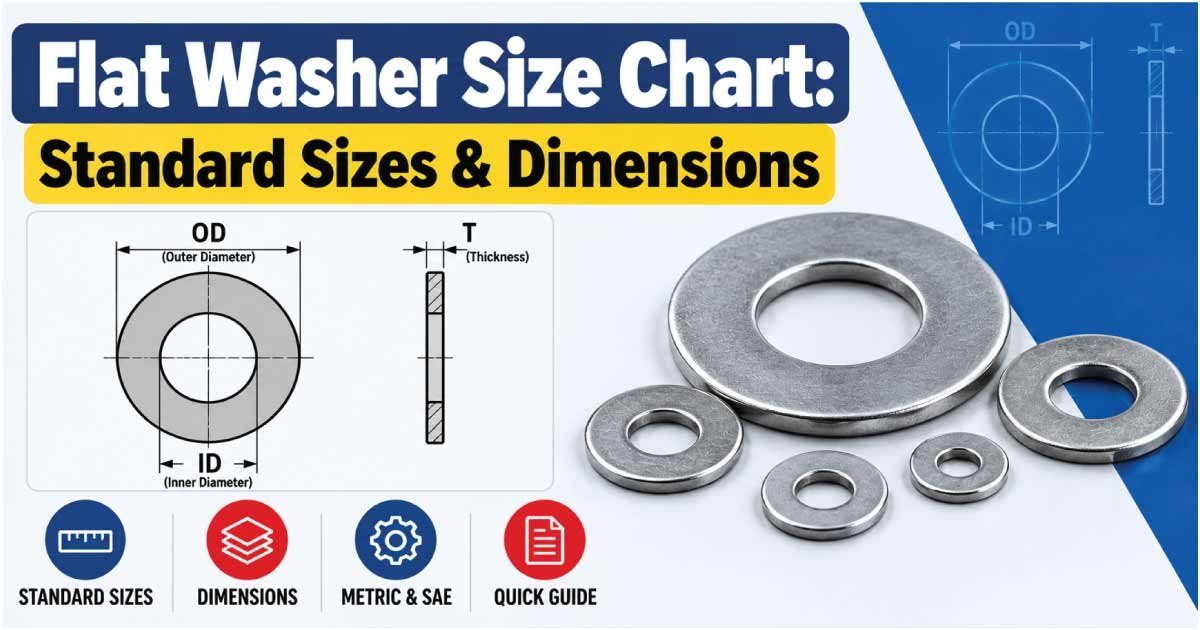
The inner diameter of a washer is the diameter of the circular hole through its center. It is sometimes abbreviated as ID, I.D., or d1 in dimensional drawings and standards.
For a flat washer, three dimensions are especially important:
- Inner diameter (ID): The diameter of the center hole.
- Outer diameter (OD): The overall diameter across the washer.
- Thickness: The thickness of the washer material.
For example, an M8 washer is intended for an M8 fastener, but its center hole is not normally exactly 8.00 mm. A standard washer requires some clearance so it can be installed over the fastener.
This means M8 refers primarily to the nominal fastener size, while the actual washer hole is slightly larger.
The same principle applies to SAE and inch-based washers. A washer identified for a particular bolt size normally has a hole larger than the bolt’s nominal shank diameter.
Understanding this distinction prevents one of the most common washer-sizing mistakes: assuming that a washer marked M10 must have a 10 mm hole.
Metric Washer Inner Diameter Chart
The following chart gives common nominal inner-hole dimensions associated with standard metric flat washers. These values are useful for identifying and selecting washers, but the exact permitted hole size can depend on the washer standard and product series.
| Metric Washer Size | Nominal Fastener Diameter (mm) | Common Washer ID (mm) |
|---|---|---|
| M2 | 2 | 2.2 |
| M2.5 | 2.5 | 2.7 |
| M3 | 3 | 3.2 |
| M4 | 4 | 4.3 |
| M5 | 5 | 5.3 |
| M6 | 6 | 6.4 |
| M8 | 8 | 8.4 |
| M10 | 10 | 10.5 |
| M12 | 12 | 13 |
| M14 | 14 | 15 |
| M16 | 16 | 17 |
| M18 | 18 | 19 |
| M20 | 20 | 21 |
| M22 | 22 | 23 |
| M24 | 24 | 25 |
| M27 | 27 | 28 |
| M30 | 30 | 31 |
| M33 | 33 | 34 |
| M36 | 36 | 37 |
| M39 | 39 | 40 |
| M42 | 42 | 43 |
| M45 | 45 | 46 |
| M48 | 48 | 50 |
These are useful reference dimensions, not a substitute for the dimensional requirements of a particular standard.
For frequently used hardware, the most commonly encountered sizes include M4, M5, M6, M8, M10, M12, M16, and M20.
Common Metric Washer ID Sizes
Some metric sizes appear much more frequently in machinery, automotive assemblies, construction, equipment, furniture, and general maintenance.
| Washer Size | Fastener Diameter | Typical Inner Diameter |
|---|---|---|
| M4 | 4 mm | 4.3 mm |
| M5 | 5 mm | 5.3 mm |
| M6 | 6 mm | 6.4 mm |
| M8 | 8 mm | 8.4 mm |
| M10 | 10 mm | 10.5 mm |
| M12 | 12 mm | 13 mm |
| M14 | 14 mm | 15 mm |
| M16 | 16 mm | 17 mm |
| M20 | 20 mm | 21 mm |
| M24 | 24 mm | 25 mm |
For example, if you measure a washer’s center hole at approximately 8.4 mm, it may correspond to a standard M8 flat washer. However, identification should also consider its outside diameter and thickness because different washer types can use different dimensional series.
SAE and US Washer Inner Diameter Chart
In the United States, washers are commonly identified according to the nominal size of the inch-based fastener. Several washer series exist, including SAE and USS patterns, and their dimensions are not interchangeable in every application.
The following table provides common reference hole sizes for frequently encountered inch-based washers.
| Nominal Washer Size | Nominal Fastener Diameter (in.) | Approx. Common Washer ID (in.) | Approx. ID (mm) |
|---|---|---|---|
| #6 | 0.138 | 0.156 | 3.97 |
| #8 | 0.164 | 0.188 | 4.78 |
| #10 | 0.190 | 0.203 | 5.16 |
| 1/4 | 0.250 | 0.281 | 7.14 |
| 5/16 | 0.3125 | 0.344 | 8.74 |
| 3/8 | 0.375 | 0.406 | 10.31 |
| 7/16 | 0.4375 | 0.469 | 11.91 |
| 1/2 | 0.500 | 0.531 | 13.49 |
| 9/16 | 0.5625 | 0.594 | 15.09 |
| 5/8 | 0.625 | 0.656 | 16.66 |
| 3/4 | 0.750 | 0.781 | 19.84 |
| 7/8 | 0.875 | 0.906 | 23.01 |
| 1 | 1.000 | 1.031 | 26.19 |
Important: Inch washer dimensions vary by washer series. A SAE washer and USS washer for the same nominal bolt diameter can have different outside diameters and thicknesses, and hole dimensions may also differ depending on the specification.
Therefore, when ordering replacement washers for a critical assembly, identify the actual washer standard or manufacturer’s part specification rather than relying only on the nominal bolt size.
Washer Inner Diameter vs Bolt Diameter
The most important relationship is simple:
Washer ID must be larger than the fastener’s diameter.
If the hole is too small, the washer cannot be installed. If the hole is excessively large, the washer may not provide the intended load distribution, particularly when the fastener head or nut is relatively small.
For example:
- An M6 bolt has a nominal diameter of 6 mm.
- A commonly used M6 washer has a hole slightly larger than 6 mm.
- An M8 bolt has a nominal diameter of 8 mm.
- A commonly used M8 washer has a hole slightly larger than 8 mm.
The washer therefore provides clearance around the fastener while creating a larger bearing surface between the fastener head or nut and the clamped material.
Why Isn’t the Washer Hole Exactly the Bolt Size?
Manufacturing tolerances, installation clearance, and practical assembly requirements are the main reasons.
A washer with an exactly 8.00 mm hole would be unnecessarily difficult to install over an 8 mm fastener if there were no clearance allowance. Standard washers are therefore designed with a hole larger than the nominal fastener diameter.
The amount of clearance depends on the washer specification and application.
How to Measure Washer Inner Diameter
If you already have a washer but do not know its size, measuring the center hole is usually the quickest way to identify its approximate nominal size.
1. Measure With a Vernier Caliper
A digital or mechanical caliper provides a convenient way to measure washer ID.
To measure:
- Close the caliper and verify that it reads zero.
- Place the internal measuring jaws inside the washer hole.
- Open the jaws until they contact the inside edges of the hole.
- Keep the jaws centered rather than tilted.
- Read the measurement.
- Compare the result with a washer size chart.
For example, an internal measurement close to 6.4 mm may indicate an M6 washer.
2. Use a Drill Bit as a Gauge
If a caliper is unavailable, a set of drill bits can provide a rough identification method.
Select a drill bit that fits through the washer hole without forcing it. Compare the bit diameter with common fastener sizes.
This method is less precise than using a caliper and should not be used to establish a critical engineering dimension.
3. Measure the Washer’s Other Dimensions
ID alone may not identify the exact washer specification.
Also measure:
- Outside diameter
- Thickness
- Overall shape
- Material
- Surface finish
- Any special features
Two washers can have the same inner diameter but different outside diameters and thicknesses.
Washer ID, OD, and Thickness: The Three Key Dimensions
When selecting a washer, think of its dimensions as a three-part specification.
| Dimension | Meaning | Why It Matters |
|---|---|---|
| ID | Center-hole diameter | Must fit over the fastener |
| OD | Outside diameter | Determines bearing area |
| Thickness | Material thickness | Affects stiffness and assembly geometry |
Inner Diameter
The ID determines whether the washer fits over the bolt, screw, stud, or other fastener.
Outer Diameter
The OD determines how much surface area the washer covers. A larger OD can distribute the clamping load over a larger area and can be useful when the material beneath the fastener requires additional bearing area.
Thickness
Thickness affects the physical stack height and the washer’s resistance to deformation. Thin washers and heavy-duty washers may therefore serve different purposes even when their IDs are identical.
Standard Washer Sizes and Dimensional Series
Not every washer identified as an M8 or 1/2-inch washer has identical dimensions.
This is because washers are manufactured to different standards and dimensional series.
Common considerations include:
- Metric vs inch sizing
- Normal vs large outside diameter
- Standard vs heavy-duty construction
- Different national or international standards
- Material and manufacturing requirements
- Application-specific washer designs
For metric flat washers, standards such as ISO 7089 and related specifications define dimensional requirements for particular washer types and property classes.
In the inch system, common washer series include SAE and USS, among others.
This distinction is important when replacing an existing washer. Matching only the inner diameter may produce a washer that fits the bolt but does not provide the required outside diameter, thickness, or load-bearing characteristics.
Discover More:
Standard vs Large OD Washers
A standard washer is not always the best option when the clamped material has a large hole, a soft surface, or a tendency to deform.
A large outside diameter washer provides more bearing area while retaining a suitable center hole.
For example, an M8 washer may have an 8.4 mm-class hole, but a larger OD version can spread the load over a substantially wider area.
Large OD washers are often useful for:
- Sheet metal
- Wood assemblies
- Composite materials
- Slotted holes
- Oversized mounting holes
- Materials that require greater load distribution
The correct choice depends on the application rather than simply selecting the largest washer available.
How to Choose the Correct Washer Inner Diameter
Start with the fastener rather than the washer.
Step 1: Identify the Fastener Size
Determine whether the fastener is metric or inch-based.
Examples include:
- M6
- M8
- M10
- 1/4 inch
- 3/8 inch
- 1/2 inch
Do not assume an inch fastener is metric simply because its measured diameter appears close to a metric size.
Step 2: Determine the Required Washer Series
Check whether the application calls for a standard, large OD, heavy-duty, structural, or specialty washer.
Step 3: Confirm the Inner Diameter
The washer must pass over the fastener without excessive interference.
Step 4: Check the Outside Diameter
Make sure the washer provides enough bearing surface beneath the bolt head or nut and against the material being clamped.
Step 5: Check Thickness
Verify that the washer thickness is compatible with the assembly and any dimensional requirements.
Step 6: Verify the Standard
For general repairs, a commercially available washer may be sufficient. For engineered or safety-critical assemblies, verify the exact standard, material, dimensions, and mechanical requirements.
Discover More:
Metric and SAE Washer Sizes: Can They Be Substituted?
Sometimes a metric and inch washer may appear physically interchangeable because their dimensions are close. That does not automatically make substitution appropriate.
For example, some metric and inch fastener diameters are relatively close:
- M6 = 6 mm
- 1/4 inch = 6.35 mm
- M8 = 8 mm
- 5/16 inch = 7.94 mm
- M10 = 10 mm
- 3/8 inch = 9.525 mm
A washer with a similar hole may physically fit, but the outside diameter, thickness, bearing surface, and applicable standard can be different.
For non-critical applications, physical compatibility may be acceptable if the complete assembly has been evaluated. For engineered assemblies, use the specified metric or inch component.
Common Washer Inner Diameter Mistakes
Choosing a washer based only on its label can cause several problems.
Mistake 1: Assuming M8 Means an 8 mm Hole
M8 identifies the nominal fastener diameter. A standard M8 washer generally has a hole larger than 8 mm.
Mistake 2: Checking Only the ID
A washer can fit perfectly over a bolt while still having an unsuitable outside diameter or thickness.
Mistake 3: Mixing Metric and SAE Hardware
A near-equivalent size is not necessarily an approved substitute.
Mistake 4: Ignoring Washer Type
Flat washers, fender washers, structural washers, lock washers, sealing washers, and other designs can have substantially different dimensions and functions.
Mistake 5: Using a Loose Washer for a Precision Assembly
Excessive clearance may be undesirable where alignment or controlled bearing is important.
Mistake 6: Measuring With a Ruler
A standard ruler is often inadequate for distinguishing small differences in washer ID. A caliper is much more suitable.
Discover More:
Washer Inner Diameter by Application
Different applications can require different washer characteristics even when the fastener diameter is identical.
| Application | Typical Washer Consideration | Main Reason |
|---|---|---|
| Machinery | Correct ID and standard OD | Reliable load distribution |
| Automotive | Specified washer dimensions | Fit and assembly requirements |
| Sheet metal | Larger OD may help | Spreads bearing load |
| Wood | Large OD often useful | Reduces local crushing |
| General maintenance | Standard flat washer | General-purpose fastening |
| Structural work | Specified structural washer | Controlled load transfer |
| Electronics | Small hardware washers | Limited installation space |
| Outdoor equipment | Material and coating matter | Corrosion resistance |
The washer’s environment matters as much as its dimensions. A washer used outdoors may require a corrosion-resistant material or coating, while an electrical or high-temperature application may require a specific material.
Washer Inner Diameter Tolerances
A chart value should not be interpreted as a guaranteed measurement for every washer.
Manufactured components have tolerances, and standards define acceptable dimensional ranges for specific products. The actual hole measurement can therefore differ slightly from a nominal chart value.
When precision matters, consult:
- The applicable washer standard
- The manufacturer’s dimensional drawing
- The product datasheet
- The engineering specification
- The relevant fastener specification
This is particularly important for critical joints, structural assemblies, pressure equipment, rotating machinery, and other applications where washer dimensions affect safety or performance.
Quick Washer ID Reference
For everyday identification, the following metric reference is useful:
| Fastener Size | Common Washer ID | Fastener Type |
|---|---|---|
| M4 | 4.3 mm | Metric |
| M5 | 5.3 mm | Metric |
| M6 | 6.4 mm | Metric |
| M8 | 8.4 mm | Metric |
| M10 | 10.5 mm | Metric |
| M12 | 13 mm | Metric |
| M14 | 15 mm | Metric |
| M16 | 17 mm | Metric |
| M20 | 21 mm | Metric |
| M24 | 25 mm | Metric |
These values provide a convenient starting point when identifying ordinary metric flat washers. Always check the washer’s complete dimensional specification if the exact standard is important.
Frequently Asked Questions
What is the inner diameter of a washer?
The inner diameter is the diameter of the center hole. It determines whether the washer can fit over a bolt, screw, stud, or other fastener.
Is washer ID the same as bolt diameter?
No. A washer intended for a particular bolt size normally has a hole slightly larger than the bolt’s nominal diameter to provide installation clearance.
What is the ID of an M8 washer?
A commonly used standard metric M8 flat washer has an inner diameter around 8.4 mm. The exact permitted dimension depends on the washer standard and dimensional series.
What is the ID of an M10 washer?
A commonly used M10 flat washer has an inner diameter around 10.5 mm. Check the applicable specification when an exact dimensional requirement applies.
How do I know what size washer I have?
Measure the center hole with a caliper, then measure the outside diameter and thickness. Compare all three dimensions with the appropriate metric or inch washer chart.
Can I use a larger washer ID?
A slightly larger hole may be acceptable in some general-purpose applications, but excessive clearance can reduce the washer’s effectiveness or create unwanted movement. The washer should be selected according to the fastener and application.
Why does my M6 washer measure more than 6 mm?
This is normal. The washer hole is designed with clearance around the nominal 6 mm fastener, so an M6 washer can have an ID around 6.4 mm in a common standard dimensional series.
Are SAE and USS washers the same?
No. SAE and USS washers are different dimensional series. They can have different outside diameters, thicknesses, and other dimensions even when intended for the same nominal fastener size.
Should the washer ID be tight around the bolt?
Generally, no. A flat washer normally needs enough clearance to slide over the fastener. It should not require force to install, although the acceptable clearance depends on the applicable standard and application.
Final Takeaway
The washer inner diameter is one of the first dimensions to check when selecting a flat washer, but it should never be considered in isolation. The washer must fit over the fastener while also providing an appropriate outside diameter, thickness, material, and dimensional standard.
For everyday metric hardware, sizes such as M6, M8, M10, and M12 are commonly encountered, with washer holes slightly larger than their corresponding nominal bolt diameters. Inch-based hardware follows a similar principle, but SAE, USS, and other washer series can have different dimensions.
If you are replacing an unknown washer, measure its ID, OD, and thickness rather than relying on appearance alone. For critical applications, use the manufacturer’s drawing or applicable standard to confirm the exact dimensions.
A washer size chart is an excellent starting point, but the complete washer specification is what determines whether a particular washer is truly suitable for the job.