
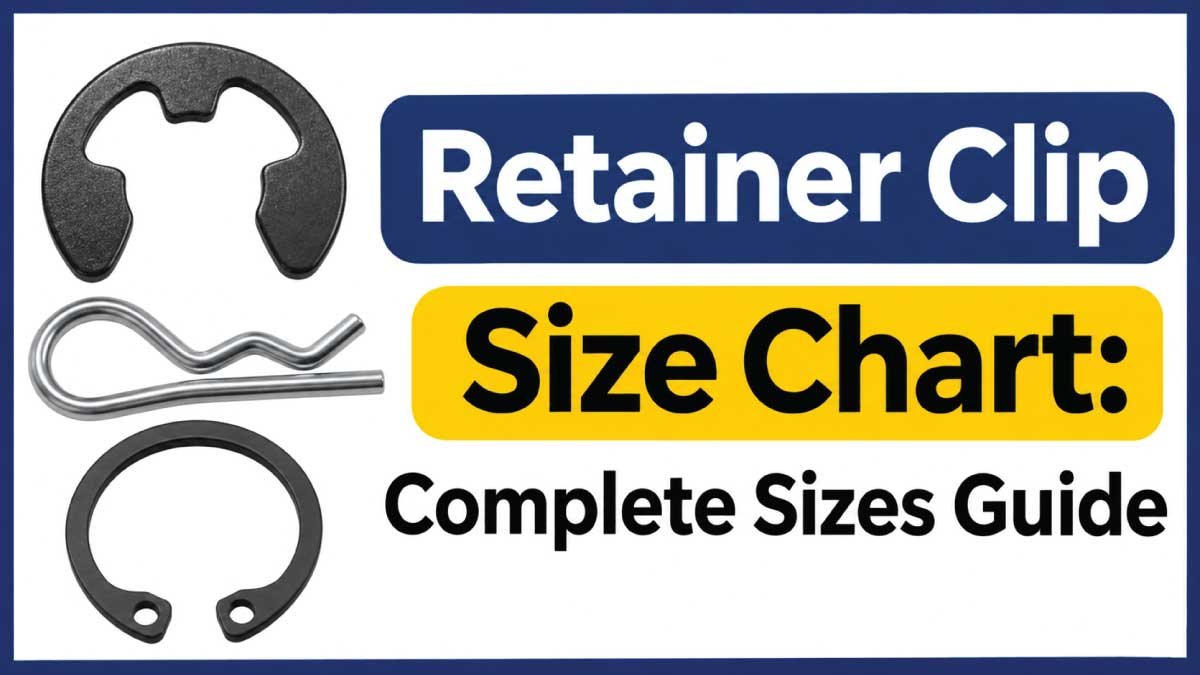
Retainer clips are fastening components designed to hold parts securely in position and prevent unwanted movement or separation. They are widely used in automotive assemblies, machinery, shafts, bearings, electrical equipment, agricultural machines, and industrial products.
These clips come in different shapes, materials, thicknesses, and dimensions. Common designs include E-clips, circlips, snap rings, retaining rings, hairpin cotter clips, and external or internal retaining clips.
Choosing the correct retainer clip size is essential for proper installation and reliable retention. A clip that is too small may not fit the groove or shaft, while an oversized clip may not lock securely. Incorrect thickness, groove dimensions, or material selection can also cause premature failure.
This Retainer Clip Size Chart explains common clip types, important dimensions, shaft and bore compatibility, retaining ring measurements, material options, and selection methods. It also covers installation considerations, applications, and common sizing mistakes.
Because retainer clips come in several different designs and dimensional standards, there is no single chart that applies to every type. Always identify the clip style before selecting its dimensions.
What Is a Retainer Clip?
A retainer clip is a mechanical fastening device used to hold a component in a specific position.
It may fit into a groove on a shaft, inside a bore, around a pin, or through a mounting hole. Its main purpose is to prevent another component from sliding, falling, or moving out of position.
Retainer clips are commonly used with:
- Shafts and axles.
- Bearings and gears.
- Pins and pivot joints.
- Wheels and pulleys.
- Mechanical linkages.
- Automotive assemblies.
- Industrial equipment.
Depending on the design, a retainer clip may be removable or intended for one-time installation.
Main Functions of Retainer Clips
- Prevent axial movement of components.
- Hold bearings and gears in position.
- Secure pins and shafts.
- Retain wheels and mechanical assemblies.
- Reduce the need for threaded fasteners in selected designs.
- Allow compact mechanical connections.
- Support convenient assembly and maintenance.
Retainer Clip Size Chart: Important Dimensions
The dimensions used to identify a retainer clip depend on its design.
For example, an E-clip is measured differently from an internal circlip or a hairpin cotter clip.
Common Retainer Clip Measurements
| Dimension | Description | Abbreviation |
|---|---|---|
| Shaft diameter | Diameter of the shaft the clip fits | SD |
| Bore diameter | Inside diameter of the housing | BD |
| Clip thickness | Material thickness | T |
| Free outside diameter | Outside diameter before installation | OD |
| Free inside diameter | Inside diameter before installation | ID |
| Groove diameter | Diameter at the bottom of the retaining groove | GD |
| Groove width | Width of the groove in the shaft or bore | GW |
| Clip width | Overall width across the clip | W |
| Clip height | Overall height of the clip | H |
| Lug or ear dimensions | Dimensions of installation or removal features | — |
Not every dimension applies to every clip style. Use the manufacturer’s drawing for the specific retaining ring or clip.
Types of Retainer Clips
Retainer clips are available in several designs. Understanding the type helps identify the correct size chart and measurement method.
1. E-Clips
E-clips are shaped like the letter E and are installed into a groove on a shaft.
They typically engage the shaft groove through their inner retaining sections.
Common applications include:
- Small motors.
- Gear assemblies.
- Bearings.
- Mechanical linkages.
- Appliances.
- Automotive components.
E-clips are often selected according to the shaft diameter and matching groove specification.
2. External Circlips
External circlips fit around the outside of a shaft and engage with a machined groove.
They prevent components from moving axially along the shaft.
Common applications include:
- Gear shafts.
- Axles.
- Bearing assemblies.
- Pulleys.
- Industrial machinery.
External circlips are commonly manufactured with two holes or lugs for installation and removal using circlip pliers.
3. Internal Circlips
Internal circlips fit inside a bore or housing groove.
They hold components inside a housing and prevent them from moving out of position.
Typical applications include:
- Gear housings.
- Bearing housings.
- Pump assemblies.
- Cylindrical equipment.
- Mechanical enclosures.
Internal clips are compressed for installation into the bore.
4. Snap Rings
Snap rings are retaining rings that engage with a shaft or housing groove.
The term can describe several retaining ring designs, including internal and external versions.
Their exact dimensions and installation requirements depend on the applicable retaining ring standard.
5. Hairpin Cotter Clips
Hairpin cotter clips are wire-form fasteners used to retain pins and shafts.
They generally pass through a cross-hole in a pin or shaft and prevent accidental separation.
Common applications include:
- Agricultural equipment.
- Trailer connections.
- Hitch pins.
- Machinery linkages.
- Removable mechanical assemblies.
6. Bow-Tie Cotter Pins
Bow-tie cotter pins use a formed wire design to retain a pin or shaft.
They are used in selected agricultural, trailer, and machinery applications.
7. Push-On Retainers
Push-on retainers are pressed onto a shaft or stud to hold a component in position.
They may use internal teeth or spring action to grip the shaft.
Some push-on retainers are intended for permanent or semi-permanent installation and may not be reusable.
Retainer Clip Type Comparison
| Retainer Clip Type | Installation Location | Main Purpose |
|---|---|---|
| E-clip | Shaft groove | Retain components on small shafts |
| External circlip | Outside shaft groove | Prevent axial movement |
| Internal circlip | Inside bore groove | Retain components inside housings |
| Snap ring | Shaft or bore groove | Secure mechanical components |
| Hairpin cotter clip | Cross-hole in pin | Prevent pin separation |
| Bow-tie cotter pin | Pin or shaft opening | Retain removable connections |
| Push-on retainer | Shaft or stud | Hold components by spring grip |
External Retaining Clip Size Chart
External retaining rings are designed for installation in grooves machined around shafts.
Their size is generally selected according to the nominal shaft diameter and the relevant retaining ring specification.
External Circlip Dimensions
| Dimension | What It Represents |
|---|---|
| Nominal shaft diameter | Shaft size the ring is designed for |
| Free inside diameter | Ring opening before installation |
| Free outside diameter | Overall diameter before installation |
| Ring thickness | Material thickness |
| Ring width | Width of the retaining ring |
| Groove diameter | Diameter at the bottom of the shaft groove |
| Groove width | Required width of the shaft groove |
Important: External retaining rings are not interchangeable based only on their free inside diameter. Their shaft size, groove dimensions, thickness, and retaining capacity must match the selected design and standard.
Internal Retaining Clip Size Chart
Internal retaining rings are installed inside a machined bore.
They expand into the housing groove and provide a retaining surface for the component.
Internal Circlip Dimensions
| Dimension | What It Represents |
|---|---|
| Nominal bore diameter | Housing bore size |
| Free outside diameter | Ring diameter before installation |
| Free inside diameter | Opening within the ring |
| Ring thickness | Material thickness |
| Ring width | Width of the retaining section |
| Groove diameter | Diameter at the bottom of the bore groove |
| Groove width | Required width of the internal groove |
The correct internal circlip must match the bore and groove dimensions. Do not select it using bore diameter alone.
E-Clip Size Chart: Measurement Reference
E-clips are frequently used on small shafts and pins.
Their dimensions are usually identified by the shaft size they are designed to retain, together with the clip’s thickness and outside dimensions.
Important E-Clip Measurements
| Measurement | Description |
|---|---|
| Compatible shaft diameter | Diameter of the shaft |
| Clip thickness | Thickness of the metal material |
| Overall width | Width across the outer edges |
| Overall height | Height of the clip profile |
| Inner retaining opening | Opening formed by the retaining legs |
| Groove compatibility | Matching shaft groove dimensions |
E-clip dimensions vary by series and manufacturer. A product drawing should be used to confirm the actual measurements before ordering.
Read Latest Guide:
Common Retainer Clip Material Types
Retainer clips are manufactured from different metals to provide suitable strength, elasticity, wear resistance, and corrosion protection.
1. Carbon Spring Steel
Carbon spring steel is widely used for retaining rings and spring clips.
It provides elastic properties that allow the clip to deform during installation and return toward its original shape.
Common applications include:
- Shaft retaining rings.
- E-clips.
- Mechanical assemblies.
- General industrial machinery.
2. Stainless Steel
Stainless steel retaining clips are used where corrosion resistance is important.
Different stainless steel grades offer different levels of corrosion resistance and mechanical performance.
Common applications include:
- Outdoor equipment.
- Marine-related machinery.
- Food-processing equipment.
- Corrosion-exposed assemblies.
The exact grade must be selected according to the operating environment.
3. Phosphor Bronze
Phosphor bronze is used in selected spring and electrical applications.
It offers useful corrosion resistance and electrical properties, although it is not the default material for every retaining ring.
4. Alloy Steel
Alloy steel retaining components may be used where specific mechanical properties are required.
Material selection depends on strength, heat treatment, operating loads, and design requirements.
Material Comparison
| Material | General Characteristics | Typical Applications |
|---|---|---|
| Carbon spring steel | Elasticity and retaining strength | General mechanical retaining rings |
| Stainless steel | Corrosion resistance depending on grade | Outdoor and industrial equipment |
| Phosphor bronze | Corrosion and electrical properties | Selected spring and electrical components |
| Alloy steel | Selected mechanical strength and heat-treatment properties | Specialized machinery |
Retainer Clip Standards
Retaining rings are manufactured according to different standards and product specifications.
The applicable standard depends on the clip design and whether it fits a shaft or a bore.
Examples include:
- DIN 471: External retaining rings for shafts.
- DIN 472: Internal retaining rings for bores.
- DIN 6799: Retaining washers or E-style retaining rings for shafts.
- ASME B18.27: Retaining rings, within the scope of the applicable standard.
These standards cover different retaining ring designs. A DIN 471 external ring, for example, should not be treated as dimensionally interchangeable with a DIN 472 internal ring.
Always identify the standard and series before using a dimensional chart.
Read Latest Guide:
How to Measure a Retainer Clip
Correct measurements are necessary when replacing an existing clip or selecting a new retaining ring.
Step 1: Identify the Clip Type
Determine whether the component is an E-clip, external circlip, internal circlip, snap ring, or cotter-style retainer.
The clip type determines which dimensions are important.
Step 2: Measure the Shaft or Bore
For an external clip, measure the shaft diameter.
For an internal clip, measure the housing bore diameter.
Use a suitable caliper or micrometer.
Step 3: Measure the Clip Thickness
Measure the thickness of the metal material.
Do not confuse thickness with the overall width or height of the clip.
Step 4: Measure the Clip Diameter
For circlips, measure the free inside and outside diameters where appropriate.
Remember that retaining rings can change shape during installation, so free dimensions are not necessarily equal to installed dimensions.
Step 5: Measure the Groove
Check the groove diameter and width.
For external retaining rings, measure the groove on the shaft. For internal retaining rings, measure the groove inside the bore.
Step 6: Check the Groove Position
Measure the distance from the end of the shaft or housing to the groove where relevant.
The groove position affects how the retained component sits in the assembly.
Step 7: Confirm the Standard
Check whether the original clip follows DIN, ASME, or a manufacturer-specific design.
Step 8: Verify the Replacement
Compare all important dimensions with the manufacturer’s product drawing before installation.
Read Latest Guide:
How to Choose the Correct Retainer Clip Size
Selecting the right retainer clip requires checking the complete mounting arrangement.
1. Identify the Application
Determine whether the clip will be installed on a shaft, inside a bore, or through a pin.
2. Confirm the Nominal Shaft or Bore Size
Measure the shaft or bore accurately and identify the corresponding retaining ring size.
3. Check the Groove Dimensions
The groove must match the retaining ring specification.
Check groove diameter, width, and position.
4. Select the Correct Clip Type
Choose an external ring for an external shaft groove and an internal ring for an internal bore groove. Use the specified E-clip or cotter-style design when the assembly requires it.
5. Check Material and Thickness
Select a suitable material and thickness based on the retaining load, environment, and equipment design.
6. Consider Operating Conditions
Account for vibration, rotation, temperature, corrosion, and mechanical loads.
7. Follow Installation Instructions
Use suitable circlip pliers or installation tools where required. Avoid overstretching or permanently deforming the clip.
Retainer Clip Applications
Retainer clips are used in many mechanical and industrial assemblies.
Automotive Industry
Retainer clips secure components in:
- Transmission assemblies.
- Axles.
- Wheel and hub systems.
- Gear mechanisms.
- Interior and exterior fittings.
- Linkages and pins.
Industrial Machinery
Industrial machines use retaining rings to hold bearings, gears, pulleys, and shafts in position.
Agricultural Equipment
Hairpin cotter clips and other retainers are used in hitch connections, removable pins, and machinery linkages.
Electrical Equipment
Small retaining clips may be used in switches, motors, connectors, and selected electrical assemblies.
Pumps and Compressors
Retaining rings can secure bearings and other internal mechanical components in suitable pump and compressor designs.
Appliances
Small clips and retaining rings are used in selected motor assemblies, rotating components, and mechanical linkages.
Common Retainer Clip Sizing Mistakes
Incorrect sizing can cause a clip to loosen, deform, or fail to retain a component.
Avoid these common mistakes:
- Choosing by appearance: Similar clips may have different dimensions.
- Ignoring shaft diameter: The retaining ring must match its intended shaft size.
- Using an internal ring externally: Internal and external rings have different designs.
- Ignoring groove width: A clip may not seat correctly in an unsuitable groove.
- Ignoring groove diameter: The retaining geometry must match the specified groove.
- Selecting the wrong thickness: Material thickness affects fit and retaining performance.
- Overstretching a circlip: Excessive expansion can permanently deform it.
- Using damaged clips: Bent or distorted clips may not retain components securely.
- Ignoring material compatibility: Corrosion and temperature can affect clip performance.
- Mixing standards: Clips made to different standards may have incompatible dimensions.
- Forcing installation: Incorrect tools or excessive force can damage the clip or groove.
Frequently Asked Questions
1. What is a retainer clip used for?
A retainer clip holds mechanical components in position and prevents unwanted movement or separation. It is commonly used with shafts, bearings, gears, pins, and machinery assemblies.
2. What are the common types of retainer clips?
Common types include E-clips, external circlips, internal circlips, snap rings, hairpin cotter clips, bow-tie cotter pins, and push-on retainers.
3. What is the difference between an internal and external circlip?
An external circlip fits around a shaft and engages with an outside groove. An internal circlip fits inside a bore and engages with an internal groove.
4. How do I measure a retainer clip?
Identify the clip type and measure the compatible shaft or bore diameter, clip thickness, relevant inside and outside diameters, and groove dimensions. Follow the manufacturer’s drawing for exact specifications.
5. What is an E-clip?
An E-clip is a retaining clip with an E-shaped profile. It fits into a groove on a shaft to prevent a component from sliding off.
6. Are retainer clips available in stainless steel?
Yes. Stainless steel retaining rings and clips are available in different grades. They are used where corrosion resistance is required, subject to the mechanical and environmental requirements.
7. Can a retainer clip be reused?
Some retaining clips can be reused if the manufacturer permits it and the clip remains undamaged. Replace any clip that is permanently deformed, cracked, corroded, or no longer fits securely.
8. What is the difference between a snap ring and a circlip?
The terms are often used interchangeably in general mechanical discussions. However, specific product designs and standards may distinguish between different retaining ring styles.
9. Which standard is used for external retaining rings?
DIN 471 is a commonly used standard for external retaining rings for shafts. DIN 472 covers internal retaining rings for bores.
10. Why does a retaining clip keep coming off?
A clip may come off because the groove dimensions are incorrect, the clip is the wrong size, the retaining ring is deformed, or the assembly experiences loads beyond its design limits.
Conclusion
A Retainer Clip Size Chart helps identify the important dimensions needed to select retaining rings and clips for mechanical assemblies. However, the correct size depends on the clip design, shaft or bore diameter, groove dimensions, thickness, material, and applicable standard.
Before ordering a replacement, identify whether you need an E-clip, external circlip, internal circlip, snap ring, or cotter-style retainer. Verify the manufacturer’s dimensional drawing and installation requirements to ensure a secure and reliable fit.