
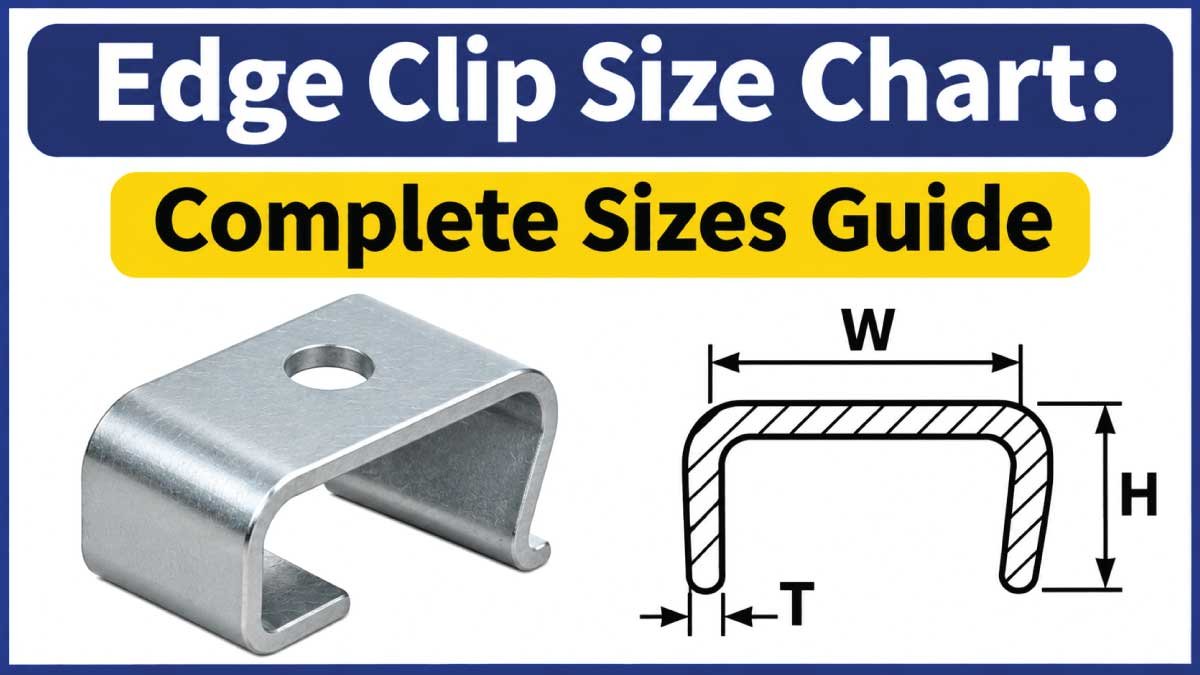
Edge clips are fastening components designed to attach to the edge of a panel, sheet, bracket, or other material. They provide a convenient way to secure cables, wires, trim, hoses, and other components without always requiring drilled holes or permanent modifications.
Edge clips are commonly used in automotive manufacturing, electrical installations, industrial machinery, appliances, furniture, and sheet metal assemblies. Depending on their design, they may grip a panel edge, support a cable, hold a wire harness, or provide a mounting point for another component.
Choosing the correct edge clip size is important for proper installation and reliable retention. An undersized clip may not fit the panel, while an oversized clip may fail to grip securely.
This Edge Clip Size Chart explains the main dimensions, common clip types, panel thickness considerations, materials, measurement methods, and selection guidelines.
Edge clips are available in many designs, and there is no single universal dimensional standard covering every type. Always compare the required measurements with the manufacturer’s product drawing.
What Is an Edge Clip?
An edge clip is a fastening or retaining component that attaches to the edge of a material. It usually has a gripping section that fits over the edge and a feature that holds or supports another component.
Some edge clips are made from plastic, while others are manufactured from spring steel or other metals.
Depending on the design, an edge clip may include:
- A panel-gripping section.
- A cable or wire retaining channel.
- A mounting hole or stud.
- A locking tab.
- A flexible retaining arm.
- A protective coating or cushioning layer.
Edge clips are useful when a component needs to be attached along a panel edge without using conventional screws, bolts, or drilled mounting holes.
Edge Clip Size Chart: Important Dimensions
The correct edge clip size depends on the panel thickness, clip opening, overall dimensions, and intended application.
Main Edge Clip Measurements
| Dimension | Description | Abbreviation |
|---|---|---|
| Panel thickness | Thickness of the edge being gripped | PT |
| Clip opening | Internal gap that fits over the panel edge | CO |
| Overall length | Total length of the clip | L |
| Overall width | Width across the clip | W |
| Overall height | Total height of the installed clip | H |
| Material thickness | Thickness of the clip material | T |
| Grip depth | Distance the clip covers along the panel edge | GD |
| Cable diameter | Diameter of the cable supported, if applicable | CD |
| Mounting diameter | Diameter of a mounting hole, if included | MD |
Not every edge clip uses all these dimensions. A cable edge clip, for example, may require cable diameter and panel thickness, while a simple metal edge protector may be selected mainly by panel thickness and profile.
Edge Clip Opening Size Chart
The clip opening is one of the most important measurements when selecting an edge clip for a panel or sheet.
It determines whether the clip can fit over the material edge.
The following values are illustrative opening-size references. They are not universal product sizes or guaranteed grip ranges.
Common Edge Clip Opening References
| Clip Opening (mm) | Approximate Opening (Inches) | General Category |
|---|---|---|
| 0.5 mm | 0.020″ | Extra small |
| 0.8 mm | 0.031″ | Extra small |
| 1.0 mm | 0.039″ | Small |
| 1.2 mm | 0.047″ | Small |
| 1.5 mm | 0.059″ | Small |
| 2.0 mm | 0.079″ | Small to medium |
| 2.5 mm | 0.098″ | Medium |
| 3.0 mm | 0.118″ | Medium |
| 4.0 mm | 0.157″ | Medium to large |
| 5.0 mm | 0.197″ | Large |
| 6.0 mm | 0.236″ | Large |
| 8.0 mm | 0.315″ | Extra large |
| 10.0 mm | 0.394″ | Extra large |
These measurements describe example opening dimensions only. The actual fit also depends on the clip’s internal shape, material flexibility, retaining mechanism, and manufacturer’s specified panel thickness range.
Why Opening Size Matters
A properly selected opening helps the clip fit over the panel edge without excessive force or unwanted movement.
If the opening is too small:
- Installation may become difficult.
- The panel edge may be scratched or deformed.
- Plastic clips may crack.
- Metal clips may permanently bend.
If the opening is too large:
- The clip may move along the edge.
- Retention may be reduced.
- Vibration may cause the clip to loosen.
- The supported component may become unstable.
Edge Clip Material Thickness Chart
Metal edge clips are manufactured in different material thicknesses according to their design and intended application.
Common Metal Thickness References
| Material Thickness (mm) | Approximate Thickness (Inches) |
|---|---|
| 0.25 mm | 0.010″ |
| 0.30 mm | 0.012″ |
| 0.40 mm | 0.016″ |
| 0.50 mm | 0.020″ |
| 0.60 mm | 0.024″ |
| 0.80 mm | 0.031″ |
| 1.00 mm | 0.039″ |
| 1.20 mm | 0.047″ |
| 1.50 mm | 0.059″ |
| 2.00 mm | 0.079″ |
| 2.50 mm | 0.098″ |
| 3.00 mm | 0.118″ |
These are general sheet-metal thickness references, not a specification for every edge clip.
Plastic edge clips use different thickness and geometry considerations. Their performance depends on polymer type, wall thickness, flexibility, and operating temperature.
How Material Thickness Affects Performance
Material thickness can influence:
- Clip stiffness.
- Retaining force.
- Resistance to deformation.
- Installation effort.
- Durability.
- Resistance to vibration.
A thicker metal clip is not automatically the best choice. The clip design, material grade, spring characteristics, and panel thickness must all be considered.
Types of Edge Clips
Edge clips are available in several designs. Each type is intended for a different fastening or retaining purpose.
1. Cable Edge Clips
Cable edge clips attach to a panel edge and hold electrical wires or cables in position.
They are commonly used in automotive wiring, electrical enclosures, appliances, and machinery.
Important measurements include:
- Panel thickness.
- Clip opening.
- Cable diameter.
- Overall clip width.
- Retaining channel dimensions.
2. Plastic Edge Clips
Plastic edge clips are lightweight components used to secure panels, trim, wires, and other parts.
They are often manufactured from nylon, polypropylene, or other engineering plastics.
Their flexibility and resistance to environmental conditions depend on the material grade.
3. Metal Edge Clips
Metal edge clips are commonly manufactured from spring steel or other suitable metals.
They may be used where greater mechanical stiffness or retaining force is required.
Some designs include protective coatings to reduce corrosion or prevent damage to the panel.
4. Edge Protector Clips
Edge protector clips cover exposed panel edges to reduce sharpness and protect cables, hoses, or nearby components from abrasion.
They may be manufactured from plastic, rubber, or metal.
Some designs provide a protective lining rather than a separate fastening point.
5. Automotive Edge Clips
Automotive edge clips are used to secure wiring harnesses, trim, hoses, and selected components along vehicle panels.
They may include additional mounting features such as cable ties, retaining channels, or locking sections.
6. Panel Edge Clips
Panel edge clips attach to sheet metal, plastic panels, or enclosure edges.
Depending on the design, they can provide a retaining point, fastening location, or support for an additional component.
Edge Clip Type Comparison
| Edge Clip Type | Main Function | Common Application |
|---|---|---|
| Cable edge clip | Holds wires and cables | Electrical installations |
| Plastic edge clip | Retains lightweight components | Appliances and panels |
| Metal edge clip | Provides mechanical retention | Industrial assemblies |
| Edge protector clip | Protects exposed edges | Sheet metal and equipment |
| Automotive edge clip | Secures vehicle components | Automotive wiring and trim |
| Panel edge clip | Attaches to panel edges | Enclosures and machinery |
Edge Clip Panel Thickness Chart
Panel thickness is a key factor when selecting an edge clip.
A clip must be designed for the thickness of the material it will grip. The opening measurement alone does not always establish compatibility because some clips use spring pressure or flexible retaining features.
Panel Thickness Reference
| Panel Thickness (mm) | Approximate Thickness (Inches) |
|---|---|
| 0.5 mm | 0.020″ |
| 0.8 mm | 0.031″ |
| 1.0 mm | 0.039″ |
| 1.2 mm | 0.047″ |
| 1.5 mm | 0.059″ |
| 2.0 mm | 0.079″ |
| 2.5 mm | 0.098″ |
| 3.0 mm | 0.118″ |
| 4.0 mm | 0.157″ |
| 5.0 mm | 0.197″ |
| 6.0 mm | 0.236″ |
| 8.0 mm | 0.315″ |
| 10.0 mm | 0.394″ |
This is a general material-thickness reference, not a chart of compatible clip sizes. A particular edge clip may support only a limited range of panel thicknesses.
Understanding Grip Range
Grip range is the manufacturer’s stated range of material thickness that a clip can accommodate.
For example, a product specified for a particular panel thickness range should be used only within that stated range.
Grip range can differ from the measured opening because the clip may flex, compress, or use a locking feature during installation.
Always use the manufacturer’s grip-range specification when available.
Read Latest Guide:
Edge Clip Materials
The material affects the clip’s strength, flexibility, corrosion resistance, and service life.
1. Nylon
Nylon is commonly used for plastic edge clips and cable-retaining components.
It offers a useful combination of strength and flexibility. Certain nylon grades are also available with improved heat or chemical resistance.
2. Polypropylene
Polypropylene is used in selected lightweight clips and panel-retaining applications.
It offers low weight and good resistance to moisture, although its temperature and mechanical limits depend on the grade.
3. Spring Steel
Spring steel is suitable for metal clips that require elastic gripping action.
It is used in retaining clips and selected panel-edge fasteners.
4. Stainless Steel
Stainless steel may be selected where corrosion resistance is important.
The appropriate grade depends on moisture, chemicals, temperature, and the surrounding environment.
5. Carbon Steel
Carbon steel is used in general-purpose metal edge clips.
Protective coatings may be applied depending on the expected exposure conditions.
Material Comparison
| Material | General Characteristics | Common Applications |
|---|---|---|
| Nylon | Strong and flexible | Cable and panel clips |
| Polypropylene | Lightweight and moisture resistant | Lightweight retaining clips |
| Spring steel | Elastic and mechanically stiff | Metal retaining clips |
| Stainless steel | Corrosion resistance varies by grade | Industrial and outdoor applications |
| Carbon steel | General mechanical strength | Sheet metal fastening |
How to Measure an Edge Clip
Accurate measurements help identify the correct replacement and prevent fitting problems.
Step 1: Identify the Clip Design
Determine whether the product is a cable edge clip, metal retaining clip, plastic panel clip, or edge protector.
Different designs require different measurements.
Step 2: Measure the Panel Thickness
Use a caliper to measure the thickness of the panel or sheet where the clip will be installed.
Measure an undamaged section if the existing edge is bent or coated.
Step 3: Measure the Clip Opening
Measure the internal distance between the gripping surfaces.
For a spring clip, avoid forcing the clip open because this can change its shape or damage it.
Step 4: Measure the Overall Dimensions
Record the clip’s total length, width, and height.
For irregular shapes, use the manufacturer’s drawing to identify the correct reference points.
Step 5: Measure the Material Thickness
For metal clips, measure the sheet thickness. For wire-form designs, measure the wire diameter.
Step 6: Check the Retaining Feature
If the clip holds a cable, wire, or other component, measure the required cable diameter or retaining-channel dimensions.
Step 7: Confirm the Grip Range
Compare the panel thickness with the manufacturer’s specified grip range.
Step 8: Check the Material and Environment
Identify whether the clip needs resistance to moisture, chemicals, vibration, heat, or outdoor exposure.
Read Latest Guide:
How to Choose the Correct Edge Clip Size
Selecting the correct clip involves more than matching its overall dimensions.
1. Identify the Application
Determine what the clip needs to hold or protect. A cable-retaining clip may have different requirements from a panel-edge protector.
2. Match the Panel Thickness
Choose a clip designed for the actual panel thickness.
3. Check the Opening and Grip Range
Confirm both the opening dimensions and the manufacturer’s permitted grip range.
4. Verify the Retaining Capacity
For cable clips, check the cable diameter and the clip’s retention design.
5. Select the Appropriate Material
Consider temperature, moisture, chemicals, vibration, and mechanical loading.
6. Check the Installation Method
Some clips push onto an edge, while others slide into position or use a locking feature.
7. Review the Manufacturer’s Drawing
Check dimensions, tolerances, installation direction, and any product-specific limitations.
Read Latest Guide:
Edge Clip Applications
Edge clips are used in many industries because they provide convenient fastening and cable-management solutions.
Automotive Manufacturing
Automotive edge clips secure wiring harnesses, cables, hoses, trim, and selected components to body panels.
They help organize components and reduce movement during vehicle operation.
Electrical Enclosures
Edge clips can hold wires and cables along enclosure panels. They may also help protect cables from sharp metal edges.
Industrial Machinery
Machinery manufacturers use suitable edge clips to retain cables, protect panels, and support removable covers.
Appliance Manufacturing
Edge clips may secure internal wiring, panels, and lightweight components in household and commercial appliances.
Furniture Manufacturing
Selected plastic and metal edge clips are used to retain panels, decorative trim, and other furniture components.
Sheet Metal Fabrication
Edge clips provide fastening or protective functions in sheet metal assemblies where conventional drilling or welding is not preferred.
Common Edge Clip Sizing Mistakes
Incorrect clip selection can result in poor retention, panel damage, or premature failure.
Avoid these common mistakes:
- Ignoring panel thickness: The clip may not fit or grip properly.
- Matching only the opening: Opening size does not always represent the approved grip range.
- Confusing clip types: A cable edge clip and an edge protector do not perform the same function.
- Ignoring cable diameter: A cable may be too large or too small for its retaining channel.
- Choosing the wrong material: Some plastics or metals may not suit the operating environment.
- Forcing installation: Excessive force can damage the clip or panel.
- Ignoring vibration: A clip used in machinery or vehicles must be suitable for its operating conditions.
- Using a damaged clip: Cracked plastic or permanently deformed metal may not retain components reliably.
- Ignoring tolerances: Small differences in panel thickness and clip dimensions can affect fit.
- Assuming universal sizing: Different manufacturers may use different designs and dimensional specifications.
Frequently Asked Questions
1. What is an edge clip used for?
An edge clip attaches to the edge of a panel, sheet, or bracket. It can hold cables, wires, trim, and other components or protect exposed edges.
2. How do I measure an edge clip?
Measure the panel thickness, clip opening, overall length, width, height, and material thickness. For cable clips, also measure the cable diameter or retaining-channel size.
3. What is the most important edge clip measurement?
Panel thickness and the manufacturer’s specified grip range are among the most important measurements for clips that attach to panel edges. Other dimensions depend on the clip’s function.
4. Are edge clips available in plastic and metal?
Yes. Plastic edge clips are commonly made from nylon or polypropylene, while metal versions may use spring steel, carbon steel, or stainless steel.
5. Can edge clips hold electrical wires?
Yes. Cable-retaining edge clips are designed to secure wires and cables along panel edges. Select a product that matches the panel thickness and cable diameter.
6. Are edge clips universal?
No. Edge clips differ in opening size, grip range, material, shape, retaining features, and intended application. Manufacturer specifications should be checked before replacement.
7. What is the difference between an edge clip and an edge protector?
An edge clip generally provides a fastening or retaining function. An edge protector is designed primarily to cover or shield an exposed edge, although some products combine both functions.
8. Can edge clips be reused?
Some edge clips can be reused if they remain undamaged and the manufacturer permits reuse. Replace clips that are cracked, deformed, corroded, or unable to retain components securely.
9. What material is best for automotive edge clips?
Nylon, suitable engineering plastics, and spring steel are commonly used in automotive clip designs. The best material depends on temperature, vibration, chemical exposure, and the required retaining force.
10. Do edge clips require drilling?
Many edge clips attach directly to an existing panel edge and do not require drilling. However, some designs use additional mounting holes, studs, or fastening features.
Conclusion
An Edge Clip Size Chart helps identify the important dimensions required for selecting a suitable panel-edge fastener. The main measurements include panel thickness, clip opening, grip range, overall length, width, material thickness, and any cable-retaining dimensions.
The correct edge clip depends on its intended application, material, and installation requirements. Before ordering a replacement, measure the panel and existing clip carefully, then compare the results with the manufacturer’s technical drawing. Proper sizing helps provide reliable retention and reduces installation problems.