
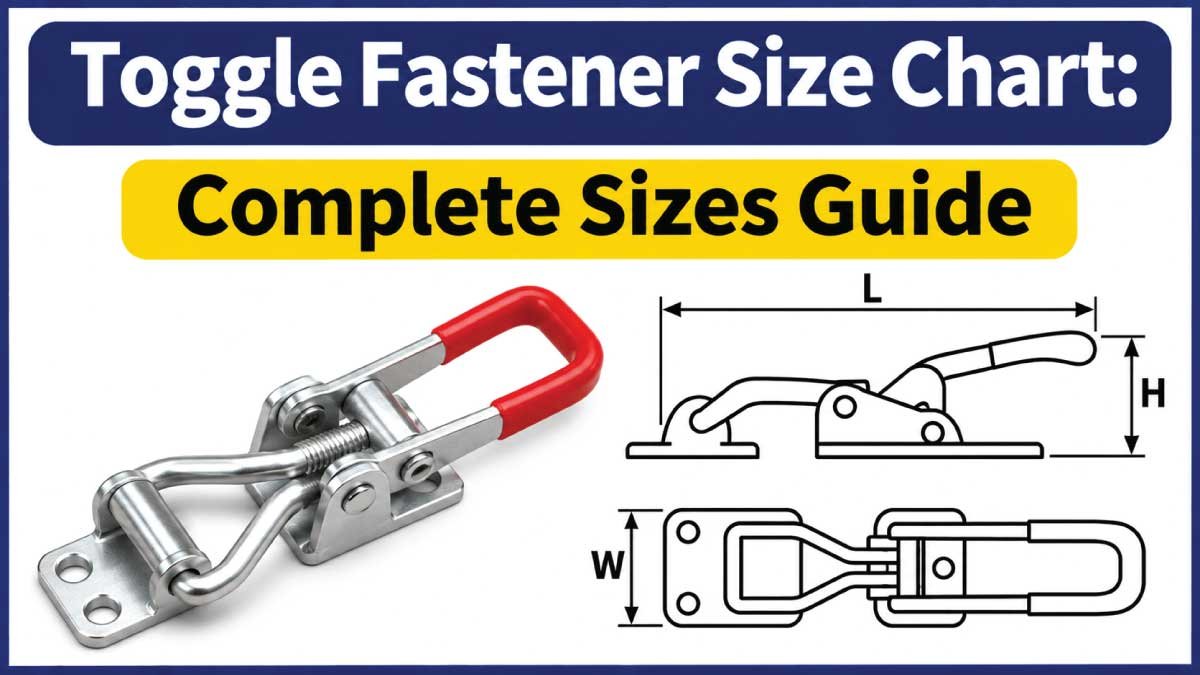
Toggle fasteners are mechanical fastening devices designed to secure panels, doors, covers, access openings, and other components. They use a movable lever, hook, latch, or toggle mechanism to create a holding force between two connected parts.
Toggle fasteners are commonly used in industrial machinery, equipment enclosures, toolboxes, storage containers, automotive assemblies, cabinets, and manufacturing equipment. Their quick operating mechanism makes them useful for applications where components need to be opened, closed, or secured repeatedly.
Selecting the correct toggle fastener size is important for achieving proper engagement, suitable clamping force, and reliable operation. The fastener must match the mounting arrangement, panel thickness, hook or catch dimensions, and required holding capacity.
This Toggle Fastener Size Chart explains important dimensions, common toggle fastener types, mounting measurements, materials, measurement methods, and selection guidelines.
Toggle fasteners are available in many designs, and their dimensions are not covered by one universal sizing standard. Always check the manufacturer’s technical drawing and load specifications before choosing a product.
What Is a Toggle Fastener?
A toggle fastener is a mechanical latch that uses a lever-operated mechanism to hold two components together.
When the lever is moved into its locked position, the mechanism applies tension or clamping force between the mounting points. Moving the lever in the opposite direction releases the connection.
A typical toggle fastener may include:
- Operating lever.
- Toggle arm.
- Hook or catch.
- Mounting base.
- Pivot pin.
- Adjustable spindle.
- Locking mechanism.
- Mounting holes.
Some designs include an adjustable hook to accommodate different installation distances. Others use a fixed hook or a safety locking feature to prevent accidental release.
Toggle Fastener Size Chart: Important Dimensions
Toggle fasteners come in different configurations, so their measurements depend on the design.
Main Toggle Fastener Measurements
| Dimension | Description | Abbreviation |
|---|---|---|
| Overall length | Total length of the fastener | L |
| Overall width | Maximum width across the assembly | W |
| Overall height | Total height of the fastener | H |
| Base length | Length of the mounting base | BL |
| Base width | Width of the mounting base | BW |
| Mounting hole diameter | Diameter of the installation holes | MHD |
| Hook length | Length of the hook section | HL |
| Hook diameter | Diameter of the hook or catch | HD |
| Spindle length | Length of the adjustable spindle, if included | SL |
| Operating lever length | Length of the handle or lever | OLL |
| Holding capacity | Manufacturer-rated holding load | HC |
Not every toggle fastener uses all these dimensions. A draw latch, for example, may require hook length and catch position, while a toggle clamp may require arm reach, spindle dimensions, and clamping capacity.
Common Toggle Fastener Size Reference
Toggle fasteners are manufactured in different sizes for lightweight enclosures, medium-duty equipment, and heavier industrial applications.
The following values are general dimensional references for comparing product measurements. They are not universal standardized product sizes.
Overall Length Reference
| Overall Length (mm) | Approximate Length (Inches) | General Category |
|---|---|---|
| 25 mm | 0.984″ | Extra small |
| 30 mm | 1.181″ | Extra small |
| 40 mm | 1.575″ | Small |
| 50 mm | 1.969″ | Small |
| 60 mm | 2.362″ | Medium |
| 75 mm | 2.953″ | Medium |
| 100 mm | 3.937″ | Large |
| 125 mm | 4.921″ | Large |
| 150 mm | 5.906″ | Extra large |
| 200 mm | 7.874″ | Extra large |
These are reference measurements rather than a guaranteed range of available products. Actual overall length depends on the toggle fastener design and manufacturer.
Toggle Fastener Mounting Hole Size Chart
Mounting holes are used to attach the fastener base and catch to the supporting surfaces.
The required hole size depends on whether the product uses screws, bolts, rivets, or another mounting arrangement.
Common Mounting Fastener Diameter References
| Nominal Fastener Size | Diameter (mm) | Approximate Diameter (Inches) |
|---|---|---|
| M3 | 3 mm | 0.118″ |
| M4 | 4 mm | 0.157″ |
| M5 | 5 mm | 0.197″ |
| M6 | 6 mm | 0.236″ |
| M8 | 8 mm | 0.315″ |
| M10 | 10 mm | 0.394″ |
These values show nominal fastener diameters, not recommended mounting-hole diameters. The actual clearance hole, tapping hole, or rivet-hole size must follow the manufacturer’s mounting instructions.
Mounting Hole Measurements to Check
- Hole diameter.
- Distance between mounting holes.
- Distance from the hole to the base edge.
- Mounting surface thickness.
- Fastener head clearance.
- Required screw or bolt specification.
Incorrect mounting-hole dimensions can affect alignment and reduce the reliability of the installation.
Toggle Fastener Hook Size Chart
The hook connects the moving part of the toggle fastener to a catch or retaining point.
Hook dimensions are important because they determine whether the fastener can engage correctly.
Important Hook Measurements
| Measurement | Description |
|---|---|
| Hook length | Overall length of the hook |
| Hook opening | Internal opening of the hook |
| Hook diameter | Diameter of the hook material |
| Hook width | Width across the hook |
| Thread diameter | Diameter of an adjustable threaded section |
| Adjustment length | Available adjustment for fitting the connection |
Hook dimensions vary considerably between product families. A replacement hook should match the original fastener’s geometry, thread, and catch arrangement.
Toggle Fastener Types
Toggle fasteners are available in several designs. Each type is suited to a different fastening requirement.
1. Adjustable Toggle Latches
Adjustable toggle latches use a hook or threaded spindle that can be adjusted to change the distance between the connected parts.
They are commonly used on toolboxes, storage containers, machinery covers, and equipment enclosures.
Important dimensions include:
- Overall length.
- Base dimensions.
- Hook length.
- Adjustment range.
- Mounting-hole spacing.
2. Draw Latches
Draw latches pull two surfaces together when the lever is closed.
They are commonly used for doors, covers, cases, cabinets, and industrial enclosures.
Some draw latches include an adjustable catch to accommodate different panel gaps.
3. Over-Center Toggle Latches
Over-center toggle latches move past a center point during locking.
This creates a stable locked position and helps resist accidental opening under suitable operating conditions.
They are used in industrial equipment, access covers, and transport containers.
4. Spring-Loaded Toggle Latches
Spring-loaded designs use a spring mechanism to assist movement or maintain tension.
They are used in selected equipment covers, machinery, and enclosures.
5. Safety Toggle Latches
Safety toggle latches include an additional locking feature to help prevent accidental release.
They are useful in applications where unintended opening could cause equipment or operational problems.
6. Toggle Clamps
Toggle clamps use a lever and linkage arrangement to apply clamping force to a workpiece.
They are commonly used in welding fixtures, machining operations, woodworking equipment, and manufacturing jigs.
Unlike a simple draw latch, a toggle clamp is primarily designed to hold a workpiece during an operation.
Toggle Fastener Type Comparison
| Toggle Fastener Type | Main Function | Common Application |
|---|---|---|
| Adjustable toggle latch | Provides adjustable fastening | Toolboxes and enclosures |
| Draw latch | Pulls two surfaces together | Doors and covers |
| Over-center latch | Maintains a stable locked position | Industrial equipment |
| Spring-loaded latch | Uses spring-assisted movement | Machinery covers |
| Safety latch | Helps prevent accidental release | Equipment enclosures |
| Toggle clamp | Applies clamping force | Manufacturing fixtures |
Toggle Fastener Materials
Toggle fasteners are manufactured from different materials depending on the required strength, corrosion resistance, weight, and operating environment.
1. Carbon Steel
Carbon steel is commonly used for general-purpose toggle fasteners.
It provides mechanical strength and is often finished with zinc plating or another protective coating.
2. Stainless Steel
Stainless steel is selected where corrosion resistance is important.
It is used in outdoor equipment, food-processing environments where the product is suitable, and industrial applications.
The appropriate grade depends on the exposure conditions and mechanical requirements.
3. Zinc-Plated Steel
Zinc-plated steel is commonly used for toggle latches and mounting components.
The coating helps protect the underlying steel against corrosion, although its performance depends on coating thickness and environmental exposure.
4. Aluminum
Aluminum is used in selected lightweight toggle fastener designs.
It may be suitable where reduced weight is important and the required mechanical loads are within the product’s rating.
5. Plastic
Plastic components may be used for handles, covers, protective parts, or complete lightweight fastening designs.
Their suitability depends on the polymer, temperature, and mechanical loading.
Material Comparison
| Material | General Characteristics | Common Applications |
|---|---|---|
| Carbon steel | General mechanical strength | Industrial latches |
| Stainless steel | Corrosion resistance varies by grade | Outdoor equipment |
| Zinc-plated steel | Protective surface coating | General-purpose fasteners |
| Aluminum | Lightweight | Lightweight equipment |
| Plastic | Lightweight and corrosion resistant | Handles and light-duty assemblies |
Toggle Fastener Holding Capacity
Holding capacity is an important factor when selecting a toggle fastener.
It describes the load a fastener is rated to resist under specified conditions. The manufacturer’s rated value should be used rather than estimating capacity from the fastener’s physical size.
Factors That Affect Holding Capacity
- Fastener material.
- Lever and linkage design.
- Hook or catch strength.
- Mounting screw size.
- Mounting surface material.
- Installation position.
- Load direction.
- Vibration and operating conditions.
Holding Capacity vs. Clamping Force
These terms are not always interchangeable.
Holding capacity generally refers to the load a fastener can resist under specified conditions. Clamping force describes the force applied to the connected surfaces or workpiece.
A toggle clamp may be rated by clamping force, while a draw latch may have a stated holding capacity.
Always check the manufacturer’s definitions and test conditions before comparing product ratings.
Read Latest Guide:
How to Measure a Toggle Fastener
Accurate measurements help identify the correct replacement and prevent installation problems.
Step 1: Identify the Fastener Type
Determine whether the component is an adjustable draw latch, over-center latch, safety latch, or toggle clamp.
Step 2: Measure Overall Length
Measure the complete fastener in its specified position.
If the product has a movable lever, record whether the measurement is taken when open or closed.
Step 3: Measure Overall Width and Height
Record the maximum width and height of the assembly.
Step 4: Measure the Mounting Base
Measure the base length, width, and thickness.
Step 5: Check Mounting Hole Dimensions
Measure the hole diameter and the distance between mounting holes.
Step 6: Measure the Hook or Catch
Record the hook length, opening, width, and thread size if the hook is adjustable.
Step 7: Check the Adjustment Range
For adjustable models, measure the available hook or spindle adjustment.
Step 8: Identify the Holding Capacity
Check the manufacturer’s rated load and application conditions.
Step 9: Compare the Technical Drawing
Confirm dimensions, material, mounting requirements, and operating specifications before ordering.
Read Latest Guide:
How to Choose the Correct Toggle Fastener Size
Selecting the correct toggle fastener requires matching its dimensions and operating characteristics to the application.
1. Determine the Application
Identify whether the fastener will secure a toolbox, machine cover, access door, cabinet, container, or workpiece.
2. Measure the Mounting Surfaces
Check the distance between the surfaces that need to be connected.
3. Select the Correct Overall Size
Make sure the fastener fits within the available installation space and allows the lever to operate freely.
4. Check Hook and Catch Compatibility
The hook must engage correctly with the catch or retaining point.
5. Confirm the Adjustment Range
For adjustable designs, select a fastener with enough adjustment to accommodate the required installation distance.
6. Verify Mounting Hardware
Match the mounting holes with the correct screws, bolts, or rivets.
7. Check Holding Capacity
Choose a product with a manufacturer-rated capacity suitable for the expected load and operating conditions.
8. Select the Appropriate Material
Consider moisture, temperature, chemicals, corrosion, and vibration.
9. Check Safety Requirements
Where accidental opening could create a hazard, select an appropriate safety-locking design and follow the equipment manufacturer’s instructions.
Read Latest Guide:
Toggle Fastener Installation Guide
Correct installation helps ensure reliable engagement and operation.
Step 1: Position the Fastener
Place the toggle latch on the selected mounting surface and check the operating clearance.
Step 2: Mark the Mounting Holes
Use the manufacturer’s mounting drawing to mark the hole positions.
Step 3: Install the Fastener Base
Attach the base using the specified mounting hardware.
Step 4: Position the Catch
Align the catch with the hook or latch arm.
Step 5: Adjust the Hook
If the fastener has an adjustable hook, set its length according to the required engagement and clamping arrangement.
Step 6: Test the Locking Action
Operate the lever and check whether the latch closes and releases smoothly.
Step 7: Inspect the Connection
Confirm that the fastener remains secure and the mounting hardware is properly installed.
Do not exceed the manufacturer’s rated load or use an unsuitable latch for a safety-critical application.
Toggle Fastener Applications
Toggle fasteners are used across many industries because they provide convenient locking and clamping solutions.
Industrial Machinery
They secure machine covers, protective guards, removable access panels, and equipment housings.
Toolboxes and Storage Containers
Draw latches hold lids and covers closed during handling, storage, and transportation.
Automotive Industry
Toggle latches may be used on selected service covers, storage compartments, and equipment enclosures.
Electrical Enclosures
Suitable toggle fasteners secure enclosure doors and access covers. Sealing requirements must be considered when selecting a latch.
Manufacturing and Fabrication
Toggle clamps hold workpieces in position during welding, drilling, cutting, assembly, and other production processes.
Furniture and Cabinets
Selected toggle latches secure doors, removable panels, and storage compartments.
Transportation Equipment
Toggle fasteners are used on suitable containers, cases, and equipment covers that require repeated opening and closing.
Common Toggle Fastener Sizing Mistakes
Incorrect fastener selection can cause poor engagement, loose connections, or premature failure.
Avoid these common mistakes:
- Ignoring overall dimensions: The fastener may not fit within the available space.
- Choosing the wrong hook length: The hook may fail to engage the catch.
- Ignoring adjustment range: The latch may not accommodate the installation distance.
- Using an unsuitable holding capacity: The fastener may not withstand the expected load.
- Incorrect mounting-hole spacing: The fastener may not align with the installation surface.
- Ignoring mounting material: Weak or thin mounting surfaces may not support the required load.
- Confusing holding capacity with clamping force: These ratings describe different performance characteristics.
- Overlooking lever clearance: The handle may hit nearby components during operation.
- Ignoring vibration: Some applications require additional locking protection.
- Selecting the wrong material: The fastener may corrode or deteriorate in its operating environment.
Frequently Asked Questions
1. What is a toggle fastener used for?
A toggle fastener is used to secure two components through a lever-operated locking mechanism. It is commonly found on equipment covers, toolboxes, cabinets, containers, and industrial machinery.
2. How do I measure a toggle fastener?
Measure the overall length, width, height, mounting-base dimensions, hole spacing, hook length, and adjustment range. Also check the manufacturer’s holding-capacity rating.
3. What is an over-center toggle latch?
An over-center toggle latch uses a linkage that moves past a center position when locked. This creates a stable locking arrangement under suitable operating conditions.
4. What is the difference between a toggle latch and a toggle clamp?
A toggle latch is generally used to hold doors, covers, or panels closed. A toggle clamp is designed primarily to apply clamping force and hold a workpiece in position during an operation.
5. Are toggle fasteners adjustable?
Many toggle fasteners have adjustable hooks or threaded spindles. Adjustment allows the user to accommodate different installation distances and panel arrangements.
6. What material is best for toggle fasteners?
Carbon steel is common for general applications, stainless steel is useful where corrosion resistance is important, and aluminum may be suitable for lightweight designs. Material selection depends on the environment and required load.
7. What is the holding capacity of a toggle fastener?
Holding capacity is the manufacturer’s rated ability of the fastener to resist a specified load under stated conditions. Always check the product rating rather than estimating it from the fastener’s size.
8. Can toggle fasteners be used outdoors?
Yes, if the material and protective finish are suitable for outdoor exposure. Stainless steel or appropriately protected steel may be used depending on the environment.
9. Are toggle fasteners available in different sizes?
Yes. They are available in different lengths, widths, hook designs, mounting arrangements, and holding capacities. Dimensions vary by manufacturer and product series.
10. How do I select a replacement toggle fastener?
Identify the fastener type, measure the mounting base and hole spacing, check hook dimensions and adjustment range, and confirm the holding-capacity rating and material.
Conclusion
A Toggle Fastener Size Chart helps identify the important dimensions required for selecting a suitable latch or clamping mechanism. These include overall length, width, height, mounting-hole dimensions, hook size, adjustment range, and holding capacity.
The correct toggle fastener depends on the application, mounting arrangement, required clamping action, and operating environment. Before purchasing, measure the existing fastener and compare its dimensions and rated capacity with the manufacturer’s technical drawing. Proper selection helps provide reliable locking, convenient operation, and secure panel retention.