
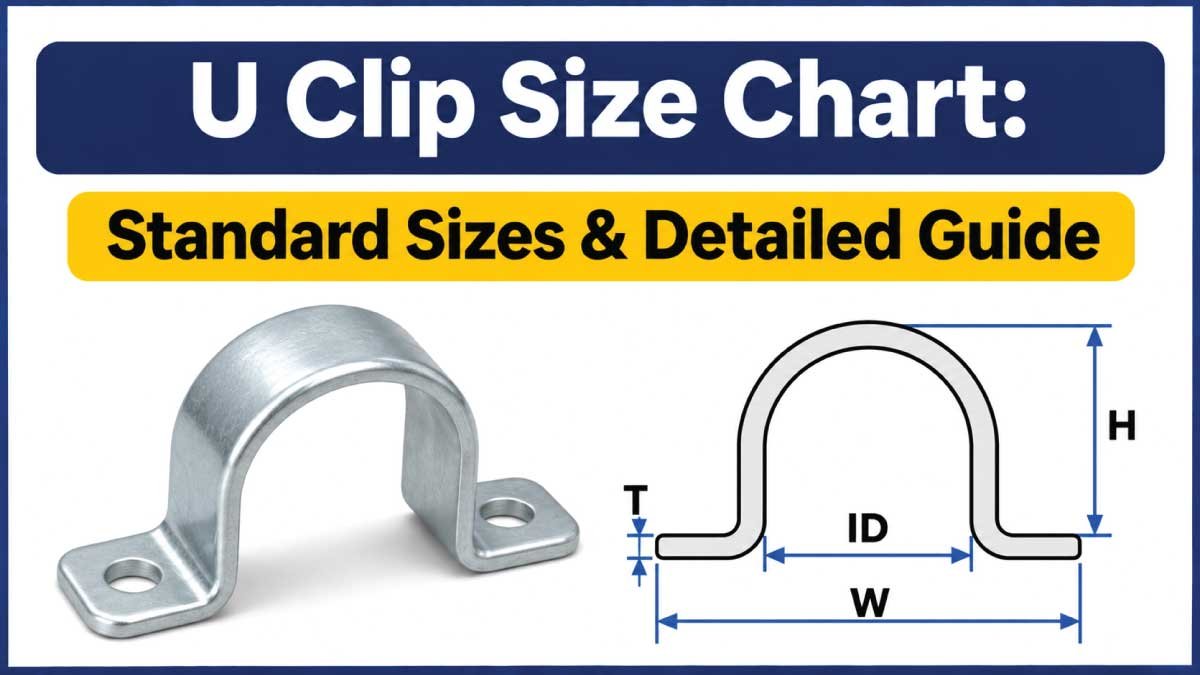
U clips are fastening components designed with a U-shaped profile to hold, secure, or connect different materials. They are commonly used in automotive assemblies, sheet metal fabrication, furniture, electrical enclosures, construction products, and industrial machinery.
Depending on their design, U clips can slide over a panel edge, grip two adjoining components, secure a threaded fastener, or provide a retaining point for a mechanical assembly.
U clips are available in different widths, lengths, material thicknesses, thread sizes, and opening dimensions. Choosing the correct size is important because an undersized clip may not fit the material, while an oversized clip may provide insufficient grip.
This U Clip Size Chart explains common dimensions, clip types, material thicknesses, opening measurements, thread options, and selection considerations. It also covers measurement methods, applications, installation, and common sizing mistakes.
U clips are manufactured in several designs, so their dimensions are not governed by one universal chart. Always identify the clip style and verify its manufacturer’s specifications before purchasing.
What Is a U Clip?
A U clip is a fastening device with a shape resembling the letter U. Its two sides are connected by a curved or flat base, creating an opening that can fit over an edge or component.
Some U clips use spring pressure to grip the material. Others include threaded sections, retaining features, or special mounting arrangements.
Common applications include:
- Automotive body panels.
- Sheet metal assemblies.
- Electrical enclosures.
- Furniture components.
- Plastic covers.
- Industrial machinery.
- Mounting brackets.
- Mechanical fastening systems.
Main Functions of U Clips
- Hold two components together.
- Secure screws or bolts in thin sheet metal.
- Provide a threaded fastening point.
- Grip panel edges.
- Retain removable covers.
- Reduce the need for welded or permanent threaded joints.
- Support quick assembly and maintenance.
U Clip Size Chart: Important Dimensions
The correct U clip size depends on its design and the material it must hold.
Common U Clip Measurements
| Dimension | Description | Abbreviation |
|---|---|---|
| Overall length | Total length of the clip | L |
| Overall width | Width across the clip | W |
| Material thickness | Thickness of the metal | T |
| Inside opening | Distance between the inner sides | IO |
| Outside width | Width across the outer sides | OW |
| Leg length | Length of each side of the U-shaped section | LL |
| Base width | Width of the connecting section | BW |
| Thread size | Size of the threaded hole, if included | — |
| Panel thickness | Thickness of the material being gripped | PT |
| Grip range | Material thickness the clip can accommodate | GR |
Not every U clip includes all these features. For example, a threaded U-nut has different measurement requirements from a simple U-shaped spring clip.
Common U Clip Opening Size Chart
The inside opening is an important measurement for clips that slide over a panel edge or sheet metal.
The following values are illustrative opening-size references, not universal product specifications.
U Clip Opening Reference
| Opening Size (mm) | Approximate Opening (Inches) | General Category |
|---|---|---|
| 0.5 mm | 0.020″ | Extra small |
| 1.0 mm | 0.039″ | Small |
| 1.5 mm | 0.059″ | Small |
| 2.0 mm | 0.079″ | Small to medium |
| 2.5 mm | 0.098″ | Medium |
| 3.0 mm | 0.118″ | Medium |
| 4.0 mm | 0.157″ | Medium to large |
| 5.0 mm | 0.197″ | Large |
| 6.0 mm | 0.236″ | Large |
| 8.0 mm | 0.315″ | Extra large |
| 10.0 mm | 0.394″ | Extra large |
The required opening depends on the material thickness, clip construction, and intended spring action. A clip’s opening should not automatically be matched to the panel thickness without checking its grip range.
U Clip Material Thickness Chart
Material thickness affects the strength, flexibility, and gripping behavior of a metal U clip.
Common Material Thicknesses
| Thickness (mm) | Approximate Thickness (Inches) |
|---|---|
| 0.25 mm | 0.010″ |
| 0.30 mm | 0.012″ |
| 0.40 mm | 0.016″ |
| 0.50 mm | 0.020″ |
| 0.60 mm | 0.024″ |
| 0.80 mm | 0.031″ |
| 1.00 mm | 0.039″ |
| 1.20 mm | 0.047″ |
| 1.50 mm | 0.059″ |
| 2.00 mm | 0.079″ |
| 2.50 mm | 0.098″ |
| 3.00 mm | 0.118″ |
These are general sheet-metal thickness references. Actual U clip products may use other thicknesses depending on their design and load requirements.
Why Material Thickness Matters
Material thickness influences:
- Clip stiffness.
- Spring force.
- Resistance to bending.
- Load capacity.
- Installation force.
- Durability under repeated use.
A thicker clip may provide greater stiffness in a comparable design, but its actual performance also depends on material grade, geometry, heat treatment, and manufacturing quality.
Types of U Clips
U clips are available in different designs for different fastening purposes.
1. U-Nuts
U-nuts are metal fasteners that slide over a panel edge or mounting flange. They provide a threaded hole for a screw or bolt.
They are commonly used in automotive bodywork, appliances, equipment covers, and sheet metal assemblies.
Important dimensions include:
- Panel thickness range.
- Thread size.
- Overall width.
- Clip length.
- Mounting position.
- Material thickness.
2. U-Shaped Spring Clips
These clips use spring pressure to grip a panel, bracket, or other component.
They may be used in removable covers, electrical enclosures, and mechanical assemblies.
3. U-Bolts
A U-bolt is a threaded fastener formed into a U shape, generally with two threaded ends.
It is used to secure pipes, tubes, rods, and other cylindrical components to supporting structures.
U-bolts are not the same as small sheet-metal U clips. They have different dimensions and load requirements.
Important U-bolt measurements include:
- Inside width.
- Inside length.
- Rod diameter.
- Thread size.
- Threaded leg length.
4. U-Clips for Sheet Metal
Sheet metal U clips slide over a metal edge and may provide a fastening point or retaining function.
They are commonly used in automotive panels, electrical boxes, and industrial enclosures.
5. Plastic U Clips
Plastic U clips are used for lightweight fastening and panel retention.
They are available in different shapes and may be manufactured from nylon, polypropylene, or other suitable plastics.
6. Cable and Wire U Clips
These clips are used to guide and secure wires or cables along a surface.
They may be manufactured from plastic or metal, depending on the required support and environmental conditions.
U Clip Type Comparison
| U Clip Type | Main Function | Common Application |
|---|---|---|
| U-nut | Provides threaded fastening | Automotive and sheet metal |
| Spring U clip | Grips or retains components | Equipment covers |
| U-bolt | Secures cylindrical objects | Pipe and structural supports |
| Sheet metal U clip | Attaches to panel edges | Enclosures and body panels |
| Plastic U clip | Lightweight retention | Panels and trim |
| Cable U clip | Holds wires and cables | Electrical installations |
U Clip Thread Size Chart
Some U clips, particularly U-nuts, include threaded holes for screws or bolts.
Thread size must match the fastener being used. Common metric and Unified thread sizes are shown below as a reference.
Common Metric Thread Sizes
| Thread Designation | Nominal Major Diameter |
|---|---|
| M3 | 3 mm |
| M4 | 4 mm |
| M5 | 5 mm |
| M6 | 6 mm |
| M8 | 8 mm |
| M10 | 10 mm |
| M12 | 12 mm |
Common Imperial Thread Sizes
| Thread Designation | Nominal Major Diameter |
|---|---|
| #6 | 0.1380″ |
| #8 | 0.1640″ |
| #10 | 0.1900″ |
| 1/4″ | 0.2500″ |
| 5/16″ | 0.3125″ |
| 3/8″ | 0.3750″ |
These tables show nominal thread diameters only. Thread pitch or threads per inch, thread series, and tolerance must also match.
For example, an M6 threaded U clip must use the correct M6 thread specification rather than an imperial fastener with a similar diameter.
U-Bolt Size Chart: Important Measurements
U-bolts are sometimes included in searches for U clips, but they are a separate fastening category.
A U-bolt is generally selected according to the diameter of the pipe or component it surrounds, the inside width, inside length, rod diameter, and thread specification.
U-Bolt Measurement Reference
| Measurement | Description |
|---|---|
| Rod diameter | Diameter of the U-bolt material |
| Inside width | Distance between the two legs |
| Inside length | Distance from the curved base to the specified leg measurement point |
| Thread size | Nominal diameter and thread specification |
| Thread length | Length of the threaded section |
| Overall width | Outside measurement across the legs |
U-bolt dimensions vary by manufacturer and application. For pipe supports, confirm the required clearance, pipe outside diameter, insulation thickness, and support arrangement.
Read Latest Guide:
U Clip Materials
U clips are manufactured from different materials to provide suitable strength, flexibility, and corrosion resistance.
1. Carbon Steel
Carbon steel U clips are commonly used in general fastening applications.
They may be zinc-plated or receive another surface treatment to improve corrosion resistance.
Typical applications include automotive assemblies, sheet metal fastening, and industrial equipment.
2. Stainless Steel
Stainless steel U clips are selected where corrosion resistance is important.
Different grades provide different mechanical and corrosion properties.
They are used in selected outdoor, industrial, marine-related, and equipment applications.
3. Spring Steel
Spring steel is used when the clip needs to flex and return toward its original shape.
It is common in retaining clips, U-shaped spring fasteners, and panel clips.
4. Nylon
Nylon U clips are lightweight and suitable for selected panel, cable, and equipment applications.
Their performance depends on the specific grade, temperature, moisture exposure, and mechanical requirements.
5. Polypropylene
Polypropylene clips are used in selected lightweight fastening applications.
They may be suitable where moisture resistance and flexibility are required.
Material Comparison
| Material | General Characteristics | Typical Applications |
|---|---|---|
| Carbon steel | General mechanical strength | Sheet metal and industrial fastening |
| Stainless steel | Corrosion resistance depending on grade | Outdoor and industrial equipment |
| Spring steel | Elasticity and retaining force | Spring and panel clips |
| Nylon | Lightweight and flexible | Cables and plastic panels |
| Polypropylene | Lightweight and moisture resistant | Lightweight equipment assemblies |
How to Measure a U Clip
Accurate measurement helps identify the correct replacement and avoid installation problems.
Step 1: Identify the U Clip Type
Determine whether you have a U-nut, spring clip, sheet metal clip, plastic clip, or U-bolt.
The measurement method depends on the design.
Step 2: Measure the Inside Opening
Use a caliper to measure the space between the two inner sides of the clip.
For a panel-edge clip, compare this opening with the panel thickness and the manufacturer’s grip range.
Step 3: Measure the Material Thickness
Measure the thickness of the metal or plastic material.
For a wire-form design, measure the wire diameter instead.
Step 4: Measure Overall Length
Measure from one end of the clip to the other.
For a U-bolt, follow the manufacturer’s stated measurement convention.
Step 5: Measure Overall Width
Record the widest dimension across the clip.
Step 6: Check the Thread Size
If the clip has a threaded hole, identify the nominal diameter and thread specification.
Step 7: Check the Panel or Component
Measure the material the clip must grip or the component it must secure.
Step 8: Confirm the Product Specification
Compare the measurements with the manufacturer’s drawing, including tolerances and installation requirements.
Read Latest Guide:
How to Choose the Correct U Clip Size
Choosing the correct U clip requires checking the clip design and the material being fastened.
1. Determine the Application
Identify whether the clip will secure sheet metal, a panel, a cable, a pipe, or another component.
2. Measure the Material Thickness
For clips that slide over an edge, measure the thickness of the panel or mounting flange.
3. Confirm the Opening Size
Check the clip’s opening and specified grip range.
4. Select the Correct Thread
For U-nuts, match the thread diameter, pitch, and series to the intended screw or bolt.
5. Check the Clip Dimensions
Verify the overall width, length, leg dimensions, and material thickness.
6. Choose a Suitable Material
Consider corrosion exposure, temperature, vibration, and mechanical loading.
7. Verify the Installation Method
Confirm whether the clip slides over an edge, snaps into a mounting position, or requires a bolt or screw.
Read Latest Guide:
U Clip Applications
U clips are used in different industries because they provide compact and convenient fastening solutions.
Automotive Industry
U-nuts and other U-shaped clips are used to provide fastening points for body panels, trim, brackets, and covers.
Sheet Metal Manufacturing
U clips are used to join thin sheet metal components and provide threaded mounting points.
Electrical Enclosures
They can secure covers, panels, and selected mounting components.
Furniture Manufacturing
Some U-shaped fasteners are used to connect or retain furniture panels and metal brackets.
Industrial Machinery
U clips may secure guards, removable covers, and mechanical components.
Plumbing and Pipe Supports
U-bolts are used in suitable pipe support arrangements to hold pipes and tubes in position.
Common U Clip Sizing Mistakes
Incorrect sizing can result in loose fittings, damaged panels, or fastener failure.
Avoid these common mistakes:
- Confusing U clips with U-bolts: They are different fastener types with different sizing systems.
- Ignoring opening width: The clip may not fit the panel or mounting flange.
- Selecting the wrong material thickness: This can affect grip and installation.
- Ignoring grip range: The clip may be too loose or difficult to install.
- Using the wrong thread size: The screw or bolt may not engage correctly.
- Ignoring thread pitch: Similar thread diameters do not guarantee compatibility.
- Choosing by appearance alone: Different clips can look similar but have different dimensions.
- Ignoring corrosion resistance: The material may deteriorate in the operating environment.
- Forcing an oversized clip: This can damage the panel or mounting edge.
- Using a damaged clip: Bent or cracked clips may not retain components reliably.
Frequently Asked Questions
1. What is a U clip used for?
A U clip is used to fasten, retain, or connect components. Common applications include automotive panels, sheet metal assemblies, electrical enclosures, and industrial equipment.
2. How do I measure a U clip?
Measure its inside opening, overall width, overall length, and material thickness. If the clip has a threaded hole, also identify its thread diameter and pitch.
3. What is a U-nut?
A U-nut is a threaded metal clip that slides over a panel edge or mounting flange. It provides a threaded fastening point for a screw or bolt.
4. What is the difference between a U clip and a U-bolt?
A U clip is generally a small fastening or retaining component. A U-bolt is a U-shaped threaded fastener commonly used to secure pipes, rods, and cylindrical objects.
5. Are U clips available in stainless steel?
Yes. Stainless steel U clips are available for applications where corrosion resistance is important. The correct grade depends on the operating environment and mechanical requirements.
6. What thread sizes are available for U-nuts?
U-nuts are available in different metric and imperial thread sizes, including common options such as M4, M5, M6, M8, #8, #10, and 1/4 inch. Availability depends on the manufacturer and product series.
7. Can U clips be reused?
Some U clips can be reused if they remain undamaged and the manufacturer permits reuse. Replace clips that are bent, cracked, corroded, or have lost their retaining properties.
8. How do I select a U clip for sheet metal?
Measure the sheet thickness, check the clip opening and grip range, identify any required thread size, and confirm the clip material and dimensions.
9. What material is best for U clips?
Carbon steel is common for general fastening, spring steel for elastic retaining applications, and stainless steel for corrosion-exposed environments. The correct material depends on the intended use.
10. Are all U clips the same size?
No. U clips come in different shapes, lengths, widths, openings, thicknesses, and thread configurations. Always identify the clip type and check its dimensional drawing.
Conclusion
A U Clip Size Chart helps compare important dimensions such as inside opening, overall width, length, material thickness, and thread size. However, the correct measurements depend on whether the product is a U-nut, spring clip, sheet metal clip, plastic clip, or U-bolt.
Before purchasing, identify the clip type and measure the component it must secure. Confirm the opening, grip range, material, and thread specifications against the manufacturer’s technical drawing. Correct sizing helps provide secure fastening and reduces installation problems.