
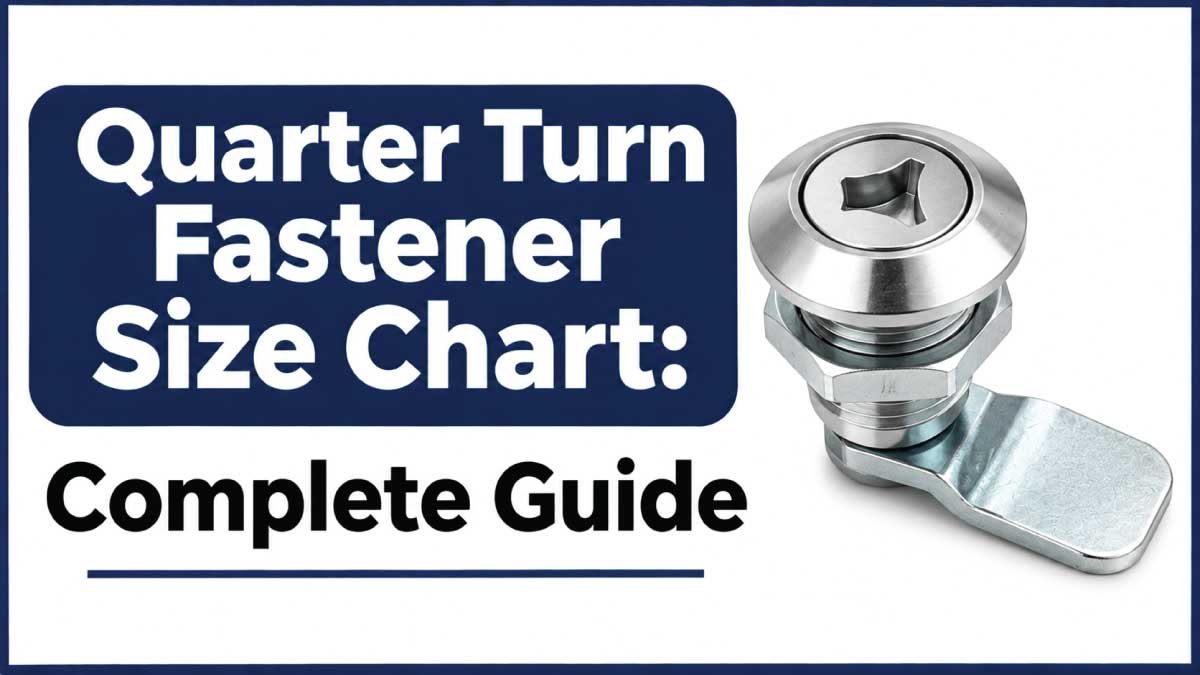
Quarter-turn fasteners are quick-release fastening components designed to secure panels, covers, access doors, and removable equipment sections. They lock or release through a short rotational movement, typically around 90 degrees or one-quarter of a full turn.
These fasteners are commonly used in automotive assemblies, aircraft panels, industrial machinery, electrical enclosures, access covers, and equipment housings. They are especially useful where frequent access is required without completely removing a conventional screw or bolt.
Choosing the correct quarter-turn fastener size is important for proper engagement, secure panel retention, and easy operation. The fastener must match the panel thickness, mounting hole, stud length, receptacle, and required grip range.
This Quarter Turn Fastener Size Chart explains important dimensions, common stud sizes, panel thickness considerations, fastener types, materials, measurement methods, and selection guidelines.
Quarter-turn fasteners are available in several proprietary designs. Their dimensions are not covered by one universal size chart, so always check the manufacturer’s technical drawing before selecting a replacement.
What Is a Quarter-Turn Fastener?
A quarter-turn fastener is a mechanical fastening device that locks or releases through approximately 90 degrees of rotation.
It generally consists of a stud or pin and a compatible receptacle. Turning the stud engages a locking feature inside the receptacle, holding the panel against its supporting structure.
Depending on the design, the fastener may use a spring-loaded stud, cam mechanism, retaining pin, or another locking arrangement.
Common components include:
- Fastener stud.
- Receptacle or socket.
- Retaining washer.
- Spring mechanism.
- Locking pin or cam.
- Head or operating drive.
- Panel mounting hardware.
Some designs use captive studs that remain attached to the panel when released. This helps prevent hardware from being lost during maintenance.
Quarter Turn Fastener Size Chart: Important Dimensions
The dimensions of a quarter-turn fastener depend on its design and mounting arrangement.
Main Quarter-Turn Fastener Measurements
| Dimension | Description | Abbreviation |
|---|---|---|
| Stud diameter | Diameter of the main fastening stud | SD |
| Stud length | Specified length of the stud | SL |
| Head diameter | Width across the fastener head | HD |
| Head height | Height of the operating head | HH |
| Panel thickness | Thickness of the panel being secured | PT |
| Grip range | Panel thickness range supported by the fastener | GR |
| Mounting hole diameter | Required installation-hole diameter | MHD |
| Receptacle diameter | Diameter of the receiving component | RD |
| Receptacle depth | Depth of the receiving component | RDep |
| Locking rotation | Rotation needed to engage or release the fastener | — |
Not every quarter-turn fastener uses all these dimensions. Some designs also require measurements for the spring, retaining washer, cam, or locking pin.
Quarter Turn Fastener Stud Diameter Chart
Stud diameter is one of the important measurements when identifying a replacement fastener.
The following values are nominal diameter references for common metric and imperial fastening sizes. They are not a universal list of quarter-turn product sizes.
Metric Diameter Reference
| Nominal Size | Diameter (mm) | Approximate Diameter (Inches) |
|---|---|---|
| M3 | 3 mm | 0.118″ |
| M4 | 4 mm | 0.157″ |
| M5 | 5 mm | 0.197″ |
| M6 | 6 mm | 0.236″ |
| M8 | 8 mm | 0.315″ |
| M10 | 10 mm | 0.394″ |
Imperial Diameter Reference
| Nominal Diameter | Diameter (Inches) | Approximate Diameter (mm) |
|---|---|---|
| 1/8″ | 0.125″ | 3.18 mm |
| 3/16″ | 0.1875″ | 4.76 mm |
| 1/4″ | 0.250″ | 6.35 mm |
| 5/16″ | 0.3125″ | 7.94 mm |
| 3/8″ | 0.375″ | 9.53 mm |
A quarter-turn stud does not necessarily use a standard machine-screw thread. Its diameter and locking geometry must match the intended receptacle and fastener series.
Quarter Turn Fastener Panel Thickness Chart
Panel thickness is an important selection factor because the fastener must reach and engage the receptacle correctly.
The required stud length depends on the complete installation arrangement, including the panel, supporting structure, receptacle position, and any washers or spacers.
Common Panel Thickness References
| Panel Thickness (mm) | Approximate Thickness (Inches) |
|---|---|
| 0.5 mm | 0.020″ |
| 0.8 mm | 0.031″ |
| 1.0 mm | 0.039″ |
| 1.2 mm | 0.047″ |
| 1.5 mm | 0.059″ |
| 2.0 mm | 0.079″ |
| 2.5 mm | 0.098″ |
| 3.0 mm | 0.118″ |
| 4.0 mm | 0.157″ |
| 5.0 mm | 0.197″ |
| 6.0 mm | 0.236″ |
| 8.0 mm | 0.315″ |
| 10.0 mm | 0.394″ |
These values are general material-thickness references, not guaranteed compatible grip ranges for quarter-turn fasteners.
Understanding Grip Range
Grip range describes the thickness of material that a particular fastener and receptacle arrangement can accommodate.
For quarter-turn fasteners, the specified grip range helps determine whether the stud can engage correctly and hold the panel securely.
An unsuitable grip range can cause several problems:
- The stud may not reach the receptacle.
- The locking mechanism may fail to engage.
- The panel may remain loose.
- Excessive pressure may be applied to the panel.
- The fastener may become difficult to release.
Always check the manufacturer’s grip-range specification instead of selecting a stud based only on overall length.
Quarter Turn Fastener Stud Length
Stud length determines how far the fastener extends toward the receptacle.
However, stud length is not measured identically across all quarter-turn product families. Some manufacturers specify the length from beneath the head, while others use a different reference point.
Important Stud Length Considerations
| Measurement | Why It Matters |
|---|---|
| Stud length | Determines the fastener’s reach |
| Panel thickness | Adds to the required grip distance |
| Receptacle position | Determines where the stud engages |
| Washer thickness | Changes the effective installed length |
| Spacer thickness | Adds to the complete material stack |
| Locking geometry | Determines whether the stud can engage correctly |
A longer stud is not automatically a better choice. It must be compatible with the receptacle and the manufacturer’s specified grip range.
Types of Quarter-Turn Fasteners
Quarter-turn fasteners are available in several designs for different installation and operating requirements.
1. Dzus-Style Fasteners
Dzus-style fasteners are quick-release fasteners commonly used in vehicle panels, racing applications, aircraft-related equipment, and removable covers.
They generally use a stud that engages a compatible spring receptacle through a short rotational movement.
Important selection dimensions include stud length, stud diameter, head style, grip range, and receptacle compatibility.
2. Cam-Action Quarter-Turn Fasteners
Cam-action fasteners use a rotating cam or locking feature to secure a panel.
The rotation moves the cam into a retaining position, holding the panel against its supporting structure.
They are used in equipment enclosures, machinery covers, and access panels.
3. Spring-Loaded Quarter-Turn Fasteners
Spring-loaded designs use a spring mechanism to support engagement, retention, or release.
They are commonly used where quick access and repeated operation are required.
4. Captive Quarter-Turn Fasteners
Captive quarter-turn fasteners remain attached to the panel when unlocked.
This reduces the risk of losing the fastener during inspection or maintenance.
5. Tool-Operated Quarter-Turn Fasteners
These fasteners use a screwdriver, special key, or other operating tool.
They are selected when a controlled locking mechanism or restricted access is required.
6. Hand-Operated Quarter-Turn Fasteners
Hand-operated versions use a knob, wing, or specially shaped head.
They are useful for applications where frequent access is needed without a separate tool.
Quarter-Turn Fastener Type Comparison
| Fastener Type | Main Feature | Common Application |
|---|---|---|
| Dzus-style | Quick-release stud and receptacle | Vehicle panels and removable covers |
| Cam-action | Rotating cam mechanism | Machinery and enclosures |
| Spring-loaded | Spring-assisted operation | Repeated-access panels |
| Captive | Remains attached to the panel | Equipment maintenance |
| Tool-operated | Requires an operating tool | Controlled-access covers |
| Hand-operated | Designed for manual operation | Frequently opened panels |
Quarter Turn Fastener Head Types
The head design determines how the fastener is operated and how it fits against the panel surface.
Common Head Styles
| Head Type | General Characteristics | Typical Application |
|---|---|---|
| Slotted head | Uses a straight screwdriver | General quick-release fastening |
| Phillips head | Uses a cross-head screwdriver | Equipment panels |
| Hex head | Uses a hexagonal tool | Mechanical assemblies |
| Knurled head | Textured surface for hand operation | Tool-free access |
| Wing head | Provides a hand-grip feature | Frequently accessed covers |
| Flush head | Designed for a low-profile surface | Panels with limited clearance |
The available head styles depend on the fastener series. Head diameter and height should be checked against the manufacturer’s drawing.
Quarter Turn Fastener Receptacle Types
The receptacle is the receiving component that engages the fastener stud.
Selecting a compatible receptacle is essential because the stud and receptacle are designed to work as a matched system.
1. Spring Receptacles
Spring receptacles use an elastic retaining feature to hold the stud in its locked position.
They are commonly used with suitable quick-release stud designs.
2. Fixed Receptacles
Fixed receptacles attach to a supporting structure and provide the receiving point for the stud.
Their mounting dimensions and position must match the fastener arrangement.
3. Floating Receptacles
Floating receptacles allow a limited amount of movement to help accommodate alignment differences.
They are used in selected assemblies where panel positioning may vary.
4. Wire-Form Receptacles
Wire-form receptacles use a formed spring-wire structure to engage the stud.
They are available in designs intended for specific fastener families.
Do not assume that receptacles from different manufacturers or product families are interchangeable. Confirm compatibility using the manufacturer’s part numbers and installation drawings.
Read Latest Guide:
Quarter Turn Fastener Materials
Material selection affects strength, corrosion resistance, weight, and service life.
1. Stainless Steel
Stainless steel is used where corrosion resistance is important.
It is common in industrial equipment, outdoor assemblies, and selected transportation applications.
The appropriate grade depends on the operating environment and mechanical requirements.
2. Carbon Steel
Carbon steel fasteners provide general mechanical strength.
They may receive zinc plating or another protective coating to improve corrosion resistance.
3. Aluminum
Aluminum is used in lightweight fastener designs and selected equipment assemblies.
Its suitability depends on the required strength and surrounding materials.
4. Spring Steel
Spring steel is commonly used in spring-loaded studs and receptacles because of its elastic properties.
5. Brass
Brass is used in selected fastening components where its material properties and corrosion behavior are suitable.
Read Latest Guide:
Material Comparison
| Material | General Characteristics | Common Applications |
|---|---|---|
| Stainless steel | Corrosion resistance varies by grade | Outdoor and industrial equipment |
| Carbon steel | General mechanical strength | Machinery and vehicle panels |
| Aluminum | Lightweight | Lightweight assemblies |
| Spring steel | Elastic retaining properties | Studs and spring receptacles |
| Brass | Suitable for selected corrosion and electrical applications | Specialized equipment |
How to Measure a Quarter-Turn Fastener
Accurate measurements help identify the correct replacement and ensure compatibility with the existing receptacle.
Step 1: Identify the Fastener Series
Determine the manufacturer and product family if possible.
Quarter-turn fasteners can have similar appearances but different locking mechanisms and dimensions.
Step 2: Measure the Stud Diameter
Use a caliper to measure the diameter of the stud.
Do not confuse the stud diameter with the head diameter.
Step 3: Measure the Stud Length
Record the length using the manufacturer’s specified measurement reference.
If the original technical drawing is unavailable, note exactly where the measurement begins and ends.
Step 4: Measure Panel Thickness
Measure the complete panel thickness that the fastener must secure.
Include additional layers, washers, or spacers where applicable.
Step 5: Check the Mounting Hole
Measure the required mounting-hole diameter and inspect its shape.
Some designs require a special hole profile rather than a simple round opening.
Step 6: Measure the Head
Record the head diameter, height, and operating style.
Step 7: Identify the Receptacle
Check the receptacle type, mounting arrangement, and compatibility with the stud.
Step 8: Confirm the Grip Range
Compare the complete installation stack with the manufacturer’s grip-range specification.
Step 9: Review the Technical Drawing
Verify all dimensions, tolerances, materials, and installation instructions before ordering.
Read Latest Guide:
How to Choose the Correct Quarter-Turn Fastener Size
Selecting the correct fastener requires matching the stud, receptacle, and panel arrangement.
1. Identify the Application
Determine whether the fastener will be used on an access panel, vehicle body, machine cover, or electrical enclosure.
2. Check Panel Thickness
Measure the complete material stack that the fastener must hold.
3. Select the Correct Stud Length
Use the manufacturer’s grip-range information to choose a suitable stud length.
4. Match the Receptacle
Confirm that the receptacle is designed for the selected stud family.
5. Verify the Mounting Hole
Check the hole diameter, shape, and tolerance.
6. Consider Operating Conditions
Account for vibration, temperature, moisture, dust, and other environmental factors.
7. Choose the Head Style
Select a head that provides the required operating access and clearance.
8. Confirm Material Compatibility
Choose a suitable material and finish for the application.
9. Check Locking and Release Operation
The fastener should engage and release according to its manufacturer’s instructions without excessive force.
Quarter-Turn Fastener Applications
Quarter-turn fasteners are used where panels need to be secured and accessed quickly.
Automotive Industry
They are used on removable body panels, racing vehicle covers, service panels, and selected engine-compartment components.
Aerospace and Aviation
Specialized quarter-turn fasteners are used in approved panel and access-cover assemblies where quick maintenance access is required.
These applications must follow the relevant engineering and approved component specifications.
Industrial Machinery
They secure machine guards, inspection covers, equipment housings, and removable access panels.
Electrical Enclosures
Quarter-turn fasteners can secure cabinet doors and removable electrical enclosure covers.
The selected design must suit the enclosure’s sealing, safety, and access requirements.
Transportation Equipment
They may be used on selected removable panels in buses, trucks, trailers, and other transportation equipment.
Appliances and Equipment Covers
Some equipment manufacturers use quick-release fasteners to simplify inspection, servicing, and component replacement.
Common Quarter-Turn Fastener Sizing Mistakes
Incorrect selection can result in loose panels, incomplete engagement, or damaged fastening components.
Avoid these common mistakes:
- Ignoring grip range: The stud may not engage correctly with the receptacle.
- Choosing by appearance alone: Similar-looking fasteners may use different locking systems.
- Using an incompatible receptacle: The stud may not lock securely.
- Measuring the head instead of the stud: These are different dimensions.
- Ignoring panel thickness: The fastener may be too short or too long for the installation.
- Using the wrong mounting hole: The fastener may not fit correctly.
- Ignoring locking rotation: Some product designs have different operating requirements.
- Overlooking vibration: The selected design must suit the operating environment.
- Mixing product families: Studs and receptacles from different series may not be compatible.
- Ignoring material requirements: Corrosion and environmental exposure can affect service life.
Frequently Asked Questions
1. What is a quarter-turn fastener used for?
A quarter-turn fastener secures removable panels, access covers, doors, and equipment enclosures. It provides quick locking and release through a short rotational movement.
2. Why is it called a quarter-turn fastener?
It is called a quarter-turn fastener because its locking mechanism generally engages or releases through approximately 90 degrees of rotation.
3. How do I measure a quarter-turn fastener?
Measure the stud diameter, stud length, head dimensions, panel thickness, and mounting-hole size. Also identify the receptacle type and required grip range.
4. What is the grip range of a quarter-turn fastener?
Grip range is the panel thickness range that a particular fastener and receptacle arrangement can accommodate while maintaining proper engagement.
5. Are quarter-turn fasteners available in different materials?
Yes. They are available in materials such as stainless steel, carbon steel, aluminum, spring steel, and brass, depending on the product design.
6. What is a Dzus-style fastener?
A Dzus-style fastener is a type of quick-release fastener that uses a stud and compatible spring receptacle to secure removable panels.
7. Are quarter-turn fasteners universal?
No. Different fastener families use different stud dimensions, locking features, receptacles, and mounting arrangements. Compatibility must be confirmed before replacement.
8. Can quarter-turn fasteners be reused?
Many quarter-turn fasteners are designed for repeated operation. However, damaged studs, worn receptacles, weakened springs, or deformed locking features should be replaced.
9. What is the difference between a quarter-turn fastener and a regular screw?
A regular screw generally uses multiple rotations to tighten or loosen a threaded joint. A quarter-turn fastener uses a locking mechanism that engages or releases through a short rotational movement.
10. Do quarter-turn fasteners require special tools?
Some designs use standard screwdrivers or other common tools, while others use special keys or hand-operated heads. The required operating method depends on the product.
Conclusion
A Quarter Turn Fastener Size Chart helps identify the important measurements required for selecting a suitable quick-release fastener. These include stud diameter, stud length, panel thickness, grip range, mounting-hole dimensions, head size, and receptacle compatibility.
The correct fastener must match the complete installation arrangement rather than just one measurement. Before purchasing, identify the fastener series, measure the panel and existing hardware, and compare the results with the manufacturer’s technical drawing. Proper selection helps provide reliable locking, convenient access, and dependable panel retention.