
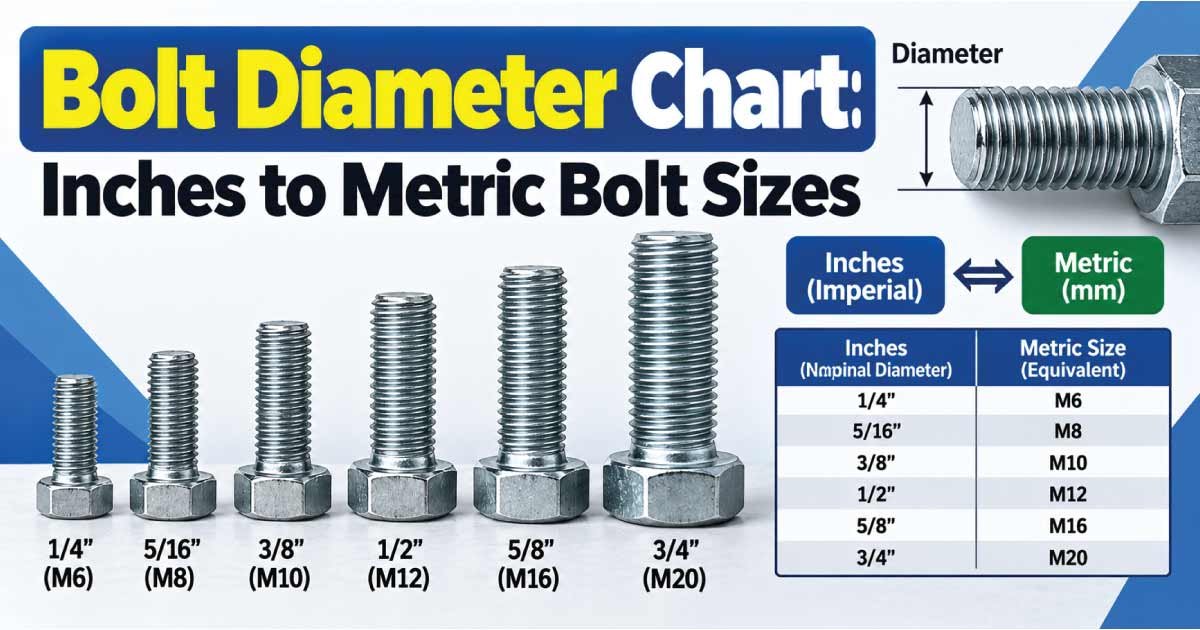
Bolt diameter is one of the most important measurements when selecting a fastener. Choosing the wrong diameter can lead to poor thread engagement, loose joints, installation problems, or a bolt that simply will not fit the intended hole or nut.
A bolt diameter chart makes it easier to compare common inch and metric sizes, understand nominal diameters, and identify the closest equivalent size. This guide covers standard bolt diameters in inches and millimeters, explains how bolt diameter is measured, and shows why inch-to-metric conversions are not always exact.
Whether you are replacing a missing fastener, selecting hardware for a repair, drilling a hole, or comparing SAE and metric bolt sizes, the charts below provide a practical starting point.
Bolt Diameter Chart: Inches to Metric
The following chart compares commonly encountered inch bolt diameters with their metric dimensions. The metric values are mathematical conversions of the nominal inch diameter and should not be interpreted as interchangeable fastener sizes.
| Inch Diameter | Decimal Diameter (in) | Equivalent Diameter (mm) | Common Identification |
|---|---|---|---|
| 1/4 in | 0.250 | 6.35 mm | 1/4 |
| 5/16 in | 0.3125 | 7.94 mm | 5/16 |
| 3/8 in | 0.375 | 9.53 mm | 3/8 |
| 7/16 in | 0.4375 | 11.11 mm | 7/16 |
| 1/2 in | 0.500 | 12.70 mm | 1/2 |
| 9/16 in | 0.5625 | 14.29 mm | 9/16 |
| 5/8 in | 0.625 | 15.88 mm | 5/8 |
| 3/4 in | 0.750 | 19.05 mm | 3/4 |
| 7/8 in | 0.875 | 22.23 mm | 7/8 |
| 1 in | 1.000 | 25.40 mm | 1 |
| 1-1/8 in | 1.125 | 28.58 mm | 1-1/8 |
| 1-1/4 in | 1.250 | 31.75 mm | 1-1/4 |
| 1-3/8 in | 1.375 | 34.93 mm | 1-3/8 |
| 1-1/2 in | 1.500 | 38.10 mm | 1-1/2 |
The equivalent diameter in millimeters is calculated by multiplying the inch measurement by 25.4. For example, a 1/2-inch bolt has a nominal diameter of 12.7 mm.
However, a 1/2-inch bolt should not automatically be replaced with an M12 bolt simply because their diameters are relatively close. Their thread systems are different, and the threads may not engage correctly.
Common Metric Bolt Diameter Chart
Metric bolts are normally identified by the letter M followed by their nominal diameter in millimeters. For example, M8 indicates a metric bolt with a nominal major diameter of approximately 8 mm.
| Metric Bolt Size | Nominal Diameter (mm) | Diameter (in) | Typical Use Category |
|---|---|---|---|
| M4 | 4 mm | 0.1575 in | Small hardware |
| M5 | 5 mm | 0.1969 in | Light-duty assemblies |
| M6 | 6 mm | 0.2362 in | General hardware |
| M8 | 8 mm | 0.3150 in | General mechanical work |
| M10 | 10 mm | 0.3937 in | Medium-duty applications |
| M12 | 12 mm | 0.4724 in | Heavy-duty assemblies |
| M14 | 14 mm | 0.5512 in | Structural/mechanical work |
| M16 | 16 mm | 0.6299 in | Heavy-duty applications |
| M18 | 18 mm | 0.7087 in | Large mechanical assemblies |
| M20 | 20 mm | 0.7874 in | Heavy machinery |
| M22 | 22 mm | 0.8661 in | Large assemblies |
| M24 | 24 mm | 0.9449 in | Heavy structural work |
| M27 | 27 mm | 1.0630 in | Large structural applications |
| M30 | 30 mm | 1.1811 in | Heavy-duty construction |
These values represent nominal bolt diameter, not necessarily the diameter measured at every point of the fastener.
Metric sizes are particularly common in machinery, automotive equipment, industrial assemblies, construction hardware, and products manufactured according to metric standards.
Inch vs Metric Bolt Diameter Comparison
One of the most common reasons people search for a bolt diameter conversion chart is to determine whether an inch bolt is close to a metric bolt.
The following comparison shows some frequently encountered sizes.
| Inch Size | Inch Diameter (mm) | Closest Common Metric Diameter | Metric Diameter (mm) | Difference (mm) |
|---|---|---|---|---|
| 1/4 in | 6.35 | M6 | 6 | 0.35 |
| 5/16 in | 7.94 | M8 | 8 | 0.06 |
| 3/8 in | 9.53 | M10 | 10 | 0.47 |
| 7/16 in | 11.11 | M12 | 12 | 0.89 |
| 1/2 in | 12.70 | M12 | 12 | 0.70 |
| 9/16 in | 14.29 | M14 | 14 | 0.29 |
| 5/8 in | 15.88 | M16 | 16 | 0.12 |
| 3/4 in | 19.05 | M20 | 20 | 0.95 |
| 7/8 in | 22.23 | M22 | 22 | 0.23 |
| 1 in | 25.40 | M24 | 24 | 1.40 |
| 1-1/8 in | 28.58 | M30 | 30 | 1.42 |
| 1-1/4 in | 31.75 | M30 | 30 | 1.75 |
| 1-1/2 in | 38.10 | — | — | — |
This table is useful for size comparison, but not as a guide for directly substituting one thread system for another.
For example, 5/16 inch and M8 are extremely close in nominal diameter, but their thread dimensions can still differ. A threaded hole designed for one should not be assumed to accept the other safely.
What Does Bolt Diameter Mean?
Bolt diameter generally refers to the nominal outside diameter of the bolt’s threaded portion. In a standard external thread, this is closely associated with the major diameter.
The nominal diameter is used to identify the fastener size.
For example:
- A 1/2-inch bolt has a nominal diameter of 1/2 inch.
- An M10 bolt has a nominal diameter of 10 mm.
- An M16 bolt has a nominal diameter of 16 mm.
- A 3/4-inch bolt has a nominal diameter of 0.75 inch.
Actual measured dimensions can vary slightly because of manufacturing tolerances and thread geometry.
It is therefore important to distinguish between nominal diameter, actual measured diameter, thread pitch, and thread form.
How to Measure Bolt Diameter
If you have an unidentified bolt, measuring its diameter is relatively straightforward.
1. Measure Across the Threads
Use a caliper to measure across the outside of the threaded section. Place the jaws over the largest diameter of the threads without forcing them into the thread valleys.
For a quick identification, you can also use a bolt gauge or thread identification tool.
2. Record the Measurement
If your caliper gives a reading close to 12.7 mm, for example, the bolt may be a nominal 1/2-inch bolt.
If the measurement is close to 12 mm, it may be an M12 metric bolt.
Do not rely on diameter alone when the measurement is close to multiple sizes.
3. Check the Thread Pitch
After measuring diameter, determine the thread pitch.
Metric threads are generally identified by pitch in millimeters, such as:
M10 × 1.5
Here:
- M10 = nominal diameter of 10 mm
- 1.5 = thread pitch of 1.5 mm
Inch threads are commonly specified by threads per inch (TPI).
For example:
1/2-13
means:
- 1/2 inch = nominal diameter
- 13 = 13 threads per inch
4. Check the Thread Form
Diameter and pitch alone may not tell the complete story. Thread standards and forms also matter.
Common systems include:
- UNC — Unified National Coarse
- UNF — Unified National Fine
- Metric coarse thread
- Metric fine thread
Correct identification requires matching the complete thread specification.
How to Convert Bolt Diameter From Inches to Millimeters
The basic conversion is simple:
1 inch = 25.4 millimeters
Therefore:
Diameter in mm = Diameter in inches × 25.4
For example, converting a 3/8-inch bolt:
0.375 × 25.4 = 9.525 mm
So a 3/8-inch bolt has a nominal diameter of 9.525 mm, commonly rounded to 9.53 mm for comparison purposes.
For 5/8 inch:
0.625 × 25.4 = 15.875 mm
Therefore, a 5/8-inch bolt has a nominal diameter of approximately 15.88 mm.
Inches to Millimeters Quick Reference
| Inches | Millimeters |
|---|---|
| 1/8 in | 3.175 mm |
| 3/16 in | 4.763 mm |
| 1/4 in | 6.350 mm |
| 5/16 in | 7.938 mm |
| 3/8 in | 9.525 mm |
| 7/16 in | 11.113 mm |
| 1/2 in | 12.700 mm |
| 9/16 in | 14.288 mm |
| 5/8 in | 15.875 mm |
| 11/16 in | 17.463 mm |
| 3/4 in | 19.050 mm |
| 7/8 in | 22.225 mm |
| 1 in | 25.400 mm |
These are direct mathematical conversions of inch measurements.
Also Read:
Why Inch and Metric Bolts Are Not Interchangeable
A common mistake is assuming that two bolts can be substituted because their diameters are nearly identical.
The diameter is only one part of the fastener specification.
Thread Pitch Is Critical
A metric bolt uses a metric pitch, while an inch fastener is generally specified by threads per inch. Even when their diameters are close, the threads can have different spacing and geometry.
For instance, M8 and 5/16 inch are very close in diameter, but they are not automatically interchangeable.
Forcing a bolt into a mismatched nut or threaded hole can damage the threads and compromise the connection.
Thread Standard Matters
Two bolts with similar diameters may have different thread standards.
For inch fasteners, you may encounter:
- UNC
- UNF
- UNEF
- Other specialized Unified thread specifications
For metric fasteners, coarse and fine pitches are common.
Always identify the complete fastener specification before substitution.
Nominal Diameter vs Actual Bolt Diameter
The number printed or stated for a bolt generally represents its nominal size.
It does not mean every part of the bolt measures exactly that dimension.
Threads have a defined profile containing:
- Major diameter
- Minor diameter
- Pitch diameter
- Thread crest
- Thread root
- Thread flank
The major diameter is associated with the largest diameter of the external thread. The nominal diameter provides the convenient size designation used for ordering and identifying the fastener.
Manufacturing tolerances mean the actual measurement may differ slightly from the nominal value.
This is why a caliper measurement should be interpreted alongside the bolt’s thread pitch and standard.
Also Read:
Bolt Diameter and Thread Pitch
Diameter and pitch should be considered together when identifying a threaded fastener.
A specification such as M12 × 1.75 provides substantially more information than simply saying M12.
The first number indicates the nominal diameter. The second indicates thread pitch.
| Example | Diameter | Pitch/TPI | System |
|---|---|---|---|
| M6 × 1.0 | 6 mm | 1.0 mm pitch | Metric |
| M8 × 1.25 | 8 mm | 1.25 mm pitch | Metric |
| M10 × 1.5 | 10 mm | 1.5 mm pitch | Metric |
| M12 × 1.75 | 12 mm | 1.75 mm pitch | Metric |
| 1/4-20 | 1/4 in | 20 TPI | Inch |
| 5/16-18 | 5/16 in | 18 TPI | Inch |
| 3/8-16 | 3/8 in | 16 TPI | Inch |
| 1/2-13 | 1/2 in | 13 TPI | Inch |
The exact thread designation should be verified against the applicable fastener standard or manufacturer’s specifications.
How to Choose the Correct Bolt Diameter
Selecting a bolt should involve more than finding a diameter that appears to fit.
Consider the following factors.
1. Match the Existing Thread
If you are replacing a bolt in an existing threaded hole, identify the diameter and thread pitch before purchasing the replacement.
2. Consider the Required Strength
Diameter affects the cross-sectional area available to carry load, but bolt strength also depends on the material, grade or property class, thread engagement, loading conditions, and joint design.
Do not select a larger or smaller bolt solely based on appearance.
3. Check the Hole Size
For a clearance hole, the hole normally needs to be appropriately sized for the selected fastener. The required clearance depends on the application and relevant standard.
For a tapped hole, the drilled hole must correspond to the required thread and tapping specification.
4. Check Bolt Length Separately
Diameter does not determine bolt length.
A bolt is specified using multiple dimensions, including diameter and length. A bolt can have the correct diameter but still be too short or excessively long for the joint.
5. Match the Fastener Standard
If the original assembly uses a particular standard, grade, coating, or material, replacing it with a random bolt of similar diameter may not provide equivalent performance.
Also Read:
Common Bolt Diameter Mistakes
Incorrect fastener selection often comes from confusing measurements that look similar.
Mistake 1: Treating Close Sizes as Identical
M8 and 5/16 inch are close in diameter, but that does not make them interchangeable.
Mistake 2: Measuring the Bolt Head Instead of the Thread
The wrench size across the bolt head is not the bolt diameter.
A bolt may have a particular hex-head size while having a completely different nominal thread diameter.
Mistake 3: Ignoring Thread Pitch
A correct diameter with the wrong pitch can still be the wrong fastener.
Mistake 4: Confusing Diameter With Length
A specification such as M10 × 50 identifies a 10 mm nominal diameter and 50 mm nominal length. The two dimensions describe different characteristics.
Mistake 5: Assuming Every Metric Bolt Has the Same Pitch
Metric bolt diameters can be available with different thread pitches. Always verify the complete designation.
Bolt Diameter vs Bolt Length
Diameter and length are two separate dimensions.
Bolt diameter identifies the nominal thickness of the threaded fastener, while bolt length identifies how far the bolt extends according to the applicable measurement convention.
For example:
M12 × 60
generally indicates:
- M = metric thread
- 12 = nominal diameter in millimeters
- 60 = nominal length in millimeters
A 1/2-13 × 2 in fastener indicates a nominal diameter of 1/2 inch, 13 threads per inch, and a nominal length of 2 inches.
When ordering replacement bolts, specify both diameter and length, along with thread pitch or TPI and the required grade or property class.
Where Different Bolt Diameters Are Used
Bolt diameter selection depends heavily on the application.
Common uses include:
- Automotive repairs
- Machinery assembly
- Industrial equipment
- Furniture and general hardware
- Construction
- Structural connections
- Agricultural machinery
- Plumbing equipment
- Manufacturing fixtures
- Mechanical repairs
Small-diameter bolts are often used where loads and component dimensions permit, while larger fasteners may be required for higher loads or specific joint designs.
However, diameter alone does not determine whether a bolt is suitable for an application. Engineering requirements, material properties, loading, joint design, and applicable standards must also be considered.
Inch Bolt Sizes vs Metric Bolt Sizes: Which Should You Use?
The correct system is normally determined by the equipment or assembly.
If the existing threaded hole is designed for an inch fastener, use the appropriate inch thread specification. If it is designed for a metric fastener, use the correct metric specification.
Avoid converting between systems simply because a similar diameter is available.
Use Inch Fasteners When:
- The original hardware is specified in inches.
- The threaded hole uses a Unified thread.
- The equipment documentation specifies inch hardware.
- Replacement components require an inch thread.
Use Metric Fasteners When:
- The equipment uses metric threads.
- The original specification identifies an M-size fastener.
- The threaded hole is manufactured to a metric standard.
- Manufacturer documentation specifies metric hardware.
The safest approach is always to match the diameter, thread pitch, length, material, strength class, and applicable standard.
Frequently Asked Questions
What is the diameter of a 1/2-inch bolt in mm?
A 1/2-inch bolt has a nominal diameter of 12.7 mm. This is a mathematical conversion and does not mean it is interchangeable with every metric bolt near 12.7 mm.
What metric bolt is closest to 1/4 inch?
A 1/4-inch diameter equals 6.35 mm, making M6 the closest common metric nominal diameter. However, M6 and 1/4-inch threads are different systems and should not be treated as automatic substitutes.
What metric size is closest to 5/16 inch?
5/16 inch converts to approximately 7.94 mm, so M8 is very close in nominal diameter. The thread specifications still need to match before considering any replacement.
What is the diameter of a 3/8-inch bolt in mm?
A 3/8-inch bolt has a nominal diameter of 9.525 mm, usually shown as 9.53 mm when rounded.
Is M12 the same as 1/2 inch?
No. M12 has a nominal diameter of 12 mm, while 1/2 inch equals 12.7 mm. Their diameters are relatively close, but their thread systems are different.
How do I know whether a bolt is metric or standard?
Measure its diameter and identify the thread pitch. Metric bolts are typically identified by millimeter diameter and pitch, while inch fasteners commonly use fractional or decimal diameter and threads per inch.
A thread gauge is particularly useful when visual identification is uncertain.
Does bolt diameter include the threads?
The nominal bolt diameter refers to the size associated with the external thread, generally corresponding closely to the major diameter. Thread geometry means the actual diameter can vary depending on exactly where and how it is measured.
Can I use a metric bolt in an inch threaded hole?
Generally, you should not assume that you can. Even when diameters are close, the thread pitch and profile may differ. Use a fastener that matches the existing thread specification unless the application has been specifically designed for another system.
Final Bolt Diameter Selection Tips
A bolt diameter chart is useful for quickly comparing inch and metric sizes, but diameter is only one part of correct fastener identification.
Before selecting a bolt, verify:
- Nominal diameter
- Thread pitch or threads per inch
- Bolt length
- Thread type and standard
- Material and strength grade/property class
- Head style
- Coating or corrosion requirements
- Application and loading conditions
The most important point is that inch-to-metric diameter conversions are comparisons, not automatic substitutions. A 5/16-inch bolt may be nearly the same diameter as an M8 bolt, but their threads can still be incompatible.
Use the bolt diameter chart to identify and compare sizes, then confirm the complete fastener specification before installation. For critical, structural, or highly loaded applications, follow the applicable engineering standard and manufacturer requirements rather than relying on diameter alone.