
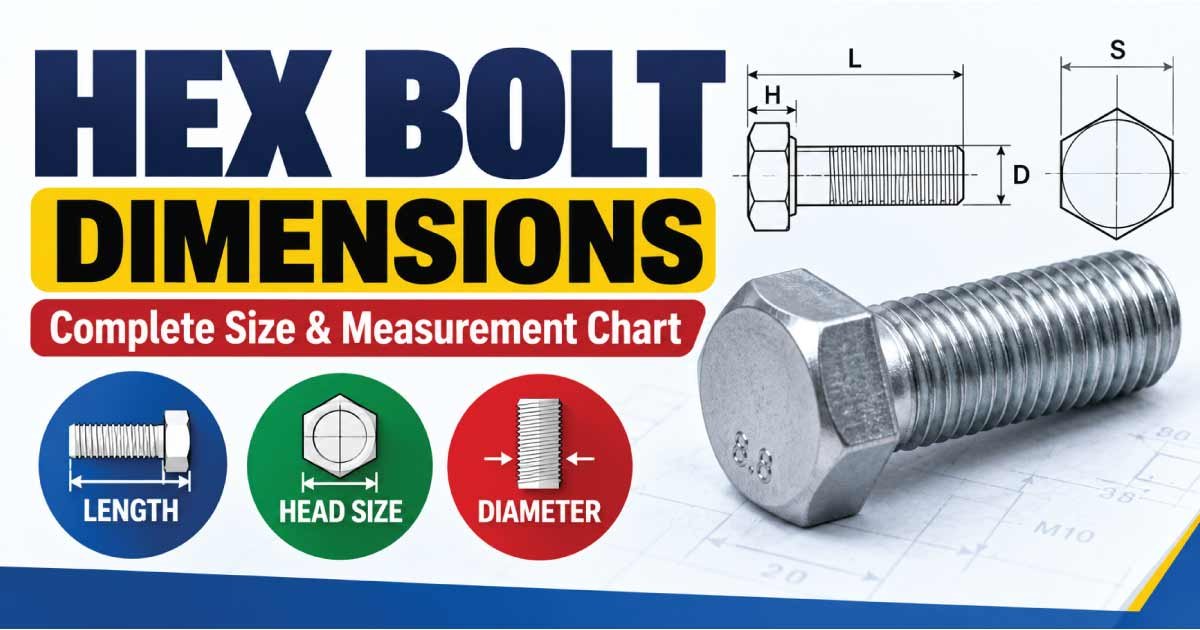
Hex bolts are among the most widely used fasteners in construction, machinery, automotive work, fabrication, and general maintenance. However, choosing the correct bolt involves more than matching the nominal diameter. Hex bolt dimensions include the bolt diameter, length, thread pitch, head width, head height, thread length, and other measurements that determine whether a fastener will fit and perform correctly.
This guide explains how to read hex bolt dimensions and provides practical metric and inch hex bolt size charts. You’ll also learn how to measure a hex bolt, understand thread specifications, select the correct length, and distinguish between common standards and bolt types.
What Are Hex Bolt Dimensions?
Hex bolt dimensions describe the physical measurements and specifications used to identify a hex-head bolt. The most important dimensions are the nominal diameter, bolt length, thread pitch, head width across flats, head height, and threaded length.
A bolt designation such as M10 × 60 tells you two important things:
- M10 = nominal metric thread diameter of 10 mm
- 60 mm = bolt length
The designation does not necessarily tell you every physical dimension of the bolt head. Head dimensions depend on the applicable standard and bolt type.
For inch fasteners, a designation such as 1/2-13 × 2 in. generally means:
- 1/2 in. = nominal diameter
- 13 = 13 threads per inch
- 2 in. = nominal bolt length
Understanding these measurements prevents common problems such as using the wrong wrench size, selecting an incompatible nut, or choosing a bolt that is too short or excessively long.
Hex Bolt Dimension Chart: Metric Sizes
The following chart provides commonly used dimensions for standard metric hex-head bolts. Exact dimensions can vary according to the applicable standard, product class, and manufacturer, so the relevant standard should be checked when a precise engineering specification is required.
| Nominal Size | Thread Pitch (mm) | Head Width Across Flats (mm) | Approx. Head Height (mm) |
|---|---|---|---|
| M6 | 1.00 | 10 | 4.0 |
| M8 | 1.25 | 13 | 5.3 |
| M10 | 1.50 | 16 | 6.4 |
| M12 | 1.75 | 18 | 7.5 |
| M14 | 2.00 | 21 | 8.8 |
| M16 | 2.00 | 24 | 10.0 |
| M18 | 2.50 | 27 | 11.5 |
| M20 | 2.50 | 30 | 12.5 |
| M22 | 2.50 | 34 | 14.0 |
| M24 | 3.00 | 36 | 15.0 |
| M27 | 3.00 | 41 | 17.0 |
| M30 | 3.50 | 46 | 18.7 |
The across-flats measurement is particularly useful because it determines the wrench or socket size needed to turn the bolt head.
For example, a commonly used M10 hex bolt has a nominal thread diameter of 10 mm and a head width of approximately 16 mm under common ISO-style dimensions. That does not mean the bolt itself is 16 mm in diameter—the 16 mm figure refers to the distance between opposite flat sides of the hexagonal head.
Metric Hex Bolt Size Chart by Diameter
Nominal diameter is one of the most important dimensions when selecting a metric hex bolt. It identifies the approximate outside diameter of the threaded portion.
| Metric Bolt Size | Nominal Diameter (mm) | Common Standard Pitch (mm) | Typical Applications |
|---|---|---|---|
| M5 | 5 | 0.80 | Light machinery, brackets |
| M6 | 6 | 1.00 | General assembly |
| M8 | 8 | 1.25 | Machinery, automotive |
| M10 | 10 | 1.50 | Equipment and structural assemblies |
| M12 | 12 | 1.75 | Heavy machinery |
| M14 | 14 | 2.00 | Automotive and industrial equipment |
| M16 | 16 | 2.00 | Heavy-duty assemblies |
| M20 | 20 | 2.50 | Structural and industrial applications |
| M24 | 24 | 3.00 | Heavy structural applications |
| M30 | 30 | 3.50 | Large machinery and structural work |
These are common coarse-pitch sizes. Metric standards also provide fine-pitch threads, which have a smaller pitch than the commonly used coarse thread for the same nominal diameter.
Understanding the Main Hex Bolt Measurements
A hex bolt has several dimensions, and each one serves a different purpose. Knowing what each measurement means makes bolt selection much easier.
1. Nominal Diameter
The nominal diameter identifies the basic size of the bolt’s threaded portion.
For example:
- M8 = approximately 8 mm nominal diameter
- M12 = approximately 12 mm nominal diameter
- M16 = approximately 16 mm nominal diameter
- 1/2 in. = 0.500 in. nominal diameter
The actual measured diameter over the external threads can differ slightly from the nominal designation because of manufacturing tolerances and thread geometry.
2. Bolt Length
Bolt length is measured from the bearing surface beneath the head to the end of the bolt for standard hex-head bolts.
For example, an M10 × 60 bolt has a nominal diameter of 10 mm and a nominal length of 60 mm.
The hexagonal head is normally not included in the stated bolt length for a conventional hex-head bolt.
3. Across-Flats Head Width
Across flats, often abbreviated AF, is the distance between two opposite flat sides of the hexagonal head.
This measurement determines the required wrench or socket.
For example, a commonly standardized M12 hex bolt has an across-flats head dimension of 18 mm under ISO-style dimensions.
4. Head Height
Head height is the vertical thickness of the bolt head.
A thicker head can provide more bearing area and a different mechanical profile, but head height is controlled by the applicable fastener standard rather than being freely selected.
5. Thread Pitch
Metric thread pitch is the distance between corresponding points on adjacent threads, measured in millimeters.
For example:
M10 × 1.5
means the nominal diameter is 10 mm and the thread pitch is 1.5 mm.
A smaller pitch number indicates a finer thread.
6. Threaded Length
Threaded length describes how much of the bolt shank contains threads.
Some hex bolts are fully threaded, while others have an unthreaded portion beneath the head. The required thread length depends on the bolt standard, nominal length, and fastener type.
Inch Hex Bolt Dimensions Chart
In the United States and other regions using Unified inch fasteners, hex-head bolts are commonly identified by nominal diameter and threads per inch.
The following table gives common nominal sizes and typical head across-flats dimensions used for standard inch hex-head fasteners. Exact dimensions depend on the applicable specification.
| Nominal Diameter (in.) | Threads Per Inch, Coarse (UNC) | Typical Head Width Across Flats (in.) |
|---|---|---|
| 1/4 | 20 | 7/16 |
| 5/16 | 18 | 1/2 |
| 3/8 | 16 | 9/16 |
| 7/16 | 14 | 5/8 |
| 1/2 | 13 | 3/4 |
| 9/16 | 12 | 7/8 |
| 5/8 | 11 | 15/16 |
| 3/4 | 10 | 1-1/8 |
| 7/8 | 9 | 1-5/16 |
| 1 | 8 | 1-1/2 |
| 1-1/8 | 7 | 1-11/16 |
| 1-1/4 | 7 | 1-7/8 |
| 1-3/8 | 6 | 2-1/16 |
| 1-1/2 | 6 | 2-1/4 |
UNC stands for Unified National Coarse. Inch fasteners are also available with UNF (Unified National Fine) threads and other thread specifications.
Hex Bolt Size Chart: Metric to Inch Comparison
Metric and inch bolt sizes should not be treated as interchangeable simply because their diameters appear close.
| Metric Size | Nominal Diameter (in.) | Approximate Inch Equivalent |
|---|---|---|
| M6 | 0.236 | 1/4 in. |
| M8 | 0.315 | 5/16 in. |
| M10 | 0.394 | 3/8 in. |
| M12 | 0.472 | 1/2 in. |
| M16 | 0.630 | 5/8 in. |
| M20 | 0.787 | 3/4 in. |
| M24 | 0.945 | 1 in. |
| M30 | 1.181 | 1-1/8 in. |
These comparisons are for diameter reference only. An approximate diameter does not mean the threads will match.
For example, an M10 bolt and a 3/8-inch bolt have relatively close diameters, but their thread dimensions are different. A metric nut should not be assumed to fit an inch bolt, or vice versa.
How to Measure a Hex Bolt
Measuring an existing bolt is often the easiest way to identify its dimensions. You can use a caliper, ruler, thread pitch gauge, and wrench or socket to collect the required measurements.
Step 1: Measure the Bolt Diameter
Place the caliper across the outside of the threaded portion.
Record the approximate diameter.
If the measurement is close to 8 mm, 10 mm, or 12 mm, it may indicate a corresponding metric nominal size. For inch bolts, compare the measurement with common fractional diameters.
Step 2: Measure the Bolt Length
Measure from the underside of the bolt head to the tip of the bolt.
For a conventional hex-head bolt, do not include the head in the nominal length measurement.
Step 3: Determine Thread Pitch
For a metric bolt, measure the distance between adjacent threads or use a metric thread pitch gauge.
For inch bolts, determine threads per inch (TPI).
A thread pitch gauge is preferable because visually estimating thread pitch can easily lead to mistakes.
Step 4: Measure the Head
Measure the distance across opposite flat sides of the hex head.
This tells you the approximate wrench or socket size.
You can also measure head height if you need to identify a specific standard or compare two fasteners.
Step 5: Check Threaded Length
Determine whether the bolt is fully threaded or partially threaded.
For replacement purposes, compare the threaded and unthreaded portions with the original fastener rather than relying only on overall length.
How to Read a Hex Bolt Size
Hex bolt markings can appear confusing at first, but the basic format is straightforward.
A metric designation might look like:
M12 × 80
This means:
- M = metric thread
- 12 = nominal diameter of 12 mm
- 80 = nominal bolt length of 80 mm
A more detailed designation might include the pitch:
M12 × 1.75 × 80
Here, 1.75 mm is the thread pitch.
An inch designation might look like:
1/2-13 × 2
This indicates:
- 1/2 in. nominal diameter
- 13 TPI
- 2 in. nominal length
The designation may also include a strength grade or property class.
Also Read:
Hex Bolt Grades and Property Classes
Dimensions tell you whether a bolt physically fits, but they do not tell you whether it has sufficient strength for an application.
Metric bolts may use property classes, such as 8.8, 10.9, or 12.9, while inch fasteners may use SAE grades or other specifications depending on the fastener system.
For example, the marking 10.9 on a metric bolt indicates a particular mechanical property classification. It is not a dimensional measurement.
When replacing a structural or load-bearing bolt, consider:
- Diameter
- Length
- Thread type
- Thread pitch
- Property class or grade
- Material
- Coating
- Applicable standard
- Nut and washer compatibility
- Required tightening procedure
Never select a replacement solely because its diameter and length appear to match.
Hex Bolt Standards and Specifications
Different standards control different aspects of fastener design. This is one reason why two bolts with the same nominal diameter may not have identical head dimensions.
Common standards and specifications encountered with hex bolts include:
- ISO standards for many metric fasteners
- ASME standards for many inch-dimensioned hex-head fasteners
- ASTM specifications for certain material, mechanical-property, and application requirements
- Manufacturer-specific specifications for specialized products
Standards can define dimensions such as head width, head height, thread requirements, tolerances, material, or mechanical properties.
When a bolt is being used in a critical engineering application, always identify the required standard rather than relying on a generic size chart.
Also Read:
Full Thread vs Partial Thread Hex Bolts
Hex bolts can have either a fully threaded shank or a partially threaded shank.
Fully Threaded Bolts
A fully threaded bolt has threads extending essentially along the available shank length up to the head or designated thread termination.
They can be useful when adjustable engagement is needed or when the joint design requires threads along most of the fastener length.
Partially Threaded Bolts
A partially threaded bolt has a smooth shank between the head and threaded section.
The unthreaded portion can be important in joints where the bolt must pass through one or more components before the threads engage the nut.
The correct choice depends on joint design, grip length, required thread engagement, and the applicable fastener specification.
Also Read:
How to Choose the Correct Hex Bolt Size
Selecting a bolt should start with the joint rather than the wrench size.
1. Match the Thread System
First determine whether the assembly uses:
- Metric threads
- UNC threads
- UNF threads
- Another specified thread system
Never force a mismatched nut onto a bolt.
2. Match the Diameter
The replacement bolt should have the required nominal diameter for the hole and joint.
If the original fastener is damaged, determine the intended size from engineering documentation, the mating nut, or reliable dimensional measurements.
3. Select the Correct Length
The bolt should provide adequate engagement without creating unnecessary protrusion or interference.
The correct length depends on the thickness of the joined materials, washers, nut thickness, and required thread engagement.
4. Check the Grade or Property Class
A bolt with the correct dimensions may still be unsuitable if its mechanical properties are inadequate.
For load-bearing applications, match the specified grade or property class.
5. Verify Head Clearance
Make sure there is enough room around the hex head for the intended wrench or socket.
This is especially important in machinery where nearby components can restrict tool access.
Common Hex Bolt Sizes and Typical Uses
There is no universal rule that assigns one application to each bolt size, because the appropriate fastener depends on loads, materials, joint design, and engineering requirements.
Nevertheless, some sizes are frequently encountered in general mechanical work.
| Size | Common General Uses |
|---|---|
| M6 | Brackets, small equipment, light machinery |
| M8 | Machinery, automotive components, mounting hardware |
| M10 | Equipment frames, automotive and mechanical assemblies |
| M12 | Heavy equipment and larger mechanical joints |
| M16 | Structural and heavy machinery applications |
| M20 | Large machinery and heavy-duty assemblies |
| M24+ | Large structural and industrial applications |
These examples describe common usage rather than engineering recommendations. The required bolt size should always be determined by the application’s design requirements.
Hex Bolt vs Hex Cap Screw
The terms hex bolt and hex cap screw are sometimes used interchangeably in everyday hardware terminology, but standards can distinguish fastener types more precisely.
A hex-head cap screw generally has controlled dimensional and manufacturing requirements and is commonly used in machine assemblies.
A generic hex bolt may refer more broadly to a hex-head threaded fastener intended to work with a nut.
When ordering replacement hardware, use the exact product designation and applicable standard rather than relying only on the phrase “hex bolt.”
Common Mistakes When Measuring Hex Bolts
Small measurement errors can result in buying the wrong fastener.
Mistake 1: Measuring the Head Instead of the Thread
The head width is not the bolt diameter.
For example, an M10 bolt may have a head width of approximately 16 mm under a common standard. The bolt is still an M10 fastener.
Mistake 2: Including the Head in Bolt Length
For conventional hex-head bolts, length is normally measured from beneath the head to the tip.
Mistake 3: Ignoring Thread Pitch
Two bolts can have the same nominal diameter but different thread pitches.
Always identify pitch before selecting a matching nut.
Mistake 4: Assuming Metric and Inch Threads Are Interchangeable
A similar diameter does not guarantee compatible threads.
Mistake 5: Choosing by Appearance
A bolt can look identical to another fastener while having a different material, grade, coating, thread specification, or standard.
Hex Bolt Dimensions FAQ
What dimensions should I measure on a hex bolt?
Measure the nominal diameter, overall length, thread pitch, head width across flats, head height, and threaded length when detailed identification is required.
Does bolt length include the hex head?
For a conventional hex-head bolt, nominal length is generally measured from the bearing surface beneath the head to the bolt tip. Other fastener styles can use different measurement conventions.
What does M10 mean on a bolt?
M10 identifies a metric bolt with a 10 mm nominal thread diameter. It does not by itself specify the bolt’s length, pitch, grade, or head dimensions.
What does M12 × 1.75 mean?
M12 indicates a nominal diameter of 12 mm, while 1.75 indicates a 1.75 mm thread pitch.
How do I know what wrench fits a hex bolt?
Measure or identify the across-flats head dimension. The corresponding wrench or socket should match that dimension and the applicable fastener standard.
Can I replace a metric bolt with an inch bolt?
Generally, you should not substitute one simply because the diameters appear similar. Metric and inch threads use different dimensional systems, so thread compatibility must be verified.
What is the difference between coarse and fine threads?
Coarse threads have a larger pitch and fewer threads per unit length than fine threads of the same nominal diameter. Fine threads have smaller spacing between adjacent threads.
Are all M10 bolts the same size?
No. M10 identifies the nominal thread diameter, but bolts can differ in length, pitch, head style, property class, thread length, coating, and standard.
Final Takeaway
Understanding hex bolt dimensions makes it much easier to identify, measure, and select the right fastener. The most important measurements are the nominal diameter, bolt length, thread pitch, head width across flats, head height, and threaded length.
For metric fasteners, designations such as M8, M10, and M12 identify nominal thread diameters, while pitch and length provide additional specifications. Inch bolts use nominal diameters and threads per inch, such as 1/2-13.
Use size charts as a starting point, but verify the applicable ISO, ASME, ASTM, manufacturer, or engineering specification when exact dimensions or mechanical performance are important. Correct thread compatibility, bolt length, grade, and joint requirements are just as important as physical size.