
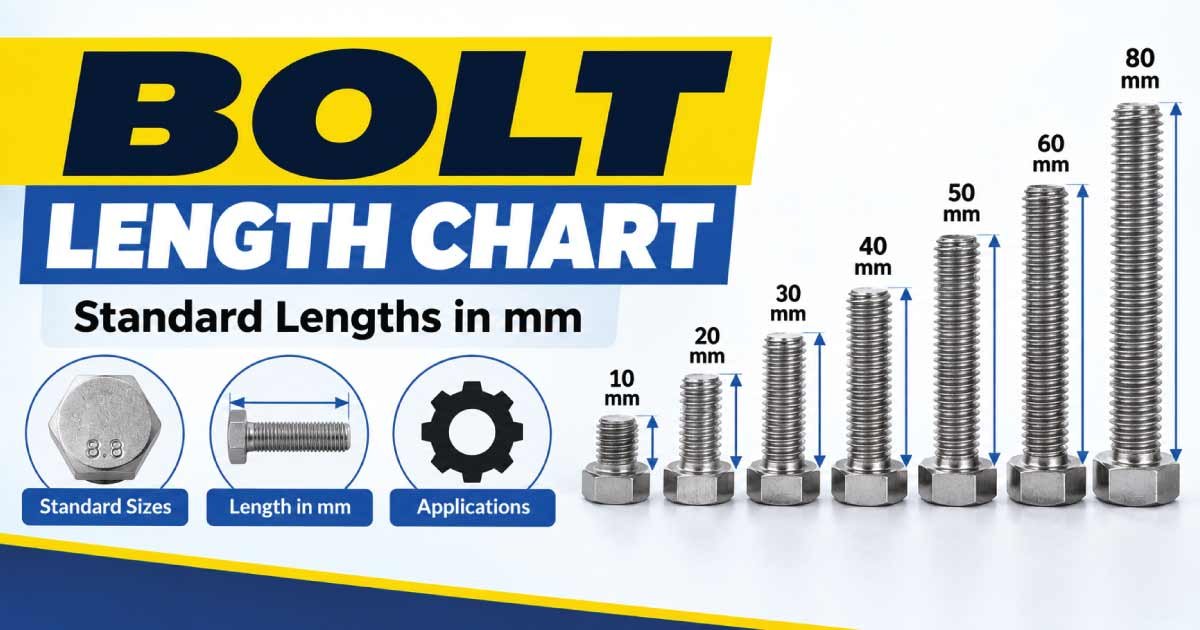
A bolt length chart makes it easier to identify the correct fastener length without guessing. Whether you are replacing a missing bolt, ordering metric hardware, repairing machinery, or assembling a structure, the bolt diameter alone is not enough. You also need the correct length and must know how that length is measured.
Metric bolts are commonly specified using the letter M followed by the nominal diameter, such as M6, M8, M10, or M12. Their lengths are normally stated in millimeters, with common sizes available in a series of standard increments.
This guide provides a practical bolt length chart in mm, explains how bolt length is measured, shows common metric bolt lengths, and covers the factors that determine whether a particular length will work for an application.
What Is Bolt Length?
Bolt length is the distance from the point where the bolt’s length measurement begins to the end of its threaded or unthreaded shank. For most conventional bolts with a flat bearing surface under the head, length is measured from directly beneath the head to the end of the bolt.
For example, an M10 × 60 bolt has:
- M10 = nominal thread diameter of approximately 10 mm
- 60 = nominal bolt length of 60 mm
The 60 mm dimension does not normally include the bolt head.
This measurement convention is important because two bolts can have the same overall physical appearance but different specified lengths depending on their head style and measurement method.
Bolt Diameter vs. Bolt Length
Diameter and length describe two different dimensions.
| Specification | What It Describes | Example |
|---|---|---|
| M6 | Nominal thread diameter | 6 mm |
| M8 | Nominal thread diameter | 8 mm |
| M10 | Nominal thread diameter | 10 mm |
| M12 | Nominal thread diameter | 12 mm |
| M16 | Nominal thread diameter | 16 mm |
| 40 mm | Nominal bolt length | 40 mm |
| 60 mm | Nominal bolt length | 60 mm |
| 100 mm | Nominal bolt length | 100 mm |
A complete fastener specification may therefore look like M12 × 80 mm, sometimes followed by the thread pitch, property class, standard, or other details.
Standard Bolt Length Chart in mm
There is no single length series that applies to every metric bolt, diameter, head style, and standard. Manufacturers and standards define available sizes according to the particular fastener design.
However, the following chart shows common nominal metric bolt lengths that buyers and users frequently encounter.
| Bolt Length (mm) | Typical Description |
|---|---|
| 10 mm | Very short |
| 12 mm | Very short |
| 16 mm | Short |
| 20 mm | Short |
| 25 mm | Short |
| 30 mm | Short |
| 35 mm | Short to medium |
| 40 mm | Medium |
| 45 mm | Medium |
| 50 mm | Medium |
| 55 mm | Medium |
| 60 mm | Medium |
| 70 mm | Medium-long |
| 75 mm | Medium-long |
| 80 mm | Long |
| 90 mm | Long |
| 100 mm | Long |
| 110 mm | Long |
| 120 mm | Long |
| 130 mm | Extra long |
| 140 mm | Extra long |
| 150 mm | Extra long |
| 160 mm | Extra long |
| 180 mm | Extra long |
| 200 mm | Extra long |
These are nominal lengths, not a guarantee that every diameter and bolt style is manufactured in every length shown. Availability depends on the fastener standard, manufacturer, diameter, thread configuration, and market.
Common Metric Bolt Lengths by Diameter
When selecting a replacement bolt, it is useful to consider diameter and length together. The following examples show commonly encountered combinations rather than a universal manufacturing schedule.
| Metric Bolt | Common Length Examples (mm) |
|---|---|
| M5 | 10, 12, 16, 20, 25, 30, 40, 50 |
| M6 | 12, 16, 20, 25, 30, 35, 40, 50, 60 |
| M8 | 16, 20, 25, 30, 35, 40, 50, 60, 70, 80 |
| M10 | 20, 25, 30, 40, 50, 60, 70, 80, 90, 100 |
| M12 | 25, 30, 40, 50, 60, 70, 80, 90, 100, 120 |
| M14 | 30, 40, 50, 60, 70, 80, 90, 100, 120 |
| M16 | 30, 40, 50, 60, 70, 80, 90, 100, 120, 140, 160 |
| M20 | 40, 50, 60, 70, 80, 100, 120, 140, 160, 180, 200 |
| M24 | 50, 60, 70, 80, 100, 120, 140, 160, 180, 200 |
The exact standard length series can vary. For critical applications, use the dimensional requirements of the applicable fastener standard or the manufacturer’s product documentation.
How Are Bolts Measured for Length?
The most important measurement rule is to identify the head style before measuring.
For a conventional hex head bolt, socket head cap screw, or similar fastener with a flat bearing surface, measure from the underside of the head to the bolt tip.
Standard Hex Head Bolt
Place the end of a ruler or caliper against the underside of the bolt head. Measure in a straight line along the bolt’s axis to the end of the fastener.
Do not include the head height in the specified bolt length.
For example, if the distance from underneath the head to the tip is 80 mm, the bolt is specified as an 80 mm long bolt, regardless of the additional height of its head.
Countersunk Fasteners
Countersunk screws are different because the head is designed to sit flush with the surface.
For many countersunk fasteners, the length is measured including the head, from the top of the head to the tip.
This is one reason you should not apply the same measurement rule to every type of fastener.
Studs and Special Fasteners
Studs, shoulder bolts, U-bolts, eye bolts, and other specialized fasteners may have their own measurement conventions.
If the fastener is unusual, check the relevant manufacturer’s drawing or dimensional specification instead of assuming that the standard under-head measurement applies.
Why Choosing the Correct Bolt Length Matters
Using the correct length is more than a matter of appearance. The bolt must provide enough usable engagement while avoiding unnecessary protrusion.
A bolt that is too short may fail to engage enough threads. A bolt that is excessively long can interfere with moving parts, require excessive washers or spacers, or create clearance problems.
Correct selection helps provide:
- Appropriate thread engagement
- Proper clamping of the joined components
- Adequate clearance behind the assembly
- Compatibility with washers and nuts
- Easier installation and maintenance
- Better consistency when replacing fasteners
The ideal length depends on the thickness of the materials being joined, the washer arrangement, the nut thickness, and the required thread engagement.
How to Choose the Right Bolt Length
Choosing a bolt length should be based on the complete joint rather than simply selecting the longest bolt that fits.
1. Measure the Material Thickness
First determine the total thickness of the parts being clamped.
For example, suppose two plates are 12 mm and 18 mm thick. Their combined thickness is:
12 mm + 18 mm = 30 mm
You then need to account for washers, the nut, and the required thread protrusion or engagement.
2. Account for Washers
If one or more washers are used under the head or nut, their thickness becomes part of the joint stack.
For example:
- Material thickness: 30 mm
- Washer thickness: 2 mm
- Second washer: 2 mm
Total before considering the nut and thread engagement: 34 mm
A bolt around 40 mm long may be considered as a starting point, but the final choice depends on the nut, thread engagement requirements, and the specific fastener assembly.
3. Consider the Nut
The bolt needs enough threaded length to engage correctly with the nut.
Simply making the bolt long enough to pass through the materials is not sufficient. There must be appropriate engagement between the bolt and nut threads.
4. Check Clearance
Before selecting a longer bolt, make sure there is enough space behind the joint.
Extra bolt protrusion can create problems around:
- Moving mechanisms
- Electrical components
- Hydraulic or pneumatic lines
- Covers and guards
- Adjacent structures
- Rotating components
A slightly longer bolt is not automatically better.
Also Read:
Bolt Length and Thread Engagement
Thread engagement is one of the most important considerations when selecting bolt length.
The bolt should engage sufficiently with the mating threaded component to develop the intended joint performance. The exact requirement depends on factors such as material strength, thread size, joint design, loading, and whether the mating component is a nut or a tapped hole.
For a tapped hole, you also need to consider the available thread depth. Selecting a very long bolt does not improve the joint if the hole is not deep enough to accept the additional threaded length.
For engineering-critical assemblies, follow the joint designer’s specifications or applicable engineering standards rather than relying on a general rule.
Common Metric Bolt Size Examples
The following examples demonstrate how diameter and length are written together.
| Bolt Specification | Diameter | Length | Meaning |
|---|---|---|---|
| M6 × 30 | 6 mm | 30 mm | 6 mm nominal diameter, 30 mm length |
| M8 × 40 | 8 mm | 40 mm | 8 mm nominal diameter, 40 mm length |
| M10 × 50 | 10 mm | 50 mm | 10 mm nominal diameter, 50 mm length |
| M12 × 60 | 12 mm | 60 mm | 12 mm nominal diameter, 60 mm length |
| M16 × 80 | 16 mm | 80 mm | 16 mm nominal diameter, 80 mm length |
| M20 × 100 | 20 mm | 100 mm | 20 mm nominal diameter, 100 mm length |
The notation describes the nominal dimensions. A complete product description may include additional information such as thread pitch and property class.
Bolt Length vs. Thread Length
Bolt length and thread length are not the same measurement.
Bolt length describes the overall specified length according to the fastener’s measurement convention. Thread length describes how much of the shank is threaded.
Some bolts are fully threaded, while others have an unthreaded portion known as the grip or plain shank.
For example, two M12 bolts could both be 80 mm long but have different thread configurations. Their overall lengths are the same, but their threaded portions may differ.
This distinction matters when the joint requires a specific grip length or when the bolt passes through several components before reaching the nut.
Fully Threaded vs. Partially Threaded
Fully threaded bolts:
- Have threads extending through most or all of the usable shank
- Are useful where adjustable thread engagement is needed
- Are common in many general-purpose applications
Partially threaded bolts:
- Have a plain shank beneath the head
- Can provide a defined grip section
- Are used in applications where the unthreaded portion is important to the joint design
Always check both overall length and thread length when replacing a partially threaded fastener.
Also Read:
Standard Bolt Length Increments
Metric fasteners are commonly offered in standardized length increments rather than arbitrary measurements.
Short bolts may be available in relatively small increments, while longer fasteners can be supplied in larger increments. The actual series depends on the diameter and applicable standard.
A practical sequence you may encounter is:
20, 25, 30, 35, 40, 45, 50, 55, 60, 70, 80, 90, 100 mm
Longer sizes may continue through 120, 140, 160, 180, 200 mm and beyond.
Not every bolt diameter is necessarily available in every increment. If you need an unusual length, check the manufacturer’s catalog before assuming that it is a standard stocked size.
How to Measure an Existing Bolt
If you have an old bolt but do not know its size, measure several dimensions rather than relying on appearance.
Step 1: Measure the Length
For a conventional bolt, measure from directly under the head to the tip.
Record the measurement in millimeters.
Step 2: Measure the Diameter
Use calipers if available. Measure across the outside of the bolt threads.
A measurement close to 8 mm suggests an M8 nominal diameter, while a measurement close to 10 mm suggests M10.
Do not expect the measured thread diameter to always be exactly equal to the nominal designation.
Step 3: Identify the Thread Pitch
Thread pitch is the distance from one thread crest to the next.
For metric fasteners, pitch is normally expressed in millimeters, such as 1.0 mm, 1.25 mm, or 1.5 mm, depending on the thread.
The same diameter can have different thread pitches, so diameter alone does not fully identify a metric bolt.
Step 4: Identify the Head Style
Look at the head shape and drive:
- Hex head
- Socket head
- Button head
- Flat or countersunk head
- Flange head
- Other specialized designs
The head style affects both measurement conventions and interchangeability.
Step 5: Check the Grade or Property Class
For structural or highly loaded applications, identify markings on the bolt head and match the required property class or material specification.
Do not replace a high-strength fastener with an ordinary bolt simply because the diameter and length appear identical.
Also Read:
Common Bolt Length Selection Mistakes
Several mistakes occur when people select replacement bolts.
Using Overall Length Instead of Specified Length
One of the most common errors is measuring from the top of a conventional hex head instead of underneath it.
This can make the replacement bolt appear shorter or longer than expected.
Ignoring Thread Pitch
An M10 bolt is not automatically interchangeable with every other M10 bolt. The thread pitch must also match the mating nut or tapped hole.
Choosing the Longest Bolt Available
Extra length is not always beneficial. A bolt that extends too far can interfere with surrounding equipment or create an unsafe protrusion.
Ignoring Thread Engagement
A bolt must provide sufficient engagement with the nut or threaded hole. Passing through the components is only part of the requirement.
Mixing Standards
Metric and inch fasteners can look similar, particularly in some smaller sizes. A visually similar imperial fastener is not necessarily a suitable substitute for a metric bolt.
Ignoring Strength Requirements
A bolt’s dimensions do not tell the entire story. Material, property class, corrosion resistance, head style, and thread specifications may all be important.
Metric Bolt Length Chart: Quick Reference
For quick selection, this compact chart lists common nominal lengths in ascending order.
| Length (mm) | Length (inches, approx.) |
|---|---|
| 10 mm | 0.39 in |
| 20 mm | 0.79 in |
| 25 mm | 0.98 in |
| 30 mm | 1.18 in |
| 40 mm | 1.57 in |
| 50 mm | 1.97 in |
| 60 mm | 2.36 in |
| 70 mm | 2.76 in |
| 80 mm | 3.15 in |
| 90 mm | 3.54 in |
| 100 mm | 3.94 in |
| 120 mm | 4.72 in |
| 140 mm | 5.51 in |
| 160 mm | 6.30 in |
| 180 mm | 7.09 in |
| 200 mm | 7.87 in |
The inch values are mathematical conversions and are included only as a reference. Metric bolts should normally be selected using their metric specifications.
Frequently Asked Questions About Bolt Length
How is bolt length normally measured?
For most conventional bolts with a flat underside beneath the head, length is measured from under the head to the end of the bolt. Countersunk fasteners commonly use a different measurement convention.
What does M10 × 60 mean?
M10 × 60 generally means a metric bolt with a nominal thread diameter of 10 mm and a nominal length of 60 mm. The complete specification may also state thread pitch, property class, coating, or applicable standard.
Is 60 mm a standard bolt length?
Yes, 60 mm is a commonly encountered metric nominal length. However, availability depends on the bolt diameter, head style, thread configuration, standard, and manufacturer.
Does bolt length include the head?
For most conventional hex-head and similar bolts, no. Length is measured from beneath the head. For countersunk fasteners, the specified length commonly includes the head.
Can I use a longer bolt if the correct length is unavailable?
Sometimes, but only if the longer bolt does not create clearance problems and the joint remains correctly assembled. Do not use excessive length simply because it is available.
How do I know which bolt length I need?
Measure the complete joint thickness, include washers or other components, and ensure sufficient thread engagement with the nut or tapped hole. Then select an appropriate standard length while checking clearance.
Are all M12 bolts the same?
No. M12 identifies the nominal diameter, but bolts can differ in thread pitch, length, head style, material, property class, coating, and thread length.
What is the difference between bolt length and thread length?
Bolt length describes the specified overall length under the applicable measurement convention. Thread length describes how much of the shank contains threads. These dimensions can be different, particularly on partially threaded bolts.
Final Tips for Using a Bolt Length Chart
A bolt length chart is most useful when combined with accurate measurements and the complete fastener specification. Before ordering or installing a replacement, verify more than just the length.
Check these details:
- Nominal diameter
- Bolt length
- Thread pitch
- Head style
- Thread length
- Property class or strength requirement
- Material and coating
- Washer requirements
- Nut or tapped-hole compatibility
- Clearance around the finished joint
For ordinary repairs, measuring an existing bolt and matching its dimensions can be a practical starting point. For machinery, structural assemblies, automotive components, pressure equipment, or other safety-critical applications, follow the manufacturer’s specification or applicable engineering standard.
Conclusion
A bolt length chart in mm provides a quick way to compare common metric fastener lengths, but selecting the right bolt requires more than choosing a number from a table. The diameter, thread pitch, head style, thread length, material, strength class, and joint design all affect compatibility.
For conventional bolts, remember the key measurement rule: length is generally measured from beneath the head to the tip. Then measure the joint, account for washers and thread engagement, and choose a suitable standard length without creating unnecessary protrusion.
When exact requirements matter, always verify the fastener specification with the applicable standard or manufacturer documentation. Accurate measurement and complete identification are the best ways to select a bolt that fits correctly and performs as intended.