
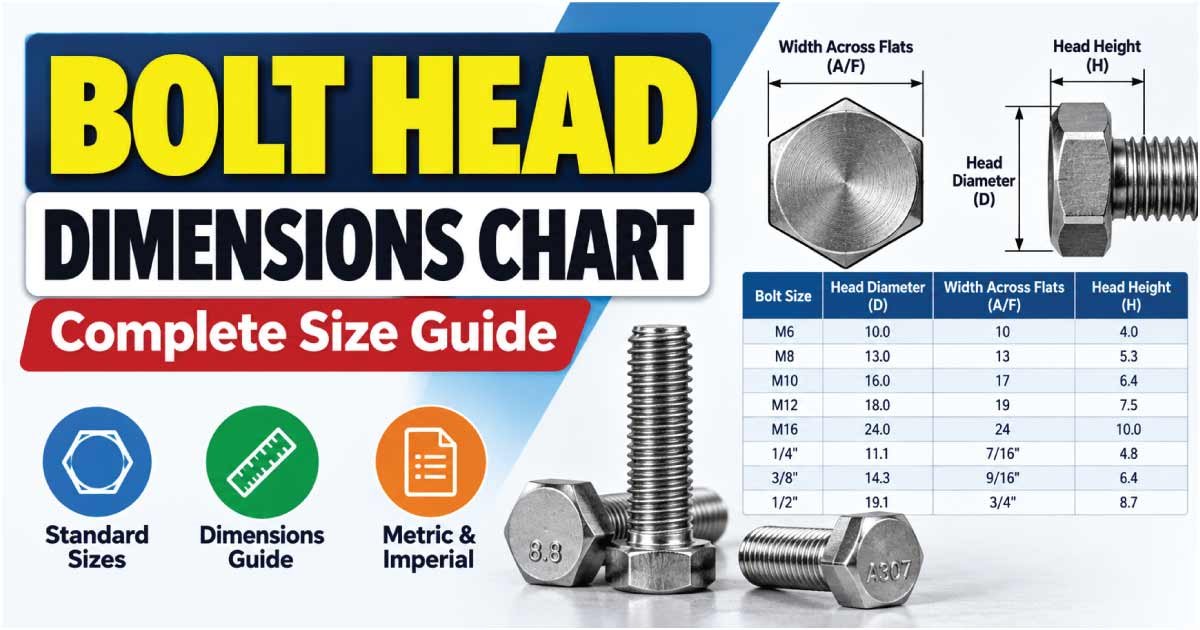
Choosing the right bolt is not only about thread diameter and length. The bolt head dimensions determine which wrench or socket fits, how much contact the tool has with the head, and whether the fastener can be installed safely in a particular space.
This bolt head dimensions chart explains the most important head measurements, including head width across flats, head height, common socket sizes, and the differences between major bolt standards. It also explains how to measure a bolt head yourself and how to avoid confusing bolt diameter with wrench size.
Because bolt-head dimensions can vary according to the fastener standard, grade, thread series, manufacturer, and bolt type, the charts below should be treated as practical reference guides rather than universal specifications. For critical applications, always verify the exact dimensional requirements against the applicable standard or manufacturer’s documentation.
What Are Bolt Head Dimensions?
Bolt head dimensions describe the physical size and geometry of the head at the top of a bolt. These measurements are important because the head is where the installation tool applies torque.
The most commonly discussed dimensions are:
- Across flats (AF): Distance between two opposite flat sides of a hex bolt head.
- Across corners (AC): Distance between two opposite corners of a hexagonal head.
- Head height: Vertical thickness of the bolt head.
- Socket size: The nominal socket or wrench size designed to fit the head.
- Head diameter: Used for round, flange, button, and other non-hex head styles.
- Bearing surface: The underside area of the head that contacts the clamped material.
For standard hex bolts, across flats is usually the most useful measurement when selecting a wrench or socket.
A common mistake is assuming that the bolt diameter and the wrench size are the same. They are not. A 1/2-inch bolt, for example, does not normally require a 1/2-inch wrench. The bolt diameter refers to the threaded shank, while the wrench size refers to the bolt head.
Bolt Head Dimensions Chart
The following chart provides commonly encountered nominal dimensions for U.S. inch-series hex bolts. Exact dimensions can differ between standards and product series, so use it as a quick reference rather than a substitute for a formal fastener specification.
| Nominal Bolt Diameter | Typical Head Width / Across Flats | Typical Socket Size | Common Application |
|---|---|---|---|
| 1/4 in | 7/16 in | 7/16 in | Small equipment |
| 5/16 in | 1/2 in | 1/2 in | General hardware |
| 3/8 in | 9/16 in | 9/16 in | Machinery and assemblies |
| 7/16 in | 5/8 in | 5/8 in | Equipment and structural work |
| 1/2 in | 3/4 in | 3/4 in | Automotive and machinery |
| 9/16 in | 7/8 in | 7/8 in | Heavy equipment |
| 5/8 in | 15/16 in | 15/16 in | Machinery and construction |
| 3/4 in | 1-1/8 in | 1-1/8 in | Heavy-duty fastening |
| 7/8 in | 1-5/16 in | 1-5/16 in | Large machinery |
| 1 in | 1-1/2 in | 1-1/2 in | Heavy equipment |
Important: Inch-series bolt head dimensions are not identical across every bolt standard. SAE, ASTM, ASME, and other specifications may prescribe different dimensions for particular fastener types and grades.
Metric Bolt Head Dimensions Chart
Metric hex bolts are identified primarily by their nominal thread diameter, such as M6, M8, M10, or M12. The head size is a separate dimension.
The following table gives commonly encountered metric hex-head sizes for general reference.
| Metric Bolt Size | Common Head Width Across Flats | Typical Socket Size | Typical Use |
|---|---|---|---|
| M4 | 7 mm | 7 mm | Small assemblies |
| M5 | 8 mm | 8 mm | Electronics and light equipment |
| M6 | 10 mm | 10 mm | General hardware |
| M8 | 13 mm | 13 mm | Machinery and automotive |
| M10 | 16 mm | 16 mm | Machinery and equipment |
| M12 | 18 mm | 18 mm | Automotive and structural assemblies |
| M14 | 21 mm | 21 mm | Heavy equipment |
| M16 | 24 mm | 24 mm | Construction and machinery |
| M18 | 27 mm | 27 mm | Heavy-duty assemblies |
| M20 | 30 mm | 30 mm | Structural and industrial work |
| M22 | 34 mm | 34 mm | Heavy machinery |
| M24 | 36 mm | 36 mm | Large structural applications |
Some metric fasteners use reduced-head dimensions, while other designs use larger or smaller heads. Always check the relevant standard when an exact dimension is required.
Key Bolt Head Measurements Explained
Understanding the terminology makes a bolt size chart much easier to use.
1. Across Flats
Across flats (AF) is the distance between two opposite parallel flat surfaces of a hexagonal bolt head.
This is normally the dimension that determines the required wrench or socket.
For example, if a hex bolt has an across-flats measurement of 13 mm, a 13 mm socket or wrench is normally the appropriate nominal tool size.
Across flats should be measured straight across the center of the head from one flat face to the opposite flat face.
2. Across Corners
Across corners is measured from one corner of a hexagonal head to the opposite corner.
It is larger than the across-flats measurement.
This dimension can be useful when checking whether a bolt head will physically fit into a recessed area or clearance hole. However, it is not normally the number used to identify the socket size.
3. Bolt Head Height
Head height is the vertical distance from the underside of the head to the top surface.
It affects:
- Available clearance above the fastener
- Clamping geometry
- Socket engagement
- Overall fastener height
- Clearance inside recessed components
A bolt can have the same thread diameter and wrench size as another bolt but a different head height because the bolts follow different dimensional standards.
4. Head Bearing Surface
The underside of the bolt head forms the bearing surface against the material or washer.
Its size affects how the clamping load is distributed.
In applications where the material could deform under the bolt head, a washer or a fastener with a larger bearing surface may be appropriate. The correct solution depends on the engineering requirements rather than simply choosing the largest available head.
Bolt Head Size vs Bolt Diameter
One of the most common fastener mistakes is confusing bolt diameter with bolt head size.
Bolt diameter describes the approximate outside diameter of the threaded portion. Bolt head size describes the tool-fitting dimension of the head.
For example:
| Bolt Identification | What It Describes |
|---|---|
| M8 | Approximately 8 mm nominal thread diameter |
| 1/2 in bolt | Approximately 1/2 inch nominal thread diameter |
| 13 mm socket | Tool size across the flats of the head |
| 3/4 in socket | Tool size across the flats of the head |
Therefore, an M8 bolt is not an 8 mm wrench bolt simply because its diameter is approximately 8 mm.
This distinction is particularly important when replacing a missing fastener or selecting a socket for an existing bolt.
How to Measure Bolt Head Dimensions
You can measure most accessible bolt heads using a digital caliper, vernier caliper, ruler, or suitable wrench.
Step 1: Identify the Head Type
First determine whether the fastener has:
- Hexagonal head
- Square head
- Socket head
- Button head
- Flange head
- Countersunk head
- Other specialized geometry
The measurement method depends on the head design.
Step 2: Measure Across Flats
For a conventional hex bolt, place the caliper jaws against two opposite flat sides.
Record the measurement in millimeters or inches.
This is the primary dimension used to identify the appropriate socket or wrench.
Step 3: Measure Head Height
Position the caliper so that it measures from the underside of the bolt head to the top surface.
Do not include the threaded shank in this measurement.
Step 4: Measure the Bolt Diameter
Measure the outside diameter of the threaded section if the bolt’s nominal size is unknown.
For greater accuracy, measure across the thread crests rather than the root of the thread.
Step 5: Measure Bolt Length
Bolt length is generally measured from the underside of the head to the end of the threaded shank for standard hex-head bolts.
Countersunk fasteners are a notable exception because their length is commonly measured differently.
How to Identify a Bolt From Its Head
If you have an unidentified bolt, the head can provide useful clues, but head dimensions alone usually cannot identify the complete fastener specification.
Check the following features:
- Head shape
- Across-flats measurement
- Head height
- Thread diameter
- Thread pitch
- Bolt length
- Material
- Grade markings
- Manufacturer markings
- Coating or finish
For example, two bolts can have similar head dimensions but different thread pitches, grades, or material properties.
A complete identification therefore requires more than simply matching the wrench size.
Also Read:
Metric vs SAE Bolt Head Dimensions
Metric and SAE fasteners can look similar, particularly when their sizes are close.
For example, some inch and metric wrench sizes can be physically close enough to create confusion.
| Measurement System | Bolt Identification Example | Tool Identification Example |
|---|---|---|
| Metric | M10 | 16 mm socket |
| Metric | M12 | 18 mm socket |
| SAE/Inch | 3/8 in | 9/16 in socket |
| SAE/Inch | 1/2 in | 3/4 in socket |
| SAE/Inch | 5/8 in | 15/16 in socket |
Do not force a metric socket onto an inch fastener, or an inch socket onto a metric fastener, simply because it appears to fit.
A tool that is slightly oversized can round the flats, especially when high torque or a stubborn corroded fastener is involved.
For important work, use the correctly specified socket or wrench.
Different Types of Bolt Heads
Not every bolt uses a conventional hexagonal head. The head style is selected according to the installation method, available clearance, appearance, and engineering requirements.
Hex Head Bolts
Hex-head bolts are among the most common fasteners used with open-end wrenches, combination wrenches, and sockets.
Their six-sided head provides multiple flat surfaces for applying torque.
Socket Head Cap Screws
Socket head cap screws have a cylindrical head with an internal hexagonal recess.
Instead of measuring across external flats, you need to identify the internal hex key or socket size.
These fasteners are useful where space around the outside of the head is limited.
Flange Head Bolts
A flange-head bolt incorporates an enlarged flange beneath the head.
The flange can provide a greater bearing area and may reduce the need for a separate washer in applications designed for that fastener.
Button Head Bolts
Button-head fasteners have a rounded, low-profile top.
They are often selected where appearance, reduced protrusion, or clearance is important.
Countersunk Bolts
Countersunk fasteners are designed to sit flush or nearly flush with the surrounding surface.
Their head geometry differs significantly from a conventional hex bolt, so a standard hex-head chart should not be used to identify their dimensions.
Also Read:
Why Bolt Head Dimensions Matter
Correct head dimensions affect more than tool selection.
Tool Fit
A correctly sized socket provides proper contact with the flats and reduces the risk of damaging the head.
Clearance
The head must fit within the available space around the fastener.
This is particularly important in machinery, automotive assemblies, and recessed mounting locations.
Load Distribution
The underside of the head transfers clamping force to the connected material, directly or through a washer.
Installation Access
A large head may require more clearance for a socket or wrench. A low-profile or socket-head design can sometimes solve access limitations.
Replacement Compatibility
A replacement bolt must match more than the thread diameter. Head dimensions, material, grade, thread pitch, length, and other specifications may all matter.
Also Read:
How to Choose the Correct Bolt Head Size
When selecting a replacement fastener, avoid choosing it solely by the socket that fits.
Use this sequence:
- Identify the bolt diameter.
- Determine the thread pitch or thread specification.
- Measure the required bolt length.
- Identify the head style.
- Check the required head dimensions.
- Confirm the material and strength grade.
- Check whether a washer or nut is required.
- Verify the applicable fastener standard.
- Confirm the manufacturer’s specifications for critical applications.
For ordinary noncritical repairs, physical measurements can help identify a matching fastener. For structural, pressure, lifting, engine, suspension, or other safety-critical applications, use the specified fastener rather than relying only on visual similarity.
Common Mistakes When Measuring Bolt Heads
Even a simple measurement can produce the wrong result if the wrong part of the fastener is measured.
Mistake 1: Measuring Bolt Diameter Instead of Head Width
The thread diameter and head width are separate dimensions.
Mistake 2: Measuring Across Corners
A hex bolt’s socket size corresponds to the across-flats dimension, not the across-corners measurement.
Mistake 3: Assuming All M10 or 1/2-Inch Bolts Have Identical Heads
Different standards and head styles can produce different dimensions.
Mistake 4: Ignoring Thread Pitch
Two bolts may have similar diameters but different thread pitches.
Mistake 5: Choosing a Replacement by Head Size Alone
A bolt with the correct head width can still be unsuitable if its material, grade, thread, or length is wrong.
Mistake 6: Using the Wrong Socket System
Metric and inch tools should not be treated as interchangeable simply because two sizes seem close.
Bolt Head Dimensions and Socket Selection
For a standard external hex bolt, the across-flats head dimension is normally the nominal socket size.
For example, a hex head measuring approximately 16 mm across its flats will generally use a 16 mm socket.
However, this relationship does not apply in exactly the same way to every fastener.
For internal-drive fasteners such as socket head cap screws, the relevant tool dimension is the size of the internal drive. For Torx fasteners, it is the Torx drive designation. For specialized heads, the manufacturer may specify a dedicated tool.
Always identify the drive type before selecting the tool.
Standardization and Why Dimensions Vary
Bolt dimensions are controlled by standards and specifications rather than by a single universal chart.
Depending on the fastener, dimensions may be influenced by standards such as ASME, ASTM, SAE, ISO, or DIN, along with specific manufacturer requirements.
This means that a chart showing one head dimension for a nominal bolt size should not automatically be applied to every bolt carrying that same nominal size.
Variations can occur because of:
- Bolt type
- Thread series
- Strength grade
- Head style
- Dimensional standard
- Reduced-head design
- Manufacturer specification
- Inch or metric system
When exact tolerances matter, consult the applicable standard or technical drawing.
Quick Bolt Head Measurement Reference
For a conventional hex bolt, remember these four measurements:
| Measurement | Where to Measure | Why It Matters |
|---|---|---|
| Bolt diameter | Across threaded shank | Identifies nominal bolt size |
| Across flats | Opposite head flats | Selects wrench or socket |
| Across corners | Opposite head corners | Checks physical clearance |
| Head height | Underside to top of head | Determines vertical clearance |
This simple distinction can prevent many fastener-selection errors.
Frequently Asked Questions
What dimension determines the socket size of a hex bolt?
The across-flats dimension normally determines the nominal socket size for an external hex bolt. Measure between two opposite flat sides of the head.
Is bolt head size the same as bolt diameter?
No. Bolt diameter describes the threaded shank, while head size generally refers to the across-flats dimension used for a wrench or socket.
How do I measure a hex bolt head?
Use a caliper to measure directly between two opposite flat sides. This gives the across-flats dimension. You can then measure head height separately.
Why does my bolt not match the size shown in a chart?
The fastener may follow a different dimensional standard, have a reduced-size head, or belong to a different head style. Manufacturer and standard-specific dimensions should take priority over a general chart.
Can I use a slightly larger socket?
It is generally better to use the correctly sized socket. A loose socket can reduce contact with the flats and increase the chance of rounding or damaging the bolt head.
Do metric and SAE bolt heads have different dimensions?
Yes. Metric and inch fasteners use different sizing systems, and their head dimensions are not necessarily interchangeable.
Does bolt grade affect head dimensions?
It can, depending on the applicable fastener specification. Grade, standard, and bolt type should be considered together rather than assuming every bolt of the same diameter has the same head geometry.
Are all M12 bolt heads the same size?
No. M12 identifies the nominal thread diameter, not a universal head dimension. The exact head size depends on the bolt type and applicable standard.
What is across flats on a bolt?
Across flats is the distance between two opposite parallel flat surfaces on a hexagonal bolt head. It is normally the key measurement for selecting a wrench or socket.
Should I use a bolt chart for critical applications?
A general chart is useful for identification and reference, but critical applications should be based on the applicable engineering specification, fastener standard, drawing, or manufacturer’s documentation.
Conclusion
Understanding bolt head dimensions makes it easier to identify fasteners, select the correct socket, check installation clearance, and choose suitable replacements. For standard hex bolts, the most important measurement for tool selection is usually across flats, while head height, across corners, and bearing surface provide additional dimensional information.
Remember that nominal bolt size does not automatically define every head dimension. Metric and inch fasteners can differ, and variations between standards and head styles are common. When exact dimensions or mechanical performance matter, verify the fastener against the relevant specification rather than relying only on a general chart.
Use the bolt head dimensions chart as a practical starting point, then confirm diameter, thread pitch, length, head style, material, grade, and standard before installing a replacement fastener.