
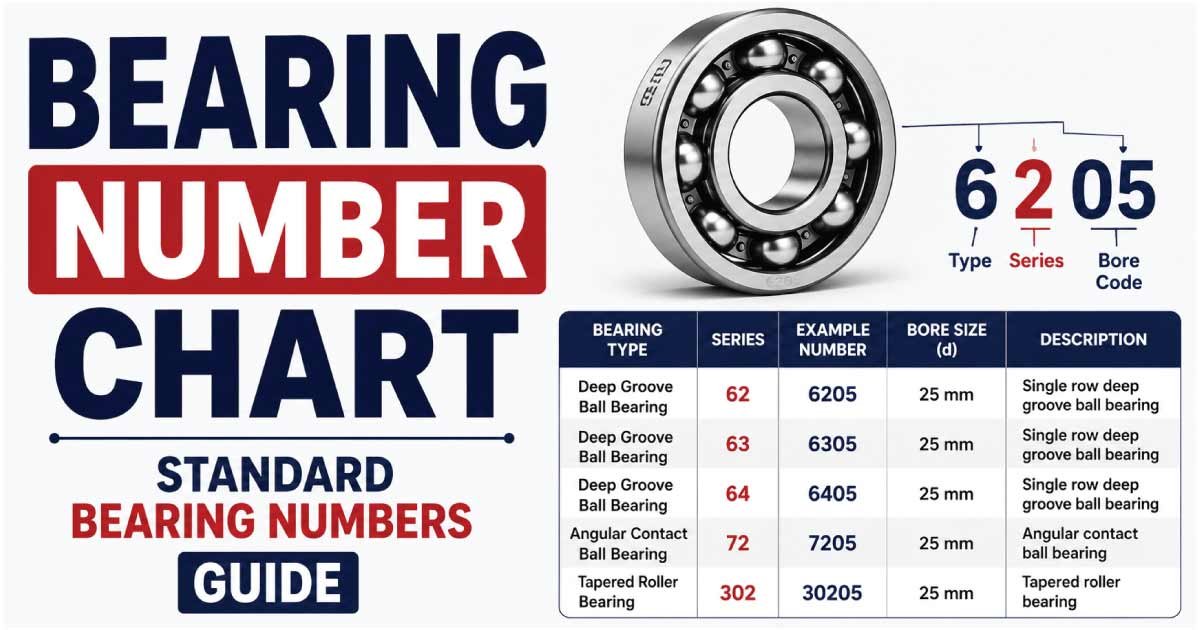
Bearings are identified using standardized numbers, letters, and suffixes that describe important characteristics such as bearing type, bore size, dimensions, internal clearance, sealing arrangement, and other design features.
Understanding a bearing number makes it much easier to identify a replacement bearing, compare different bearing models, determine bore size, and select the correct component for a machine or mechanical assembly.
A typical bearing designation may look like 6205, 6205-2RS, or 6205-ZZ. Although these numbers can appear complicated at first, many common bearing designations follow recognizable patterns.
This guide explains common bearing numbers, bearing designation systems, bore codes, common 6000, 6200, 6300, and 6800 series bearings, suffixes, dimensions, and how to identify an unknown bearing.
What Is a Bearing Number?
A bearing number is a standardized identification code assigned to a bearing.
It can communicate information about:
- Bearing series
- Bearing type
- Bore size
- Sealing arrangement
- Shield arrangement
- Internal clearance
- Cage design
- Precision class
- Lubrication
- Other special characteristics
For example:
6205-2RS
can be interpreted as a 6200-series deep-groove ball bearing with a specific bore size and rubber seals on both sides.
The exact meaning of individual prefixes and suffixes can vary between bearing manufacturers, so manufacturer documentation should be checked when a designation is critical.
Common Bearing Number Chart
The following table shows commonly encountered deep-groove ball bearing numbers and their typical basic dimensions.
| Bearing Number | Bore | Outside Diameter | Width |
|---|---|---|---|
| 6000 | 10 mm | 26 mm | 8 mm |
| 6001 | 12 mm | 28 mm | 8 mm |
| 6002 | 15 mm | 32 mm | 9 mm |
| 6003 | 17 mm | 35 mm | 10 mm |
| 6004 | 20 mm | 42 mm | 12 mm |
| 6005 | 25 mm | 47 mm | 12 mm |
| 6006 | 30 mm | 55 mm | 13 mm |
| 6007 | 35 mm | 62 mm | 14 mm |
| 6008 | 40 mm | 68 mm | 15 mm |
| 6009 | 45 mm | 75 mm | 16 mm |
| 6010 | 50 mm | 80 mm | 16 mm |
These dimensions are typical for standard bearings in this series.
6200 Series Bearing Number Chart
The 6200 series is one of the most commonly encountered deep-groove ball-bearing families.
| Bearing Number | Bore | OD | Width |
|---|---|---|---|
| 6200 | 10 mm | 30 mm | 9 mm |
| 6201 | 12 mm | 32 mm | 10 mm |
| 6202 | 15 mm | 35 mm | 11 mm |
| 6203 | 17 mm | 40 mm | 12 mm |
| 6204 | 20 mm | 47 mm | 14 mm |
| 6205 | 25 mm | 52 mm | 15 mm |
| 6206 | 30 mm | 62 mm | 16 mm |
| 6207 | 35 mm | 72 mm | 17 mm |
| 6208 | 40 mm | 80 mm | 18 mm |
| 6209 | 45 mm | 85 mm | 19 mm |
| 6210 | 50 mm | 90 mm | 20 mm |
| 6211 | 55 mm | 100 mm | 21 mm |
| 6212 | 60 mm | 110 mm | 22 mm |
| 6213 | 65 mm | 120 mm | 23 mm |
| 6214 | 70 mm | 125 mm | 24 mm |
| 6215 | 75 mm | 130 mm | 25 mm |
| 6216 | 80 mm | 140 mm | 26 mm |
| 6217 | 85 mm | 150 mm | 28 mm |
| 6218 | 90 mm | 160 mm | 30 mm |
| 6219 | 95 mm | 170 mm | 32 mm |
| 6220 | 100 mm | 180 mm | 34 mm |
6300 Series Bearing Number Chart
The 6300 series generally has a larger outside diameter and width than the corresponding 6200 series for a given bore.
| Bearing Number | Bore | OD | Width |
|---|---|---|---|
| 6300 | 10 mm | 35 mm | 11 mm |
| 6301 | 12 mm | 37 mm | 12 mm |
| 6302 | 15 mm | 42 mm | 13 mm |
| 6303 | 17 mm | 47 mm | 14 mm |
| 6304 | 20 mm | 52 mm | 15 mm |
| 6305 | 25 mm | 62 mm | 17 mm |
| 6306 | 30 mm | 72 mm | 19 mm |
| 6307 | 35 mm | 80 mm | 21 mm |
| 6308 | 40 mm | 90 mm | 23 mm |
| 6309 | 45 mm | 100 mm | 25 mm |
| 6310 | 50 mm | 110 mm | 27 mm |
| 6311 | 55 mm | 120 mm | 29 mm |
| 6312 | 60 mm | 130 mm | 31 mm |
| 6313 | 65 mm | 140 mm | 33 mm |
| 6314 | 70 mm | 150 mm | 35 mm |
| 6315 | 75 mm | 160 mm | 37 mm |
| 6316 | 80 mm | 170 mm | 39 mm |
| 6317 | 85 mm | 180 mm | 41 mm |
| 6318 | 90 mm | 190 mm | 43 mm |
| 6319 | 95 mm | 200 mm | 45 mm |
| 6320 | 100 mm | 215 mm | 47 mm |
6800 Series Bearing Number Chart
The 6800 series is commonly associated with thin-section deep-groove ball bearings.
| Bearing Number | Bore | OD | Width |
|---|---|---|---|
| 6800 | 10 mm | 19 mm | 5 mm |
| 6801 | 12 mm | 21 mm | 5 mm |
| 6802 | 15 mm | 24 mm | 5 mm |
| 6803 | 17 mm | 26 mm | 5 mm |
| 6804 | 20 mm | 32 mm | 7 mm |
| 6805 | 25 mm | 37 mm | 7 mm |
| 6806 | 30 mm | 42 mm | 7 mm |
| 6807 | 35 mm | 47 mm | 7 mm |
| 6808 | 40 mm | 52 mm | 7 mm |
| 6809 | 45 mm | 58 mm | 7 mm |
| 6810 | 50 mm | 65 mm | 7 mm |
| 6811 | 55 mm | 72 mm | 9 mm |
| 6812 | 60 mm | 78 mm | 10 mm |
| 6813 | 65 mm | 85 mm | 10 mm |
| 6814 | 70 mm | 90 mm | 10 mm |
| 6815 | 75 mm | 95 mm | 10 mm |
| 6816 | 80 mm | 100 mm | 10 mm |
| 6817 | 85 mm | 110 mm | 13 mm |
| 6818 | 90 mm | 115 mm | 13 mm |
| 6819 | 95 mm | 120 mm | 13 mm |
| 6820 | 100 mm | 125 mm | 13 mm |
6900 Series Bearing Number Chart
The 6900 series is another thin-section bearing family.
| Bearing Number | Bore | OD | Width |
|---|---|---|---|
| 6900 | 10 mm | 22 mm | 6 mm |
| 6901 | 12 mm | 24 mm | 6 mm |
| 6902 | 15 mm | 28 mm | 7 mm |
| 6903 | 17 mm | 30 mm | 7 mm |
| 6904 | 20 mm | 37 mm | 9 mm |
| 6905 | 25 mm | 42 mm | 9 mm |
| 6906 | 30 mm | 47 mm | 9 mm |
| 6907 | 35 mm | 55 mm | 10 mm |
| 6908 | 40 mm | 62 mm | 12 mm |
| 6909 | 45 mm | 68 mm | 12 mm |
| 6910 | 50 mm | 72 mm | 12 mm |
| 6911 | 55 mm | 80 mm | 13 mm |
| 6912 | 60 mm | 85 mm | 13 mm |
| 6913 | 65 mm | 90 mm | 13 mm |
| 6914 | 70 mm | 100 mm | 16 mm |
| 6915 | 75 mm | 105 mm | 16 mm |
| 6916 | 80 mm | 110 mm | 16 mm |
| 6917 | 85 mm | 120 mm | 18 mm |
| 6918 | 90 mm | 125 mm | 18 mm |
| 6919 | 95 mm | 130 mm | 18 mm |
| 6920 | 100 mm | 140 mm | 20 mm |
How to Read Bearing Numbers
Bearing designations can appear complicated, but many common metric ball bearings follow a recognizable structure.
Consider:
6205-2RS
The main designation is:
6205
The suffix:
2RS
indicates the sealing arrangement in many commonly used designation systems.
The exact interpretation can vary by manufacturer, but common suffix conventions include:
- 2RS = contact seals on both sides
- ZZ or 2Z = shields on both sides
- C3 = greater-than-normal internal clearance
Always confirm the manufacturer’s designation because suffix meanings are not universally identical across every bearing brand.
What Does the First Number in a Bearing Mean?
The first digit or letter in a bearing designation can indicate the bearing type or design family.
For example, many common ball-bearing designations use:
- 6 for deep-groove ball bearings
- 7 for angular-contact ball bearings in certain designation systems
- 3 for certain spherical roller bearing series
- 5 for thrust ball bearings in many common systems
However, bearing designation systems vary by manufacturer and bearing type.
The complete bearing number should therefore be interpreted using the relevant manufacturer’s catalog.
What Does the Bearing Series Mean?
The bearing series describes the dimensional relationship of the bearing.
For deep-groove ball bearings, common series include:
- 6000 series
- 6200 series
- 6300 series
- 6400 series
- 6800 series
- 6900 series
For a similar bore size, different series can have different outside diameters and widths.
For example, a 6205 and 6305 both have a 25 mm bore, but their outside diameter and width differ.
6205
- Bore = 25 mm
- OD = 52 mm
- Width = 15 mm
6305
- Bore = 25 mm
- OD = 62 mm
- Width = 17 mm
Therefore, they are not dimensionally interchangeable even though the bore is identical.
Bearing Bore Code Chart
For many metric radial ball bearings, the final two digits of the basic bearing number are associated with the bore size.
For standard bearings with bore codes 04 and above, the common rule is:
Bore diameter = bore code × 5 mm
Examples:
| Bore Code | Bore Diameter |
|---|---|
| 00 | 10 mm |
| 01 | 12 mm |
| 02 | 15 mm |
| 03 | 17 mm |
| 04 | 20 mm |
| 05 | 25 mm |
| 06 | 30 mm |
| 07 | 35 mm |
| 08 | 40 mm |
| 09 | 45 mm |
| 10 | 50 mm |
| 11 | 55 mm |
| 12 | 60 mm |
| 13 | 65 mm |
| 14 | 70 mm |
| 15 | 75 mm |
| 16 | 80 mm |
| 17 | 85 mm |
| 18 | 90 mm |
| 19 | 95 mm |
| 20 | 100 mm |
The first four bore codes use special values rather than simply multiplying by five.
Also Read:
Bearing Number Examples
6204
The basic bearing number is 6204.
The final digits 04 correspond to a 20 mm bore.
A standard 6204 bearing has typical dimensions:
- Bore = 20 mm
- Outside diameter = 47 mm
- Width = 14 mm
6205
The final digits 05 correspond to a 25 mm bore.
Typical dimensions:
- Bore = 25 mm
- OD = 52 mm
- Width = 15 mm
6206
The final digits 06 correspond to a 30 mm bore.
Typical dimensions:
- Bore = 30 mm
- OD = 62 mm
- Width = 16 mm
Bearing Number and Bore Size Chart
| Bearing | Bore |
|---|---|
| 6000 | 10 mm |
| 6001 | 12 mm |
| 6002 | 15 mm |
| 6003 | 17 mm |
| 6004 | 20 mm |
| 6005 | 25 mm |
| 6006 | 30 mm |
| 6007 | 35 mm |
| 6008 | 40 mm |
| 6009 | 45 mm |
| 6010 | 50 mm |
| 6200 | 10 mm |
| 6201 | 12 mm |
| 6202 | 15 mm |
| 6203 | 17 mm |
| 6204 | 20 mm |
| 6205 | 25 mm |
| 6206 | 30 mm |
| 6207 | 35 mm |
| 6208 | 40 mm |
| 6209 | 45 mm |
| 6210 | 50 mm |
What Does 2RS Mean on a Bearing?
The suffix 2RS commonly indicates that the bearing has a seal on both sides.
For example:
6205-2RS
generally refers to a 6205 bearing with two contact seals.
Sealed bearings can help retain lubricant and reduce the entry of contaminants.
The exact suffix designation should be confirmed with the bearing manufacturer because manufacturers can use different naming conventions.
What Does ZZ Mean on a Bearing?
ZZ commonly refers to metal shields on both sides of a bearing.
For example:
6205-ZZ
typically indicates a 6205 bearing with shields on both sides.
Metal shields and rubber seals are not the same.
A shield generally provides a non-contact or low-contact protective barrier, while seals can provide stronger contamination protection depending on their design.
2RS vs. ZZ Bearings
| Feature | 2RS | ZZ / 2Z |
|---|---|---|
| Protection | Rubber seals | Metal shields |
| Lubricant retention | Generally good | Generally good |
| Contact | Typically contact seal | Typically shielded |
| Contamination protection | Generally stronger | More limited |
| Friction | Can be higher | Usually lower |
| Common use | Dust, moisture, contamination | Clean or moderate environments |
The correct choice depends on speed, temperature, contamination, lubrication, and application requirements.
Also Read:
What Does C3 Mean on a Bearing?
C3 is a common bearing internal-clearance designation.
It generally indicates greater internal radial clearance than normal.
For example:
6205-C3
is commonly a 6205 bearing with C3 internal clearance.
C3 does not mean that the bearing is a different physical size. It describes internal clearance.
Other clearance categories exist, and the appropriate clearance depends on operating conditions.
Common Bearing Suffixes
| Suffix | Common Meaning |
|---|---|
| 2RS | Rubber seals on both sides |
| 2Z | Shields on both sides |
| ZZ | Shields on both sides |
| C3 | Greater-than-normal internal clearance |
| C4 | Greater internal clearance than C3 |
| NR | Snap-ring groove and retaining ring arrangement in applicable designs |
| N | Snap-ring groove in applicable designs |
Suffix meanings can vary between manufacturers, so the manufacturer’s catalog should be treated as the final authority.
Bearing Dimensions
Three basic dimensions are especially important when selecting a bearing:
Bore Diameter
The bore is the internal diameter.
It determines the shaft size that the bearing is designed to fit.
Outside Diameter
The outside diameter determines how the bearing fits into a housing or bore.
Width
Width determines the axial space occupied by the bearing.
These three dimensions are often written as:
Bore × Outside Diameter × Width
For example, a typical 6205 bearing is:
25 × 52 × 15 mm
How to Identify an Unknown Bearing
If the bearing number is unreadable, you can identify the bearing using its dimensions.
Step 1: Measure the Bore
Use a precision caliper to measure the inside diameter.
Step 2: Measure the Outside Diameter
Measure across the outer ring.
Step 3: Measure the Width
Measure the total bearing width.
Step 4: Check the Bearing Type
Determine whether it is:
- Deep-groove ball bearing
- Angular-contact bearing
- Tapered roller bearing
- Spherical roller bearing
- Needle bearing
- Thrust bearing
Step 5: Compare With a Bearing Catalog
Use the measured dimensions to find a matching designation.
Step 6: Check the Suffix
If the original bearing had seals, shields, clearance specifications, or other special features, those details should also be matched.
Also Read:
Why Bearing Dimensions Matter
Two bearings can have the same bore but completely different outside diameters and widths.
For example:
6205
and
6305
both have a 25 mm bore.
However:
| Bearing | Bore | OD | Width |
|---|---|---|---|
| 6205 | 25 mm | 52 mm | 15 mm |
| 6305 | 25 mm | 62 mm | 17 mm |
Therefore, choosing a bearing based only on shaft diameter can result in an incorrect fit.
Bearing Series Comparison
| Series | General Characteristics |
|---|---|
| 6000 | Light series |
| 6200 | Medium/light series |
| 6300 | Heavier than 6200 for comparable bore |
| 6400 | Heavier-duty dimensional series |
| 6800 | Thin section |
| 6900 | Thin section, different OD/width relationship |
The actual load capacity and performance depend on the specific bearing design and manufacturer.
6205 Bearing Number Explained
The 6205 is one of the most commonly encountered deep-groove ball-bearing designations.
Its basic dimensions are typically:
- Bore = 25 mm
- Outside diameter = 52 mm
- Width = 15 mm
Common variants can include:
- 6205
- 6205-2RS
- 6205-ZZ
- 6205-C3
- 6205-2RS-C3
The suffix changes the bearing configuration while the basic 6205 designation identifies the primary bearing size and type.
6206 Bearing Number Explained
A typical 6206 bearing has:
- 30 mm bore
- 62 mm outside diameter
- 16 mm width
Common variants include sealed, shielded, and increased-clearance versions.
Always match the suffix when replacing an existing bearing if the application requires the same sealing or clearance arrangement.
6207 Bearing Number Explained
A typical 6207 has:
- 35 mm bore
- 72 mm outside diameter
- 17 mm width
The 6207 is commonly encountered in industrial machinery and mechanical equipment.
6305 Bearing Number Explained
A typical 6305 bearing has:
- 25 mm bore
- 62 mm outside diameter
- 17 mm width
Although it has the same 25 mm bore as a 6205, its outside diameter and width are larger.
Bearing Number vs. Bearing Size
The bearing number identifies a specific bearing configuration, while bearing size refers to its physical dimensions.
For example:
6205
identifies a particular bearing series and bore code.
Its dimensions are typically:
25 × 52 × 15 mm
When replacing a bearing, both the number and dimensions should be checked.
Metric Bearing Numbers
Many modern industrial bearings use metric dimensions.
Common metric deep-groove bearing examples include:
- 6000
- 6001
- 6002
- 6200
- 6201
- 6202
- 6203
- 6204
- 6205
- 6206
- 6300
- 6301
- 6302
- 6303
- 6304
- 6305
The bore codes in these designations often provide a quick indication of the internal diameter.
Inch Bearing Numbers
Some bearing systems use inch dimensions and different designation systems.
Inch bearings should not be identified using metric bearing-number rules.
When dealing with inch bearings, check:
- Manufacturer
- Bearing series
- Bore
- OD
- Width
- Bearing type
- Applicable standard
Do not assume that a bearing number from one designation system follows the same rules as a metric bearing number.
Bearing Number Chart for Quick Reference
| Bearing | Bore | OD | Width |
|---|---|---|---|
| 6000 | 10 | 26 | 8 |
| 6001 | 12 | 28 | 8 |
| 6002 | 15 | 32 | 9 |
| 6003 | 17 | 35 | 10 |
| 6004 | 20 | 42 | 12 |
| 6005 | 25 | 47 | 12 |
| 6200 | 10 | 30 | 9 |
| 6201 | 12 | 32 | 10 |
| 6202 | 15 | 35 | 11 |
| 6203 | 17 | 40 | 12 |
| 6204 | 20 | 47 | 14 |
| 6205 | 25 | 52 | 15 |
| 6206 | 30 | 62 | 16 |
| 6207 | 35 | 72 | 17 |
| 6208 | 40 | 80 | 18 |
| 6300 | 10 | 35 | 11 |
| 6301 | 12 | 37 | 12 |
| 6302 | 15 | 42 | 13 |
| 6303 | 17 | 47 | 14 |
| 6304 | 20 | 52 | 15 |
| 6305 | 25 | 62 | 17 |
| 6306 | 30 | 72 | 19 |
| 6307 | 35 | 80 | 21 |
All dimensions are in millimeters.
Frequently Asked Questions About Bearing Numbers
What does a bearing number tell you?
A bearing number identifies the bearing type, series, bore size, and sometimes other configuration details. Suffixes provide additional information about seals, shields, clearance, and special features.
What does 6205 mean?
6205 is a common deep-groove ball-bearing designation. A standard 6205 typically has a 25 mm bore, 52 mm outside diameter, and 15 mm width.
What is the bore of a 6204 bearing?
A standard 6204 has a 20 mm bore.
What is the bore of a 6205 bearing?
A standard 6205 has a 25 mm bore.
What is the bore of a 6206 bearing?
A standard 6206 has a 30 mm bore.
What does 2RS mean?
2RS commonly means the bearing has rubber contact seals on both sides.
What does ZZ mean?
ZZ commonly means the bearing has metal shields on both sides.
What does C3 mean?
C3 generally indicates greater-than-normal internal radial clearance.
Are 6205 and 6305 interchangeable?
Not normally. Although both commonly have a 25 mm bore, their outside diameters and widths are different.
How do I identify a bearing without a number?
Measure the bore, outside diameter, and width, identify the bearing type, and compare the dimensions with a manufacturer’s bearing catalog.
What are the three main bearing dimensions?
The three primary dimensions are bore diameter, outside diameter, and width.
What is a 6000 bearing?
6000 is a common deep-groove ball-bearing designation with a typical 10 mm bore, 26 mm outside diameter, and 8 mm width.
What is a 6200 bearing?
6200 is a common deep-groove ball bearing with a typical 10 mm bore, 30 mm outside diameter, and 9 mm width.
What is a 6300 bearing?
6300 is a deep-groove ball bearing with a typical 10 mm bore, 35 mm outside diameter, and 11 mm width.
What is the difference between 2RS and ZZ?
2RS commonly uses rubber seals, while ZZ or 2Z commonly indicates metal shields. Their performance characteristics differ, particularly in sealing, friction, and contamination protection.
Final Thoughts
A bearing number is much more than a simple identification code. It can provide information about bearing type, series, bore size, sealing arrangement, internal clearance, and other characteristics needed for proper selection.
For common metric deep-groove ball bearings, the 6000, 6200, 6300, 6800, and 6900 series are particularly useful to understand. The final two digits often provide a quick way to determine the bore size, especially for standard bore codes.
For example, a 6205 typically has a 25 mm bore, while a 6206 typically has a 30 mm bore. However, the complete bearing selection also requires checking outside diameter, width, sealing, clearance, load capacity, speed, and operating environment.
When replacing a bearing, the safest approach is to match the complete bearing designation, not just the bore diameter. If the number is unreadable, measure the bearing carefully and verify the dimensions and configuration against the manufacturer’s specifications before ordering a replacement.