
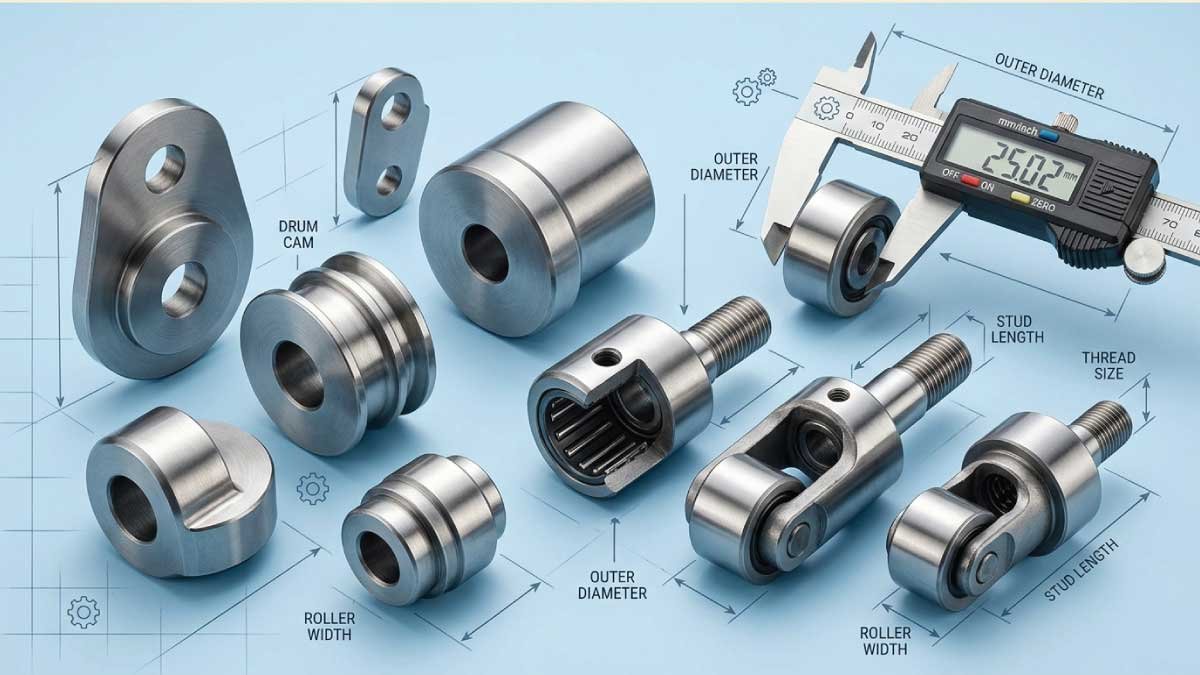
Cams and cam followers are essential mechanical components used to convert rotary motion into linear or controlled motion. You will find them in engines, automation machines, textile machinery, packaging systems, and robotics.
A cam works by pushing against a follower, which then moves in a controlled pattern. Because these components operate under constant contact and load, selecting the correct size is critical for performance, durability, and smooth operation.
That is why engineers and technicians often rely on a cam and cam followers size chart when designing or replacing parts.
This guide explains cam follower sizes, types, dimensions, and provides a practical reference chart for real-world use.
What Is a Cam?
A cam is a specially designed mechanical component that rotates or slides to produce controlled motion in another part of a machine. It converts rotary motion into a predetermined linear or oscillating movement. The exact motion depends entirely on the cam’s profile shape, which is engineered for precision.
Cams are used to:
- Open and close valves
- Control engine timing
- Drive automation systems
- Create precise mechanical motion
The shape of the cam determines how the follower moves.
What Is a Cam Follower?
A cam follower is a mechanical part that stays in direct contact with the cam surface and translates its motion into guided movement. It is built to withstand continuous contact while reducing friction and wear. Cam followers ensure smooth transfer of motion in machines requiring accuracy and stability.
It typically consists of:
- A roller or needle bearing
- A stud or shaft
- A bearing housing
Cam followers are designed to handle:
- High loads
- Continuous contact
- Rotational movement
- Minimal friction
Why Cam and Cam Follower Size Matters
Correct sizing is essential because it directly affects how efficiently the cam and follower system operates under load and motion conditions. Proper dimensions ensure accurate contact, reduced stress, and stable performance. Incorrect sizing can quickly lead to mechanical issues, reduced efficiency, and early system failure.
If size is incorrect:
- Excessive wear
- Noise and vibration
- Misalignment
- Bearing failure
- Poor motion accuracy
If correctly sized:
- Smooth operation
- Long lifespan
- Reduced friction
- High load capacity
Cam Follower Size Chart (Standard Metric Series)
Cam followers are mechanical components that are commonly selected based on their stud diameter, roller diameter, and width. These dimensions directly affect load handling, durability, and suitability for different mechanical applications. The following chart helps classify cam followers from light-duty to extra heavy-duty industrial use.
1. Small Cam Followers (Light-duty applications)
Small cam followers are designed for low-load and precision-based systems where smooth motion and compact size are important. They are commonly used in instruments, small machines, and light automation setups where forces are minimal but accuracy is required.
| Stud Size (mm) | Roller Diameter (mm) | Width (mm) | Load Capacity |
|---|---|---|---|
| 3 mm | 10 mm | 8 mm | Very light duty |
| 4 mm | 12 mm | 10 mm | Light automation |
| 5 mm | 16 mm | 11 mm | Small machinery |
| 6 mm | 19 mm | 12 mm | Instrument systems |
| 8 mm | 24 mm | 14 mm | Light mechanical loads |
2. Medium Cam Followers (Industrial applications)
Medium cam followers are widely used in standard industrial machines where moderate loads and continuous operation are involved. They provide a good balance between strength and efficiency, making them suitable for packaging, textile, and automation systems that run for long durations.
| Stud Size (mm) | Roller Diameter (mm) | Width (mm) | Load Capacity |
|---|---|---|---|
| 10 mm | 30 mm | 15 mm | Medium load systems |
| 12 mm | 35 mm | 18 mm | Packaging machines |
| 14 mm | 40 mm | 20 mm | Textile machinery |
| 16 mm | 47 mm | 24 mm | Automation systems |
| 18 mm | 52 mm | 24 mm | Conveyor systems |
3. Heavy-duty Cam Followers (High load applications)
Heavy-duty cam followers are built for strong mechanical systems that experience high stress, heavy impact, and continuous operation. These are commonly found in industrial presses, construction equipment, and large-scale machinery where durability and load resistance are critical.
| Stud Size (mm) | Roller Diameter (mm) | Width (mm) | Load Capacity |
|---|---|---|---|
| 20 mm | 62 mm | 28 mm | Heavy machinery |
| 22 mm | 72 mm | 30 mm | Industrial presses |
| 25 mm | 80 mm | 32 mm | Construction equipment |
| 30 mm | 90 mm | 36 mm | High-load systems |
| 35 mm | 100 mm | 40 mm | Mining machinery |
4. Extra Heavy-duty Cam Followers
Extra heavy-duty cam followers are engineered for extreme working conditions where very high loads, shock forces, and continuous heavy operations are involved. They are used in large industrial plants, steel manufacturing units, and massive mechanical systems requiring maximum strength and reliability.
| Stud Size (mm) | Roller Diameter (mm) | Width (mm) | Application |
|---|---|---|---|
| 40 mm | 110 mm | 45 mm | Steel plants |
| 45 mm | 120 mm | 50 mm | Large automation lines |
| 50 mm | 130 mm | 55 mm | Heavy industrial presses |
| 60 mm | 150 mm | 60 mm | Extreme load systems |
You May Also Like:
Cam Types and Their Sizes
Cam types are mainly defined by their shape and motion style, and each design has a direct impact on its size, strength, and application. Some cams are compact and simple, while others are large and built for heavy industrial motion control systems requiring higher force and precision.
1. Plate Cam
Plate cams are one of the simplest and most commonly used cam types. They have a flat, disc-like shape and rotate around a fixed axis. Their size is usually compact, making them suitable for light-duty machines where basic motion control is required without complex mechanical arrangements.
- Flat disc shape
- Used in simple machines
- Compact size
- Low to medium loads
2. Cylindrical Cam
Cylindrical cams, also known as drum cams, are designed in a cylindrical shape and provide highly precise motion control. They are commonly used in automated systems where accurate timing and repetitive motion are required. Their size is generally medium to large depending on load and system complexity.
- Drum-shaped cam
- Used in automation systems
- Medium size range
- High precision motion
3. Translating Cam
Translating cams move in a straight line instead of rotating, which makes them suitable for specialized mechanical systems. Their size is not fixed and is often custom-designed based on the machine’s requirements. They are used where linear motion control and precise displacement are needed.
- Moves linearly instead of rotating
- Used in specialized machinery
- Custom sizing required
- Designed for specific applications
4. Wedge Cam
Wedge cams operate by sliding motion and are commonly used in lifting or pushing mechanisms. They are generally medium to large in size because they must handle significant force and mechanical stress. These cams are suitable for heavy-duty applications where strong lifting action is required.
- Used for lifting mechanisms
- Medium to large size
- High force applications
Cam Follower Types
Cam followers are designed in different structural forms to match specific mechanical needs such as load handling, alignment, and motion accuracy. Each type has its own construction style and is selected based on working conditions, speed, and force requirements in a system.
1. Stud Type Cam Follower
Stud type cam followers come with an integrated stud shaft, making them very easy to mount directly into a machine body. They are widely used in general-purpose machinery because of their simple design, compact structure, and quick installation. They are suitable for light to medium load applications.
- Built-in stud shaft
- Easy installation
- Common in general machinery
2. Yoke Type Cam Follower
Yoke type cam followers are mounted using a separate pin or shaft instead of a built-in stud. This design allows them to handle significantly higher loads and better shock resistance. They are commonly used in heavy-duty machines where strength and durability are more important than compact installation.
- Mounted using a pin or shaft
- Higher load capacity
- Used in heavy machinery
3. Needle Roller Cam Follower
Needle roller cam followers use needle bearings inside the roller to reduce friction and improve load distribution. This design provides high precision movement and smooth operation, making them suitable for applications where accuracy and low resistance are essential in continuous motion systems.
- Uses needle bearings
- High precision
- Low friction
4. Crowned Roller Cam Follower
Crowned roller cam followers have a slightly curved roller surface instead of a flat one. This design helps reduce edge stress and improves alignment during operation. They are especially useful in systems where slight misalignment can occur and smooth contact must be maintained.
- Slightly curved roller surface
- Reduces edge stress
- Improves alignment
You May Also Like:
Cam Follower Dimension Breakdown
Each cam follower is defined by key dimensional parameters that directly affect its strength, motion behavior, and suitability for different mechanical applications. These measurements help engineers select the right follower for load capacity, stability, and precision in various industrial systems.
1. Stud Diameter
The stud diameter refers to the thickness of the shaft that is used to mount the cam follower into a machine structure. It plays a major role in determining overall strength and load-handling capability. Larger stud sizes are used for heavy-duty systems, while smaller sizes fit compact mechanisms.
- Small: 3–8 mm
- Medium: 10–18 mm
- Large: 20–50+ mm
2. Roller Diameter
The roller diameter is the outer circular surface that directly contacts the cam profile. It greatly influences how load is distributed and how smoothly the motion is transferred. Larger rollers provide better load capacity and durability, while smaller rollers respond faster and are used in lighter, high-speed applications.
- Affects load distribution and contact surface.
- Larger rollers = higher load capacity
- Smaller rollers = faster response
3. Width
The width of a cam follower determines its stability during operation and its ability to handle lateral forces. Wider followers provide improved load distribution and greater strength, making them suitable for heavy applications. Narrow designs are used where space is limited and compact installation is required.
- Determines stability and strength.
- Wider = better load distribution
- Narrow = compact design
How to Select Cam Follower Size (Selection Guide)
Selecting the correct cam follower size is important for ensuring smooth motion, long service life, and reduced wear in mechanical systems. The selection depends on load, speed, motion type, alignment, and working environment. A properly chosen cam follower improves efficiency and prevents premature failure of the entire mechanism.
1. Load Requirements
Load capacity is one of the most important factors in selecting cam follower size. When the system carries heavy loads, a larger roller diameter and thicker stud are required to distribute stress evenly. Light-duty applications can use smaller followers, but under-sizing may lead to deformation and early bearing failure.
2. Speed of Operation
The operating speed directly affects cam follower selection. High-speed systems require precision bearings with low rotational inertia to reduce vibration and heat generation. Smaller and well-balanced followers are preferred for fast motion, while slower systems can use larger sizes that prioritize strength over speed efficiency and smooth operation.
3. Type of Motion
The nature of motion determines the suitable cam follower type and size. Continuous motion systems need heavy-duty cam followers designed for long-term endurance and consistent contact. In contrast, intermittent or stop-start motion applications can use standard followers, as they experience less continuous stress and wear during operation cycles.
4. Alignment Conditions
Alignment plays a critical role in performance and durability. If there is a possibility of shaft misalignment, crowned rollers are preferred because they can self-adjust and reduce edge loading. Proper alignment allows the use of standard rollers, but poor alignment demands more flexible designs to avoid uneven wear and stress concentration.
5. Environmental Conditions
Working conditions significantly impact cam follower selection. In dusty or dirty environments, sealed cam followers are essential to prevent contamination and bearing damage. For high-temperature applications, heat-resistant materials and specialized lubricants are required. Harsh environments demand more durable designs to ensure reliable performance and longer operational life.
You May Also Like:
Cam & Cam Follower Applications
Cam and cam follower systems are widely used mechanical components that convert rotary motion into controlled linear or reciprocating motion. They are essential in systems where precise timing, smooth movement, and reliable automation are required across multiple industries like automotive, manufacturing, robotics, and heavy machinery.
1. Automotive engines
In automotive engines, cam and cam follower systems are used in valve timing mechanisms such as those found in vehicles like the Toyota Corolla. The camshaft controls the opening and closing of engine valves at precise intervals, while cam followers ensure smooth contact, reduced friction, and efficient engine timing for better performance and fuel efficiency.
2. Industrial automation
In industrial automation, cam and cam follower systems are used in packaging machines, conveyor systems, and assembly lines. They help achieve synchronized and repetitive mechanical motion with high accuracy. These systems are essential in mass production environments where consistency, timing precision, and reduced mechanical errors are critical for efficient operation.
3. Textile machinery
In textile machinery, cam and cam follower mechanisms are used for high-speed motion control and precise repetitive movements. They play an important role in weaving, knitting, and stitching processes by ensuring accurate mechanical timing. This helps maintain fabric quality and allows machines to run smoothly at very high production speeds.
4. Robotics
In robotics, cam and cam follower systems are used for motion control and high-precision positioning tasks. They help robots perform controlled and repeatable movements in operations like picking, placing, and assembly. These components improve accuracy, stability, and smooth motion, making them essential for advanced automated robotic systems.
5. Heavy machinery
In heavy machinery, cam and cam follower systems are used in press machines, mining equipment, and construction systems. They help manage powerful mechanical movements with precision and reliability. These components are built to handle heavy loads, reduce wear, and ensure consistent performance in demanding industrial environments.
Common Cam Follower Materials
Cam followers are manufactured using different materials depending on load, speed, environment, and durability requirements. The material selection directly affects performance, wear resistance, and service life. Industries choose specific materials to ensure smooth motion, reduced friction, and reliable operation in mechanical systems ranging from engines to automation equipment.
1. Bearing steel
Bearing steel is widely used for cam followers due to its high strength and excellent fatigue resistance. It can handle heavy loads and continuous motion without deforming easily. This material is commonly used in industrial machinery where durability, precision, and long operational life are required under demanding working conditions.
2. Stainless steel
Stainless steel cam followers offer strong corrosion resistance, making them suitable for environments exposed to moisture, chemicals, or hygiene requirements. They are commonly used in food processing and chemical industries. This material ensures reliable performance while preventing rust, extending component life, and maintaining smooth mechanical operation in harsh conditions.
3. Case-hardened steel
Case-hardened steel is designed with a hard outer layer and a tough inner core, providing excellent wear resistance. This makes cam followers highly durable under friction and repetitive motion. It is widely used in applications where long service life, strength, and resistance to surface wear are essential for consistent performance.
You May Also Like:
Cam Follower Failure Reasons
Cam follower failures usually occur due to improper operating conditions, poor maintenance, or incorrect installation. These issues reduce efficiency, increase wear, and shorten service life. Understanding the main causes helps in improving machine reliability, reducing downtime, and ensuring smooth mechanical performance in industrial and automotive applications.
1. Overloading
Overloading happens when cam followers are subjected to forces beyond their rated capacity. This excessive stress leads to deformation, surface fatigue, and early failure. Continuous overloading significantly reduces lifespan and can cause sudden breakdowns in machinery, making proper load selection very important for safe and efficient operation.
2. Poor lubrication
Poor lubrication increases friction between the cam and follower surfaces, leading to excessive heat generation and wear. Without proper lubrication, metal-to-metal contact occurs, which damages bearings and reduces smooth motion. Regular lubrication is essential to maintain efficiency, minimize wear, and extend the overall service life of the component.
3. Misalignment
Misalignment occurs when the cam follower is not properly aligned with the cam surface. This results in uneven contact, causing localized stress and irregular wear patterns. Over time, it can lead to vibration, noise, and premature failure. Proper installation and alignment are critical for stable and efficient system performance.
4. Contamination
Contamination from dust, dirt, or debris can enter the cam follower bearing system and damage internal components. These particles increase friction and accelerate wear, leading to reduced performance and early failure. Using seals and proper protective measures helps prevent contamination and ensures smooth and reliable operation in harsh environments.
Maintenance Tips
Proper maintenance of cam followers is essential for ensuring long service life, smooth motion, and reliable machine performance. Regular care helps reduce wear, prevent unexpected breakdowns, and improve efficiency in mechanical systems used in automotive, industrial, and automation applications.
1. Regular lubrication
Regular lubrication is important to reduce friction between the cam and follower surfaces. It helps minimize heat buildup and prevents metal-to-metal contact. Proper lubrication also reduces wear and ensures smooth movement. Using the correct type and amount of lubricant significantly increases the lifespan and performance of cam follower systems.
2. Inspection
Routine inspection helps identify early signs of wear, noise, vibration, or surface damage in cam followers. Checking components regularly allows timely maintenance before serious failure occurs. This practice improves machine reliability, reduces downtime, and ensures that the system continues to operate safely and efficiently under working conditions.
3. Proper alignment
Proper alignment ensures that the cam follower maintains even contact with the cam surface. This helps distribute load evenly and reduces uneven wear. Misalignment can cause vibration, noise, and premature failure. Accurate installation and periodic adjustment are necessary to maintain smooth operation and extend the life of the mechanical system.
4. Use sealed units
Using sealed cam follower units helps protect internal components from dust, dirt, and moisture. This prevents contamination-related damage and reduces maintenance requirements. Sealed units are especially useful in harsh or dirty environments, as they ensure longer service life, improved reliability, and consistent performance of the mechanical system.
Quick Reference Chart (Most Used Sizes)
Cam follower sizes are selected based on load requirements, machine type, and operating conditions. Smaller sizes are used in light-duty systems, while larger sizes handle heavy loads and extreme industrial applications. This quick guide helps engineers and technicians choose the right stud diameter for efficient performance.
5–8 mm stud → light machinery
Cam followers with 5–8 mm stud diameters are used in light machinery where loads are minimal and motion is relatively simple. These are common in small automation devices, office equipment, and compact mechanical systems. They offer smooth operation, low friction, and are ideal for precision-based light-duty applications.
10–16 mm stud → industrial automation
Cam followers in the 10–16 mm range are widely used in industrial automation systems. They are suitable for packaging machines, conveyor systems, and assembly lines. This size provides a balance between strength and precision, making it ideal for continuous operation under moderate loads and repetitive motion conditions.
20–30 mm stud → heavy machinery
Cam followers with 20–30 mm stud diameters are designed for heavy machinery applications. They are used in press machines, construction equipment, and material handling systems. These components are built to handle high loads, strong impacts, and continuous operation while maintaining durability and stable mechanical performance.
40–60 mm stud → extreme load systems
Cam followers in the 40–60 mm range are used in extreme load systems where maximum strength and durability are required. These are found in mining equipment, large industrial presses, and heavy construction machinery. They are engineered to withstand very high stress, heavy impact loads, and harsh working environments.
Final Thoughts
A cam and cam follower size chart is essential for selecting the right component in mechanical systems. Since these parts are constantly in motion and under load, proper sizing directly affects performance, durability, and safety.
The key points to remember are:
- Cam followers are defined by stud size, roller diameter, and width
- Larger sizes handle higher loads but require more space
- Proper lubrication and alignment are critical for long life
- Different applications require different cam follower types
From small automation systems to heavy industrial machines and automotive engines like Toyota Corolla, cam followers play a vital role in converting motion efficiently.
Choosing the right size from the beginning ensures smooth operation, reduced maintenance, and long-term reliability in any mechanical system.