
If you have ever worked with pipes—whether in plumbing, construction, or mechanical projects, you already know how confusing pipe sizes can be. Stainless steel pipes are widely used because of their durability, corrosion resistance, and long lifespan. But understanding their sizing system? That’s where many people get stuck.
In this complete guide, I will walk you through everything you need to know about stainless steel pipe size charts in a simple, practical, and real-world way, just like a teacher explaining it step by step.
Key Terms You Must Know
Before jumping into the stainless steel pipe size chart, it’s important to understand a few basic pipe sizing terms. These terms are commonly used in engineering, plumbing, manufacturing, and industrial systems, and they help you read pipe charts accurately without confusion or sizing mistakes.
1. Nominal Pipe Size (NPS)
Nominal Pipe Size (NPS) is a standardized system used to identify pipe sizes in North America. It serves as a reference name rather than an exact physical measurement, which often confuses beginners when comparing pipe dimensions for the first time.
For example:
- A 2-inch NPS pipe does NOT mean it is exactly 2 inches in diameter.
Instead, the actual outside diameter is usually larger than the stated nominal size. NPS helps manufacturers and engineers maintain compatibility between fittings, valves, and different piping systems across industries.
2. Outside Diameter (OD)
Outside Diameter (OD) refers to the actual external width of the pipe measured from one outer edge to the opposite outer edge. For a specific NPS value, the outside diameter usually stays constant regardless of the schedule or wall thickness.
This consistency is important because fittings, clamps, flanges, and connectors are designed according to the pipe’s outside diameter. Even if wall thickness changes, the OD generally remains the same for compatibility purposes.
3. Inside Diameter (ID)
Inside Diameter (ID) is the measurement of the hollow internal opening through which fluids, gases, or materials flow. This dimension directly affects flow rate, pressure performance, and overall system efficiency in both industrial and residential piping applications.
The inside diameter changes depending on the pipe wall thickness. Thicker walls reduce the internal opening, while thinner walls increase flow space. That’s why two pipes with the same NPS can still have different flow capacities.
4. Schedule (SCH)
Schedule (SCH) refers to the wall thickness of a pipe. It is one of the most important factors in pipe selection because it affects pressure handling capability, strength, durability, and the pipe’s inside diameter.
Common schedules:
- SCH 5 (thin)
- SCH 10
- SCH 40 (standard)
- SCH 80 (thick)
- SCH 160 (extra thick)
Higher schedule = thicker pipe walls.
A higher schedule pipe can withstand greater pressure and harsh operating conditions, but it also becomes heavier, more expensive, and slightly reduces internal flow space due to increased wall thickness.
Stainless Steel Pipe Size Chart (Standard Reference)
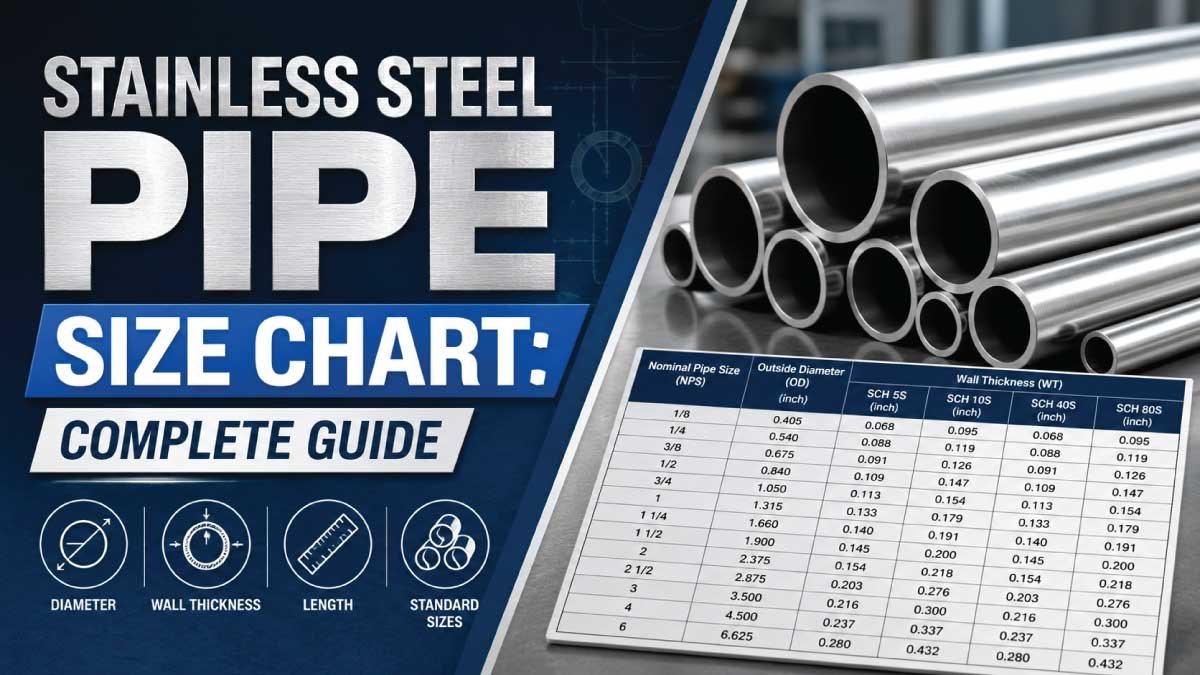
Here is a simplified and commonly used stainless steel pipe size chart:
| NPS (Inch) | OD (mm) | SCH 10 ID (mm) | SCH 40 ID (mm) | SCH 80 ID (mm) |
|---|---|---|---|---|
| 1/2 | 21.3 | 18.0 | 15.8 | 13.7 |
| 3/4 | 26.7 | 23.5 | 20.9 | 18.6 |
| 1 | 33.4 | 30.2 | 26.6 | 24.3 |
| 1 1/2 | 48.3 | 44.5 | 40.9 | 38.1 |
| 2 | 60.3 | 56.3 | 52.5 | 49.3 |
| 3 | 88.9 | 84.7 | 77.9 | 73.7 |
| 4 | 114.3 | 109.1 | 102.3 | 97.1 |
| 6 | 168.3 | 161.5 | 154.1 | 146.3 |
| 8 | 219.1 | 211.1 | 202.7 | 193.7 |
Important Tip:
OD remains the same for each NPS, but ID changes depending on schedule.
Understand the Size Chart (Simple Explanation)
Understanding a stainless steel pipe size chart becomes much easier once you know how outside diameter, wall thickness, and inside diameter work together. Many beginners assume pipe sizing is complicated, but the basic concept is actually simple when explained practically.
Let me explain this in an easy way:
- If you pick a 2-inch pipe, its outer diameter is always 60.3 mm
But if you choose:
- SCH 10 → thinner walls → larger inner diameter
- SCH 80 → thicker walls → smaller inner diameter
So, the flow capacity changes, even though the outer size is the same. This happens because thicker walls reduce the internal opening available for liquid or gas flow, which directly impacts pressure handling and system performance.
How to Choose the Right Pipe Size
Selecting the correct stainless steel pipe size is not only about dimensions. It also depends on the operating conditions, flow needs, pressure levels, and the type of fluid moving through the system. A practical approach helps avoid costly installation or performance problems later.
1. Flow Requirement
The first thing to evaluate is the amount of liquid, gas, or material that needs to move through the pipe system. Flow requirement plays a major role in determining the proper inside diameter and overall pipe efficiency.
Ask yourself:
- How much liquid or gas needs to pass through?
Higher flow → larger inner diameter required.
If the pipe is too small, the system may experience reduced efficiency, pressure drops, and restricted flow. Larger internal diameters allow smoother movement and better performance in high-flow industrial applications.
2. Pressure Rating
Pressure rating is another critical factor when selecting stainless steel pipes, especially in industrial plants, steam systems, hydraulic systems, and chemical processing environments where pipes must safely withstand high internal pressure without failure.
- High-pressure systems need thicker pipes
- Choose higher schedules like SCH 80 or SCH 160
Thicker pipe walls provide additional strength and durability under demanding operating conditions. Although higher schedule pipes cost more and reduce internal flow space slightly, they offer better safety and long-term reliability in pressure-intensive applications.
3. Application Type
| Application | Recommended Schedule |
|---|---|
| Water supply | SCH 10 / SCH 40 |
| Industrial piping | SCH 40 / SCH 80 |
| High-pressure lines | SCH 80 / SCH 160 |
| Structural use | Depends on load |
4. Corrosion Environment
Stainless steel grades matter too:
- 304 → general use
- 316 → marine and chemical environments
Even the correct size won’t help if the material isn’t suitable.
Our Trending Post:
Stainless Steel Pipe Schedules Explained
Pipe schedules can seem confusing at first, but they simply represent the wall thickness of a pipe. As the schedule number increases, the pipe wall becomes thicker, stronger, heavier, and more capable of handling high-pressure or demanding industrial environments.
Let’s break schedules down in a very practical way:
SCH 10
- Thin wall
- Lightweight
- Used in low-pressure systems
SCH 10 pipes are commonly selected for applications where high pressure is not a major concern. They are easier to handle, less expensive, and ideal for systems requiring good corrosion resistance with reduced overall weight and material cost.
SCH 40
- Standard thickness
- Most commonly used
- Good balance between strength and cost
SCH 40 is one of the most widely used pipe schedules because it offers reliable strength for general industrial, plumbing, construction, and mechanical applications while still remaining cost-effective and practical for everyday use.
SCH 80
- Thick walls
- Suitable for high pressure
- More durable but heavier
SCH 80 pipes are designed for systems operating under higher pressure or more demanding conditions. Their thicker walls improve durability and strength, making them suitable for industrial processing, chemical plants, and heavy-duty piping systems.
SCH 160
- Very thick
- Used in extreme conditions
SCH 160 pipes are built for highly demanding applications involving extreme pressure, harsh chemicals, or severe operating environments. These pipes provide maximum strength and safety but are significantly heavier and more expensive than lower schedules.
Our Trending Post:
Example (Easy to Understand)
Understanding pipe schedules becomes much easier when you look at a real-world example. In practical systems, engineers often balance flow capacity and pressure strength depending on how the piping system will actually be used in industrial or residential applications.
Imagine you are designing a water system:
- You choose a 2-inch pipe
If you use SCH 10:
- More water can flow
- But pressure resistance is lower
If you use SCH 80:
- Less flow
- But stronger and safer for high pressure
So, it’s always a trade-off between flow vs strength. A thinner wall gives you more internal space for fluid movement, while a thicker wall provides greater durability and pressure-handling capability for demanding operating conditions.
Common Mistakes to Avoid
When working with stainless steel pipes, beginners often focus only on pipe size numbers without understanding the technical details behind them. This can lead to installation problems, reduced efficiency, unnecessary costs, or even system failure in high-pressure applications.
From experience, here are mistakes beginners often make:
1. Confusing OD with ID
Many new users assume the pipe size always represents the inner diameter, but that is not how standard pipe sizing systems work in industrial and mechanical applications. Understanding the difference between OD and ID is extremely important.
- Many people assume pipe size equals inner diameter—it doesn’t.
The outside diameter usually stays constant for a given NPS, while the inside diameter changes depending on the wall thickness or schedule. This confusion often causes incorrect pipe selection and flow calculation errors.
2. Ignoring Schedule
Some people only look at the nominal pipe size and completely ignore the schedule number. This is a major mistake because the schedule directly affects pipe strength, pressure rating, and the inside diameter available for fluid flow.
- Choosing only NPS without considering schedule can lead to failure.
For example, two pipes may both be labeled as 2-inch pipes, but SCH 10 and SCH 80 will perform very differently under pressure. Always evaluate wall thickness before final selection.
3. Over-Sizing Pipes
Bigger pipes are not always better. Oversized pipes increase project cost and may reduce system efficiency if the flow requirement does not actually need such a large internal diameter or higher material usage.
Bigger pipes:
- Cost more
- Waste material
- Reduce efficiency
Large pipes can also increase installation complexity and require additional support structures. Proper sizing helps maintain balance between performance, efficiency, and long-term operating costs.
4. Not Considering Standards
Many beginners purchase pipes without checking whether they follow recognized engineering and manufacturing standards. This can create compatibility issues, fitting problems, or even safety risks in industrial and construction applications.
Always follow industry standards like:
- ASME
- ASTM
- ANSI
These ensure compatibility and safety. Standardized pipes and fittings are manufactured within specific tolerances, helping systems operate reliably across different industries and international projects.
Stainless Steel Pipe Standards
Pipe standards are essential because they define dimensions, tolerances, material quality, pressure capability, and manufacturing requirements. Without standardization, pipes from different manufacturers may not fit correctly or perform safely in critical systems.
Different standards define pipe dimensions and tolerances:
- ASTM A312 → Stainless steel pipes
- ASME B36.19 → Stainless steel pipe dimensions
- ANSI → General standards
These standards make sure pipes fit properly across systems worldwide. They also help engineers, manufacturers, and contractors maintain consistency, safety, and reliable performance in plumbing, structural, mechanical, and industrial piping applications.
Metric vs Imperial Sizes
In many countries, pipe sizes are given in inches (NPS), but actual measurements may be in millimeters.
For example:
- 2-inch pipe → 60.3 mm OD
So always double-check units before purchasing.
Our Trending Post:
Applications of Stainless Steel Pipes
Stainless steel pipes are widely used across multiple industries because of their strength, corrosion resistance, and long service life. Their ability to perform under pressure, moisture, heat, and chemical exposure makes them one of the most reliable piping solutions available today.
Stainless steel pipes are used in:
1. Construction
In the construction industry, stainless steel pipes are commonly used for structural and architectural applications because they provide excellent durability, modern appearance, and resistance to weather-related corrosion in both indoor and outdoor environments.
- Structural supports
- Handrails
These pipes are often selected for commercial buildings, bridges, stair systems, and industrial frameworks where long-term strength and low maintenance are important factors.
2. Oil & Gas
The oil and gas industry requires pipes that can safely handle high pressure, temperature fluctuations, and corrosive environments. Stainless steel pipes are preferred because they offer excellent mechanical strength and reliable performance in demanding operating conditions.
- High-pressure pipelines
- Offshore systems
Their resistance to rust and harsh chemicals makes them suitable for refineries, drilling operations, offshore platforms, and energy transportation systems.
3. Food Industry
In food and beverage processing, hygiene and cleanliness are extremely important. Stainless steel pipes are widely used because their smooth surfaces resist contamination and are easy to clean, helping maintain strict sanitary standards.
- Hygienic piping
- Dairy and beverage systems
These pipes are commonly found in milk processing plants, breweries, food factories, and commercial kitchens where cleanliness and corrosion resistance are critical requirements.
4. Chemical Industry
Chemical plants often transport aggressive liquids, gases, and corrosive substances that can quickly damage ordinary steel pipes. Stainless steel pipes are designed to resist chemical attack and maintain long-term reliability in harsh industrial environments.
- Corrosion-resistant transport
They are used in chemical processing systems, pharmaceutical plants, and industrial manufacturing facilities where safety and corrosion protection are essential.
5. Automotive & Mechanical
The automotive and mechanical industries use stainless steel pipes for systems that require strength, heat resistance, and durability under vibration and pressure. These pipes help improve performance and increase component lifespan.
- Exhaust systems
- Hydraulic lines
They are also used in heavy machinery, manufacturing equipment, and mechanical assemblies where reliable fluid or gas transport is required.
Benefits of Stainless Steel Pipes
Stainless steel pipes are preferred in many industries because they combine durability, strength, and corrosion resistance with low maintenance requirements. Although the initial cost may be higher, they often provide better long-term value compared to ordinary steel pipes.
Here’s why they are preferred:
- Excellent corrosion resistance
- Long lifespan
- High strength
- Low maintenance
- Environmentally friendly
Even though they cost more initially, they save money in the long run because they require fewer repairs, last longer, and maintain reliable performance even in harsh industrial and outdoor conditions.
Tips for Beginners
If you are new to pipe sizing or mechanical systems, understanding the basics before purchasing pipes can save time, money, and frustration. A small sizing mistake can affect system efficiency, pressure handling, and long-term durability.
If you are just starting out (like many readers of mechanical blogs), here’s my simple advice:
- Always check both NPS and schedule
- Use standard charts instead of guessing
- Think about application first, size second
- When in doubt, consult an engineer or supplier
I’ve seen many projects fail just because of incorrect sizing—not because of poor materials. Proper planning and understanding of pipe dimensions are just as important as choosing high-quality stainless steel itself.
Quick Reference Summary
This quick summary helps simplify the most important stainless steel pipe sizing concepts. Keeping these points in mind makes it easier to read pipe charts, compare schedules, and understand how pipe dimensions affect flow and pressure performance.
- NPS = nominal size (not actual diameter)
- OD = fixed for each pipe size
- ID = depends on schedule
- Schedule = wall thickness
- Higher schedule = thicker pipe
Once you understand these core terms, selecting the correct stainless steel pipe becomes much more practical and less confusing for both beginners and professionals.
Our Trending Post:
Final Thoughts
Understanding stainless steel pipe size charts might seem complicated at first, but once you grasp the basics—NPS, OD, ID, and schedule—it becomes much easier to compare pipe sizes and choose the correct option for different applications.
Think of it like this:
- Outer size stays the same
- Inner space changes
- Thickness determines strength
Whenever you select a pipe, don’t just ask “What size?” Instead, think about the operating conditions and the actual system requirements before making a decision.
Ask:
- What flow do I need?
- What pressure will it handle?
- What environment will it face?
That’s how professionals think—and now you can too.