
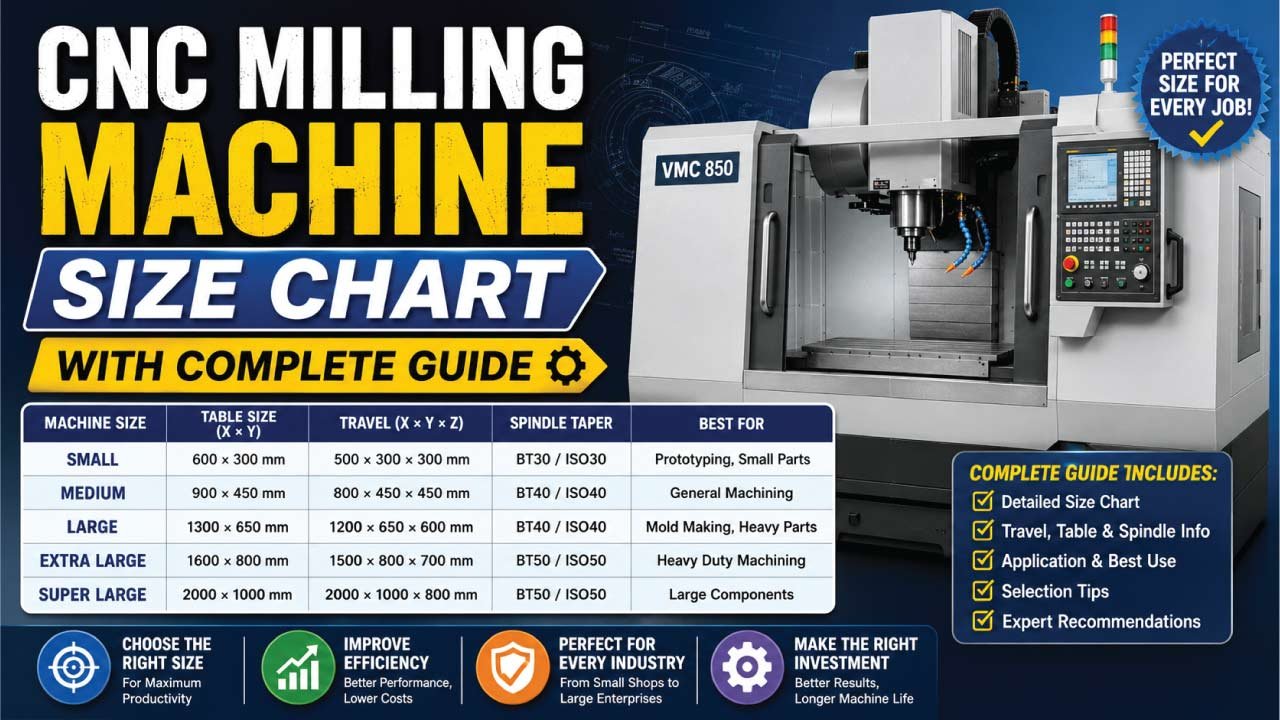
CNC milling machines are among the most important machines used in manufacturing, machining, metalworking, aerospace, automotive production, and industrial engineering. These machines provide precise cutting, drilling, shaping, and finishing operations for metals, plastics, composites, and other materials.
Choosing the correct CNC milling machine size is critical because machine dimensions directly affect workspace capacity, production capability, material handling, machining precision, and manufacturing efficiency. Whether you are operating a small workshop, tool room, or industrial production facility, understanding CNC mill sizes helps you select the right machine for your needs.
This complete guide explains CNC milling machine sizes, travel dimensions, table capacities, spindle types, machine categories, and selection tips.
What Is a CNC Milling Machine?
A CNC milling machine is a computer-controlled machining tool that removes material from a workpiece using rotating cutting tools. CNC stands for Computer Numerical Control, meaning the machine follows programmed instructions automatically.
CNC milling machines are used for:
- Metal cutting
- Precision machining
- Mold manufacturing
- Automotive components
- Aerospace parts
- Prototype production
- Tool making
- Industrial fabrication
Unlike manual milling machines, CNC mills offer extremely high accuracy, repeatability, and automation.
Why CNC Milling Machine Size Matters
Choosing the correct CNC milling machine size is extremely important for manufacturing performance, machining accuracy, production efficiency, and long-term operational flexibility. Machine size directly affects the types of parts that can be produced, the materials that can be machined, and the overall productivity of the workshop or factory. Selecting the right machine size also helps reduce limitations during future production expansion.
1. Workpiece Capacity
Larger CNC milling machines can handle bigger workpieces, heavier materials, and oversized components more effectively. The machine’s travel dimensions and table size determine the maximum part size that can be machined. Choosing the correct machine capacity helps avoid production limitations when working with large industrial or custom-manufactured parts.
2. Machining Flexibility
Proper CNC machine dimensions allow manufacturers to perform more advanced and complex machining operations. Larger work areas provide better flexibility for multi-axis machining, multiple setups, and larger fixture arrangements. This improves the ability to produce complicated components with higher precision and reduced repositioning requirements.
3. Production Efficiency
Correct machine sizing improves overall workflow efficiency and reduces setup restrictions during production. A machine that is too small may require multiple setups for large parts, increasing machining time and labor costs. Properly sized CNC milling machines help maintain smoother production processes and improve manufacturing productivity.
4. Tool Clearance
Larger CNC milling machines often support bigger tooling systems, longer cutting tools, and larger spindle configurations. Adequate tool clearance is important for deep cutting operations, complex part geometries, and high-precision machining. Better tool accessibility also helps reduce collisions and improves machining safety.
5. Future Expansion
Selecting the right CNC milling machine size supports future manufacturing growth and changing production requirements. Businesses that plan for future expansion can handle larger projects and more advanced machining operations without replacing equipment too soon. Investing in suitable machine capacity helps improve long-term operational flexibility and production scalability.
Understand The CNC Milling Machine Dimensions
CNC milling machine size is usually determined by:
- Table size
- X-axis travel
- Y-axis travel
- Z-axis travel
- Spindle capacity
These dimensions define the machine’s working envelope.
CNC Milling Machine Size Chart
Below is a common CNC milling machine size chart.
| Machine Type | Typical Table Size | Common Application |
|---|---|---|
| Mini CNC Mill | 12 × 6 inch | Hobby machining |
| Benchtop CNC Mill | 18 × 8 inch | Small parts |
| Vertical CNC Mill | 40 × 16 inch | General machining |
| Large CNC Mill | 60 × 30 inch | Industrial machining |
| Bridge Mill | 80 × 40 inch | Heavy manufacturing |
| Gantry CNC Mill | 120+ inch tables | Aerospace production |
Mini CNC Milling Machines
Mini CNC mills are compact machines designed for small workshops and hobby applications.
Common Sizes
| Machine Size | Typical Use |
|---|---|
| 12 × 6 inch | Small prototypes |
| 16 × 8 inch | Hobby machining |
| 18 × 10 inch | Small metal parts |
Advantages
- Affordable
- Compact footprint
- Lower power requirements
- Beginner-friendly
Limitations
- Smaller cutting area
- Lower spindle power
- Limited heavy-duty machining capability
Benchtop CNC Milling Machines
Benchtop mills are larger than hobby machines and commonly used in tool rooms and small businesses.
Common Applications
- Prototype production
- Small metal fabrication
- Educational training
- Precision parts machining
Typical Sizes
| Table Size | Common Use |
|---|---|
| 24 × 10 inch | Small workshops |
| 30 × 12 inch | Tool rooms |
| 36 × 14 inch | Light industrial work |
Vertical CNC Milling Machines
Vertical CNC mills are among the most common industrial machining centers.
Common Sizes
| Table Size | Typical Industry |
|---|---|
| 40 × 16 inch | General machining |
| 50 × 20 inch | Automotive parts |
| 60 × 24 inch | Industrial manufacturing |
Why Vertical CNC Mills Are Popular
Vertical machining centers offer:
- High precision
- Efficient chip removal
- Versatile tooling
- Faster setup
- Better accessibility
They are widely used in manufacturing shops worldwide.
Horizontal CNC Milling Machines
Horizontal mills use horizontally mounted spindles.
Common Applications
- Heavy metal removal
- Production machining
- Large industrial components
Advantages
- Better chip evacuation
- Higher productivity
- Improved heavy cutting performance
Common Sizes
| Table Size | Industrial Use |
|---|---|
| 40 × 20 inch | Medium production |
| 60 × 30 inch | Heavy manufacturing |
| 80 × 40 inch | Large components |
CNC Mill Axis Travel Chart
Axis travel determines machine movement range.
| Axis | Function |
|---|---|
| X-Axis | Left-to-right movement |
| Y-Axis | Front-to-back movement |
| Z-Axis | Vertical movement |
Typical Travel Sizes
| Machine Type | X Travel | Y Travel | Z Travel |
|---|---|---|---|
| Mini Mill | 12 inch | 6 inch | 8 inch |
| Benchtop Mill | 20 inch | 10 inch | 12 inch |
| Vertical Mill | 40 inch | 20 inch | 25 inch |
| Industrial Mill | 60+ inch | 30+ inch | 30+ inch |
CNC Milling Machine Table Size Chart
Table size determines workpiece support capacity.
| Table Size | Typical Application |
|---|---|
| 18 × 8 inch | Small machining |
| 40 × 16 inch | Standard production |
| 60 × 24 inch | Heavy industrial work |
| 120 × 40 inch | Aerospace components |
CNC Milling Machine Spindle Size Chart
Spindle power affects cutting capability and material removal rates.
| Spindle Power | Common Use |
|---|---|
| 1–2 HP | Hobby machining |
| 3–5 HP | Small business |
| 7–15 HP | Industrial production |
| 20+ HP | Heavy-duty machining |
CNC Milling Machine Tool Holder Sizes
Tool holders secure cutting tools inside the spindle.
| Tool Holder Type | Common Application |
|---|---|
| ER Collet | Small tools |
| CAT40 | Standard industrial machining |
| CAT50 | Heavy-duty milling |
| BT40 | High-speed machining |
| HSK | Precision manufacturing |
CNC Milling Machine Types
CNC milling machines come in different types, each designed for specific manufacturing needs, material types, and production scales. Choosing the right machine type helps improve machining accuracy, productivity, and operational efficiency. From small precision work to large industrial components, each CNC milling machine category serves a unique purpose in modern manufacturing.
1. Vertical Machining Centers (VMC)
Vertical Machining Centers (VMCs) are the most commonly used CNC milling machines in general manufacturing. In this type, the spindle is positioned vertically, allowing easy access to the workpiece. VMCs are widely used for producing parts with moderate complexity and are ideal for small to medium-sized components in industries like automotive, engineering, and general fabrication.
2. Horizontal Machining Centers (HMC)
Horizontal Machining Centers (HMCs) are designed for high-volume production and heavy-duty machining tasks. The horizontal spindle orientation allows better chip removal and improved efficiency during continuous operations. These machines are commonly used in industries requiring mass production and high-speed machining of complex parts.
3. Gantry Mills
Gantry milling machines are used for machining extremely large and heavy workpieces that cannot fit into standard CNC machines. These machines feature a bridge-like structure that spans over the work area, providing high stability and precision. Gantry mills are commonly used in aerospace, shipbuilding, and large-scale industrial manufacturing.
4. Bridge Mills
Bridge mills are heavy-duty CNC machines designed for large industrial components and high-precision machining. They feature a fixed bridge structure with a moving table or spindle system. Bridge mills are widely used in mold making, automotive manufacturing, and heavy engineering applications where accuracy and stability are critical.
5. Tool Room Mills
Tool room mills are specialized CNC machines designed for precision work, prototyping, and small batch production. These machines are commonly used in tool and die making, research and development, and fine-detail machining. Tool room mills focus on accuracy, surface finish quality, and fine control rather than high-volume production.
Explore Our Latest Article:
CNC Milling Machine Materials
CNC milling machines are highly versatile and can machine a wide range of materials depending on tooling, spindle power, and machining settings. Different materials require different cutting speeds, feeds, and tool types, making material selection an important factor in CNC machining performance and final product quality.
1. Metals
Metals are among the most commonly machined materials in CNC milling. They are used in automotive, aerospace, construction, and engineering applications due to their strength and durability.
- Aluminum
- Steel
- Stainless steel
- Brass
- Copper
- Titanium
Aluminum is widely used for its lightweight properties and ease of machining, while steel and stainless steel are preferred for high-strength applications. Titanium is used in aerospace and medical industries due to its excellent strength-to-weight ratio.
2. Plastics
Plastics are commonly used in CNC milling for lightweight parts, prototypes, and non-structural components. They are easier to machine compared to metals and often require lower cutting forces.
- Acrylic
- Nylon
- Delrin (Acetal)
- PVC
Acrylic is popular for transparent components, while nylon and Delrin are used for mechanical parts that require strength and low friction. PVC is often used in industrial and chemical applications.
3. Composite Materials
Composite materials combine multiple substances to achieve improved strength, durability, and lightweight properties. CNC machining of composites requires special tooling to prevent delamination and material damage.
- Carbon fiber
- Fiberglass
Carbon fiber is widely used in aerospace, automotive, and sports equipment due to its high strength and low weight. Fiberglass is commonly used in marine, construction, and industrial applications where durability and corrosion resistance are important.
CNC Milling Machine Size for Aluminum
Aluminum machining is common in CNC milling.
Recommended machine features:
- High spindle speed
- Good rigidity
- Efficient coolant system
Popular sizes:
- Benchtop mills
- 40 × 16 inch VMCs
- 50 × 20 inch machining centers
CNC Milling Machine Size for Steel
Steel requires stronger and more rigid machines.
Recommended Features
- Heavy cast iron frame
- Powerful spindle
- Stable guideways
- High torque
Common industrial sizes:
- 40 × 20 inch
- 50 × 25 inch
- 60 × 30 inch
CNC Milling Machine Weight Chart
| Machine Type | Approximate Weight |
|---|---|
| Mini CNC Mill | 200–500 lbs |
| Benchtop Mill | 800–2000 lbs |
| Vertical CNC Mill | 5000–12000 lbs |
| Large Industrial Mill | 20000+ lbs |
CNC Milling Machine Floor Space Requirements
Machine size is not the only consideration.
Additional space is needed for:
- Operator access
- Tool changes
- Coolant systems
- Chip removal
- Maintenance access
Example:
A standard vertical machining center may require over 12 × 15 feet of floor space.
Explore Our Latest Article:
CNC Milling Machine Coolant Systems
Coolant helps control heat during machining.
Common Coolant Types
- Flood coolant
- Mist coolant
- Through-spindle coolant
Proper cooling improves:
- Tool life
- Surface finish
- Machining speed
CNC Milling Machine Accuracy
Machine size can affect machining precision.
Typical Accuracy Ranges
| Machine Type | Accuracy |
|---|---|
| Hobby CNC Mill | ±0.005 inch |
| Benchtop Mill | ±0.002 inch |
| Industrial CNC Mill | ±0.0005 inch |
Choose the Right CNC Milling Machine Size
Selecting the correct CNC milling machine size is a critical decision that directly impacts productivity, machining capability, production cost, and long-term business growth. A well-chosen machine size ensures efficient workflows, reduces production limitations, and supports both current and future manufacturing requirements.
1. Consider Part Dimensions
One of the most important factors in selecting a CNC milling machine is the size of the parts you plan to produce. The machine must have enough X, Y, and Z travel to accommodate your largest workpieces comfortably. Choosing a machine that is too small can lead to multiple setups, reduced accuracy, and slower production times.
2. Evaluate Production Volume
Production volume plays a major role in machine selection. High-volume manufacturing environments often require larger, more robust CNC milling machines capable of continuous operation. These machines help improve efficiency, reduce cycle times, and support consistent mass production without frequent downtime or repositioning.
3. Consider Future Needs
It is important to think beyond current production requirements and consider future business growth. Investing in a slightly larger CNC milling machine can provide flexibility for upcoming projects, larger components, and expanding customer demands. This helps avoid early equipment replacement and supports long-term scalability.
4. Analyze Material Types
The type of materials being machined also affects machine size and rigidity requirements. Harder materials such as steel, stainless steel, and titanium require more powerful and stable machines to maintain precision and reduce vibration. Larger, more rigid CNC machines are better suited for heavy-duty machining applications.
5. Review Budget
Budget is a major factor when selecting a CNC milling machine, as larger machines come with higher overall costs. These costs include:
- Higher purchase price
- Increased installation requirements
- Greater maintenance expenses
- Higher power consumption
While larger machines provide more capability, it is important to balance cost with actual production needs to ensure a cost-effective investment.
Explore Our Latest Article:
Common CNC Milling Machine Problems
CNC milling machines are highly reliable, but selecting the wrong specifications or ignoring key machine limitations can lead to serious production issues. Understanding common problems helps improve machine selection, machining performance, and overall manufacturing efficiency.
1. Buying a Machine Too Small
One of the most common mistakes is choosing a CNC milling machine that is too small for production needs. A limited work area restricts the size of parts that can be machined and often requires multiple setups for larger components. This reduces accuracy, increases production time, and limits future manufacturing growth.
2. Insufficient Z-Axis Travel
Insufficient Z-axis travel creates major limitations when working with taller workpieces or longer cutting tools. This restriction can prevent the machine from completing deep cuts or complex operations. It also reduces flexibility in tooling options and may force operators to redesign setups unnecessarily.
3. Weak Spindle Power
A weak spindle reduces the machine’s ability to cut hard materials such as steel, stainless steel, or titanium effectively. Low spindle power can result in slower machining speeds, tool wear, and poor cutting performance. This ultimately affects productivity and limits the range of materials that can be processed.
4. Poor Rigidity
Low machine rigidity leads to vibration during cutting operations, especially when machining hard materials or performing heavy cuts. Excess vibration can reduce surface finish quality, decrease dimensional accuracy, and shorten tool life. A rigid machine structure is essential for stable and precise CNC milling operations.
5. Limited Tool Capacity
CNC milling machines with limited tool magazine capacity require frequent tool changes during machining operations. This increases cycle time and reduces overall efficiency. Machines with higher tool capacity allow for more complex machining operations without interruption, improving productivity and reducing downtime.
CNC Milling Machine Maintenance Tips
Proper maintenance of a CNC milling machine is essential for ensuring long-term performance, machining accuracy, and operational reliability. Regular upkeep helps prevent unexpected breakdowns, reduces repair costs, and extends the overall lifespan of the machine. A well-maintained CNC system also improves productivity and surface finish quality.
1. Lubricate Guideways
Guideways are critical components that control smooth machine movement along different axes. Regular lubrication reduces friction, prevents excessive wear, and ensures precise motion control. Proper lubrication also helps maintain machining accuracy and reduces the risk of mechanical damage over time.
2. Clean Chips Regularly
Metal chips and debris generated during machining can accumulate around the machine bed, tool area, and moving components. If not cleaned regularly, these chips can interfere with machine movement and damage sensitive parts. Frequent cleaning helps maintain smooth operation and prevents long-term wear on mechanical systems.
3. Inspect Tool Holders
Tool holders play an important role in maintaining machining accuracy and stability. Worn, damaged, or loose tool holders can lead to poor cutting performance, vibration, and inaccurate dimensions. Regular inspection ensures tools are securely held and operating at optimal precision levels.
4. Monitor Coolant Levels
Coolant is essential for controlling temperature, reducing friction, and improving tool life during machining operations. Low coolant levels can lead to overheating, poor surface finish, and increased tool wear. Regular monitoring and refilling help maintain consistent machining performance and protect both tools and materials.
5. Check Spindle Condition
The spindle is one of the most important components of a CNC milling machine, responsible for rotating the cutting tool at high speeds. Spindle wear or imbalance can negatively affect machining accuracy, surface finish, and overall performance. Regular inspection helps detect early signs of damage and ensures consistent cutting precision.
Explore Our Latest Article:
CNC Milling Machine Safety Tips
CNC milling machines operate at high speeds with sharp cutting tools, making safety a top priority in any machining environment. Proper safety practices help prevent injuries, protect equipment, and ensure smooth and efficient production. Following basic safety guidelines is essential for both beginners and experienced operators.
1. Wear Safety Glasses
Always wear safety glasses or protective goggles when operating a CNC milling machine. During machining, high-speed cutting produces metal chips and debris that can easily fly into the eyes. Proper eye protection reduces the risk of serious injuries and ensures safe working conditions.
2. Secure Workpieces Properly
Workpieces must be tightly secured using clamps, vises, or fixtures before starting any machining operation. Loose materials can shift during cutting, causing tool damage, inaccurate machining, or dangerous projectiles. Proper workpiece clamping ensures stability, accuracy, and operator safety throughout the process.
3. Avoid Loose Clothing
Operators should avoid wearing loose clothing, jewelry, or accessories near CNC machines. Moving parts such as spindles, tool changers, and rotating cutters can easily catch loose items, leading to serious accidents. Wearing fitted clothing and proper protective gear helps minimize safety risks in the workshop.
4. Use Proper Ventilation
CNC machining can produce metal dust, fumes, and coolant mist that may be harmful if inhaled over time. Proper ventilation systems or dust extraction units help maintain clean air quality in the workspace. Good airflow also improves operator comfort and reduces long-term health risks.
5. Keep Guards Installed
Machine guards are designed to protect operators from moving parts, chips, and coolant spray. Removing or disabling safety guards increases the risk of accidents and injuries. Keeping all protective covers and safety features properly installed ensures a safer and more controlled machining environment.
Industrial CNC Milling Machine Sizes
Large industrial machines support mass production and oversized parts.
Common Industrial Sizes
| Machine Type | Typical Table Size |
|---|---|
| Large VMC | 60 × 30 inch |
| Bridge Mill | 80 × 40 inch |
| Gantry Mill | 120 × 60 inch |
Industries using large mills include:
- Aerospace
- Automotive
- Defense
- Heavy equipment manufacturing
Conclusion
Understanding CNC milling machine sizes is essential for selecting the right equipment for machining, manufacturing, metalworking, and industrial production. A proper CNC milling machine size chart helps compare table dimensions, axis travel, spindle power, and workspace capacity.
Small benchtop mills work well for hobby and prototype machining, while vertical machining centers dominate professional manufacturing environments. Large industrial mills support heavy-duty production and oversized components.
Before purchasing a CNC milling machine, carefully consider workpiece size, material type, future production goals, available workshop space, and machining requirements. Choosing the correct machine size improves productivity, machining accuracy, workflow efficiency, and long-term manufacturing capability.
FAQ:
What is a CNC milling machine size?
CNC milling machine size refers to the machine’s working capacity, including table size, X-Y-Z axis travel, spindle power, and overall machining envelope. These dimensions determine how large a workpiece can be processed. Larger machines are used for industrial production, while smaller ones are suitable for hobby or prototype machining applications.
Why does CNC milling machine size matter?
Machine size matters because it directly affects workpiece capacity, machining flexibility, and production efficiency. A properly sized machine allows accurate cutting of large or complex parts. If the machine is too small, it increases setups and reduces precision, while oversized machines may increase cost and space requirements unnecessarily.
How do I choose the right CNC milling machine size?
To choose the right size, consider your part dimensions, material type, production volume, and future needs. Ensure the machine has enough X, Y, and Z travel for your largest components. Also evaluate spindle power and workspace requirements. Selecting the correct size improves efficiency, accuracy, and long-term manufacturing flexibility.
What are common CNC milling machine sizes?
Common CNC milling machine sizes include mini mills (12 × 6 inch), benchtop mills (18 × 8 inch), vertical mills (40 × 16 inch), and large industrial mills (60 × 30 inch or more). Gantry and bridge mills are used for oversized parts in aerospace and heavy manufacturing industries.
What is the difference between vertical and horizontal CNC mills?
Vertical CNC mills have a vertically mounted spindle and are widely used for general machining and precision parts. Horizontal CNC mills use a horizontal spindle, offering better chip removal and higher efficiency for heavy cutting. Vertical mills are more common, while horizontal mills are preferred for large-scale production work.
What materials can be machined on CNC milling machines?
CNC milling machines can process metals like aluminum, steel, stainless steel, brass, copper, and titanium, as well as plastics such as acrylic, nylon, and PVC. They can also machine composites like carbon fiber and fiberglass. Material choice depends on spindle power, tooling, and machine rigidity for optimal performance.