
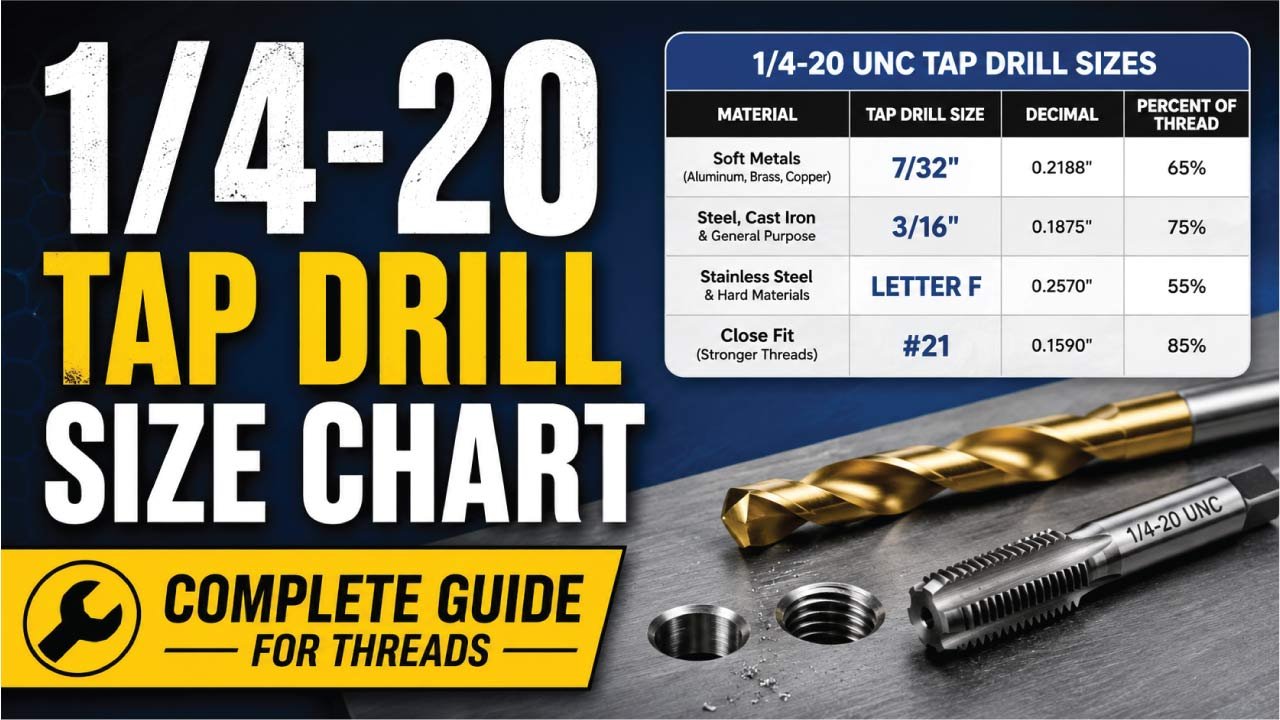
The 1/4-20 thread is one of the most commonly used fastener sizes in machining, manufacturing, automotive repair, metal fabrication, woodworking, and mechanical engineering. Whether you are tapping holes by hand or using CNC machining equipment, selecting the correct tap drill size is essential for creating accurate and strong threads.
Using the wrong drill size can cause broken taps, weak threads, oversized holes, or poor fastener fitment. This complete guide explains the 1/4-20 tap drill size chart, thread dimensions, tapping methods, drill bit selection, thread percentage calculations, and best practices for accurate threading.
What Does 1/4-20 Mean?
The thread designation “1/4-20” is a standard Unified Thread Size used in mechanical engineering and fastening systems. It combines diameter and thread pitch information in a compact format. The first part defines the screw diameter, while the second part indicates how many threads are present per inch of length.
1/4 Inch
This refers to the major diameter of the screw, which is the outermost thickness measured across the threads. It defines how wide the fastener is and plays a key role in load capacity and fit. A 1/4-inch screw is commonly used in machinery, automotive, and structural applications.
\frac{1}{4}\ \text{inch} = 0.250\ \text{inch}
The screw diameter is approximately 0.250 inches.
20 Threads Per Inch (TPI)
The number 20 means the fastener has a thread pitch of 20 threads per inch, which controls how tightly the screw engages with a matching nut or tapped hole. A higher TPI provides finer adjustment, while 20 TPI offers a balanced combination of strength, grip, and ease of assembly.
20\ \text{threads per inch}
This means there are 20 thread peaks within one inch of screw length.
What Is a Tap Drill Size?
A tap drill size refers to the diameter of the drill bit used before creating internal threads with a tap. It determines how much material is removed so that the tap can cut accurate and properly shaped threads inside the hole. Correct sizing is essential for strong and reliable threaded joints.
A properly selected drill size ensures the tap has enough material to form threads without excessive force. If the hole is too small, the tap may break; if too large, the threads become weak and loose. This balance is critical in machining, manufacturing, and mechanical assembly work.
Correct tap drill sizing helps:
- Prevent broken taps
- Create strong threads
- Improve thread accuracy
- Reduce cutting resistance
- Ensure proper fastener fit
1/4-20 Tap Drill Size Chart
Below is the standard drill size chart used for creating internal threads for 1/4-20 UNC fasteners. This chart is widely used in machining, fabrication, and mechanical workshops to ensure accurate thread cutting and proper fastener engagement.
Thread Size | Threads Per Inch | Tap Drill Size | Decimal Size
1/4-20 UNC | 20 TPI | #7 Drill Bit | 0.201 inch
This combination is considered industry standard and is commonly referenced in engineering manuals and workshop guides. It provides a reliable balance between thread strength and ease of tapping.
Standard Tap Drill for 1/4-20
The most commonly recommended drill bit for creating 1/4-20 UNC internal threads is the #7 drill bit. This size produces a hole that allows proper thread formation without overloading the tap, making it suitable for both hand tapping and machine operations.
#7 Drill Bit
0.201\ \text{inch}
This drill size is widely accepted because it produces a consistent thread profile and reduces the chances of tool damage during the tapping process. It is suitable for steel, aluminum, and many general-purpose materials.
Why 75% Thread Engagement Is Common
Thread engagement refers to how much of the internal thread profile is fully formed and in contact with the fastener. It plays a major role in determining the strength and durability of the joint.
In most mechanical applications, 75% engagement is preferred because it offers an optimal balance between strength and ease of manufacturing. Higher engagement levels increase friction and tapping force, which can lead to tool wear or breakage.
Benefits of 75% Threads
- Strong enough for most applications
- Easier tapping process
- Reduced tap breakage risk
- Better chip evacuation
- Faster machining efficiency
Very high thread percentages (above 75–80%) are generally avoided because they significantly increase cutting resistance and can damage taps, especially in harder materials.
1/4-20 Thread Dimensions Chart
| Specification | Dimension |
|---|---|
| Major Diameter | 0.250 inch |
| Threads Per Inch | 20 |
| Tap Drill Size | #7 |
| Drill Decimal Size | 0.201 inch |
| Pitch | 0.050 inch |
Understanding Thread Pitch
Thread pitch is the distance between threads.
For 1/4-20 threads:
\frac{1}{20}=0.050\ \text{inch}
This means each thread is spaced 0.050 inches apart.
UNC vs UNF Threads
1/4-inch fasteners are available in different thread types.
| Thread Type | Threads Per Inch |
|---|---|
| 1/4-20 UNC | 20 TPI |
| 1/4-28 UNF | 28 TPI |
UNC Threads
UNC stands for Unified National Coarse, which is one of the most commonly used thread standards in mechanical fastening systems. These threads have a larger pitch (fewer threads per inch), making them easier to install and more resistant to damage in general-purpose applications such as construction and machinery.
Coarse threads like UNC are widely preferred where quick assembly, strength, and durability in softer materials are required. They also perform well in dirty or less precise environments.
Advantages
- Faster installation
- Better for soft materials
- Stronger thread roots
- Easier assembly
UNF Threads
UNF stands for Unified National Fine, which features a higher thread count per inch compared to UNC threads. This results in finer, more precise threading that is commonly used in applications requiring high accuracy, tight clamping, and resistance to loosening under vibration.
Fine threads are typically used in automotive, aerospace, and precision engineering where controlled tightening is important.
Advantages
- Better vibration resistance
- Higher clamping force
- More precise adjustment
1/4-20 Clearance Hole Size Chart
Clearance holes are drilled to allow bolts or screws to pass through a material without engaging threads. These holes ensure proper alignment and prevent damage to the fastener or workpiece. The hole size depends on the fit type required for the application.
This chart shows standard clearance sizes used for 1/4-20 bolts in mechanical and structural assemblies.
Fit Type | Drill Size | Decimal Size
Close Fit | F Drill | 0.257 inch
Normal Fit | 17/64 inch | 0.266 inch
Loose Fit | H Drill | 0.266 inch
Metric Equivalent of 1/4-20
The 1/4-20 UNC thread is based on the imperial system, but its closest metric equivalent is approximately 6.35 mm in diameter. However, even though the sizes appear similar, metric and imperial threads are not interchangeable due to differences in pitch and thread standards.
0.250\ \text{inch} \approx 6.35\ \text{mm}
Using incorrect matching systems can lead to loose fittings, thread damage, or complete failure of the joint.
Materials Commonly Tapped with 1/4-20 Threads
1/4-20 threads are highly versatile and can be used in a wide range of materials. Their coarse design makes them suitable for both soft and moderately hard materials, ensuring strong holding power and reliable performance in different mechanical applications.
Metals
- Aluminum
- Steel
- Stainless steel
- Brass
- Copper
Plastics
- Acrylic
- Nylon
- Delrin
- PVC
Wood
- Hardwood
- Softwood
- Plywood
Hand Tapping vs Machine Tapping
Tapping methods depend on production requirements, accuracy needs, and available tools. Both hand tapping and machine tapping are widely used in workshops, manufacturing units, and repair jobs, but they differ in speed, precision, and consistency.
1. Hand Tapping
Hand tapping is a manual process where a tap wrench is used to cut internal threads. It is commonly used for small jobs, repairs, and low-volume work where precision machinery is not required.
Advantages
- Low cost
- Portable
- Good for repairs
2. Machine Tapping
Machine tapping is performed using drill presses, CNC machines, or automated tapping systems. It is used in production environments where speed, consistency, and accuracy are critical.
Advantages
- Faster production
- Higher accuracy
- Better consistency
Common Types of Taps
Several tap styles are used for 1/4-20 threading.
| Tap Type | Application |
|---|---|
| Taper Tap | Starting threads |
| Plug Tap | General purpose |
| Bottoming Tap | Blind holes |
| Spiral Point Tap | Through holes |
| Spiral Flute Tap | Blind holes |
1/4-20 Tap Drill Size Formula
A simple engineering formula is often used to estimate the correct tap drill size before cutting internal threads. This helps machinists quickly select an appropriate drill bit without always relying on a chart. The formula gives a close approximation of the ideal hole size for proper thread formation.
\text{Tap Drill Size} = \text{Major Diameter} – \frac{1}{\text{TPI}}
This method is especially useful in workshop environments where quick calculations are needed for different thread sizes. It ensures a balance between thread strength and ease of tapping, reducing the risk of tool damage or incorrect sizing.
For 1/4-20:
0.250 – \frac{1}{20}=0.200
This calculated value is very close to the standard drill size used in practice. It aligns well with real-world machining standards and provides a reliable starting point for selecting drill bits.
This closely matches the standard #7 drill size of 0.201 inch, which is widely accepted in engineering and manufacturing for producing strong and accurate 1/4-20 threads.
Drill Bit Types for Tapping
Different types of drill bits are used before tapping depending on the material, application, and production requirements. Choosing the correct drill bit type is important because it affects cutting performance, tool life, and thread quality.
1. High-Speed Steel (HSS)
High-Speed Steel (HSS) drill bits are the most commonly used type in general-purpose drilling and tapping operations. They are affordable, widely available, and suitable for most soft to medium-hard materials such as aluminum, mild steel, and plastics.
HSS bits are ideal for hand tapping and low-speed machine operations where durability and flexibility are required rather than extreme hardness resistance.
2. Cobalt Drill Bits
Cobalt drill bits are designed for tougher materials and high-heat conditions. They contain added cobalt content, which improves hardness and heat resistance, making them suitable for stainless steel and other hard alloys.
These drill bits maintain sharpness longer under stress and are commonly used in industrial and heavy-duty machining applications where standard HSS bits may wear out quickly.
3. Carbide Drill Bits
Carbide drill bits are the most durable and high-performance option, typically used in CNC machining and high-speed production environments. They offer excellent hardness, wear resistance, and precision cutting ability.
These bits are ideal for large-scale manufacturing where consistency, speed, and accuracy are critical. However, they are more brittle than HSS or cobalt and require stable, rigid machine setups for best performance.
Tapping Lubrication Guide
Lubrication reduces friction and improves thread quality.
| Material | Recommended Lubricant |
|---|---|
| Aluminum | Cutting oil |
| Steel | Thread cutting fluid |
| Stainless Steel | Heavy tapping fluid |
| Brass | Often dry tapping |
| Plastic | Light lubrication |
Recommended Tap Speeds
Correct spindle speed improves thread quality.
| Material | Suggested Speed |
|---|---|
| Aluminum | High speed |
| Mild Steel | Medium speed |
| Stainless Steel | Low speed |
Explore Our Latest Article:
Blind Hole vs Through Hole Tapping
In mechanical machining, the type of hole directly affects how threads are cut and which tap should be used. The two main types are through holes and blind holes, and each requires a different tapping strategy to ensure clean, accurate, and safe thread formation.
Through holes are easier to tap because the tool passes completely through the material, while blind holes require more careful control since the bottom of the hole limits tool movement.
1. Through Holes
Through holes pass completely through the material from one side to the other. This allows chips to exit freely, making the tapping process smoother and reducing the risk of tool clogging or breakage.
Because of this open design, tapping is generally faster and more efficient compared to blind holes, especially in production environments.
Best Tap Type
- Spiral point tap
Spiral point taps are ideal because they push chips forward and out of the hole, making them perfect for continuous chip evacuation in through-hole applications.
2. Blind Holes
Blind holes are drilled to a specific depth and do not pass through the material. This makes chip removal more difficult, increasing the risk of tap binding if not properly managed.
These holes require careful depth control and proper lubrication to avoid tool damage and ensure clean thread formation.
Best Tap Type
- Spiral flute tap
- Bottoming tap
Spiral flute taps help pull chips upward, while bottoming taps are used to finish threads close to the bottom of the hole, making them ideal for precise depth control.
Common 1/4-20 Tapping Problems
During 1/4-20 thread cutting, several common issues can occur due to incorrect setup, poor tool selection, or improper machining practices. Understanding these problems helps improve thread quality and tool life.
1. Broken Taps
Tap breakage is one of the most frequent problems in threading operations. It usually occurs when excessive force is applied or when the drill size is incorrect, increasing cutting resistance and stressing the tool beyond its limit.
Usually caused by:
- Incorrect drill size
- Excessive force
- Poor lubrication
2. Oversized Threads
Oversized threads occur when the internal thread becomes too loose, reducing holding strength and causing poor fastener engagement. This can lead to weak joints and mechanical failure in critical applications.
May result from:
- Worn taps
- Incorrect drill bits
- Machine vibration
3. Poor Thread Finish
A poor thread finish affects the smooth engagement between bolt and hole, leading to rough assembly, reduced strength, and possible galling in metal applications.
Often caused by:
- Dull taps
- Improper speed
- Insufficient lubrication
4. Tap Binding
Tap binding happens when the tap gets stuck inside the hole due to chip buildup or excessive friction. This is especially common in deep holes or harder materials where chip evacuation is limited.
Proper lubrication and correct tap selection are essential to prevent this issue.
Explore Our Latest Article:
CNC Machining and 1/4-20 Threads
In modern manufacturing, CNC machines are widely used for producing 1/4-20 threads with high precision and repeatability. These machines ensure consistent thread quality across large production runs.
CNC systems can use multiple methods depending on material type and required accuracy.
- Rigid tapping
- Thread milling
- Form tapping
Rigid tapping is the most common method due to its speed and simplicity, while thread milling is used for complex or high-precision applications.
Thread Milling vs Tapping
Both tapping and thread milling are used to create internal threads, but they differ in process, tool design, and application suitability.
1. Tapping
Tapping uses a dedicated tool (tap) to cut threads directly into a pre-drilled hole. It is the most traditional and widely used method in workshops and production lines.
Advantages
- Fast operation
- Simple setup
- Low tooling cost
2. Thread Milling
Thread milling uses a rotating cutting tool to gradually machine threads inside a hole. This method offers more control and flexibility, especially in CNC environments.
Advantages
- Better for large holes
- Reduced breakage risk
- Excellent accuracy
1/4-20 Thread Depth Guidelines
Recommended thread depth depends on material strength.
| Material | Recommended Depth |
|---|---|
| Steel | 1 × diameter |
| Aluminum | 1.5 × diameter |
| Plastic | 2 × diameter |
Conclusion
Understanding the 1/4-20 tap drill size chart is essential for accurate threading, strong fastener connections, and reliable machining performance. The standard #7 drill bit, measuring 0.201 inches, is commonly used to create proper 1/4-20 UNC threads with approximately 75% thread engagement.
Whether you are hand tapping, using a drill press, or programming CNC machines, selecting the correct drill size improves thread quality, reduces tap breakage, and ensures proper fastener fitment. By following correct tapping procedures, lubrication practices, and thread depth guidelines, you can achieve precise and durable 1/4-20 threaded holes across a wide range of materials and applications.
Explore Our Latest Article:
FAQ:
What is the correct tap drill size for 1/4-20 threads?
The standard tap drill size for 1/4-20 UNC threads is a #7 drill bit, measuring 0.201 inches. This size is widely used in machining because it creates about 75% thread engagement, which ensures strong internal threads, smooth tapping operation, and reduces the risk of tap breakage during manual or machine-based threading processes.
Why is 75% thread engagement commonly used?
75% thread engagement is commonly used because it provides an ideal balance between strength and manufacturability. It delivers strong holding power while keeping tapping forces manageable. Higher engagement increases friction and tool stress, which can lead to breakage. This level is efficient for most industrial, automotive, and general machining applications.
What happens if the wrong drill size is used for tapping?
Using the wrong drill size can seriously affect thread quality and tool performance. A smaller drill increases cutting resistance, often causing tap breakage. A larger drill reduces thread depth, leading to weak and loose fasteners. Both situations compromise mechanical strength, accuracy, and long-term reliability of the threaded joint in assemblies.
What is the difference between UNC and UNF threads?
UNC threads are coarse with fewer threads per inch, making them stronger, easier to assemble, and more suitable for general-purpose applications. UNF threads are finer with more threads per inch, offering higher precision, better vibration resistance, and stronger clamping force. Each type is selected based on application requirements and performance needs.
Which materials can be tapped with 1/4-20 threads?
1/4-20 threads can be tapped in a wide range of materials including steel, aluminum, brass, copper, plastics, and wood. Their coarse design makes them highly versatile and suitable for both soft and medium-hard materials. They are commonly used in automotive, woodworking, electronics, and general industrial applications for secure fastening.
What is the difference between hand tapping and machine tapping?
Hand tapping is a manual process using a tap wrench, best for repairs, small jobs, and low-volume work. Machine tapping uses CNC machines or drill presses for faster, more accurate, and consistent results. It is ideal for production environments where precision, speed, and repeatability are important for large-scale manufacturing.