
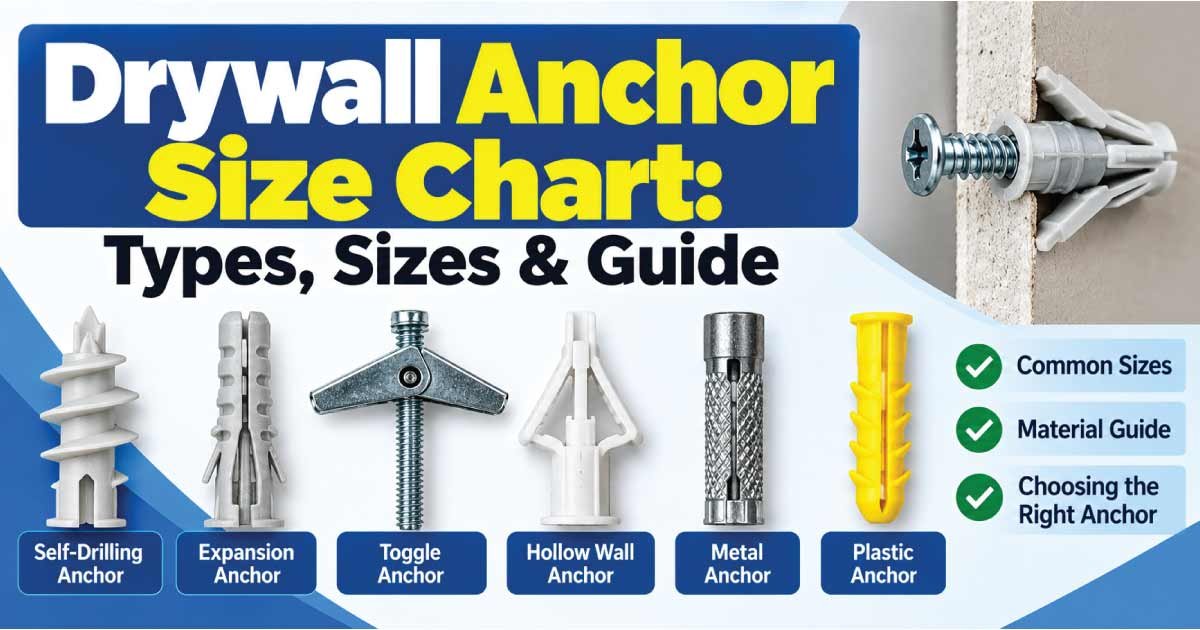
Drywall anchors make it possible to secure shelves, mirrors, pictures, cabinets, fixtures, and other items to drywall when a wall stud is not available. However, choosing the correct drywall anchor size and type is important because anchors differ significantly in design, holding capacity, hole size, and installation method.
A small plastic expansion anchor may work well for a lightweight picture, while a self-drilling or toggle-style anchor may be more appropriate for a heavier wall-mounted object. The thickness of the drywall, the weight of the item, the type of load, and the condition of the wall all affect the choice.
This drywall anchor size chart explains common anchor types, typical dimensions, drill-hole requirements, applications, and selection considerations. Because manufacturers use different designs and ratings, the dimensions shown are general categories rather than universal specifications. Always verify the manufacturer’s instructions and published load rating for the specific anchor you are installing.
Drywall Anchor Size Chart
The table below provides a practical starting point for comparing common drywall anchor types. Exact dimensions and load ratings vary by manufacturer and product design.
| Anchor Type | Typical Size Range | Typical Hole Requirement | Best For |
|---|---|---|---|
| Plastic expansion anchor | Small to medium | Small drilled hole | Light-duty pictures and accessories |
| Self-drilling anchor | Small to medium | Often no separate pilot hole | Light to moderate wall fixtures |
| Threaded drywall anchor | Medium | Manufacturer-specific | General-purpose mounting |
| Hollow-wall metal anchor | Medium | Drilled hole | Moderate loads |
| Molly bolt | Medium to large | Drilled hole | Shelves and fixtures |
| Toggle bolt | Medium to large | Larger drilled hole | Heavy-duty hollow-wall mounting |
| Strap toggle | Medium to large | Larger drilled hole | Heavier loads and fixtures |
The phrase drywall anchor size can refer to several measurements, including the anchor diameter, body length, screw size, drill-hole diameter, or overall anchor dimensions. Always identify which measurement a manufacturer is providing before selecting a product.
Understanding Drywall Anchor Sizes
A drywall anchor does not have one universal sizing system. Unlike a bolt that can be identified by a standard nominal diameter and thread pitch, drywall anchors come in many proprietary designs.
1. Anchor Diameter
The diameter describes the approximate width of the anchor body or threaded section. Larger anchors generally provide more surface area or a larger mechanical engagement with the drywall, but diameter alone does not determine holding strength.
A large-looking anchor can still be unsuitable if the drywall is weak or the anchor design is intended only for light loads.
2. Anchor Length
Anchor length is especially important for hollow-wall anchors and toggle-style systems. The anchor must fit within the wall cavity and accommodate the drywall thickness.
Longer does not automatically mean stronger. The correct length depends on the specific anchor mechanism and the wall construction.
3. Screw Size
Many anchors are supplied with a matching screw. The screw diameter and length should normally follow the manufacturer’s recommendation.
Using a screw that is too large can damage the anchor or prevent proper expansion. A screw that is too small may not engage the anchor correctly.
4. Drill-Hole Diameter
For anchors that require drilling, the recommended hole diameter is one of the most important specifications.
The hole must be large enough for the anchor to enter without excessive force but not so large that the anchor becomes loose.
5. Drywall Thickness
Common residential drywall thicknesses include 1/2 inch and 5/8 inch, while other thicknesses can also be encountered.
An anchor designed for one wall thickness may not perform correctly in another. Toggle and hollow-wall anchors often specify an allowable material-thickness range.
Common Types of Drywall Anchors
Different drywall anchors work through different mechanical principles. Understanding how each type works makes it easier to select the right option.
1. Plastic Expansion Anchors
Plastic expansion anchors are among the simplest wall anchors. They are inserted into a pre-drilled hole, and the screw expands or spreads the anchor body behind the surface.
They are commonly used for:
- Lightweight pictures
- Small decorations
- Wall-mounted accessories
- Small brackets
- Light household fixtures
Their main advantage is simplicity and low cost. Their limitation is that they generally provide less holding strength than properly installed toggle-style systems.
2. Self-Drilling Drywall Anchors
Self-drilling anchors have a pointed or cutting tip that allows the anchor to create its own opening in drywall.
They are convenient because installation can often be completed without first drilling a separate pilot hole.
Typical uses include:
- Small shelves
- Pictures
- Decorative objects
- Lightweight fixtures
- Small hardware
The manufacturer’s screw specification should be followed carefully because self-drilling anchors differ considerably in design.
3. Threaded Drywall Anchors
Threaded anchors have external threads that bite into the drywall while the supplied screw engages the internal portion.
They can provide a more secure installation than basic expansion plugs for many light- to medium-duty applications.
Their benefits include:
- Quick installation
- Stronger mechanical engagement than some basic plastic plugs
- No access to the back of the wall required
- Convenient removal in many designs
They should still be selected according to the manufacturer’s stated load rating.
4. Hollow-Wall Metal Anchors
Metal hollow-wall anchors, often associated with Molly-style fasteners, expand behind the drywall when the screw is tightened.
The expanded portion creates a larger bearing area against the back of the wallboard.
They can be useful for:
- Shelves
- Wall fixtures
- Brackets
- Cabinets and accessories where appropriate
- Medium-duty applications
Installation requirements vary significantly, so the supplied instructions should be followed.
5. Molly Bolts
A Molly bolt is a hollow-wall fastener designed to expand behind the wall surface. Depending on the design, the metal sleeve may expand or fold outward when installed.
One benefit is that the expanded metal body distributes the load over a larger area than a simple plastic plug.
However, correct installation is essential. If the sleeve does not expand properly, the anchor may not achieve its intended performance.
6. Toggle Bolts
Toggle bolts use a spring-loaded or hinged toggle that passes through a drilled hole and opens behind the drywall.
Once opened, the toggle provides a broad bearing surface against the rear of the wallboard.
Toggle bolts are often considered when mounting heavier items to hollow drywall, particularly when no stud is available.
They require a relatively large hole, which is their main disadvantage.
7. Strap Toggles
Strap toggles use a strap-and-toggle mechanism that is inserted through the wall opening. Once the toggle reaches the cavity behind the drywall, it opens and provides a broad load-bearing surface.
They are useful for heavier fixtures and can be easier to position than traditional spring toggles in some installations.
Drywall Anchor Size and Weight Capacity
One of the biggest mistakes when selecting an anchor is assuming that anchor size alone determines how much weight it can hold.
Actual capacity depends on several factors:
- Anchor design
- Manufacturer rating
- Drywall thickness
- Drywall condition
- Load direction
- Installation quality
- Screw size
- Distance between anchors
- Distance from wall edges
- Whether the load is static or frequently moved
A manufacturer may publish separate ratings for different drywall thicknesses and loading conditions.
Static vs. Pull-Out Loads
A wall-mounted object does not always place a simple downward load on an anchor.
For example, a picture hanging close to the wall primarily creates a downward force. A deep shelf carrying objects creates both downward force and leverage that can pull the upper fasteners away from the wall.
This distinction is important.
The same anchor may support a particular static load but perform differently when the mounted object creates leverage or repeated movement.
For heavy or safety-critical installations, fastening directly into framing is generally preferable when practical.
Drywall Anchor Size Chart by Application
Instead of selecting an anchor based only on its physical size, start with the object and the type of load involved.
| Application | Typical Anchor Category | Load Consideration | Important Note |
|---|---|---|---|
| Small picture | Plastic or self-drilling | Light | Use manufacturer’s rating |
| Wall decoration | Plastic or threaded | Light | Avoid damaged drywall |
| Small bathroom accessory | Threaded or hollow-wall | Light to moderate | Moisture-resistant construction may matter |
| Small shelf | Threaded, Molly, or toggle | Moderate | Consider shelf leverage |
| Large shelf | Toggle or stud fastening | Moderate to heavy | Studs are preferred where possible |
| Mirror | Appropriate hollow-wall anchor or stud | Variable | Consider mirror weight and mounting hardware |
| Heavy cabinet | Stud/framing preferred | Heavy | Do not rely solely on light-duty anchors |
| Grab bar | Structural framing or approved reinforcement | Safety-critical | Do not use ordinary drywall anchors alone |
These categories are general guidance, not universal load ratings.
How to Choose the Right Drywall Anchor Size
Choosing an anchor should begin with the installation conditions rather than the anchor package.
1. Determine the Weight of the Object
Find the actual weight of the item you are mounting. For shelves, consider the total expected weight, including anything that will be placed on the shelf.
Do not size the anchor based only on the empty shelf.
2. Check for a Wall Stud
Before installing an anchor, locate nearby studs with a stud finder or another suitable method.
If the mounting location aligns with a stud, a properly selected screw or structural fastener into the framing can provide a more secure connection than a drywall anchor.
3. Identify the Drywall Thickness
Determine whether the wallboard is approximately 1/2 inch, 5/8 inch, or another thickness.
This information is particularly important for hollow-wall anchors and toggle systems.
4. Identify the Load Type
Ask whether the object:
- Hangs close to the wall
- Extends outward from the wall
- Will be moved frequently
- Creates leverage
- Is safety-critical
An object that extends far from the wall can place considerably more stress on the anchor than a similarly weighted object mounted close to the surface.
5. Check the Manufacturer’s Rating
The manufacturer’s published specifications are more important than a generic drywall anchor size chart.
Check:
- Recommended drywall thickness
- Maximum load
- Recommended screw
- Required hole diameter
- Minimum installation spacing
- Installation procedure
- Whether the rating is for a single anchor or multiple anchors
How to Measure for a Drywall Anchor
Accurate measurement helps prevent oversized holes and incompatible fasteners.
Measure the Drywall Thickness
If you have access to an exposed edge of the wallboard, measure its thickness directly. During remodeling, this may be easy to determine.
If the wall is finished, you may need to identify the wall construction through existing openings or documentation rather than making an unnecessary hole.
Measure the Anchor
Depending on the anchor type, measure:
- Overall length
- Maximum body diameter
- Thread diameter
- Expansion section
- Head diameter
Do not assume the largest outside dimension is the required drill-hole size.
Measure the Drill Hole
For drilled anchors, use the hole diameter specified by the manufacturer.
This is more reliable than measuring the anchor and guessing the hole size.
Also Read:
Drywall Anchor Installation Guide
Proper installation is just as important as selecting the correct size.
Step 1: Locate the Installation Point
Mark the exact position where the screw or anchor will be installed.
Check for studs, electrical wiring, plumbing, and other concealed hazards before drilling or cutting into a wall.
Step 2: Select the Anchor
Choose an anchor based on:
- Object weight
- Drywall thickness
- Load direction
- Manufacturer rating
- Mounting hardware
- Required hole size
Step 3: Drill the Correct Hole
If drilling is required, use the specified drill-bit diameter.
Avoid enlarging the hole unnecessarily because excessive clearance can prevent the anchor from gripping the wall properly.
Step 4: Insert the Anchor
Install the anchor according to its design.
A plastic plug may simply be pushed into the hole. A threaded anchor may be screwed directly into the drywall. A toggle must pass through the opening and deploy behind the wall.
Step 5: Install the Screw
Use the recommended screw.
Do not overtighten. Excessive torque can crush drywall, strip the anchor, or damage the mounting surface.
Step 6: Mount the Object
Secure the bracket, hook, shelf, or other hardware.
For installations using multiple anchors, distribute the load appropriately and ensure the mounting hardware is properly aligned.
Also Read:
Drywall Anchor Types: Comparison
Different designs offer different combinations of convenience, strength, and installation requirements.
| Type | Installation | Hole Size | Typical Use | Main Advantage |
|---|---|---|---|---|
| Plastic expansion | Pre-drilled | Small | Light duty | Simple and inexpensive |
| Self-drilling | Screws into drywall | Small | Light duty | Fast installation |
| Threaded | Screws into drywall | Small to moderate | Light/moderate duty | Convenient installation |
| Molly | Drilled | Moderate | Moderate duty | Expands behind wall |
| Metal hollow-wall | Drilled | Moderate | Moderate duty | Broad bearing area |
| Toggle bolt | Drilled | Large | Heavy hollow-wall loads | Large bearing surface |
| Strap toggle | Drilled | Large | Heavier fixtures | Strong hollow-wall engagement |
Common Drywall Anchor Mistakes
Even a high-quality anchor can fail when installed incorrectly.
Using the Wrong Anchor for the Load
A lightweight plastic anchor should not automatically be used for a heavy shelf or cabinet.
Match the anchor’s published rating to the actual application.
Ignoring Drywall Condition
Old, cracked, water-damaged, or deteriorated drywall may not provide the same holding performance as sound wallboard.
If the surrounding material is compromised, changing to a larger anchor may not solve the problem.
Drilling an Oversized Hole
A hole that is larger than specified can reduce the anchor’s engagement with the drywall.
Always use the manufacturer’s recommended hole diameter.
Using the Wrong Screw
An incompatible screw can prevent an anchor from expanding or engaging correctly.
If the anchor includes a screw, use it unless the manufacturer specifies compatible alternatives.
Overtightening
More torque does not necessarily mean more holding power.
Overtightening can damage drywall and weaken the connection.
Ignoring Leverage
A shelf that extends outward from the wall can generate substantial leverage. The weight may be modest, but the force on the upper anchors can be much greater than expected.
Also Read:
When You Should Use a Stud Instead
Drywall anchors are useful, but they are not always the best solution.
Use a stud or structural framing connection whenever practical for:
- Heavy cabinets
- Large shelving systems
- Wall-mounted equipment
- Heavy storage units
- Safety-related fixtures
- Objects that experience significant movement or leverage
A stud provides a structural attachment point instead of relying on the gypsum board alone.
For installations such as grab bars, handrails, or other safety-critical hardware, follow the applicable installation instructions and structural requirements rather than substituting ordinary drywall anchors.
Tips for Better Drywall Anchor Performance
A few simple practices can significantly improve installation quality.
- Choose the anchor based on the application, not just its physical size.
- Check the manufacturer’s load rating and drywall thickness range.
- Use the specified drill-hole diameter.
- Avoid placing anchors too close to damaged drywall or unsupported edges.
- Use multiple mounting points when the hardware is designed for them.
- Distribute loads rather than concentrating excessive weight on one fastener.
- Avoid overtightening.
- Check whether the object creates leverage away from the wall.
- Use structural framing for heavy or safety-critical installations.
- Keep the manufacturer’s installation instructions with the hardware for future reference.
Frequently Asked Questions About Drywall Anchor Sizes
What size drywall anchor do I need?
The correct size depends on the object’s weight, drywall thickness, load type, and anchor design. Start with the manufacturer’s rated capacity rather than choosing the largest anchor available.
How big should the hole be for a drywall anchor?
The required hole diameter depends on the anchor. Some self-drilling anchors create their own opening, while toggle and hollow-wall anchors require specific drilled-hole sizes. Always follow the manufacturer’s instructions.
Are bigger drywall anchors stronger?
Not necessarily. Anchor diameter is only one factor. The anchor’s design, expansion mechanism, drywall condition, installation method, and published load rating all affect performance.
Can drywall anchors hold heavy items?
Some heavy-duty toggle and hollow-wall systems can support substantial loads when correctly installed in suitable drywall. However, heavy or safety-critical objects should generally be attached to structural framing whenever possible.
Can I use a drywall anchor in 5/8-inch drywall?
Many anchors are compatible with 5/8-inch drywall, but not every anchor is. Check the manufacturer’s specified material-thickness range before installation.
Should I use a stud instead of a drywall anchor?
If a suitable stud is available at the mounting location, fastening into the stud is often preferable for heavier loads. Drywall anchors are particularly useful when structural framing is unavailable or not positioned where needed.
Can I reuse a drywall anchor?
Some anchors are designed for one-time installation, while others may be removable. Do not assume an anchor can safely be reused after removal. Inspect the anchor and follow the manufacturer’s guidance.
Why did my drywall anchor pull out?
Possible causes include an oversized hole, damaged drywall, excessive load, improper installation, an incompatible screw, insufficient expansion, or excessive leverage from the mounted object.
Final Takeaway
The best drywall anchor size is not simply the largest or longest anchor you can fit into the wall. The correct choice depends on the anchor type, drywall thickness, object weight, load direction, hole diameter, screw compatibility, and manufacturer-rated capacity.
For light objects, plastic expansion and self-drilling anchors may be convenient choices. Threaded and hollow-wall anchors can provide greater engagement for moderate applications, while toggle-style systems are often considered for heavier loads in hollow drywall.
Most importantly, treat a drywall anchor size chart as a selection guide rather than a substitute for the manufacturer’s specifications. When an installation is heavy, safety-critical, or subject to significant leverage, attach the hardware to structural framing whenever possible.