
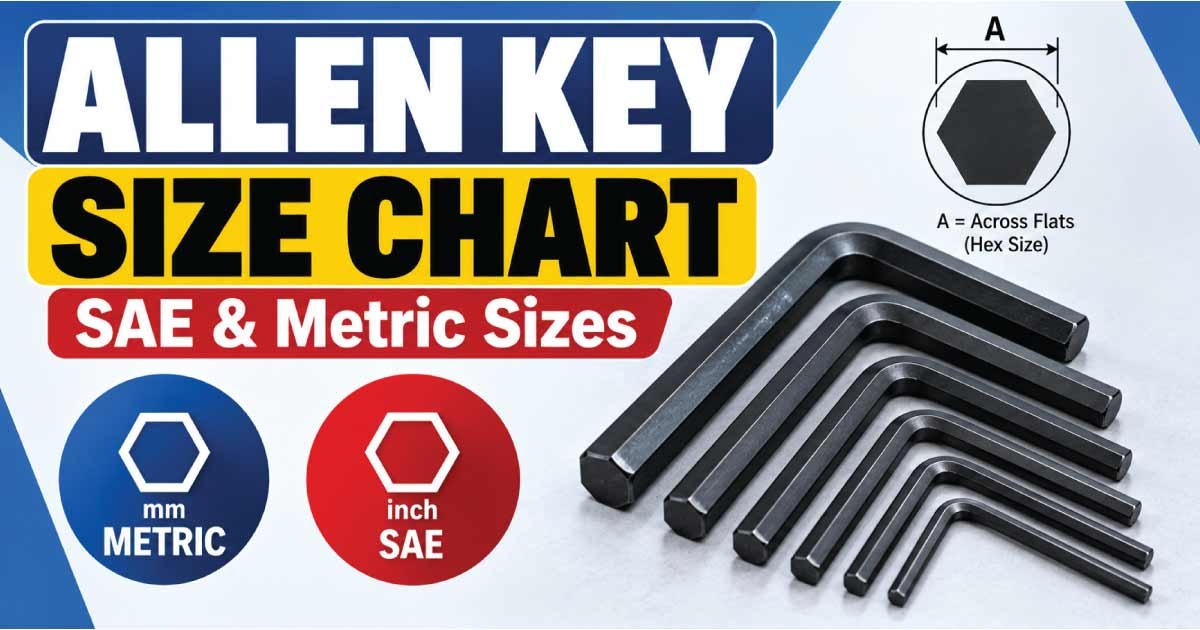
An Allen key size chart makes it easier to identify the correct hex key for a bolt, screw, or other fastener. Allen keys, also called hex keys or hex wrenches, are available in both metric and SAE (inch) sizes, and using the wrong size can damage the fastener or make removal difficult.
The most common metric sizes range from small keys such as 1.5 mm and 2 mm to larger sizes such as 10 mm and above. SAE sets use fractional-inch measurements such as 1/16″, 3/32″, 1/8″, 5/32″, 3/16″, 1/4″, and 3/8″.
This guide provides practical SAE and metric Allen key sizes, explains their differences, shows approximate conversions, and helps you select the correct hex key for your application.
What Is an Allen Key?
An Allen key is a small L-shaped or T-shaped tool with a hexagonal cross-section. It fits into the internal hexagonal socket found in certain screws and bolts.
The tool is commonly made from hardened steel and is designed to transfer torque to a fastener without requiring an external wrenching surface.
Allen keys are widely used for:
- Furniture assembly
- Bicycles and cycling components
- Automotive repairs
- Machinery
- Industrial equipment
- Electronics and appliances
- Plumbing fixtures
- General maintenance
- Manufacturing and engineering
The name Allen key is commonly used interchangeably with hex key and hex wrench. Although terminology varies by region and manufacturer, the basic tool is the same.
How Allen Keys Are Sized
Allen keys are sized according to the distance across the flats of the hexagonal cross-section.
For example, a 5 mm Allen key has a hexagonal working end measuring approximately 5 mm across its flats.
The same principle applies to SAE tools. A 1/4-inch hex key has a working-end size of 1/4 inch across the flats.
Metric Allen Key Size Chart
Metric Allen keys are measured in millimeters. They are particularly common in products and machinery manufactured using metric specifications.
The following chart lists commonly encountered metric hex key sizes.
| Metric Size | Approx. SAE Equivalent | Common Uses |
|---|---|---|
| 1.5 mm | 1/16″ (approx.) | Small screws, electronics |
| 2 mm | 5/64″ (approx.) | Small machinery, electronics |
| 2.5 mm | 3/32″ (approx.) | Small equipment, furniture |
| 3 mm | 1/8″ (approx.) | Furniture, bicycles, machinery |
| 4 mm | 5/32″ (approx.) | Furniture, machinery |
| 5 mm | 3/16″ (approx.) | Bicycles, machinery, automotive |
| 6 mm | 1/4″ (approx.) | Automotive, machinery |
| 7 mm | 9/32″ (approx.) | Specialized applications |
| 8 mm | 5/16″ (approx.) | Automotive, machinery |
| 9 mm | 11/32″ (approx.) | Specialized applications |
| 10 mm | 3/8″ (approx.) | Automotive, industrial equipment |
| 12 mm | 15/32″ (approx.) | Large machinery and fasteners |
| 14 mm | 9/16″ (approx.) | Heavy-duty applications |
| 17 mm | 11/16″ (approx.) | Large industrial fasteners |
| 19 mm | 3/4″ (approx.) | Large machinery |
The SAE equivalents in this table are approximate size comparisons, not interchangeable replacements. A metric and SAE key that appear close in size may still differ enough to damage a fastener.
SAE Allen Key Size Chart
SAE Allen keys are measured in inches, usually using fractional-inch dimensions. They remain common in American-made machinery, vehicles, tools, bicycles, and other equipment.
| SAE Size | Decimal Inch | Approx. Metric Equivalent |
|---|---|---|
| 0.028″ | 0.028″ | 0.71 mm |
| 1/16″ | 0.0625″ | 1.59 mm |
| 5/64″ | 0.0781″ | 1.98 mm |
| 3/32″ | 0.0938″ | 2.38 mm |
| 7/64″ | 0.1094″ | 2.78 mm |
| 1/8″ | 0.125″ | 3.18 mm |
| 9/64″ | 0.1406″ | 3.57 mm |
| 5/32″ | 0.1563″ | 3.97 mm |
| 3/16″ | 0.1875″ | 4.76 mm |
| 7/32″ | 0.2188″ | 5.56 mm |
| 1/4″ | 0.250″ | 6.35 mm |
| 5/16″ | 0.3125″ | 7.94 mm |
| 3/8″ | 0.375″ | 9.53 mm |
| 7/16″ | 0.4375″ | 11.11 mm |
| 1/2″ | 0.500″ | 12.70 mm |
| 9/16″ | 0.5625″ | 14.29 mm |
| 5/8″ | 0.625″ | 15.88 mm |
| 3/4″ | 0.750″ | 19.05 mm |
SAE sets can contain many additional sizes, particularly for specialized industrial applications. Always check the fastener specification or tool markings when an exact fit matters.
Metric vs SAE Allen Keys
The main difference between metric and SAE Allen keys is the measurement system used to define the tool size.
Metric tools use millimeters, while SAE tools use inches.
For example:
- A 5 mm Allen key is metric.
- A 3/16-inch Allen key is SAE.
- A 6 mm key is metric.
- A 1/4-inch key is SAE.
Some sizes are relatively close. For example, 5 mm is approximately 0.197 inches, while 3/16 inch is approximately 4.76 mm. They may look similar, but they are not the same size.
Are Metric and SAE Allen Keys Interchangeable?
Generally, no.
Although certain sizes may appear to fit, substituting one system for another can create excessive clearance between the tool and fastener.
This can result in:
- Rounded hex sockets
- Slipping during use
- Damaged tool edges
- Reduced torque transfer
- Difficulty removing the fastener
For a critical or tightly torqued fastener, use the exact specified size rather than the closest-looking alternative.
Allen Key Size Conversion Chart
A conversion chart can help when you encounter a fastener specified in a different measurement system.
| Metric | Inches Approx. | Closest Common SAE Size |
|---|---|---|
| 1.5 mm | 0.0591″ | 1/16″ |
| 2 mm | 0.0787″ | 5/64″ |
| 2.5 mm | 0.0984″ | 3/32″ |
| 3 mm | 0.1181″ | 1/8″ |
| 4 mm | 0.1575″ | 5/32″ |
| 5 mm | 0.1969″ | 3/16″ |
| 6 mm | 0.2362″ | 1/4″ |
| 8 mm | 0.3150″ | 5/16″ |
| 10 mm | 0.3937″ | 3/8″ |
| 12 mm | 0.4724″ | 15/32″ |
| 14 mm | 0.5512″ | 9/16″ |
| 17 mm | 0.6693″ | 11/16″ |
| 19 mm | 0.7480″ | 3/4″ |
This table is useful for comparison and identification, but the closest SAE size should not automatically be treated as a substitute for the metric size.
Also Read:
How to Measure an Allen Key
If an Allen key has no readable size marking, you can determine its size by measuring the hexagonal working end.
1. Measure Across the Flats
The most useful measurement is the distance across two opposite flat sides of the hexagonal section.
A caliper provides the most reliable measurement.
For example, if the distance across the flats is approximately 5 mm, the tool is a 5 mm metric Allen key.
2. Check the Tool Set
Many Allen key sets have the size stamped or laser-marked on each tool. If individual markings are difficult to read, compare the unknown key with a known-size tool.
3. Test the Fastener Carefully
If measuring the key is not possible, test suspected sizes carefully.
The correct key should:
- Enter the socket fully.
- Sit firmly against the internal flats.
- Have minimal visible movement.
- Turn the fastener without slipping.
Do not force a key that does not seat properly.
How to Choose the Correct Allen Key Size
Choosing the right size is primarily about getting a secure, full-depth fit between the tool and the fastener.
Check the Fastener Socket
Look inside the fastener and identify its shape. A standard internal hex socket requires a standard hex key, while other internal-drive designs may require a different tool.
Match the Measurement System
Determine whether the fastener uses metric or SAE dimensions.
If the equipment documentation specifies 6 mm, use a 6 mm key. If it specifies 1/4 inch, use a 1/4-inch key.
Make Sure the Key Seats Fully
Insert the key completely into the socket before applying torque.
A proper fit should feel solid rather than loose.
Consider Access
The size of the key is not the only factor. The shape of the tool matters when access is restricted.
Depending on the application, you may need:
- L-shaped Allen keys
- T-handle hex keys
- Ball-end hex keys
- Hex-bit sockets
- Long-reach hex keys
Also Read:
Types of Allen Keys
Different Allen key designs are intended for different working conditions.
L-Shaped Allen Keys
The traditional L-shaped design is one of the most common.
Its two ends provide different leverage and access options. The longer arm can provide greater reach, while the shorter arm can be useful where clearance is limited.
T-Handle Allen Keys
T-handle hex keys have a fixed handle that provides a comfortable grip and can make repetitive fastening work easier.
They are often useful in workshops and assembly environments.
Ball-End Allen Keys
Ball-end hex keys have a rounded working end that can engage a hex socket at an angle.
This makes them useful where straight access is difficult.
However, the ball end should not automatically be treated as equivalent to a standard full-contact hex end for high-torque applications. The appropriate tool depends on the fastener and manufacturer’s guidance.
Hex Bit Sockets
Hex bits can be used with a ratchet, torque wrench, or other compatible drive tool.
They are particularly useful when controlled torque or greater leverage is required.
Common Allen Key Sizes and Their Uses
Some sizes appear frequently in everyday applications.
2 mm to 3 mm
Small hex keys are commonly found in compact equipment, small hardware, electronics, and precision assemblies.
4 mm to 6 mm
This range is widely encountered in furniture, bicycles, machinery, equipment, and general maintenance.
A 5 mm Allen key is particularly common across many applications, although the actual required size depends on the fastener.
8 mm to 10 mm
Larger sizes are often used for bigger fasteners found in machinery, automotive components, and heavy-duty assemblies.
12 mm and Larger
Large hex keys are typically associated with larger fasteners and specialized or industrial equipment.
The application determines the required size, so the fastener specification should always take priority over assumptions based on appearance.
Also Read:
Why the Correct Allen Key Size Matters
Using the right size is important for both the tool and the fastener.
A properly fitting hex key distributes the applied force across the internal flats of the socket.
Using an undersized or incorrect key can cause the tool to move inside the socket instead of transferring torque efficiently.
Problems Caused by the Wrong Size
Common problems include:
- Rounded fastener sockets
- Slipping tools
- Damaged hex-key corners
- Difficulty loosening bolts
- Difficulty achieving the required torque
- Permanent fastener damage
If a fastener is already damaged, repeatedly trying different keys can make the problem worse. A suitable extraction method or professional repair may be necessary.
Allen Key Size Chart for Quick Reference
For everyday work, the following compact chart covers several commonly encountered sizes.
| Size System | Size | Approx. Conversion |
|---|---|---|
| Metric | 2 mm | 0.0787″ |
| Metric | 2.5 mm | 0.0984″ |
| Metric | 3 mm | 0.1181″ |
| Metric | 4 mm | 0.1575″ |
| Metric | 5 mm | 0.1969″ |
| Metric | 6 mm | 0.2362″ |
| Metric | 8 mm | 0.3150″ |
| Metric | 10 mm | 0.3937″ |
| SAE | 1/16″ | 1.5875 mm |
| SAE | 5/64″ | 1.9844 mm |
| SAE | 3/32″ | 2.3813 mm |
| SAE | 1/8″ | 3.1750 mm |
| SAE | 5/32″ | 3.9688 mm |
| SAE | 3/16″ | 4.7625 mm |
| SAE | 1/4″ | 6.3500 mm |
| SAE | 5/16″ | 7.9375 mm |
| SAE | 3/8″ | 9.5250 mm |
The metric-to-inch values are mathematical conversions. The closest listed SAE size may still be different enough that it should not be used as a direct substitute.
Common Allen Key Mistakes to Avoid
Even a quality hex key can cause problems if it is used incorrectly.
Avoid these common mistakes:
- Forcing a nearly correct size into a fastener.
- Mixing SAE and metric tools without checking the actual dimensions.
- Using a damaged or rounded Allen key.
- Applying excessive force before confirming the size.
- Using a ball-end key for an application requiring maximum contact and torque.
- Failing to fully insert the key into the socket.
- Assuming every fastener from a particular product uses the same size.
- Ignoring manufacturer torque specifications during final assembly.
When a fastener is difficult to turn, first verify the size, drive type, condition, and direction of rotation before applying more force.
Frequently Asked Questions About Allen Key Sizes
What are the most common metric Allen key sizes?
Common metric sizes include 2 mm, 2.5 mm, 3 mm, 4 mm, 5 mm, 6 mm, 8 mm, and 10 mm. Larger and smaller sizes are also available for specialized applications.
What are the most common SAE Allen key sizes?
Frequently encountered SAE sizes include 1/16″, 5/64″, 3/32″, 1/8″, 5/32″, 3/16″, 7/32″, 1/4″, 5/16″, and 3/8″.
Is a 5 mm Allen key the same as 3/16 inch?
No. A 5 mm key is approximately 0.1969 inch, while 3/16 inch equals approximately 4.7625 mm. They are close but not identical.
Is 1/4 inch the same as 6 mm?
No. 1/4 inch equals 6.35 mm, making it slightly larger than 6 mm. The difference can be enough to cause an improper fit in a precision hex socket.
How do I know whether I need SAE or metric Allen keys?
Check the equipment documentation, fastener specifications, or tool markings. If the size is specified in millimeters, use a metric key. If it is specified in inches or fractions of an inch, use an SAE key.
Can I use an SAE Allen key on a metric bolt?
Only if the exact dimensions are confirmed to be suitable, which is uncommon for standard applications. In general, do not substitute SAE for metric or metric for SAE simply because the sizes appear close.
What size Allen key is commonly used for bicycles?
Bicycles use several different hex sizes depending on the component. Common sizes include 4 mm, 5 mm, and 6 mm, but the correct size varies by manufacturer and component.
What is the difference between a hex key and an Allen key?
In everyday tool terminology, hex key, Allen key, and Allen wrench generally refer to the same basic type of internal-hex tool. “Allen” is a widely recognized trade name that has become a common generic term for this tool style.
Conclusion
An Allen Key Size Chart is a useful reference when working with internal hex fasteners in metric or SAE sizes. Metric keys are measured in millimeters, while SAE keys are measured in inches, and the two systems should not be treated as interchangeable simply because certain sizes appear close.
For the best fit, identify the fastener’s specified measurement system, select the exact size, and make sure the key seats fully inside the socket before applying torque. Keeping both metric and SAE Allen key sets available is often the most practical solution for mixed equipment and repair work.
When accuracy matters, always prioritize the manufacturer’s fastener specification and recommended tool size over approximate conversion charts.