
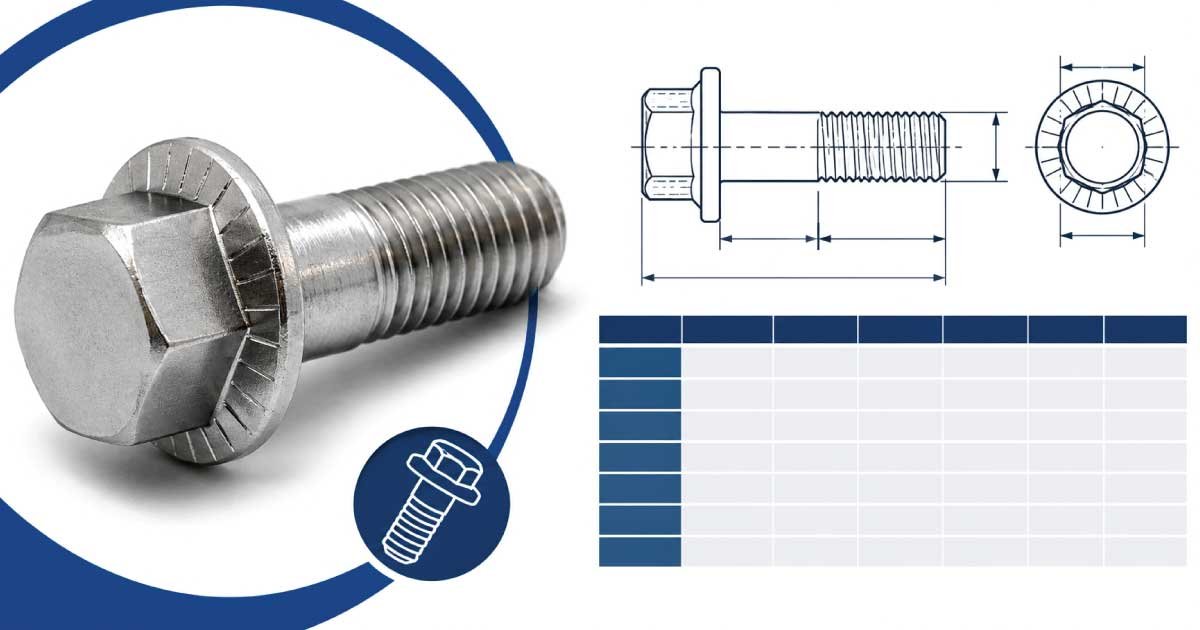
Flange bolts are widely used in automotive, machinery, construction, and industrial applications because they provide strong fastening with built-in load distribution. Instead of using a separate washer, flange bolts have a built-in flange that spreads pressure evenly, reducing loosening and improving joint stability.
If you have ever struggled to identify the correct flange bolt size, this flange bolt chart guide will make everything simple. In this article, you’ll learn standard flange bolt sizes, measurements, thread types, and how to choose the right bolt for your application.
What Is a Flange Bolt?
A flange bolt is a specialized fastener that features a built-in circular flange under its head. This flange acts like an integrated washer, helping distribute load more evenly across the surface, improving stability, reducing stress concentration, and increasing resistance against loosening in mechanical assemblies.
Key Features of Flange Bolt
Flange bolts are designed to improve strength, stability, and vibration resistance in mechanical systems. Their built-in flange eliminates the need for separate washers, making installation easier while ensuring better load distribution and long-term reliability in high-stress environments like engines and industrial machines.
Key Features:
- Built-in washer-like flange
- Better load distribution
- Higher vibration resistance
- Common in automotive engines and heavy machinery
- Available in metric and imperial sizes
Flange bolts are especially useful where vibration is high, such as in engines, gear assemblies, and structural frames.
Why Flange Bolt Size Matters
Flange bolt size is crucial because it directly affects joint strength, safety, and mechanical performance. The correct size ensures proper tightening force and load distribution, while incorrect sizing can weaken connections and lead to serious mechanical or structural issues.
Problems Caused by Wrong Flange Bolt Size
Using the wrong flange bolt size can compromise the integrity of a mechanical system. It may lead to loose fittings, stripped threads, uneven stress distribution, and in severe cases, complete equipment failure or safety hazards in industrial and automotive applications.
Choosing the wrong flange bolt size can lead to:
- Loose joints
- Thread stripping
- Equipment failure
- Uneven load distribution
- Safety risks in mechanical systems
That’s why understanding a flange bolt chart is essential for mechanics, engineers, and DIY users.
Standard Flange Bolt Size Chart (Metric)
The metric flange bolt size chart is widely used in automotive, construction, and industrial applications. It provides standardized measurements for bolt size, thread pitch, head size, and flange diameter to ensure compatibility and proper mechanical performance in engineering assemblies.
Metric Flange Bolt Size Chart Overview
This chart includes commonly used metric flange bolt sizes from M5 to M20. Each size is matched with thread pitch, head dimensions, flange diameter, and typical applications to help users select the correct bolt for different mechanical and structural requirements.
| Bolt Size | Thread Pitch (mm) | Head Size (mm) | Flange Diameter (mm) | Typical Use |
|---|---|---|---|---|
| M5 | 0.8 | 8–10 | 11–13 | Small electronics, light assemblies |
| M6 | 1.0 | 10–11 | 14–16 | Automotive trim, brackets |
| M8 | 1.25 | 12–13 | 17–20 | Engine covers, machinery |
| M10 | 1.5 | 14–17 | 21–24 | Suspension parts, heavy machinery |
| M12 | 1.75 | 17–19 | 24–28 | Structural applications |
| M14 | 2.0 | 19–22 | 28–32 | Industrial equipment |
| M16 | 2.0 | 22–24 | 32–36 | Heavy construction |
| M20 | 2.5 | 27–30 | 38–45 | High-load applications |
Standard Flange Bolt Size Chart (Imperial)
Imperial flange bolt sizes are commonly used in the United States and some industrial systems. These measurements are based on inches and threads per inch (TPI), making them suitable for machinery designed under imperial standards.
Imperial Flange Bolt Size Chart Overview
This chart lists standard imperial flange bolt sizes along with thread count, head size, and typical applications. It helps users choose the correct bolt for light, medium, and heavy-duty mechanical systems requiring strong and stable fastening.
| Bolt Size | Threads per Inch (TPI) | Head Size (inch) | Typical Use |
|---|---|---|---|
| 1/4″ | 20–28 | 7/16″ | Light assemblies |
| 5/16″ | 18–24 | 1/2″ | Automotive components |
| 3/8″ | 16–24 | 9/16″–5/8″ | Medium-duty machinery |
| 7/16″ | 14–20 | 5/8″–11/16″ | Engine mounts |
| 1/2″ | 13–20 | 3/4″ | Heavy equipment |
| 9/16″ | 12–18 | 13/16″ | Industrial structures |
| 5/8″ | 11–18 | 15/16″ | High-strength joints |
How to Read a Flange Bolt Chart
Understanding a flange bolt chart is important for selecting the correct fastener for mechanical, automotive, and industrial applications. Each value in the chart represents a specific dimension that affects fit, strength, and performance of the bolt in different assembly conditions.
1. Bolt Size (M6, M8, M10, etc.)
Bolt size represents the nominal diameter of the bolt thread in millimeters. It is one of the most important specifications because it determines compatibility with the corresponding nut or tapped hole in mechanical assemblies.
2. Thread Pitch
Thread pitch refers to the distance between two adjacent threads on the bolt. Fine thread pitches provide stronger grip and better vibration resistance, while coarse threads allow faster installation and are more suitable for general-purpose applications.
3. Head Size
Head size indicates the wrench or socket dimension required to tighten or loosen the bolt. It is essential for selecting proper tools and ensuring correct torque application during installation or removal in mechanical systems.
4. Flange Diameter
Flange diameter defines the size of the built-in washer-like base under the bolt head. A larger flange spreads load over a wider surface area, reducing stress concentration and improving joint stability in high-pressure or vibration-heavy environments.
🔧 Explore Our Expert Guide 👉 Square U Bolt Size Chart: Complete Guide 2025 + Pdf
Common Types of Flange Bolts
Flange bolts are available in different designs depending on application requirements, surface sensitivity, and vibration conditions. Each type offers unique benefits in terms of grip, stability, and resistance to loosening in mechanical systems.
1. Serrated Flange Bolts
Serrated flange bolts feature ridges or teeth under the flange surface. These ridges increase friction and help prevent loosening caused by vibration, making them highly suitable for automotive engines and high-movement mechanical environments.
2. Non-Serrated Flange Bolts
Non-serrated flange bolts have a smooth underside without gripping teeth. They are commonly used in applications where surface protection is important, such as delicate machinery, electronics, and assemblies where scratching or surface damage must be avoided.
3. Hex Flange Bolts
Hex flange bolts combine a hexagonal head with an integrated flange base. They are the most commonly used type due to their ease of installation, compatibility with standard tools, and reliable performance in both light and heavy-duty mechanical applications.
How to Measure a Flange Bolt
Accurate measurement of a flange bolt is essential for proper replacement and compatibility in mechanical systems. Each dimension must be measured carefully using tools like calipers and thread gauges to ensure correct sizing and safe installation.
Step 1: Measure Thread Diameter
Use a vernier caliper to measure the outer diameter of the threaded section. This measurement determines the bolt size (e.g., M6, M8, M10) and ensures compatibility with matching nuts or threaded holes.
Step 2: Measure Thread Pitch
Use a thread pitch gauge to measure the distance between threads. This helps identify whether the bolt has a fine or coarse thread, which affects grip strength and installation behavior in different applications.
Step 3: Measure Bolt Length
Measure the length of the bolt from directly under the flange to the tip. This ensures the bolt is neither too short nor too long for the intended assembly, maintaining proper fastening strength and alignment.
Step 4: Measure Flange Diameter
Measure the outer edge of the flange to determine how much surface area is used for load distribution. A correct flange size helps improve stability and reduces stress on connected components.
Step 5: Check Head Size
Measure across the flats of the hex head to determine the correct wrench or socket size. This ensures proper tool selection and allows accurate tightening without damaging the bolt head during installation or removal.
Applications of Flange Bolts
Flange bolts are widely used across multiple industries because they provide strong fastening, vibration resistance, and even load distribution. Their built-in flange design makes them suitable for both light-duty and heavy-duty mechanical systems where reliability and stability are essential.
1. Automotive Industry
In the automotive sector, flange bolts are commonly used in critical systems that require high strength and resistance to vibration. They help maintain secure connections in moving parts and high-temperature environments where safety and durability are important.
Applications:
- Engine assemblies
- Transmission systems
- Exhaust systems
2. Construction
Flange bolts play a key role in construction projects where strong and stable joints are required. They are used in steel frameworks and structural connections that must withstand heavy loads and long-term stress.
Applications:
- Steel framing
- Structural joints
- Heavy load connections
3. Machinery
In industrial machinery, flange bolts are used to secure rotating and high-load components. They ensure proper alignment and reduce the risk of loosening during continuous operation in demanding environments.
Applications:
- Gear systems
- Pumps and compressors
- Industrial equipment
4. Electronics
Flange bolts are also used in electronic assemblies where secure mounting and stability are required. They help hold enclosures and internal components in place without requiring additional washers.
Applications:
- Enclosures
- Mounting brackets
- Support structures
🔧 Explore Our Expert Guide 👉 Flange Size Chart: Complete Guide 2025 + Pdf
Materials Used in Flange Bolts
Flange bolts are manufactured using different materials depending on strength requirements, environmental conditions, and application type. Each material offers unique benefits such as corrosion resistance, high tensile strength, or cost-effectiveness.
1. Steel Flange Bolts
Steel flange bolts are the most commonly used type due to their high strength and durability. They are suitable for general engineering and industrial applications where moderate corrosion resistance is sufficient.
2. Stainless Steel Flange Bolts
Stainless steel flange bolts offer excellent corrosion resistance, making them ideal for marine, outdoor, and humid environments. They provide long-lasting performance even in harsh weather conditions without rusting easily.
3. Alloy Steel Flange Bolts
Alloy steel flange bolts are designed for high-strength applications. They offer superior tensile strength and are commonly used in heavy machinery and structural systems where maximum durability is required.
4. Coated Flange Bolts (Zinc or Black Oxide)
Coated flange bolts are treated with protective layers such as zinc or black oxide to prevent rust and corrosion. They are widely used in automotive systems where moderate protection and cost efficiency are required.
How to Choose the Right Flange Bolt
Selecting the correct flange bolt is essential for ensuring safety, durability, and proper mechanical performance. The choice depends on load conditions, environmental exposure, vibration levels, thread compatibility, and tool availability.
1. Load Requirements
Higher load applications require larger diameter bolts such as M10, M12, or above. Proper sizing ensures the bolt can handle stress without deformation or failure during operation.
2. Environment
Environmental conditions play a major role in material selection. Corrosive or outdoor environments require stainless steel or coated bolts to prevent rust and ensure long-term reliability.
3. Vibration Levels
In high-vibration systems, serrated flange bolts are preferred because they provide better grip and reduce the chances of loosening over time in dynamic mechanical conditions.
4. Thread Compatibility
It is important to match the bolt’s thread pitch with the threaded hole. Incorrect matching can lead to stripping, poor fastening, or complete joint failure.
5. Tool Availability
Always choose a bolt size that matches available tools such as wrenches or sockets. This ensures proper installation and prevents damage during tightening or removal.
🔧 Explore Our Expert Guide 👉 Chain Link Size Chart: Complete Guide 2025 with Pdf
Common Mistakes to Avoid
Many users make avoidable errors when selecting or installing flange bolts. These mistakes can reduce performance, weaken joints, and create safety risks in mechanical systems.
- Ignoring thread pitch
- Using wrong head size tools
- Reusing damaged bolts
- Mixing metric and imperial systems
- Over-tightening bolts
Avoiding these mistakes improves safety, reliability, and the overall lifespan of mechanical assemblies.
Flange Bolt vs Regular Bolt
| Feature | Flange Bolt | Regular Bolt |
|---|---|---|
| Washer needed | No | Yes |
| Vibration resistance | High | Medium |
| Load distribution | Excellent | Moderate |
| Installation time | Faster | Slower |
Flange bolts are generally more efficient in modern mechanical systems due to their built-in flange design, which improves load distribution, reduces installation steps, and enhances vibration resistance compared to traditional bolt and washer combinations.
Final Thoughts
A flange bolt chart is an essential reference for anyone working with mechanical assemblies, automotive repairs, or industrial machinery. By understanding bolt sizes, thread pitches, and flange dimensions, you can easily choose the right fastener for your project.
Whether you’re working on a small engine or a heavy-duty structure, using the correct flange bolt ensures safety, strength, and long-term reliability.