
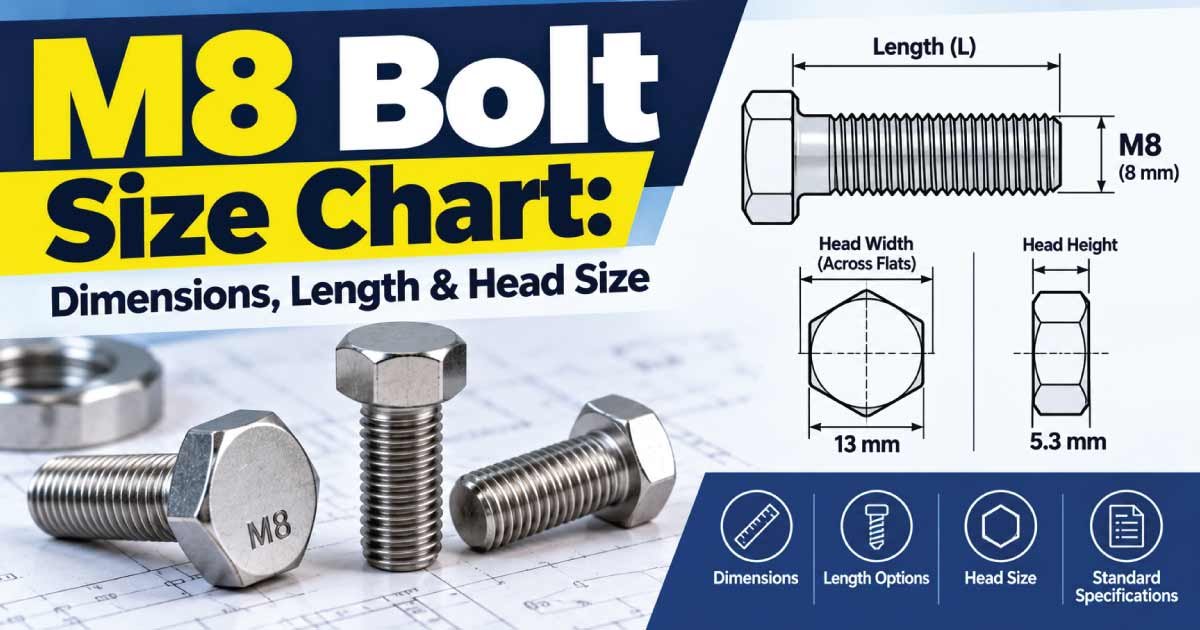
An M8 bolt size chart makes it easier to identify the correct diameter, length, thread pitch, and head dimensions for a fastening job. Although “M8” tells you the bolt has an approximately 8 mm nominal thread diameter, it does not describe the bolt’s length, head style, thread pitch, or strength class.
This guide covers the most important M8 bolt dimensions, including standard metric thread information, common bolt lengths, hex head sizes, measurement methods, and practical selection tips. You’ll also find tables for quick reference and explanations of how M8 bolts compare with nearby metric sizes such as M6 and M10.
Whether you are replacing an existing fastener, designing an assembly, working on machinery, or choosing hardware for a DIY project, the right measurements help ensure proper fit and reliable clamping.
M8 Bolt Size at a Glance
An M8 bolt belongs to the metric fastener system and has a nominal thread diameter of 8 mm. The “M” indicates a metric thread, while “8” refers to the nominal outside diameter of the threaded portion.
For many general-purpose applications, the standard coarse M8 thread is M8 × 1.25, meaning the thread pitch is 1.25 mm.
The following table provides a quick overview of commonly referenced M8 specifications.
| M8 Specification | Typical Value |
|---|---|
| Nominal diameter | 8 mm |
| Coarse thread pitch | 1.25 mm |
| Fine thread pitch | 1.0 mm or other specified pitch |
| Nominal diameter in inches | 0.315 in |
| Common hex head width across flats | 13 mm |
| Bolt length | Application dependent |
| Thread type | Metric |
| Common strength classes | 8.8, 10.9, 12.9 |
| Common materials | Carbon steel, alloy steel, stainless steel |
The exact dimensions of an M8 bolt can vary according to bolt type, product standard, head style, material, and manufacturer. Therefore, this chart should be used as a practical reference rather than a substitute for the applicable fastener standard or manufacturer’s drawing.
M8 Bolt Dimensions Explained
Understanding what each measurement means is more useful than simply memorizing a bolt size.
An M8 bolt has several important dimensions:
- Nominal diameter: Approximately 8 mm
- Length: Measured according to the bolt’s head style
- Thread pitch: Distance from one thread crest to the next
- Head dimensions: Depend on the bolt design and standard
- Across-flats dimension: The distance between opposite flat sides of a hex head
- Across-corners dimension: Distance between opposite corners of the head
- Threaded length: The portion of the shank containing threads
These dimensions work together to determine whether a fastener is suitable for a particular assembly.
M8 Bolt Diameter
The “8” in M8 represents the bolt’s nominal thread diameter of 8 mm. It is not necessarily the exact measured diameter of every part of the threaded surface because manufacturing tolerances and thread geometry affect the measurement.
When identifying an unknown bolt, measuring the outside diameter of its threads with a caliper can help determine whether it is approximately M8.
An M8 bolt is larger than M6 and smaller than M10, making it a common middle-size metric fastener for mechanical and structural assemblies.
M8 Thread Pitch
Thread pitch is the distance between corresponding points on adjacent threads.
The most common coarse M8 thread is:
M8 × 1.25
This means:
- M8 = nominal 8 mm diameter
- 1.25 = 1.25 mm thread pitch
M8 fine-thread versions are also available. Because different pitches are not interchangeable, identifying the pitch is important when replacing a nut, tapped hole, or existing bolt.
M8 Bolt Size Chart by Length
Bolt length is one of the most important measurements when selecting an M8 fastener. An M8 bolt can be manufactured in many different lengths while retaining the same 8 mm nominal diameter.
Common commercial lengths include sizes such as 10 mm, 12 mm, 16 mm, 20 mm, 25 mm, 30 mm, 35 mm, 40 mm, 50 mm, 60 mm, 70 mm, 80 mm, 100 mm, and longer options.
Availability varies by bolt style, thread configuration, standard, and supplier.
| M8 Bolt Length | Approx. Length in Inches | Typical Use |
|---|---|---|
| 10 mm | 0.39 in | Thin components |
| 12 mm | 0.47 in | Short assemblies |
| 16 mm | 0.63 in | Light-to-medium assemblies |
| 20 mm | 0.79 in | General fastening |
| 25 mm | 0.98 in | General-purpose assemblies |
| 30 mm | 1.18 in | Thicker components |
| 40 mm | 1.57 in | Multi-layer assemblies |
| 50 mm | 1.97 in | Thicker assemblies |
| 60 mm | 2.36 in | Extended fastening |
| 70 mm | 2.76 in | Deep assemblies |
| 80 mm | 3.15 in | Long fastening applications |
| 100 mm | 3.94 in | Extended or heavy assemblies |
These are length references, not recommendations for a particular application. The correct length depends on the thickness of the materials being joined, washers used, nut engagement, tapped-hole depth, and the specific fastener design.
How Is an M8 Bolt Length Measured?
One of the most common sources of confusion is measuring bolt length incorrectly.
For a conventional hex-head bolt, length is normally measured from the underside of the head to the end of the bolt. The head itself is generally not included in the nominal bolt length.
For example, an M8 × 40 hex-head bolt is nominally 40 mm long from beneath the head to the tip.
However, some fastener designs are measured differently.
Length Measurement by Head Style
For most standard bolts with a head that sits above the workpiece:
Length = underside of head to bolt tip
For countersunk fasteners, the measurement convention can differ because the head is designed to sit flush with the material.
This is why identifying the bolt type before comparing lengths is important.
Why Correct Length Matters
A bolt that is too short may not provide sufficient thread engagement. A bolt that is excessively long can interfere with moving components, create clearance problems, or leave unnecessary thread protruding from the assembly.
For a replacement bolt, compare:
- Original bolt diameter
- Original length
- Thread pitch
- Head style
- Strength class
- Material or corrosion resistance
- Washer and nut arrangement
M8 Hex Bolt Head Size
For a common M8 hex-head bolt made to widely used metric dimensions, the across-flats head dimension is commonly 13 mm.
This is the measurement across two opposite flat sides of the hexagonal head.
| M8 Hex Head Measurement | Typical Reference |
|---|---|
| Nominal bolt diameter | 8 mm |
| Common across-flats dimension | 13 mm |
| Wrench/socket size | 13 mm |
| Head shape | Hexagonal |
| Measurement system | Metric |
The exact head dimensions can vary with the bolt standard and head design. Low-profile, flange, socket-head, button-head, and other M8 fasteners can have substantially different head dimensions.
Therefore, M8 does not automatically mean every M8 bolt uses a 13 mm wrench.
For a standard hex-head bolt, however, 13 mm is a familiar reference size.
M8 Bolt Head Types
M8 is a thread/diameter designation rather than a description of the head style. Several different bolt designs can use an M8 thread.
Hex Head Bolt
Hex-head bolts have six flat sides and are commonly installed with a wrench or socket.
They are widely used for:
- Machinery
- Automotive assemblies
- Equipment frames
- Brackets
- General mechanical fastening
- Fabricated metal assemblies
Socket Head Cap Screw
An M8 socket head cap screw uses an internal hexagonal drive rather than an external hex head. It provides a compact installation profile and is frequently used where access around the fastener is limited.
Its head diameter and height differ from those of a conventional M8 hex bolt.
Button Head
Button-head socket screws have a rounded, lower-profile head. They can be useful when a smoother external profile is desirable.
Flange Head
An M8 flange-head fastener incorporates a flange beneath the head. The flange distributes the clamping load over a larger area and can sometimes reduce the need for a separate washer.
Countersunk Head
Countersunk M8 fasteners are designed to sit flush with the surrounding surface when installed in a properly prepared countersunk hole.
The appropriate head style depends on the available clearance, surface requirements, tool access, and joint design.
M8 Bolt Thread Size and Pitch Chart
Thread pitch deserves particular attention when selecting a replacement M8 bolt.
| M8 Thread Designation | Nominal Diameter | Pitch | Thread Type |
|---|---|---|---|
| M8 × 1.25 | 8 mm | 1.25 mm | Coarse |
| M8 × 1.0 | 8 mm | 1.0 mm | Fine |
| M8 × other pitch | 8 mm | Specified value | Special/fine |
The M8 × 1.25 coarse thread is a common general-purpose configuration.
Fine-thread M8 bolts can provide different characteristics, including finer adjustment and potentially greater thread engagement per unit length, but they should only be used with a matching nut or threaded hole.
Never force an M8 × 1.25 bolt into an M8 × 1.0 threaded hole. The nominal diameter is the same, but the thread geometry does not match.
M8 Bolt Size Compared With M6 and M10
Comparing neighboring metric sizes can help when selecting hardware or identifying an unknown fastener.
| Bolt Size | Nominal Diameter | Common Coarse Pitch | Typical Hex Head Across Flats |
|---|---|---|---|
| M6 | 6 mm | 1.0 mm | 10 mm |
| M8 | 8 mm | 1.25 mm | 13 mm |
| M10 | 10 mm | 1.5 mm | 16 mm |
The M8 size sits between M6 and M10 in both nominal diameter and commonly associated coarse thread pitch.
A larger diameter does not automatically mean a bolt is suitable for every application. Strength class, material, joint design, preload, loading conditions, and installation method also matter.
How to Measure an M8 Bolt
If the bolt marking is unavailable, you can identify an M8 bolt by measuring several characteristics.
1. Measure the Thread Diameter
Use a digital caliper to measure the outside diameter of the threaded portion.
A measurement close to 8 mm indicates an M8 nominal diameter, subject to normal manufacturing tolerances and measurement conditions.
2. Determine the Thread Pitch
A thread-pitch gauge is the easiest way to identify pitch.
Alternatively, you can measure the distance across several thread intervals and divide by the number of intervals. For example, a distance of 12.5 mm across 10 thread pitches corresponds to a 1.25 mm pitch.
3. Measure the Bolt Length
For a conventional hex-head bolt, measure from the underside of the head to the tip.
Do not include the head height in the nominal length.
4. Measure the Head
For a hex-head bolt, measure across the flat sides of the head. A common M8 hex-head reference is 13 mm across flats.
5. Check the Strength Marking
Metric steel bolts may carry markings on the head that identify their strength class. Common classes include 8.8, 10.9, and 12.9.
Do not assume that all M8 bolts have the same strength. The M8 designation identifies size, not mechanical performance.
Discover More:
How to Choose the Correct M8 Bolt Length
Choosing the correct length requires more than measuring the total thickness of the components.
Consider the complete fastening stack, including:
- Material thickness
- Washers
- Spacers
- Brackets
- Nuts
- Threaded inserts
- Required thread engagement
- Blind-hole depth
- Clearance behind the joint
For a through-bolt connection, the bolt must be long enough to pass through the assembled components and provide appropriate nut engagement.
For a tapped-hole connection, the bolt must provide sufficient usable thread engagement without bottoming out in the hole.
Avoid Choosing an Excessively Long Bolt
Longer is not automatically better.
An unnecessarily long bolt may:
- Interfere with nearby components
- Reduce ground clearance
- Contact internal parts
- Create an untidy assembly
- Increase installation difficulty
Select the shortest suitable length that provides the required engagement and clearance.
Discover More:
M8 Bolt Strength Classes
Bolt size and bolt strength are separate specifications.
For example, an M8 × 40 designation primarily communicates the diameter and length. A marking such as 8.8 communicates a mechanical property classification for a compatible steel fastener.
Common metric strength classes include:
- 8.8
- 10.9
- 12.9
Higher strength classes should not simply be substituted for lower classes without considering the complete joint design. The mating nut, washer, threaded material, tightening method, and loading conditions all affect the performance of the assembly.
For safety-critical or highly loaded applications, use the fastener specification required by the equipment manufacturer, engineering drawing, or applicable standard.
M8 Stainless Steel Bolt Sizes
M8 bolts are also widely available in stainless steel.
Stainless fasteners can be useful where corrosion resistance is important, including:
- Outdoor equipment
- Marine-related environments
- Food-processing equipment
- General maintenance
- Architectural assemblies
- Damp or humid environments
However, stainless steel fasteners should not be treated as direct substitutes for high-strength alloy-steel bolts.
When choosing stainless M8 hardware, verify the specific stainless grade and mechanical properties, particularly when the fastener will carry significant loads.
Discover More:
Common Applications for M8 Bolts
M8 bolts are used across many mechanical and industrial applications because the size offers a useful balance between compactness and fastening capability.
Typical applications include:
- Machinery and equipment
- Metal brackets
- Automotive components
- Motor and engine assemblies
- Furniture hardware
- Fabricated frames
- Industrial enclosures
- Electrical equipment mounting
- Construction-related assemblies
- Workshop projects
- General maintenance and repair
The correct bolt specification depends on the actual load and environment rather than the application name alone.
For example, an M8 bolt used to attach a light bracket is subject to very different requirements from an M8 fastener in a highly loaded mechanical joint.
Common M8 Bolt Selection Mistakes
Several mistakes can cause an otherwise correctly sized bolt to fail to fit or perform as intended.
Mistake 1: Assuming M8 Identifies the Entire Bolt
M8 only describes the nominal metric diameter. It does not tell you:
- Length
- Head style
- Pitch
- Strength class
- Material
- Finish
Always specify the complete fastener configuration.
Mistake 2: Ignoring Thread Pitch
Two M8 bolts can have the same nominal diameter but different pitches.
Always match the pitch to the existing nut or tapped hole.
Mistake 3: Measuring Bolt Length Including the Head
For conventional hex-head bolts, including head height in the length measurement can result in selecting the wrong replacement.
Mistake 4: Assuming Every M8 Bolt Has a 13 mm Head
A 13 mm across-flats dimension is a common reference for conventional M8 hex-head bolts, but other M8 head styles use different dimensions.
Mistake 5: Choosing Strength by Size Alone
An M8 bolt can be manufactured in different materials and strength classes. Diameter alone does not establish its load capacity.
Mistake 6: Replacing a Special Fastener With a Generic Bolt
Some machinery uses specific head profiles, coatings, thread lengths, or strength grades. A generic M8 bolt may physically fit while still being unsuitable for the application.
M8 Bolt and Nut Compatibility
An M8 bolt should be paired with a nut having the same nominal diameter and compatible thread pitch.
For example:
M8 × 1.25 bolt → M8 × 1.25 nut
Likewise:
M8 × 1.0 bolt → M8 × 1.0 nut
The thread pitch must match. The nut’s material and strength classification should also be appropriate for the bolt and joint.
Washers should likewise be selected according to the bolt size and application. A washer can distribute clamping force over a larger surface and help protect the joined material.
M8 Bolt Measurement Checklist
If you need to identify or replace an M8 bolt, record the following information before ordering:
- Nominal diameter: Approximately 8 mm
- Thread pitch: Commonly 1.25 mm for coarse thread
- Length: Measure according to the head-style convention
- Head style: Hex, socket, button, flange, countersunk, or another design
- Head dimensions: Especially important where tool clearance is limited
- Strength class: Check the head marking where applicable
- Material: Carbon steel, alloy steel, stainless steel, or specified material
- Finish/coating: Important for corrosion resistance and application requirements
- Threaded length: Relevant when partial-thread bolts are used
Keeping these measurements together prevents many ordering mistakes.
Frequently Asked Questions About M8 Bolts
What diameter is an M8 bolt?
An M8 bolt has a nominal thread diameter of 8 mm. The actual measured thread diameter can differ slightly because of thread geometry and manufacturing tolerances.
What is the standard M8 thread pitch?
The commonly used coarse M8 thread has a 1.25 mm pitch, designated M8 × 1.25. Fine-thread versions are also available.
What size wrench fits an M8 bolt?
A conventional M8 hex-head bolt commonly uses a 13 mm across-flats head, so a 13 mm wrench or socket is a common match. Other M8 head styles may require different tools.
What lengths do M8 bolts come in?
M8 bolts are available in numerous lengths, commonly including 10, 12, 16, 20, 25, 30, 40, 50, 60, 70, 80, and 100 mm, with availability depending on the bolt type and supplier.
Is M8 the same as 8 mm?
M8 indicates an 8 mm nominal metric thread diameter. It does not mean every dimension of the bolt is 8 mm.
Can I use an M8 × 1.0 bolt instead of M8 × 1.25?
Not with a standard M8 × 1.25 nut or tapped hole. The two bolts have different thread pitches and are not directly interchangeable.
Is an M8 bolt stronger than an M6 bolt?
Diameter alone does not determine strength. An M8 bolt has a larger nominal diameter than M6, but actual load capacity depends on material, strength class, thread engagement, joint design, and loading conditions.
How do I know which M8 bolt to buy?
Identify the diameter, thread pitch, length, head style, material, strength class, and finish required for the application. For an existing assembly, matching the original specification is usually the safest approach.
Final Takeaway
An M8 bolt size chart is useful for quickly checking the most important dimensions, but the M8 designation is only the starting point. An M8 bolt has a nominal 8 mm diameter, and the common coarse thread is M8 × 1.25. Conventional M8 hex-head bolts commonly use a 13 mm across-flats head, while bolt length can vary widely according to the assembly.
Before purchasing an M8 fastener, confirm its length, thread pitch, head style, strength class, material, and application requirements. When the fastener is part of safety-critical machinery or a specified engineered assembly, always follow the manufacturer’s documentation or applicable fastener standard.