
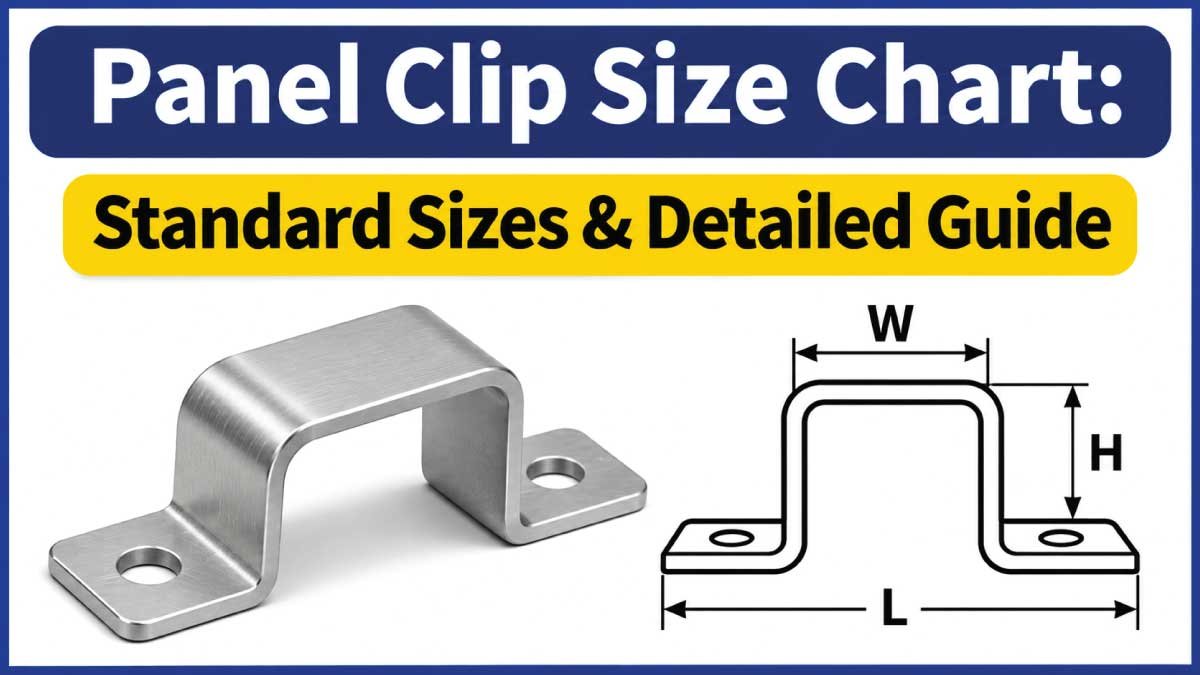
Panel clips are small fastening components used to secure panels, covers, trim pieces, and other materials to supporting structures. They are commonly found in automotive interiors, electrical enclosures, appliances, furniture, machinery, and industrial equipment.
Choosing the correct panel clip size is important for achieving a secure fit. A clip that is too small may not hold the panel properly, while an oversized clip may damage the mounting hole or prevent the panel from sitting flush.
Panel clips are available in different styles, including push-in clips, plastic rivets, edge clips, U-clips, spring clips, and metal retaining clips. Each design has its own dimensions and installation requirements.
This Panel Clip Size Chart explains common clip measurements, hole sizes, panel thickness compatibility, clip types, materials, and selection considerations. It also covers measurement methods, applications, and common fitting mistakes.
Because panel clips are not governed by one universal dimensional standard, the charts below explain common measurement categories and typical size ranges rather than claiming that every clip follows identical dimensions.
What Is a Panel Clip?
A panel clip is a fastening device designed to attach one panel or component to another surface or supporting structure.
Many panel clips are installed by pushing them into a mounting hole. Other designs slide over a panel edge, engage with a stud, or lock into a matching slot.
Panel clips can be made from plastic, nylon, spring steel, stainless steel, or other materials.
Main Functions of Panel Clips
Panel clips are used to:
- Hold interior and exterior panels in position.
- Secure automotive door cards and trim.
- Attach appliance covers and access panels.
- Retain electrical enclosure components.
- Reduce movement and vibration.
- Allow quick installation and removal.
- Replace damaged or missing original fasteners.
The correct clip depends on the panel design, hole dimensions, material thickness, and required holding strength.
Panel Clip Size Chart: Important Dimensions
Panel clips have several measurements that determine whether they fit a particular mounting application.
Common Panel Clip Measurements
| Dimension | Description | Abbreviation |
|---|---|---|
| Head diameter | Width across the clip head | HD |
| Stem diameter | Diameter of the main clip body | SD |
| Hole diameter | Required mounting hole diameter | H |
| Overall length | Total clip length | L |
| Grip range | Panel thickness the clip can securely hold | GR |
| Stem length | Length of the section entering the hole | SL |
| Head height | Height of the clip head | HH |
| Retaining diameter | Width across retaining legs or barbs | RD |
These measurements vary according to clip construction and manufacturer specifications.
Panel Clip Measurement Diagram Guide
<text>Use the following measurement references when comparing panel clips:</text>
| Measurement | What to Check |
|---|---|
| Head diameter | Measure across the widest part of the head |
| Stem diameter | Measure the main insertion section |
| Mounting hole | Measure the opening in the panel or support |
| Grip range | Compare with the combined panel thickness |
| Overall length | Measure from the top of the head to the end |
| Retaining feature | Check barb, leg, or locking-tab dimensions |
A clip’s advertised size may refer to its mounting hole, stem diameter, or product family. Always check the manufacturer’s dimensional drawing to understand what the stated size represents.
Common Panel Clip Size Ranges
Panel clips are available in many sizes. The following table provides general examples of dimensions commonly encountered in small plastic and metal panel fastening products. These are illustrative size ranges, not universal fit specifications.
Panel Clip Diameter Reference
| Clip Category | Approximate Stem or Body Diameter |
|---|---|
| Extra small | 2–3 mm |
| Small | 3–4 mm |
| Medium | 4–6 mm |
| Large | 6–8 mm |
| Extra large | 8–10 mm |
| Heavy-duty | 10 mm and above |
The required mounting hole is not necessarily equal to the stem diameter. Some clips use flexible legs or expanding sections that require a specific hole size.
Panel Clip Length Reference
| Clip Category | Approximate Overall Length |
|---|---|
| Short | 5–10 mm |
| Medium | 10–15 mm |
| Long | 15–20 mm |
| Extra long | 20–30 mm |
| Heavy-duty | 30 mm and above |
These categories are general references. Actual clip length should be selected from the product drawing and required panel engagement.
Panel Clip Hole Size Chart
Mounting hole diameter is one of the most important factors when selecting a panel clip.
The hole must allow the clip to enter without excessive force while providing enough retention to keep the panel securely attached.
Example Mounting Hole Reference
| Nominal Hole Diameter | Approximate Diameter (Inches) | General Size Category |
|---|---|---|
| 3 mm | 0.118″ | Small |
| 4 mm | 0.157″ | Small |
| 5 mm | 0.197″ | Small to medium |
| 6 mm | 0.236″ | Medium |
| 7 mm | 0.276″ | Medium |
| 8 mm | 0.315″ | Medium to large |
| 9 mm | 0.354″ | Large |
| 10 mm | 0.394″ | Large |
| 12 mm | 0.472″ | Extra large |
| 14 mm | 0.551″ | Extra large |
This is a hole-diameter reference, not a guaranteed clip compatibility chart. The required hole size depends on the clip’s retaining design, material flexibility, and manufacturer’s specification.
Why Hole Diameter Matters
If the hole is too small:
- The clip may be difficult to install.
- Retaining legs may become damaged.
- Plastic clips may crack.
- The panel may deform around the mounting point.
If the hole is too large:
- The clip may become loose.
- Retaining tabs may fail to engage.
- Vibration may cause rattling.
- The panel may separate from its support.
Measure the mounting hole accurately before ordering replacement clips.
Panel Thickness and Grip Range
Grip range describes the thickness of the material that a clip is designed to hold.
Some panel clips have flexible retaining legs that accommodate a limited thickness range. Other designs use a fixed shoulder or locking arrangement.
Example Panel Thickness Reference
| Panel Thickness | Approximate Thickness (Inches) |
|---|---|
| 0.5 mm | 0.020″ |
| 1 mm | 0.039″ |
| 1.5 mm | 0.059″ |
| 2 mm | 0.079″ |
| 2.5 mm | 0.098″ |
| 3 mm | 0.118″ |
| 4 mm | 0.157″ |
| 5 mm | 0.197″ |
| 6 mm | 0.236″ |
These are panel thickness conversions, not clip grip-range ratings.
How to Choose the Correct Grip Range
First, measure the thickness of the panel being fastened. If the clip passes through a panel and attaches to a separate support, consider the complete stack-up specified by the clip manufacturer.
For example, an automotive trim clip may need to accommodate a trim panel and a supporting mounting flange.
A clip with an unsuitable grip range may not lock properly or may leave the panel loose.
Types of Panel Clips
Different panel clips are designed for different mounting arrangements.
1. Push-In Panel Clips
Push-in clips are installed by pressing the clip into a prepared mounting hole.
They commonly use flexible legs, barbs, or expanding sections to hold the panel.
Typical applications include:
- Automotive interior trim.
- Plastic covers.
- Appliance panels.
- Equipment enclosures.
2. Plastic Rivet Clips
Plastic rivet clips use a pin or center section to expand the retaining body.
Depending on the design, the center pin may be pushed or inserted to lock the clip.
Common applications include:
- Vehicle bumper covers.
- Wheel arch liners.
- Door trim.
- Underbody panels.
- Plastic equipment housings.
3. Edge Clips
Edge clips attach to the edge of a panel rather than requiring a conventional round mounting hole.
They may use spring tension or gripping tabs to hold the panel.
Typical applications include:
- Automotive trim.
- Cable routing.
- Decorative panels.
- Metal and plastic sheet assemblies.
4. U-Clips
U-clips are shaped to slide over the edge of a panel or bracket.
Some versions include a threaded section or retaining feature for a screw or bolt.
Common applications include:
- Automotive body panels.
- Sheet metal assemblies.
- Appliance housings.
- Industrial enclosures.
5. Spring Clips
Spring clips use elastic metal force to maintain a secure connection.
They are available in different shapes and sizes depending on the panel and mounting design.
Typical applications include:
- Removable covers.
- Electrical equipment.
- Machinery guards.
- Metal panel assemblies.
6. Trim Panel Clips
Trim clips are commonly used to secure decorative or protective panels.
They may be manufactured from nylon, polypropylene, or other suitable materials.
Common applications include vehicle door panels, dashboards, interior trim, and decorative covers.
Panel Clip Type Comparison
| Clip Type | Main Retaining Method | Typical Application |
|---|---|---|
| Push-in clip | Flexible legs or barbs | Plastic panels and trim |
| Plastic rivet | Expanding center pin | Automotive body panels |
| Edge clip | Gripping panel edge | Trim and sheet assemblies |
| U-clip | Spring or edge engagement | Sheet metal panels |
| Spring clip | Elastic metal force | Equipment covers |
| Trim clip | Snap-fit retention | Automotive interiors |
The appearance of two clips may be similar even when their hole requirements and retaining dimensions differ.
Read Latest Guide:
Panel Clip Materials
Panel clips are manufactured from different materials depending on the required strength, flexibility, corrosion resistance, and operating environment.
Nylon Panel Clips
Nylon clips are commonly used where flexibility, low weight, and resistance to wear are important.
They are found in automotive trim, equipment panels, and plastic assemblies.
Material grade and environmental conditions affect their performance.
Polypropylene Clips
Polypropylene clips are used in many lightweight panel fastening applications.
They can provide useful flexibility and resistance to moisture in suitable environments.
ABS Plastic Clips
ABS clips are used in selected interior and equipment applications where dimensional stability and impact characteristics are important.
Their suitability depends on the specific grade and operating conditions.
Spring Steel Clips
Spring steel clips use elastic metal force to retain panels.
They are often used in applications requiring a metal retaining component.
Corrosion protection may be necessary depending on the environment.
Stainless Steel Clips
Stainless steel clips are used where corrosion resistance is important.
The appropriate stainless steel grade depends on exposure conditions and the required mechanical properties.
Read Latest Guide:
Material Comparison
| Material | General Characteristics | Typical Application |
|---|---|---|
| Nylon | Flexible and lightweight | Automotive and equipment trim |
| Polypropylene | Lightweight and moisture resistant | Plastic panels |
| ABS | Used in selected rigid plastic components | Equipment and interior panels |
| Spring steel | Elastic retaining force | Metal panel assemblies |
| Stainless steel | Corrosion resistance depending on grade | Industrial and outdoor equipment |
Automotive Panel Clip Size Considerations
Automotive panel clips are used in many parts of a vehicle.
Common locations include:
- Door cards.
- Dashboard trim.
- Bumper covers.
- Wheel arch liners.
- Engine covers.
- Underbody shields.
- Interior pillar trim.
- Trunk and boot panels.
Automotive clips often have manufacturer-specific dimensions and retaining designs.
A clip that fits one vehicle model may not fit another, even when both clips look similar.
Important Automotive Clip Measurements
When replacing an automotive panel clip, check:
- Mounting hole diameter.
- Clip head diameter.
- Stem length.
- Retaining leg shape.
- Panel thickness.
- Overall clip height.
- Vehicle make, model, and production year.
Where possible, use the original equipment part number or a verified replacement reference.
Read Latest Guide:
How to Measure a Panel Clip
Accurate measurement helps identify the correct replacement.
Step 1: Remove the Existing Clip
Remove the clip carefully using a suitable trim removal tool.
Avoid pulling forcefully because the clip or surrounding panel may break.
Step 2: Measure the Head Diameter
Use a caliper to measure across the widest part of the clip head.
Record the result in millimeters.
Step 3: Measure the Stem Diameter
Measure the main section that enters the mounting hole.
For clips with multiple retaining legs, also record the widest expanded diameter if available.
Step 4: Measure the Overall Length
Measure from the top of the head to the end of the clip.
This helps determine whether the clip can reach and engage the supporting structure.
Step 5: Measure the Mounting Hole
Measure the diameter of the hole in the panel or support.
Check whether the hole is round, slotted, or specially shaped.
Step 6: Check the Grip Range
Measure the panel thickness and compare it with the clip’s specified grip range.
Step 7: Identify the Retaining Design
Determine whether the clip uses barbs, flexible legs, an expanding pin, a spring, or an edge-gripping arrangement.
Step 8: Verify the Part Number
For automotive and equipment applications, compare the original part number with the replacement product information.
How to Choose the Correct Panel Clip
Selecting the correct clip involves checking its dimensions and the structure it must hold.
1. Identify the Panel Material
Determine whether the panel is plastic, metal, composite, or another material.
Some clips are designed for flexible plastic panels, while others are intended for sheet metal.
2. Measure the Mounting Hole
Confirm the hole diameter and shape.
Do not assume the required hole size is identical to the clip stem diameter.
3. Check the Panel Thickness
Choose a clip that matches the specified grip range.
4. Compare the Head Diameter
The clip head must cover the intended mounting area and fit the panel design.
5. Confirm the Clip Length
The clip must reach the supporting surface and engage correctly.
6. Consider Environmental Conditions
For outdoor, automotive engine-bay, or industrial applications, consider temperature, moisture, chemicals, vibration, and corrosion exposure.
7. Match the Retaining Style
Choose the same type of retaining mechanism as the original clip unless the replacement is specifically designed as an alternative.
Common Panel Clip Applications
Panel clips are used across many industries because they provide convenient fastening without always requiring screws or bolts.
Automotive Industry
Panel clips secure vehicle interior and exterior trim, bumper covers, wheel liners, and other body components.
Electrical Enclosures
They help attach access covers, protective panels, and selected enclosure components.
Home Appliances
Clips may secure plastic housings, removable covers, and decorative panels on appliances.
Furniture Manufacturing
Panel clips can be used in selected furniture assemblies to hold backing panels, covers, and trim components.
Industrial Machinery
Machinery manufacturers use suitable clips for covers, guards, access panels, and other components.
HVAC Equipment
Panel clips can secure selected access covers and sheet-metal components in heating and cooling equipment.
Common Panel Clip Sizing Mistakes
Incorrect panel clip selection can result in loose panels, damaged mounting holes, or broken fasteners.
Avoid these common mistakes:
- Choosing by appearance alone: Similar clips may have different dimensions.
- Ignoring hole diameter: A clip may not fit or retain correctly.
- Using the wrong grip range: The panel may remain loose or fail to lock.
- Ignoring head diameter: The clip head may not cover the mounting opening.
- Selecting the wrong stem length: The retaining section may not reach the support.
- Using an incompatible material: Temperature or chemical exposure may damage the clip.
- Forcing an oversized clip: This can crack plastic panels or deform metal openings.
- Reusing damaged clips: Broken retaining legs may not hold securely.
- Ignoring vehicle compatibility: Automotive clips can vary by manufacturer and model.
- Overlooking vibration: Some applications require clips specifically designed for vibration resistance.
Frequently Asked Questions
1. What is a panel clip used for?
A panel clip is used to fasten panels, trim pieces, covers, and other components to a supporting structure. It is common in automotive, electrical, appliance, furniture, and industrial applications.
2. How do I find the correct panel clip size?
Measure the head diameter, stem diameter, overall length, mounting hole, and panel thickness. Also identify the retaining design and check the manufacturer’s specifications.
3. What is the standard panel clip hole size?
There is no single standard hole size for all panel clips. Mounting requirements vary by clip design, manufacturer, and application.
4. What does grip range mean on a panel clip?
Grip range is the thickness of material that a clip is designed to hold securely. The panel thickness must fall within the manufacturer’s specified range.
5. Are panel clips available in different materials?
Yes. Common materials include nylon, polypropylene, ABS plastic, spring steel, and stainless steel. The appropriate material depends on the application and operating environment.
6. Can panel clips be reused?
Some clips are designed for removal and reuse, but many plastic clips can become damaged during removal. Inspect the retaining features and replace any clip that is cracked, bent, or worn.
7. What is the difference between a panel clip and a plastic rivet?
A panel clip is a broad category of panel fastening devices. A plastic rivet is a specific type that generally uses a pin or center section to expand and secure the retaining body.
8. How do I remove a push-in panel clip?
Use a suitable trim removal tool to lift the clip head and release its retaining legs. Apply controlled force to avoid damaging the panel or mounting hole.
9. Are automotive panel clips universal?
No. Some clips are interchangeable, but many are vehicle-specific. Check the original part number, dimensions, and vehicle compatibility before purchasing.
10. Why does a panel clip keep coming loose?
A clip may come loose because the mounting hole is oversized, the retaining legs are damaged, the grip range is incorrect, or the clip is incompatible with the panel. Check the hole and clip dimensions before replacing it.
Conclusion
A Panel Clip Size Chart helps compare important fastening dimensions, including head diameter, stem diameter, overall length, mounting hole size, and panel thickness. However, panel clips do not follow one universal sizing system, so the correct dimensions must be confirmed for the specific clip design.
Before purchasing replacement clips, identify the retaining style, measure the mounting hole, check the required grip range, and confirm material compatibility. Correct clip selection helps secure panels properly and reduces the risk of loose fittings, broken fasteners, and installation problems.