
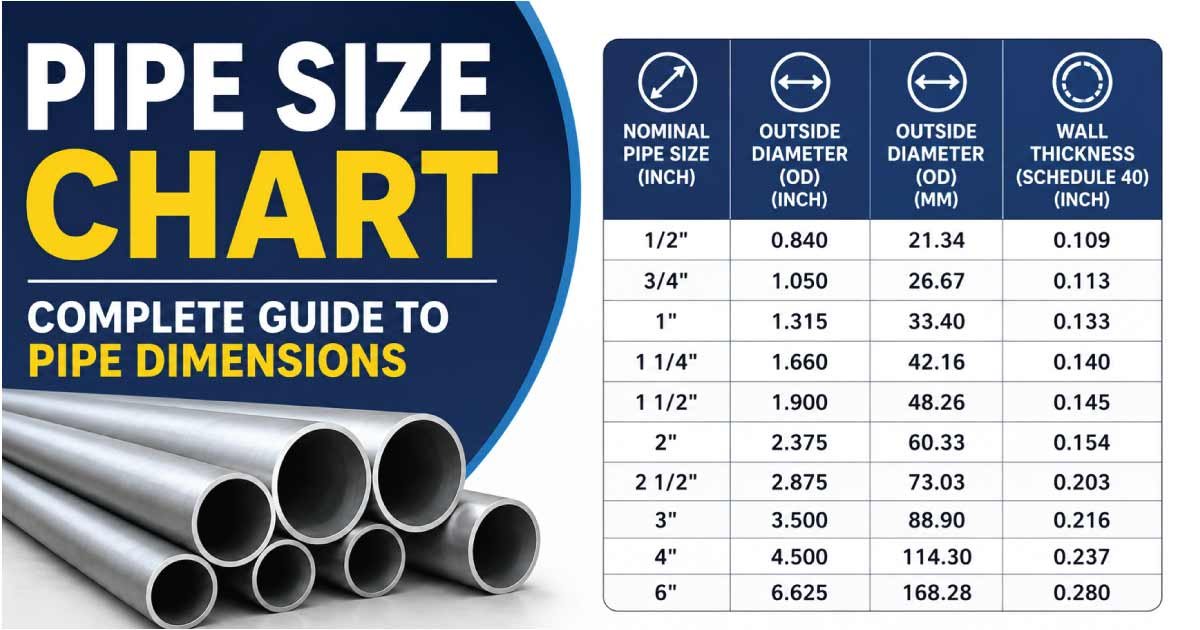
Choosing the correct pipe size is important for plumbing, water supply, drainage, heating systems, gas lines, irrigation, industrial applications, and mechanical installations. Pipe size can be confusing because the number printed on a pipe does not always represent its actual outside or inside diameter.
A pipe size chart helps compare nominal pipe sizes, outside diameters, wall thicknesses, inside diameters, and common pipe standards. Understanding these measurements makes it easier to select compatible fittings, valves, couplings, threads, and replacement pipes.
This complete guide explains nominal pipe size, actual pipe dimensions, NPS, DN, Schedule numbers, metric pipe sizes, common steel pipe dimensions, and how to measure a pipe correctly.
What Is Pipe Size?
Pipe size is a standardized way of identifying the approximate dimensions and capacity of a pipe.
The most important measurements include:
- Nominal pipe size (NPS)
- Outside diameter (OD)
- Inside diameter (ID)
- Wall thickness
- Schedule
- Nominal diameter (DN)
The term nominal means that the stated size is a standardized designation rather than necessarily the exact measured diameter.
For example, a 2-inch nominal pipe does not have an outside diameter of exactly 2 inches. A standard 2-inch NPS pipe has an outside diameter of approximately 2.375 inches (60.3 mm).
This difference between nominal size and actual dimensions is one of the most important things to understand when working with pipes.
Nominal Pipe Size Chart
Nominal Pipe Size, commonly abbreviated as NPS, is widely used for North American pipe systems.
| NPS | Nominal Size | Outside Diameter |
|---|---|---|
| 1/8 | 1/8 in | 0.405 in |
| 1/4 | 1/4 in | 0.540 in |
| 3/8 | 3/8 in | 0.675 in |
| 1/2 | 1/2 in | 0.840 in |
| 3/4 | 3/4 in | 1.050 in |
| 1 | 1 in | 1.315 in |
| 1-1/4 | 1-1/4 in | 1.660 in |
| 1-1/2 | 1-1/2 in | 1.900 in |
| 2 | 2 in | 2.375 in |
| 2-1/2 | 2-1/2 in | 2.875 in |
| 3 | 3 in | 3.500 in |
| 3-1/2 | 3-1/2 in | 4.000 in |
| 4 | 4 in | 4.500 in |
| 5 | 5 in | 5.563 in |
| 6 | 6 in | 6.625 in |
| 8 | 8 in | 8.625 in |
| 10 | 10 in | 10.750 in |
| 12 | 12 in | 12.750 in |
| 14 | 14 in | 14.000 in |
| 16 | 16 in | 16.000 in |
| 18 | 18 in | 18.000 in |
| 20 | 20 in | 20.000 in |
| 24 | 24 in | 24.000 in |
For NPS sizes from 1/8 through 12, the outside diameter is generally larger than the nominal size. For larger sizes, the nominal designation generally corresponds much more closely to the outside diameter.
Pipe Size in Millimeters
The same common pipe sizes can be expressed using millimeter dimensions.
| NPS | Approx. Outside Diameter |
|---|---|
| 1/2 in | 21.3 mm |
| 3/4 in | 26.7 mm |
| 1 in | 33.4 mm |
| 1-1/4 in | 42.2 mm |
| 1-1/2 in | 48.3 mm |
| 2 in | 60.3 mm |
| 2-1/2 in | 73.0 mm |
| 3 in | 88.9 mm |
| 4 in | 114.3 mm |
| 5 in | 141.3 mm |
| 6 in | 168.3 mm |
| 8 in | 219.1 mm |
| 10 in | 273.1 mm |
| 12 in | 323.9 mm |
| 14 in | 355.6 mm |
| 16 in | 406.4 mm |
| 18 in | 457.2 mm |
| 20 in | 508.0 mm |
| 24 in | 609.6 mm |
These values represent common nominal pipe dimensions and should not be interpreted as the inside diameter.
What Does NPS Mean?
NPS stands for Nominal Pipe Size.
It is a standardized designation used primarily in North America to identify pipe size.
NPS does not necessarily equal the measured outside or inside diameter.
For example:
NPS 2
has a nominal size of 2 inches but an outside diameter of approximately 2.375 inches.
Similarly:
NPS 4
has a nominal size of 4 inches but an outside diameter of approximately 4.500 inches.
The actual inside diameter depends on the wall thickness or pipe schedule.
What Is DN Pipe Size?
DN stands for nominal diameter and is commonly used in international metric-based standards.
DN numbers are generally expressed in millimeters.
Common examples include:
| DN | Approx. NPS |
|---|---|
| DN15 | 1/2 in |
| DN20 | 3/4 in |
| DN25 | 1 in |
| DN32 | 1-1/4 in |
| DN40 | 1-1/2 in |
| DN50 | 2 in |
| DN65 | 2-1/2 in |
| DN80 | 3 in |
| DN100 | 4 in |
| DN125 | 5 in |
| DN150 | 6 in |
| DN200 | 8 in |
| DN250 | 10 in |
| DN300 | 12 in |
| DN350 | 14 in |
| DN400 | 16 in |
| DN450 | 18 in |
| DN500 | 20 in |
| DN600 | 24 in |
DN and NPS are related designations, but they are not simply exact conversions of one another.
Pipe Outside Diameter vs. Inside Diameter
One of the most common pipe-sizing mistakes is confusing outside diameter with inside diameter.
Outside Diameter
Outside diameter is measured from the outside surface of one side of the pipe to the outside surface on the opposite side.
It is especially important when selecting:
- Compression fittings
- Clamps
- Mechanical couplings
- Pipe supports
- Sleeves
- Certain tubing fittings
Inside Diameter
Inside diameter is the distance across the open internal passage.
It affects the available flow area and therefore influences fluid velocity and pressure loss.
Inside diameter changes when wall thickness changes.
For a simple cylindrical pipe:
Inside Diameter = Outside Diameter − 2 × Wall Thickness
For example, if a pipe has:
- OD = 60.3 mm
- Wall thickness = 3.91 mm
Then:
60.3 − (2 × 3.91) = approximately 52.48 mm ID
Actual dimensions should always be verified against the applicable pipe specification.
Pipe Schedule Explained
Pipe schedule describes the wall thickness of many standardized steel and other metal pipes.
Common schedules include:
- Schedule 5
- Schedule 10
- Schedule 20
- Schedule 30
- Schedule 40
- Schedule 60
- Schedule 80
- Schedule 100
- Schedule 120
- Schedule 140
- Schedule 160
The important point is that schedule does not simply mean pressure rating.
The actual pressure capability depends on pipe material, dimensions, temperature, manufacturing standard, corrosion allowance, joint design, and other factors.
For a given nominal pipe size, increasing the schedule generally means a thicker wall and a smaller internal diameter.
Also Read:
Schedule 40 Pipe Size Chart
Schedule 40 is one of the most commonly encountered pipe wall classifications.
| NPS | Outside Diameter | Approx. Wall Thickness |
|---|---|---|
| 1/2 in | 21.3 mm | 2.77 mm |
| 3/4 in | 26.7 mm | 2.87 mm |
| 1 in | 33.4 mm | 3.38 mm |
| 1-1/4 in | 42.2 mm | 3.56 mm |
| 1-1/2 in | 48.3 mm | 3.68 mm |
| 2 in | 60.3 mm | 3.91 mm |
| 2-1/2 in | 73.0 mm | 5.16 mm |
| 3 in | 88.9 mm | 5.49 mm |
| 4 in | 114.3 mm | 6.02 mm |
| 5 in | 141.3 mm | 6.55 mm |
| 6 in | 168.3 mm | 7.11 mm |
| 8 in | 219.1 mm | 8.18 mm |
| 10 in | 273.1 mm | 9.27 mm |
| 12 in | 323.9 mm | 9.53 mm |
These are commonly referenced dimensions for Schedule 40 steel pipe. Actual specifications should be verified against the applicable standard and material.
Schedule 80 Pipe Size Chart
Schedule 80 generally provides a thicker wall than Schedule 40 for the same nominal size.
| NPS | Outside Diameter | Approx. Wall Thickness |
|---|---|---|
| 1/2 in | 21.3 mm | 3.73 mm |
| 3/4 in | 26.7 mm | 3.91 mm |
| 1 in | 33.4 mm | 4.55 mm |
| 1-1/4 in | 42.2 mm | 4.85 mm |
| 1-1/2 in | 48.3 mm | 5.08 mm |
| 2 in | 60.3 mm | 5.54 mm |
| 2-1/2 in | 73.0 mm | 7.01 mm |
| 3 in | 88.9 mm | 7.62 mm |
| 4 in | 114.3 mm | 8.56 mm |
| 5 in | 141.3 mm | 9.53 mm |
| 6 in | 168.3 mm | 10.97 mm |
| 8 in | 219.1 mm | 12.70 mm |
| 10 in | 273.1 mm | 15.09 mm |
| 12 in | 323.9 mm | 17.48 mm |
Because Schedule 80 has a thicker wall, its inside diameter is generally smaller than Schedule 40 for the same nominal pipe size.
Pipe Size and Wall Thickness
Wall thickness is the distance between the outside and inside surfaces of the pipe wall.
A thicker pipe wall can provide greater mechanical strength and corrosion allowance, but it also reduces the internal flow area.
For example, two pipes can both be NPS 2 while having different wall thicknesses.
The outside diameter remains approximately the same, but the inside diameter changes.
This is why a pipe’s nominal size alone cannot tell you its exact internal flow diameter.
Also Read:
Pipe Size vs. Tubing Size
Pipe and tubing are not always sized using the same conventions.
Pipe
Pipe is commonly identified using nominal pipe size and schedule.
Tubing
Tubing is often specified directly by its outside diameter and wall thickness.
For example:
1-inch tubing
may actually have an outside diameter of exactly 1 inch, depending on the tubing standard.
A nominal 1-inch pipe, on the other hand, has an outside diameter of approximately 1.315 inches.
This difference is extremely important when selecting fittings.
How to Measure Pipe Size
If you do not know the pipe’s nominal size, you can measure the pipe directly.
Step 1: Measure the Outside Diameter
Use a caliper for smaller pipes or a tape measure and diameter calculation for larger pipes.
For a round pipe:
Diameter = Circumference ÷ π
Step 2: Identify the Material
Determine whether the pipe is:
- Steel
- Stainless steel
- Copper
- PVC
- CPVC
- PEX
- HDPE
- Aluminum
- Another material
Different materials use different sizing systems.
Step 3: Measure Wall Thickness
If possible, measure the wall thickness directly.
Step 4: Compare With a Standard Chart
Compare the measured outside diameter with standard nominal dimensions.
Step 5: Check Existing Fittings
The fittings, valves, markings, or manufacturer’s information can help confirm the pipe size.
Common Plumbing Pipe Sizes
Residential plumbing uses a variety of pipe sizes depending on the application.
Common sizes include:
- 1/2 inch
- 3/4 inch
- 1 inch
- 1-1/4 inch
- 1-1/2 inch
- 2 inch
- 3 inch
- 4 inch
Smaller sizes are commonly used for water distribution, while larger sizes are often used for drainage, building services, commercial systems, and other applications.
The appropriate pipe size depends on flow requirements, pressure, fixture demand, material, local plumbing requirements, and system design.
Also Read:
Common Pipe Sizes for Water Supply
Water supply systems often use smaller pipe sizes than major drainage or industrial systems.
Typical sizes can include:
1/2-Inch Pipe
Often encountered in individual fixture connections and smaller branches.
3/4-Inch Pipe
Common for larger branches and certain residential distribution systems.
1-Inch Pipe
Often used for larger supply lines and distribution branches.
1-1/4 Inch and Larger
These sizes may be used for higher-flow requirements, commercial systems, building services, and main distribution lines.
Actual sizing should be based on flow demand and the applicable plumbing code rather than a general size assumption.
Drainage Pipe Size
Drainage systems use different sizing considerations because gravity flow, slope, fixture loading, and pipe material all influence capacity.
Common drainage sizes include:
- 1-1/2 inch
- 2 inch
- 3 inch
- 4 inch
- 6 inch
- 8 inch
The correct drainage pipe size depends on the number and type of fixtures, expected flow, slope, venting requirements, local plumbing regulations, and pipe material.
Pipe Thread Size vs. Pipe Diameter
Pipe thread sizes can be particularly confusing because the nominal thread size does not always equal the measured outside diameter.
For example, a nominal 1/2-inch pipe thread is associated with a pipe whose actual outside diameter is significantly greater than 1/2 inch.
Pipe threads are commonly identified using standards such as:
- NPT
- BSP
- Other regional or industry-specific standards
A fitting marked with a nominal pipe thread size should not be assumed to have an outside diameter equal to the marking.
NPT Pipe Thread Sizes
NPT stands for National Pipe Taper and is a common U.S. pipe thread standard.
Common nominal NPT sizes include:
- 1/8 NPT
- 1/4 NPT
- 3/8 NPT
- 1/2 NPT
- 3/4 NPT
- 1 NPT
- 1-1/4 NPT
- 1-1/2 NPT
- 2 NPT
NPT threads are tapered, meaning the diameter changes along the threaded section.
Thread compatibility requires matching the appropriate thread standard, nominal size, and gender.
BSP vs. NPT Pipe Threads
BSP and NPT are different pipe thread systems.
BSP threads are commonly associated with British standards, while NPT is widely used in North America.
Even when two fittings appear to have similar nominal sizes, their thread profiles, pitch, and taper characteristics may differ.
Do not assume a BSP fitting will correctly mate with an NPT fitting.
When selecting threaded pipe components, always identify the thread standard.
Pipe Size Conversion Chart
| NPS | Approx. DN | Outside Diameter |
|---|---|---|
| 1/2 in | DN15 | 21.3 mm |
| 3/4 in | DN20 | 26.7 mm |
| 1 in | DN25 | 33.4 mm |
| 1-1/4 in | DN32 | 42.2 mm |
| 1-1/2 in | DN40 | 48.3 mm |
| 2 in | DN50 | 60.3 mm |
| 2-1/2 in | DN65 | 73.0 mm |
| 3 in | DN80 | 88.9 mm |
| 4 in | DN100 | 114.3 mm |
| 5 in | DN125 | 141.3 mm |
| 6 in | DN150 | 168.3 mm |
| 8 in | DN200 | 219.1 mm |
| 10 in | DN250 | 273.1 mm |
| 12 in | DN300 | 323.9 mm |
| 14 in | DN350 | 355.6 mm |
| 16 in | DN400 | 406.4 mm |
| 18 in | DN450 | 457.2 mm |
| 20 in | DN500 | 508.0 mm |
| 24 in | DN600 | 609.6 mm |
DN values are nominal designations and are not necessarily exact conversions of NPS dimensions.
How Pipe Size Affects Flow
Pipe diameter has a major effect on fluid flow.
A larger internal diameter provides a greater flow area, while a smaller internal diameter restricts the available flow area.
The flow area of a circular pipe can be calculated using:
A = πD² ÷ 4
where:
- A = cross-sectional area
- D = inside diameter
Because diameter is squared in this equation, a relatively small change in internal diameter can produce a significant change in cross-sectional area.
However, actual pipe sizing requires consideration of flow rate, velocity, pressure loss, fluid characteristics, elevation, fittings, and system requirements.
Pipe Size and Pressure Rating
Pipe size and pressure rating are separate characteristics.
A larger pipe is not automatically capable of handling greater pressure.
Pressure capability depends on:
- Pipe material
- Wall thickness
- Temperature
- Manufacturing standard
- Pipe grade
- Corrosion allowance
- Joint type
- Design requirements
For example, two pipes with the same nominal diameter can have different schedules and therefore different wall thicknesses.
For pressurized systems, use the applicable engineering standard and manufacturer’s pressure rating.
Steel Pipe Size vs. PVC Pipe Size
Steel and plastic pipe can use different sizing conventions.
A steel pipe may be specified using NPS and Schedule, while PVC systems commonly use their own dimensional standards and pressure classifications.
Some plastic pipes have outside diameters that correspond closely to nominal sizes, while others use different dimension ratios.
Therefore, a 2-inch steel pipe and a 2-inch plastic pipe should not automatically be assumed to have identical outside or inside dimensions.
Always verify the specific pipe standard and fitting compatibility.
Common Pipe Size Mistakes
Assuming Nominal Size Equals Outside Diameter
A 2-inch NPS pipe does not have a 2-inch outside diameter.
Confusing Inside and Outside Diameter
The two dimensions are different and can vary according to wall thickness.
Ignoring Schedule
Two pipes with the same nominal size can have different wall thicknesses.
Mixing Pipe and Tubing Measurements
Tubing is often specified by actual outside diameter, while pipe is commonly identified by nominal size.
Ignoring Thread Standards
NPT and BSP threads should not be treated as automatically interchangeable.
Selecting Pipe Only by Diameter
Flow rate, pressure, temperature, material, and application requirements also matter.
How to Choose the Correct Pipe Size
When selecting a pipe, consider the complete application rather than the nominal diameter alone.
Check:
- Nominal pipe size
- Outside diameter
- Inside diameter
- Wall thickness
- Schedule or pressure class
- Pipe material
- Operating pressure
- Operating temperature
- Required flow rate
- Fitting compatibility
- Thread standard
- Applicable codes and standards
For residential plumbing, local plumbing codes should be followed. For industrial systems, engineering specifications and applicable piping standards should be used.
Pipe Size Chart: Quick Reference
| Nominal Size | Approx. OD | Approx. DN |
|---|---|---|
| 1/2 in | 21.3 mm | DN15 |
| 3/4 in | 26.7 mm | DN20 |
| 1 in | 33.4 mm | DN25 |
| 1-1/4 in | 42.2 mm | DN32 |
| 1-1/2 in | 48.3 mm | DN40 |
| 2 in | 60.3 mm | DN50 |
| 2-1/2 in | 73.0 mm | DN65 |
| 3 in | 88.9 mm | DN80 |
| 4 in | 114.3 mm | DN100 |
| 6 in | 168.3 mm | DN150 |
| 8 in | 219.1 mm | DN200 |
| 10 in | 273.1 mm | DN250 |
| 12 in | 323.9 mm | DN300 |
Frequently Asked Questions About Pipe Sizes
What does NPS mean in pipe sizing?
NPS means Nominal Pipe Size. It is a standardized designation used to identify pipe sizes, particularly in North American systems.
Does a 2-inch pipe have a 2-inch outside diameter?
No. A standard 2-inch NPS pipe has an outside diameter of approximately 2.375 inches or 60.3 mm.
What is DN50 pipe?
DN50 is a nominal metric designation commonly associated with NPS 2 pipe.
What is the difference between pipe size and tubing size?
Pipe is commonly identified by nominal size, while tubing is often identified by its actual outside diameter and wall thickness.
Does Schedule 80 pipe have a larger outside diameter than Schedule 40?
For the same NPS, the outside diameter is generally the same while Schedule 80 has a thicker wall. The thicker wall therefore produces a smaller inside diameter.
What is the inside diameter of a pipe?
Inside diameter is the distance across the internal opening. It depends on the pipe’s outside diameter and wall thickness.
How do I measure pipe size?
Measure the outside diameter, determine the wall thickness if possible, identify the material and pipe standard, and compare the measurements with the appropriate size chart.
What is the most common pipe size?
There is no single size that is most common across all industries. Sizes such as 1/2, 3/4, 1, 2, 4, and 6 inches are widely encountered in different applications.
Are NPT and BSP threads interchangeable?
No. They are different thread standards and should not be assumed to be compatible.
Does a larger pipe always provide better performance?
Not necessarily. Pipe size should be selected based on flow requirements, velocity, pressure loss, system design, cost, and applicable standards.
Final Thoughts on Pipe Sizes
Understanding pipe dimensions is essential for choosing the correct pipe, fitting, valve, coupling, or replacement component. The most important concept to remember is that nominal pipe size is not necessarily the actual outside or inside diameter.
For many North American steel pipe systems, NPS identifies the nominal size while the Schedule designation helps identify wall thickness. International systems commonly use DN designations, while tubing and plastic piping may use different dimensional conventions.
When identifying an existing pipe, measure the outside diameter first and determine the wall thickness when possible. Then compare the measurements with the appropriate standard rather than relying only on the number printed on the pipe.
For any piping system, the correct selection should consider pipe size, inside diameter, wall thickness, material, pressure, temperature, flow requirements, fittings, and applicable codes.
A pipe size chart is an excellent reference tool, but the final pipe specification should always be verified against the relevant manufacturer, engineering standard, or local code—especially for pressurized, gas, industrial, or safety-critical applications.