
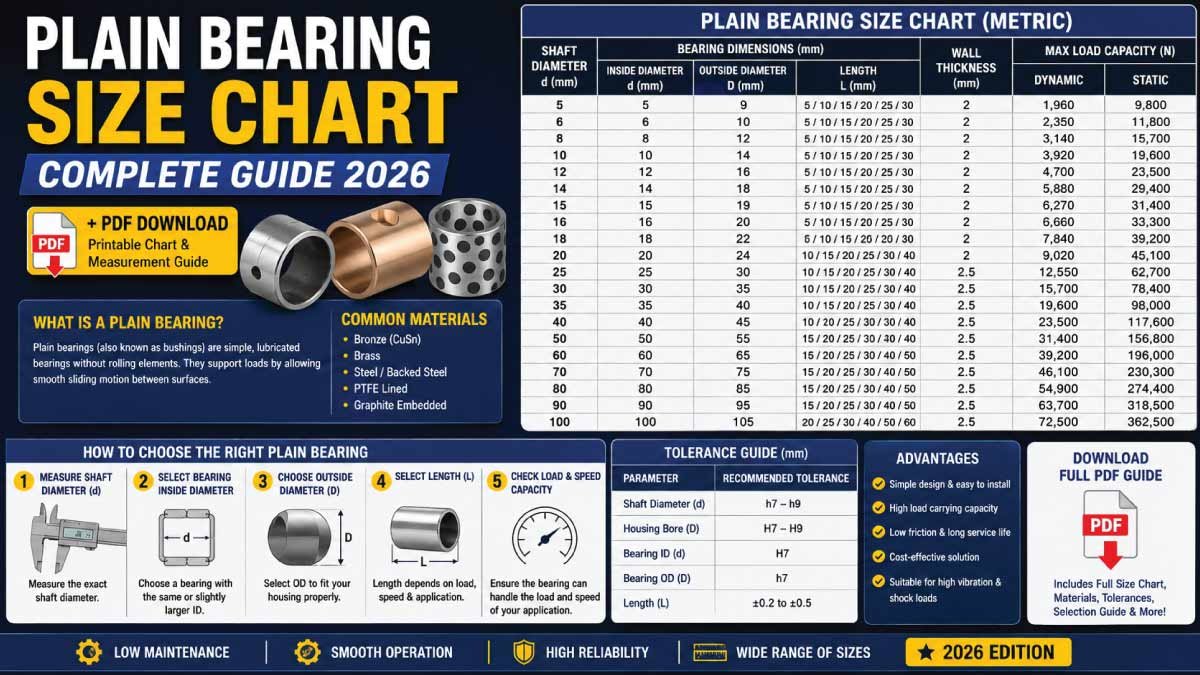
Plain bearings are one of those mechanical components that look simple on the outside but play a huge role in how smoothly machines operate. From automotive engines and industrial machinery to household appliances and agricultural equipment, plain bearings are everywhere.
Yet, many people struggle when it comes to understanding plain bearing sizes and how to read a plain bearing size chart correctly. If you have ever been confused by inner diameter (ID), outer diameter (OD), length, or clearance values, you are not alone.
This guide breaks everything down in a clear, human way—no unnecessary jargon, no overcomplicated formulas. By the end, you’ll know exactly how to read a plain bearing size chart and choose the right bearing for your application.
What Is a Plain Bearing?
A plain bearing, also called a sleeve bearing or bushing, is a bearing that allows sliding motion between two surfaces instead of rolling motion like ball or roller bearings.
Unlike rolling bearings, plain bearings:
- Have no rolling elements
- Rely on direct surface contact
- Use lubrication or self-lubricating materials to reduce friction
Their simplicity makes them durable, quiet, cost-effective, and ideal for heavy loads or slow to moderate speeds.
Why Plain Bearing Size Matters
Plain bearing size plays a critical role in machine performance and reliability. Even a small sizing mistake can affect alignment, lubrication, and load handling. Selecting the correct bearing size ensures smooth operation, longer service life, and helps prevent avoidable mechanical damage and costly downtime.
Choosing the wrong size plain bearing can cause serious issues, such as:
- Excessive wear
- Shaft misalignment
- Overheating
- Noise and vibration
- Premature failure of the machine
That’s why manufacturers provide plain bearing size charts—to ensure the bearing fits perfectly with the shaft and housing.
Key Dimensions in a Plain Bearing Size Chart
A plain bearing size chart may look simple at first glance, but each listed dimension plays a specific role in how the bearing performs inside a machine. Understanding these basic measurements helps you avoid fitment issues, reduce wear, and ensure reliable operation. Before using any size chart, it’s important to know what each dimension actually means and why it matters.
1. Inner Diameter (ID)
The inner diameter is the diameter of the hole inside the bearing.
This must match the shaft diameter.
- Measured in millimeters (mm) or inches
- A poor ID fit can lead to wobbling or seizure
Tip: Always measure the shaft first, then select a bearing with a matching ID.
2. Outer Diameter (OD)
The outer diameter is the outside measurement of the bearing.
- Fits into the housing or bore
- Must match the housing size precisely
If the OD is too small, the bearing may spin in the housing. If it’s too large, installation becomes difficult or impossible.
3. Bearing Length (Width)
The length (also called width) affects:
- Load capacity
- Stability
- Wear distribution
Longer bearings can handle higher loads but may increase friction. Shorter bearings are compact but may wear faster under heavy loads.
4. Wall Thickness
Wall thickness is calculated as:
(OD − ID) ÷ 2
This dimension impacts:
- Strength
- Load resistance
- Heat dissipation
Thin-wall bearings are common in precision equipment, while thicker walls are used in heavy-duty applications.
5. Clearance
Clearance is the small gap between the shaft and the bearing ID.
- Too little clearance → overheating
- Too much clearance → vibration and noise
Some size charts include standard clearance ranges, especially for engine and industrial bearings.
Typical Plain Bearing Size Chart (Metric Example)
Plain bearing size charts are designed to give a quick, clear reference for matching shaft sizes with the correct bearing dimensions. In metric systems, sizes are listed in millimeters and commonly follow standardized proportions used across industrial and automotive applications. Understanding this format helps you select a bearing that fits accurately and performs reliably.
Below is a general example of how plain bearing sizes are presented. Always check the manufacturer’s data for exact tolerances.
| Shaft Size (ID) | Outer Diameter (OD) | Length (L) |
|---|---|---|
| 10 mm | 12 mm | 10 mm |
| 12 mm | 14 mm | 12 mm |
| 15 mm | 17 mm | 15 mm |
| 20 mm | 24 mm | 20 mm |
| 25 mm | 29 mm | 25 mm |
| 30 mm | 34 mm | 30 mm |
| 40 mm | 44 mm | 40 mm |
| 50 mm | 54 mm | 50 mm |
This format makes it easy to match your shaft size with the correct bearing dimensions.
Inch-Based Plain Bearing Size Chart
n the United States, many machines and tools still use inch measurements for bearings. This chart provides a quick reference to match shaft, outer diameter, and length, ensuring proper fit and smooth operation.
| Shaft Size (ID) | Outer Diameter (OD) | Length |
|---|---|---|
| 1/4 in | 5/16 in | 1/4 in |
| 3/8 in | 1/2 in | 3/8 in |
| 1/2 in | 5/8 in | 1/2 in |
| 3/4 in | 7/8 in | 3/4 in |
| 1 in | 1-1/4 in | 1 in |
Always confirm whether your equipment uses metric or inch standards before ordering.
Our Trending Post:
Common Types of Plain Bearings and Their Size Considerations
Plain bearings may look simple, but their size directly affects machine performance. Understanding bearing dimensions ensures smooth operation, prevents wear, and helps you select the right fit for engines, industrial machines, and everyday equipment.
1- Sleeve Bearings
Sleeve bearings are the most widely used plain bearings, offering a simple, cylindrical design. Their straightforward size charts make them easy to select and install, and they are commonly found in motors, fans, pumps, and other general machinery applications.
- Cylindrical shape
- Simple size chart
- Used in motors, fans, and pumps
2- Flanged Plain Bearings
Flanged plain bearings include a lip or flange on one end to prevent axial movement. These bearings require extra measurements for proper installation, and size charts typically list ID, OD, length, flange thickness, and flange diameter for accurate selection.
- Prevent axial movement
- Require additional flange diameter measurements
Size charts often list:
- ID
- OD
- Length
- Flange thickness
- Flange diameter
3- Thrust Plain Bearings
Thrust plain bearings are specially designed to handle axial loads, making them ideal for applications where directional forces are present. Their size charts focus on inner and outer race diameters, as well as thickness, which is critical for proper load support.
- Size charts focus on inner and outer race diameters
- Thickness is critical
Materials and Their Impact on Size Selection
The material of a plain bearing influences strength, friction, and durability. It also affects sizing tolerances, thermal expansion, and load capacity. Choosing the right material ensures optimal performance and proper clearance, especially in high-heat or heavy-duty applications.
Common Materials:
- Bronze
- Brass
- PTFE-lined
- Plastic (nylon, acetal)
- Composite materials
Some materials expand more with heat, so clearance values in the size chart become especially important.
Our Trending Post:
How to Measure for the Correct Plain Bearing Size
Accurate measurement is essential when selecting a plain bearing. Properly measuring the shaft, housing, and bearing length ensures a perfect fit, prevents premature wear, and guarantees smooth operation in both replacement and new-design applications.
If you are replacing an existing bearing, follow these steps:
Measure the shaft diameter using a caliper
Measure the housing bore
Measure the bearing length
Check for wear—don’t rely on worn bearings for accurate sizing
For new designs, always start with the shaft size, then work outward.
Common Mistakes When Using a Plain Bearing Size Chart
Even experienced technicians can make errors when selecting plain bearings. Simple mistakes like ignoring clearance, mixing units, or assuming uniform tolerances often lead to premature failure, increased wear, and operational issues. Careful attention to size charts prevents these problems.
Many bearing failures come from simple mistakes:
Mixing metric and inch sizes
Ignoring clearance recommendations
Choosing length based only on availability
Assuming all manufacturers use identical tolerances
Always read the fine print in the size chart.
Our Trending Post:
Plain Bearing Tolerances Explained Simply
Tolerances indicate the allowable variation in bearing dimensions, ensuring proper fit and reliable performance. Correct tolerance selection prevents excessive wear, overheating, and vibration, especially in high-speed or high-temperature applications, and helps match bearings to precision or heavy-duty machinery.
Tolerances define how much variation is allowed in dimensions.
Tight tolerance → precision equipment
Loose tolerance → heavy-duty, slow-speed machinery
Size charts may show:
Nominal size
Maximum and minimum values
This is especially important in high-speed or high-temperature applications.
Applications Where Plain Bearing Size Accuracy Is Critical
Accurate bearing sizing is crucial in high-performance systems. Even minor deviations can cause wear, misalignment, or failure. Industries like automotive, CNC machining, hydraulics, agriculture, and industrial conveyors rely on precise measurements for reliable, efficient, and long-lasting operation.
Automotive engines
CNC machines
Hydraulic systems
Agricultural equipment
Industrial conveyors
In these systems, even a 0.01 mm error can lead to performance problems.
How to Choose the Right Plain Bearing Using a Size Chart
Selecting the correct plain bearing requires careful comparison of shaft, housing, length, clearance, and material. Following a systematic checklist ensures proper fit, smooth operation, and long-lasting performance, reducing wear, vibration, and costly mechanical failures.
Here’s a simple checklist:
✔ Match ID with shaft size
✔ Match OD with housing bore
✔ Choose proper length for load
✔ Confirm clearance values
✔ Verify material compatibility
If all five match, you’re on the right track.
Our Trending Post:
Final Thoughts
A plain bearing size chart is more than just a table of numbers—it’s a guide to keeping machines running smoothly, quietly, and efficiently. Understanding how to read IDs, ODs, lengths, and clearances gives you confidence when selecting bearings, whether you’re a mechanic, engineer, student, or DIY enthusiast.
Instead of guessing or relying on trial and error, take a few minutes to study the size chart and measure correctly. It can save you time, money, and unnecessary equipment failure in the long run.
If you’re building a size-guide or mechanical reference website, content like this helps readers trust your site—and that trust brings repeat visitors.