
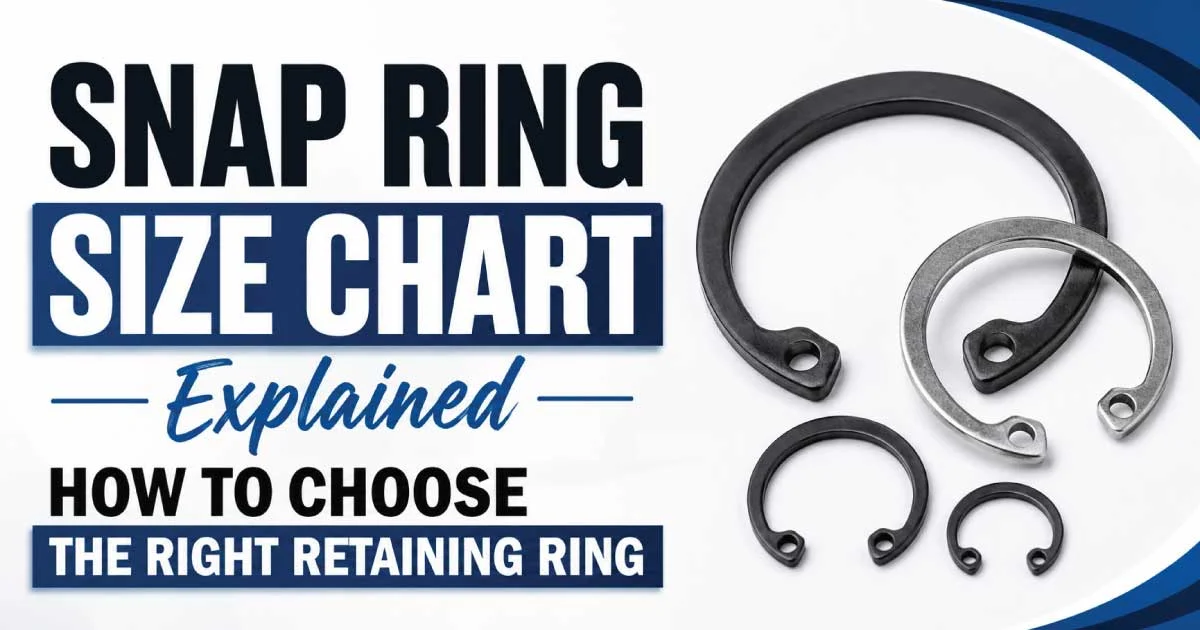
Snap rings are small but important retaining components used to keep bearings, gears, shafts, bushings, and other machine parts in their correct position. Choosing the right snap ring size is not simply a matter of matching the ring’s outside or inside diameter. The shaft or housing diameter, groove dimensions, ring thickness, section, and installation type all affect whether a snap ring will fit and perform correctly.
This snap ring size chart provides a practical starting point for understanding common internal and external snap ring sizes, the measurements that matter, and how to select the correct ring for an application. Snap rings are available in both inch and metric systems, and exact dimensions can vary by design series and manufacturer. For critical applications, always verify the manufacturer’s specification against the actual groove dimensions.
Understanding Snap Ring Sizes
A snap ring, also called a retaining ring in many applications, is designed to fit into a machined groove and create a shoulder that prevents an assembly component from moving axially.
There are two basic arrangements:
- External snap rings fit into grooves on shafts.
- Internal snap rings fit into grooves inside housings or bores.
The ring itself is normally identified by the nominal shaft or housing diameter for which it is designed. However, the nominal diameter alone does not provide enough information to determine whether two rings are interchangeable.
Rotor Clip notes that retaining-ring size is defined by the shaft or housing diameter where the ring is installed, while different standards such as ANSI Inch, DIN, ANSI Metric, and JIS may use different designs and specifications.
For this reason, a proper snap ring size chart should be used together with the groove dimensions rather than as a substitute for them.
Snap Ring Size Chart
The following table shows representative nominal size ranges commonly encountered in metric and inch snap-ring systems. These are size-reference ranges, not universal dimensional specifications. Exact ring thickness, groove diameter, section, and tolerances depend on the particular ring series.
| Snap Ring Type | Typical Size System | Nominal Size Reference | Installation Location |
|---|---|---|---|
| External metric snap ring | Metric | 4–150 mm | Shaft groove |
| Internal metric snap ring | Metric | 4–150 mm* | Housing/bore groove |
| External inch snap ring | Inch | 0.157–10 in* | Shaft groove |
| Internal inch snap ring | Inch | 0.157–10 in* | Housing/bore groove |
| Heavy-duty metric constant-section ring | Metric | 13–300 mm | Shaft or housing groove |
| Heavy-duty inch constant-section ring | Inch | 0.500–11 in | Shaft or housing groove |
*Available ranges vary according to manufacturer, series, standard, and ring configuration.
For example, Rotor Clip lists standard constant-section snap rings from 4 mm to 150 mm and custom sizes beyond that range. Smalley lists its metric constant-section FH and FS series from 13 mm to 300 mm, while its standard imperial FHE and FSE series cover 0.500 to 11 inches.
Internal vs. External Snap Ring Sizes
The most important first step is identifying where the ring will be installed.
External Snap Ring
An external snap ring is installed in a groove machined around the outside of a shaft. After installation, part of the ring remains above the groove and acts as a retaining shoulder.
External snap rings are commonly used to retain:
- Bearings
- Gears
- Wheels
- Bushings
- Washers
- Pulleys
- Other components mounted on shafts
The ring must be sized for the shaft and groove geometry. A ring that is close to the shaft diameter but has the wrong groove requirements may still be unsuitable.
Internal Snap Ring
An internal snap ring is installed inside a housing or bore. When compressed and inserted into the groove, the ring expands against the groove and creates an internal shoulder.
Common applications include:
- Bearing retention
- Gearbox assemblies
- Hydraulic components
- Electric motors
- Cylinders
- Housings
- Machine-tool assemblies
Rotor Clip’s metric internal snap-ring specifications, for example, identify the housing diameter, groove diameter, groove width, free diameter, thickness, and section as separate dimensions.
Snap Ring Dimensions You Need to Know
A snap ring size chart becomes much more useful when you understand the dimensions behind the size designation.
Shaft Diameter
For an external ring, the shaft diameter is the diameter of the shaft where the retaining groove is located.
It is often represented by Ds in engineering drawings and manufacturer specifications.
The shaft diameter is an important starting measurement, but it should not be the only measurement used to select a ring.
Housing or Bore Diameter
For an internal snap ring, measure the housing or bore diameter where the ring will be installed.
This dimension is commonly represented as Dh in engineering documentation.
Groove Diameter
The groove diameter determines how the ring sits within the machined groove.
For an external ring, the groove reduces the effective diameter of the shaft.
For an internal ring, the groove increases the available diameter inside the housing.
Groove Width
Groove width must provide enough space for the ring’s axial thickness without allowing excessive movement.
A ring may have the correct nominal diameter but still be unsuitable if the groove width does not match its specification.
Ring Thickness
Ring thickness affects the amount of material occupying the groove and contributes to the ring’s ability to retain the component.
It should always be compared with the specified groove width and tolerance.
Free Diameter
Free diameter refers to the ring diameter before it is installed and constrained by the shaft or housing groove.
This measurement can be especially useful when identifying an existing ring, but it must be measured correctly because installation or deformation can change the ring.
Rotor Clip specifically warns that free diameter measurements can be misleading if a retaining ring has already been installed or its lugs have been compressed or expanded.
How to Measure for the Correct Snap Ring Size
Selecting the correct snap ring starts with measuring the mating part rather than simply measuring the ring itself.
For an External Snap Ring
Follow these steps:
- Measure the shaft diameter with a suitable caliper.
- Identify the diameter at the actual retaining groove.
- Measure the groove width.
- Measure the groove diameter or groove depth as required by the ring specification.
- Determine the available radial and axial clearance.
- Match these measurements to the manufacturer’s snap-ring chart.
- Confirm the ring material and load requirements.
The shaft diameter normally provides the starting point for selecting an external ring, but the groove dimensions determine whether the ring will actually fit.
For an Internal Snap Ring
For an internal ring:
- Measure the housing or bore diameter.
- Measure the groove diameter.
- Measure groove width.
- Check the groove location and edge margin.
- Compare the measurements with the manufacturer’s ring specifications.
- Confirm that the ring’s free diameter and section are appropriate.
- Verify installation clearance.
Rotor Clip’s identification guidance similarly recommends measuring the relevant shaft or housing dimensions and matching those measurements against the manufacturer’s specification drawings.
Metric Snap Ring Size Chart
Metric snap rings are commonly specified around nominal metric shaft or housing dimensions. However, there is no single universal dimensional table covering every snap-ring style.
The following examples illustrate how manufacturer-specific metric sizing works.
| Ring Series Example | Type | Nominal Diameter | Typical Application |
|---|---|---|---|
| SR | External metric | Series-dependent | Bearing/shaft retention |
| SB | External metric | Series-dependent | Metric bearing retention |
| CFS | External metric | Series-dependent | Flat-wire shaft retention |
| CBS | External metric | Series-dependent | Metric bearing retention |
| CRS | External metric | Series-dependent | Round-wire shaft retention |
| CFH | Internal metric | Series-dependent | Housing/bore retention |
| FH | External metric | 13–300 mm stock range | Heavy-duty retention |
| FS | External metric | 13–300 mm stock range | Heavy-duty retention |
Rotor Clip identifies SR, SB, CFS, CBS, and CRS as external metric snap-ring series for different shaft and bearing applications.
Smalley’s FH and FS constant-section metric series are listed for internal and external applications respectively, with standard stock sizes from 13 mm to 300 mm.
The important point is that metric does not automatically mean every 10 mm, 12 mm, 15 mm, or 20 mm ring is interchangeable. The series and groove specification must also match.
Inch Snap Ring Size Chart
Inch snap rings are commonly identified using nominal shaft or housing dimensions in inches.
| Ring Type | Measurement System | Representative Standard Range | Installation |
|---|---|---|---|
| External constant-section | Inch | 0.500–11 in | Shaft |
| Internal constant-section | Inch | 0.500–11 in | Housing |
| Eaton-style external | Inch | 0.312–10 in | Shaft |
| Eaton-style internal | Inch | 0.375–10 in | Housing |
These ranges are manufacturer-specific examples rather than a universal inch snap-ring standard. Smalley lists FHE and FSE constant-section imperial rings from 0.500 to 11 inches, while its Eaton-interchange series have different ranges.
When replacing an existing inch snap ring, match the original ring’s series or groove specification whenever possible instead of selecting the nearest nominal diameter.
Snap Ring Size vs. Groove Size
One of the most common mistakes is assuming that the snap ring size and groove size are identical.
They are related, but they describe different things.
For an external snap ring:
Shaft diameter → groove diameter → groove width → ring dimensions
For an internal snap ring:
Housing diameter → groove diameter → groove width → ring dimensions
The ring must fit into the groove while maintaining enough engagement to resist the expected axial load.
For example, Smalley’s FS-100 external metric snap ring is intended for a 100.00 mm shaft diameter, but its specification also gives a groove diameter of 96.50 mm, groove width of 3.15 mm, free inside diameter of 95.50 mm, and ring thickness of 2.91 mm.
This illustrates why choosing a ring only from its nominal shaft size can be insufficient.
Also Read:
How to Choose the Right Snap Ring
Use this practical selection process before ordering a replacement.
1. Identify the Ring Type
Determine whether you need:
- External
- Internal
- Metric
- Inch
- Constant-section
- Another retaining-ring configuration
2. Measure the Mating Component
Measure the shaft or housing accurately with a suitable measuring tool.
Avoid relying on an old ring’s dimensions if the ring has been permanently deformed.
3. Check the Groove
The groove is just as important as the ring.
Verify:
- Groove diameter
- Groove width
- Groove depth
- Available edge margin
- Axial clearance
4. Check the Load
Consider the force the ring will need to retain.
A light-duty application may require a different ring than an assembly exposed to high thrust or impact loading.
Constant-section snap rings are commonly selected for heavy-duty or impact-loading applications because of their uniform cross-section.
5. Check the Material
Common retaining-ring materials include carbon steel and stainless steel, but exact material availability depends on the ring series.
The environment may also affect material selection. Consider corrosion exposure, temperature, wear, and other operating conditions.
6. Confirm the Manufacturer’s Specification
Before final installation, compare your measurements with the manufacturer’s catalog or engineering drawing.
This is particularly important for safety-critical, high-speed, high-load, or precision assemblies.
Also Read:
Common Snap Ring Size Mistakes
Even a small dimensional error can cause a retaining ring to fit incorrectly.
Avoid these common mistakes:
- Choosing the ring based only on outside diameter.
- Confusing an internal ring with an external ring.
- Ignoring groove width.
- Mixing metric and inch sizes.
- Assuming different manufacturers use identical dimensions.
- Reusing a ring that has been permanently deformed.
- Installing a ring without checking groove condition.
- Ignoring the expected thrust load.
- Using an incompatible ring series.
- Measuring free diameter incorrectly.
A correct nominal diameter does not guarantee a correct assembly. The ring, groove, shaft or housing, and expected load must all work together.
Snap Ring Size Chart: Quick Selection Guide
| Application | Ring Type | First Measurement | Other Important Checks |
|---|---|---|---|
| Component on shaft | External | Shaft diameter | Groove diameter and width |
| Component inside housing | Internal | Housing/bore diameter | Groove diameter and width |
| Metric machine | Metric ring | Metric shaft/housing | Applicable standard |
| Inch machine | Inch ring | Inch shaft/housing | Applicable standard |
| Heavy thrust load | Heavy-duty ring | Shaft/housing diameter | Load capacity and groove strength |
| Bearing retention | Bearing-specific ring where required | Bearing/shaft or housing size | Manufacturer specification |
| Replacement ring | Match existing series | Existing mating dimensions | Original groove specification |
This table is useful as a first screening tool. It should not replace the engineering drawing or manufacturer’s dimensional chart when an exact fit is required.
Also Read:
Snap Ring Installation Tips
Correct installation is important because a ring that is damaged or improperly seated may not provide reliable retention.
Before installation:
- Inspect the ring for cracks, distortion, or corrosion.
- Inspect the groove for burrs and damage.
- Confirm the ring orientation.
- Use the correct retaining-ring pliers when the design requires them.
- Avoid excessive expansion or compression.
- Make sure the ring is completely seated in the groove.
- Verify that the retained component cannot move past the ring.
For external rings, excessive expansion during installation can permanently deform the ring. Rotor Clip provides specific installation guidance for controlling expansion during installation.
Never force a ring into a groove that does not match its specified dimensions.
Frequently Asked Questions About Snap Ring Sizes
What size snap ring do I need?
Start with the shaft diameter for an external ring or the housing/bore diameter for an internal ring. Then verify groove diameter, groove width, ring thickness, and the applicable ring series.
Are snap ring sizes universal?
No. Snap rings with the same nominal diameter can have different dimensions depending on the manufacturer, design, standard, and series.
How do I measure an external snap ring?
Measure the shaft diameter and groove dimensions first. If identifying the ring itself, additional measurements such as free diameter, thickness, and section may be required.
How do I measure an internal snap ring?
Measure the housing or bore diameter, groove diameter, and groove width. Compare those dimensions with the manufacturer’s internal-ring specification.
What is the difference between an internal and external snap ring?
An external snap ring fits into a groove around a shaft. An internal snap ring fits into a groove inside a housing or bore.
Can I replace a metric snap ring with an inch snap ring?
Generally, you should not substitute one simply because the nominal dimensions appear close. Metric and inch rings can have different groove and section requirements.
Does snap ring thickness matter?
Yes. Thickness and section affect how the ring fits in the groove and how it handles retaining forces. Always match the specified ring and groove dimensions.
Can I reuse a snap ring?
It depends on the ring design and application. If a ring has been permanently deformed, damaged, cracked, or overstressed, replacement is the safer choice.
What information should I have before buying a snap ring?
Ideally, have the shaft or housing diameter, groove diameter, groove width, ring type, measurement system, load requirements, and applicable standard or manufacturer series.
Conclusion
A reliable snap ring size chart is more than a list of diameters. The correct snap ring depends on the shaft or housing diameter, groove dimensions, ring thickness, section, installation type, material, and required retaining capacity.
For a quick selection, first determine whether the ring is internal or external, then measure the mating shaft or housing and its groove. After that, match the measurements to the correct manufacturer series and standard.
For ordinary applications, a nominal size may be enough to identify the general ring category. For precision, high-load, high-speed, or safety-critical applications, always verify the complete dimensional specification before installation.