
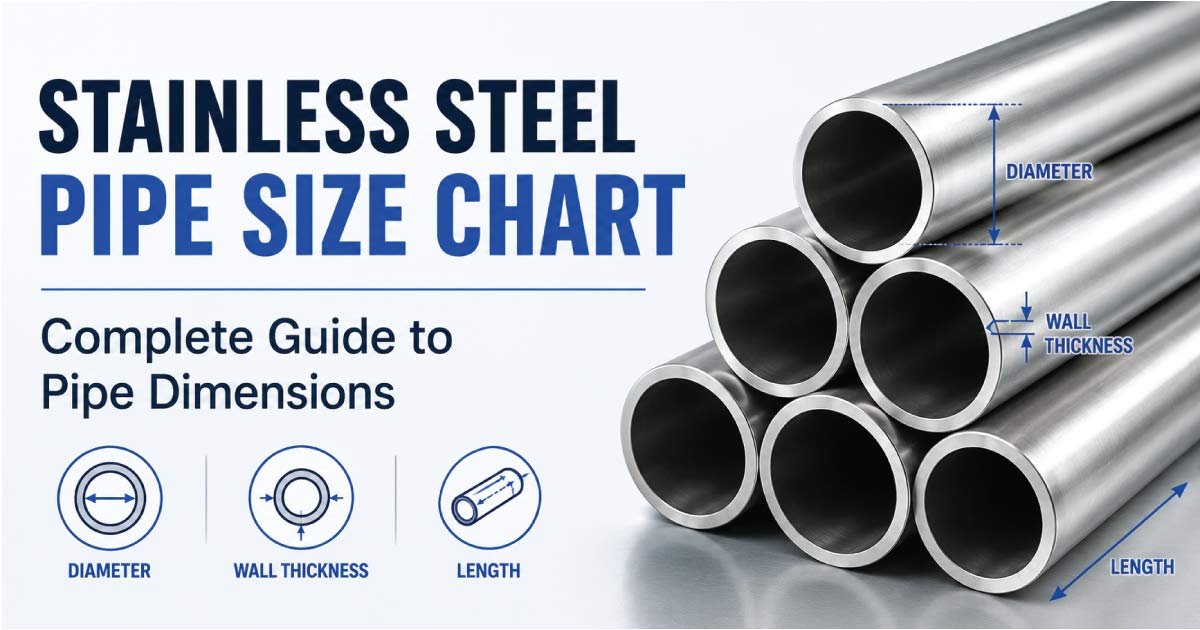
Stainless steel pipes are widely used in industries such as construction, manufacturing, plumbing, oil and gas, food processing, and chemical plants. Their strength, corrosion resistance, and long service life make them one of the most reliable piping materials available today.
However, selecting the correct pipe size can be confusing, especially for beginners. Stainless steel pipes are identified using several measurements, including nominal pipe size (NPS), outside diameter (OD), wall thickness, and schedule number.
This guide explains everything you need to know about stainless steel pipe dimensions, standard sizes, schedules, and how to read a stainless steel pipe size chart.
What Is a Stainless Steel Pipe?
A stainless steel pipe is a hollow cylindrical tube manufactured from stainless steel alloys containing chromium, nickel, and other elements that improve corrosion resistance and durability.
These pipes are commonly used for:
- Water distribution systems
- Chemical processing plants
- Food and beverage industries
- Pharmaceutical manufacturing
- Oil and gas pipelines
- Heat exchangers
- Structural applications
Because stainless steel resists rust and corrosion, it performs exceptionally well in harsh environments where ordinary steel pipes may fail.
Understanding Stainless Steel Pipe Dimensions
Before using a pipe size chart, it is important to understand the measurements used to classify pipes.
1. Nominal Pipe Size (NPS)
NPS is the standard designation used in North America for pipe sizing.
Interestingly, NPS does not always represent the actual diameter of the pipe. Instead, it serves as a standardized naming system.
For example:
- NPS 2 pipe has an actual outside diameter of 2.375 inches.
- NPS 4 pipe has an actual outside diameter of 4.500 inches.
2. Outside Diameter (OD)
Outside Diameter is the actual measurement across the outer surface of the pipe.
The OD remains constant for a given NPS regardless of wall thickness.
3. Inside Diameter (ID)
Inside Diameter refers to the measurement inside the pipe.
The ID changes depending on wall thickness.
Thicker walls reduce the inside diameter and affect flow capacity.
4. Wall Thickness
Wall thickness determines the pipe’s strength and pressure-handling capability.
It is often specified using a schedule number.
5. Pipe Schedule
A schedule indicates wall thickness.
Common stainless steel pipe schedules include:
- Schedule 5S
- Schedule 10S
- Schedule 40S
- Schedule 80S
The higher the schedule number, the thicker the pipe wall.
Stainless Steel Pipe Size Chart
The following chart shows common stainless steel pipe dimensions.
| NPS | Outside Diameter (in.) | Outside Diameter (mm) |
|---|---|---|
| 1/8″ | 0.405 | 10.3 |
| 1/4″ | 0.540 | 13.7 |
| 3/8″ | 0.675 | 17.1 |
| 1/2″ | 0.840 | 21.3 |
| 3/4″ | 1.050 | 26.7 |
| 1″ | 1.315 | 33.4 |
| 1-1/4″ | 1.660 | 42.2 |
| 1-1/2″ | 1.900 | 48.3 |
| 2″ | 2.375 | 60.3 |
| 2-1/2″ | 2.875 | 73.0 |
| 3″ | 3.500 | 88.9 |
| 4″ | 4.500 | 114.3 |
| 5″ | 5.563 | 141.3 |
| 6″ | 6.625 | 168.3 |
| 8″ | 8.625 | 219.1 |
| 10″ | 10.750 | 273.1 |
| 12″ | 12.750 | 323.9 |
This chart provides standard outside diameters used across most stainless steel piping systems.
Common Stainless Steel Pipe Schedules
Different schedules provide varying wall thicknesses.
1. Schedule 5S
Schedule 5S pipes have thin walls and are commonly used in low-pressure applications.
Applications include:
- Food processing
- Water transport
- Sanitary systems
Advantages:
- Lightweight
- Lower cost
- Easy installation
2. Schedule 10S
Schedule 10S is one of the most commonly used stainless steel pipe schedules.
It offers a good balance between strength and weight.
Applications include:
- Industrial piping
- HVAC systems
- Water treatment facilities
3. Schedule 40S
Schedule 40S provides greater wall thickness and pressure resistance.
Common uses:
- Chemical plants
- Process piping
- Industrial systems
4. Schedule 80S
Schedule 80S pipes have thick walls designed for demanding environments.
Applications include:
- High-pressure systems
- Oil and gas facilities
- Power generation plants
Stainless Steel Pipe Schedule Example
Consider a 2-inch stainless steel pipe.
The outside diameter remains:
- OD = 2.375 inches
However, wall thickness changes with schedule.
| Schedule | Wall Thickness (in.) |
|---|---|
| 5S | 0.065 |
| 10S | 0.109 |
| 40S | 0.154 |
| 80S | 0.218 |
As the wall thickness increases, the inside diameter decreases.
This affects fluid flow and pressure ratings.
How to Read a Stainless Steel Pipe Size Chart
Many beginners find pipe charts confusing.
Follow these steps:
Step 1: Identify the NPS
Determine the nominal pipe size required for your application.
Example:
- NPS 3
Step 2: Find the Outside Diameter
Locate the OD corresponding to the selected NPS.
For NPS 3:
- OD = 3.500 inches
Step 3: Select the Schedule
Choose a schedule based on operating pressure and structural requirements.
Example:
- Schedule 40S
Step 4: Determine Wall Thickness
Refer to schedule tables to find wall thickness.
Step 5: Calculate Inside Diameter
Use the formula:
ID = OD − (2 × Wall Thickness)
This helps determine flow capacity.
Metric Stainless Steel Pipe Sizes
Many countries use metric measurements instead of inches.
Common metric stainless steel pipe sizes include:
| DN | Approximate NPS | OD (mm) |
|---|---|---|
| DN15 | 1/2″ | 21.3 |
| DN20 | 3/4″ | 26.7 |
| DN25 | 1″ | 33.4 |
| DN32 | 1-1/4″ | 42.2 |
| DN40 | 1-1/2″ | 48.3 |
| DN50 | 2″ | 60.3 |
| DN80 | 3″ | 88.9 |
| DN100 | 4″ | 114.3 |
| DN150 | 6″ | 168.3 |
| DN200 | 8″ | 219.1 |
DN stands for Diameter Nominal and is commonly used in Europe and Asia.
Advantages of Stainless Steel Pipes
Stainless steel pipes offer several benefits compared to carbon steel and plastic pipes.
Excellent Corrosion Resistance :The chromium layer protects the pipe from rust and chemical attack.
High Strength: Stainless steel can withstand high pressure and temperature conditions.
Long Service Life: Many stainless steel piping systems last for decades with minimal maintenance.
Hygienic Surface: The smooth surface prevents contamination, making it ideal for food and pharmaceutical industries.
Recyclable Material: Stainless steel is environmentally friendly and highly recyclable.
Factors to Consider When Choosing Pipe Size
Selecting the right pipe size requires evaluating several factors.
Flow Rate
The required fluid flow influences pipe diameter.
Higher flow rates generally require larger pipes.
Pressure Requirements
High-pressure systems often require thicker wall schedules.
Temperature Conditions
Extreme temperatures may affect material selection and wall thickness requirements.
Installation Space
Available space may limit pipe size choices.
Industry Standards
Always follow applicable standards and codes.
Stainless Steel Pipe Standards
Several international standards govern stainless steel pipe manufacturing.
ASTM A312
Used for seamless and welded stainless steel pipes intended for high-temperature and corrosive service.
ASME B36.19M
Provides dimensions for stainless steel pipes.
ASME B36.10M
Covers dimensions for welded and seamless steel pipes.
ISO Standards
Many international projects use ISO specifications for pipe dimensions and quality requirements.
Common Applications of Stainless Steel Pipes
Stainless steel pipes are found in numerous industries.
Oil and Gas Industry
Used for transporting petroleum products and natural gas.
Chemical Processing
Excellent resistance to corrosive chemicals.
Food Processing
Maintains cleanliness and product purity.
Pharmaceutical Manufacturing
Provides sanitary conditions required for medicine production.
Construction Industry
Used in structural and architectural applications.
Water Treatment Plants
Ideal for handling treated and untreated water.
Mistakes to Avoid When Selecting Pipe Sizes
Many buyers make sizing errors that can increase costs or reduce system efficiency.
Common mistakes include:
- Confusing NPS with actual diameter
- Ignoring pipe schedule
- Overlooking pressure requirements
- Using incorrect standards
- Selecting oversized pipes unnecessarily
- Failing to account for future expansion
Understanding pipe dimensions helps avoid these costly mistakes.
Conclusion
A stainless steel pipe size chart is an essential reference for engineers, contractors, fabricators, and maintenance professionals. Understanding nominal pipe size, outside diameter, wall thickness, and schedule numbers allows you to choose the correct pipe for any application.
Whether you’re designing a plumbing system, industrial process line, chemical plant, or structural framework, selecting the proper stainless steel pipe dimensions ensures safety, performance, and long-term reliability. By using standardized pipe charts and industry specifications, you can confidently choose the right stainless steel pipe size for your project.
Also Read: 👉 Dealing with a leaking pipe can be frustrating, especially when incorrect pipe joint sizes are the cause. This guide explains how to fix leaking pipe joint size issues, identify common fitting problems, and choose the correct pipe fitting sizes for a secure connection. Learn practical solutions to prevent water leaks, improve plumbing performance, and avoid costly repairs. Read the full post for step-by-step tips and expert guidance.
What is a stainless steel pipe size chart?
A stainless steel pipe size chart is a reference table that shows pipe dimensions such as nominal pipe size (NPS), outside diameter (OD), inside diameter (ID), and wall thickness. It helps engineers, builders, and technicians select the correct pipe size for pressure, flow, and structural requirements in various applications.
How are stainless steel pipe sizes measured?
Stainless steel pipe sizes are measured using nominal pipe size (NPS), which is a standardized designation. The actual measurement depends on outside diameter (OD) and wall thickness. Inside diameter (ID) changes with schedule. These measurements ensure compatibility with fittings, pressure ratings, and system design requirements in engineering and construction.
What does NPS mean in stainless steel pipes?
NPS stands for Nominal Pipe Size. It is a standard used to identify pipe size, but it does not always match the actual diameter. For smaller pipes, NPS differs from OD, while larger pipes match. It simplifies classification and standardization across industries for manufacturing, installation, and design consistency.
What is the difference between NPS and actual pipe diameter?
NPS is a nominal labeling system, not the exact physical measurement of a pipe. Actual diameter refers to the real outside diameter (OD) or inside diameter (ID). For pipes under 14 inches, NPS and OD differ. Above that size, NPS usually equals OD, ensuring standardized industrial compatibility.
What is pipe schedule and how does it affect pipe size?
Pipe schedule refers to wall thickness, such as SCH 5S, 10S, 40S, and 80S. Higher schedule numbers mean thicker walls. It directly affects inside diameter (ID) and pressure handling capacity. Thicker schedules are used for high-pressure systems, while thinner schedules are used for low-pressure or lightweight applications.
What is the difference between outside diameter (OD) and inside diameter (ID)?
Outside diameter (OD) is the total width of the pipe from one outer edge to the other. Inside diameter (ID) is the hollow space where fluid flows. OD remains constant for a given NPS, while ID changes depending on wall thickness (schedule), affecting flow capacity and pressure performance.
How do I choose the correct stainless steel pipe size?
To choose the correct pipe size, consider flow requirements, pressure rating, and application type. Select NPS based on system design, then check OD, ID, and schedule. Also consider material grade for corrosion resistance. Proper selection ensures safety, durability, and efficient fluid or structural performance in industrial and construction systems.
What standards are used for stainless steel pipe dimensions?
Stainless steel pipe dimensions are mainly governed by ASME B36.19 and ASME B36.10 standards. These define outside diameter, wall thickness, and schedules. They ensure uniform sizing across manufacturers worldwide. Following these standards guarantees compatibility, safety, and reliability in engineering, plumbing, oil and gas, and industrial applications.