
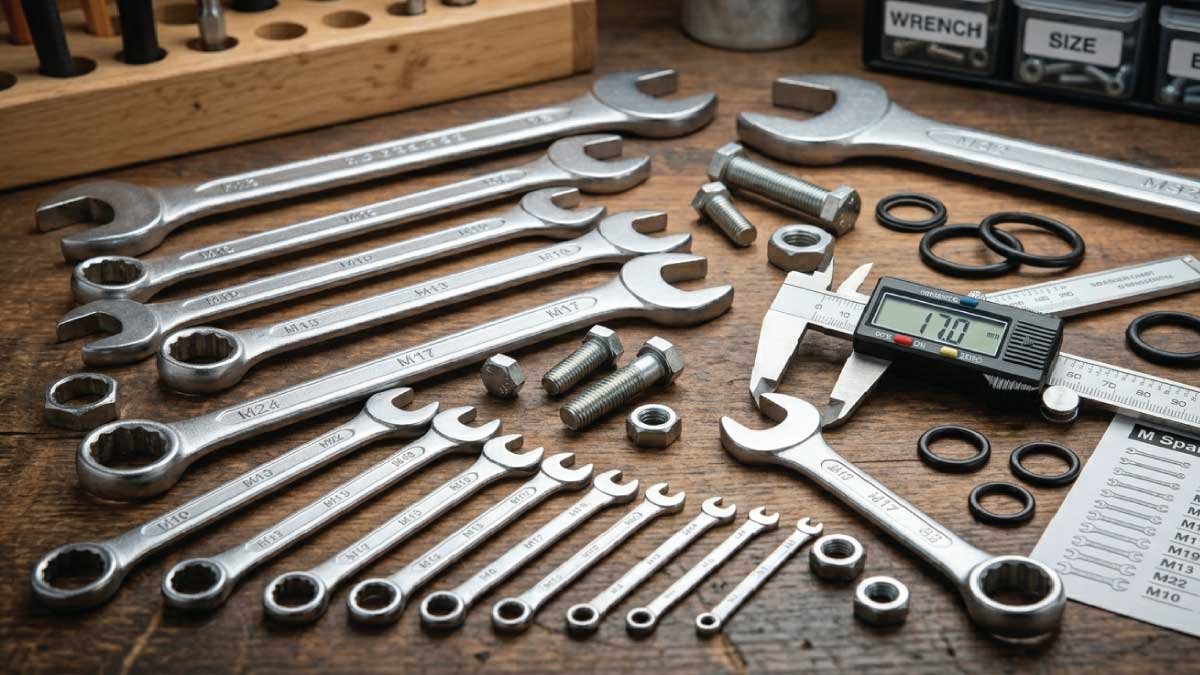
In mechanical work, one of the most commonly used hand tools is the spanner (also called a wrench). Whether you are working on automotive repair, machinery maintenance, plumbing, or industrial assembly, you will always encounter metric bolt sizes that require the correct spanner.
Using the wrong spanner size can damage bolt heads, reduce tightening accuracy, and even cause safety hazards. That is why professionals always rely on an M spanner size chart (Metric wrench size chart) before starting any mechanical task.
In this guide, we will break down metric spanner sizes, explain how they relate to bolt sizes, and provide a complete reference chart that you can use in real-world applications.
What Is an M Spanner?
An “M spanner” refers to a wrench or spanner designed for tightening and loosening metric-sized bolts and nuts. The “M” represents metric thread designations such as M6, M8, M10, M16, and so on. These sizes are commonly used in mechanical, automotive, and industrial assemblies where standardized metric fasteners are required for consistent fitting and strength.
For example:
M6 bolt → requires a specific wrench size
M10 bolt → requires a larger wrench
M20 bolt → requires a heavy-duty spanner
Metric spanners are standardized based on the bolt head size, not the thread diameter, which means the wrench opening is designed to match the external flats of the nut or bolt head for proper grip and torque transfer.
Why Spanner Size Matters
Choosing the correct spanner size is essential for safe, efficient, and damage-free mechanical work. The right fit ensures proper torque application and prevents slipping, which is critical in both light and heavy engineering tasks.
If the spanner is too small:
- It will not fit on the bolt head
- Can damage the tool or bolt edges
- Slows down work
If the spanner is too large:
- It will slip off the bolt
- Can round off bolt heads
- Increases risk of injury
Proper sizing ensures:
Correct spanner selection improves both performance and safety during mechanical operations. It allows controlled force application without damaging components.
- Better grip
- Accurate torque application
- Longer tool and bolt life
M Spanner Size Chart (Metric Bolt to Wrench Size)
Below is a standard metric spanner size chart used in mechanical, automotive, and industrial applications. It helps match metric bolt sizes (M series) with the correct wrench or spanner opening for safe tightening and proper torque application.
1. Small metric bolts
Small metric bolts are used in precision work where compact size and light fastening force are required. These are common in electronics, small devices, and delicate machinery where accuracy and space-saving design are important.
| Bolt Size (M) | Thread Diameter (mm) | Spanner Size (mm) |
|---|---|---|
| M1.6 | 1.6 mm | 3 mm |
| M2 | 2 mm | 4 mm |
| M2.5 | 2.5 mm | 5 mm |
| M3 | 3 mm | 5.5 mm |
| M4 | 4 mm | 7 mm |
| M5 | 5 mm | 8 mm |
These sizes are commonly used in electronics, small machines, and precision equipment.
2. Medium metric bolts
Medium metric bolts are the most widely used sizes in general engineering applications. They offer a balance between strength and usability, making them ideal for automotive assemblies, machinery, and structural connections where moderate loads are applied.
| Bolt Size (M) | Thread Diameter (mm) | Spanner Size (mm) |
|---|---|---|
| M6 | 6 mm | 10 mm |
| M7 | 7 mm | 11 mm |
| M8 | 8 mm | 13 mm |
| M10 | 10 mm | 17 mm |
| M12 | 12 mm | 19 mm |
These are the most commonly used sizes in automotive and general machinery.
3. Large metric bolts
Large metric bolts are designed for heavy-duty mechanical systems that require strong fastening under high load conditions. They are commonly used in construction, industrial machines, and equipment exposed to vibration and stress.
| Bolt Size (M) | Thread Diameter (mm) | Spanner Size (mm) |
|---|---|---|
| M14 | 14 mm | 22 mm |
| M16 | 16 mm | 24 mm |
| M18 | 18 mm | 27 mm |
| M20 | 20 mm | 30 mm |
| M22 | 22 mm | 32 mm |
| M24 | 24 mm | 36 mm |
These sizes are used in construction, heavy machinery, and industrial equipment.
4. Extra-large industrial bolts
Extra-large industrial bolts are used in high-load structural applications where maximum strength and durability are required. These bolts are found in large infrastructure projects, power plants, turbines, and mining equipment.
| Bolt Size (M) | Spanner Size (mm) |
|---|---|
| M27 | 41 mm |
| M30 | 46 mm |
| M33 | 50 mm |
| M36 | 55 mm |
| M42 | 65 mm |
| M48 | 75 mm |
These are used in bridges, turbines, mining equipment, and heavy structural assemblies.
You May Also Like:
Understanding Metric Bolt Size vs Spanner Size
One of the most confusing parts for beginners is that the bolt size (M value) is not the same as the spanner size. Many people assume that an M10 bolt would use a 10 mm wrench, but in reality, the wrench size is based on the bolt head dimensions, not the thread diameter.
For example:
M10 bolt does NOT use a 10 mm spanner
Instead, it uses a 17 mm spanner
This difference often leads to mistakes during repair or assembly work if the sizing concept is not clearly understood.
This happens because:
- M size refers to thread diameter
- Spanner size refers to bolt head width across flats (AF)
Common Spanner Types Used for Metric Bolts
Spanners are essential hand tools used for tightening and loosening metric bolts and nuts in mechanical, automotive, and industrial work. Different spanner types are designed for specific applications depending on access, torque requirements, and working conditions. Choosing the right spanner improves efficiency, safety, and reduces damage to fasteners.
1. Open-end spanner
An open-end spanner has a U-shaped jaw that grips two opposite sides of a bolt or nut. It is commonly used for quick adjustments in tight spaces where speed is important. However, it provides less grip compared to ring spanners and may slip if high torque is applied.
2. Ring spanner
A ring spanner has a fully enclosed circular head that fits securely around a bolt or nut. It offers a strong and stable grip, making it ideal for loosening tight or rusted fasteners. This design reduces the risk of slipping and allows better torque application in demanding mechanical tasks.
3. Combination spanner
A combination spanner features an open-end on one side and a ring end on the other. It is the most commonly used spanner type because it provides both speed and strong grip in one tool. It is widely used in automotive repair, maintenance, and general mechanical applications.
4. Adjustable wrench
An adjustable wrench has a movable jaw that can be set to different sizes, making it suitable for multiple bolt sizes. It is useful when the exact size of the fastener is unknown. However, it may not provide as firm a grip as fixed-size spanners under high torque.
5. Socket wrench
A socket wrench uses interchangeable sockets and a ratchet mechanism for fast and repetitive tightening or loosening. It is highly efficient for production lines and mechanical workshops. This tool allows continuous motion without repositioning, making it ideal for high-speed assembly and maintenance work.
You May Also Like:
How to Identify the Correct Spanner Size
Choosing the correct spanner size is important for safe and efficient tightening or loosening of bolts and nuts. Using the wrong size can damage the fastener edges or cause slipping. Even without a chart, you can identify the right size using simple and practical methods in workshops or fieldwork.
Method 1: Markings on bolt head
Most metric bolts have size markings such as M6, M8, or M10 engraved or printed on the head or packaging. These markings indicate the bolt diameter and help you match it with the correct spanner size using standard reference charts. This is the quickest and most reliable identification method.
Method 2: Trial fitting
Trial fitting is a practical method where you test different spanners until you find the one that fits perfectly. The correct size should fit snugly without any looseness or movement. If the spanner is too loose or too tight, it is not the correct size for that bolt.
Method 3: Measuring with caliper
Using a caliper is the most accurate method for identifying spanner size. Measure the bolt head width across flats (AF), which is the distance between two opposite flat sides. This measurement helps you determine the exact spanner size needed, ensuring a precise fit and preventing damage to the fastener.
Automotive Applications of M Spanner Sizes
Metric spanners are extensively used in automotive repair, maintenance, and assembly because most modern vehicles are designed using metric fasteners. Correct spanner selection is essential for safe disassembly and proper reassembly without damaging bolts or components.
For example, in a typical car like Toyota Corolla, you will commonly find:
M6 bolts → 10 mm spanner
M8 bolts → 13 mm spanner
M10 bolts → 17 mm spanner
M12 bolts → 19 mm spanner
These standard sizes help mechanics quickly identify the correct tools during servicing, reducing errors and improving efficiency in repair work.
These sizes are used in:
- Engine components
- Suspension systems
- Body panels
- Brake assemblies
You May Also Like:
Industrial Applications
In industrial environments, spanner sizes are generally larger and designed to handle high torque and heavy-duty fastening tasks. These applications involve strong structural components where precision, strength, and safety are essential. Proper spanner selection ensures secure fastening and reliable performance in construction, machinery, and energy-related industries.
1. Construction industry
In the construction industry, spanners are commonly used for M16 to M30 bolts. These are found in heavy steel structures, bridges, and large frameworks. The spanners used here must handle high torque to ensure strong joint connections. Proper tightening is critical for structural stability and long-term safety of buildings and infrastructure.
2. Machinery industry
In the machinery industry, spanners are typically used for M10 to M24 bolts. These bolts are used in equipment assembly, motor mounts, and mechanical frames. Accurate tightening ensures smooth machine operation, reduces vibration, and prevents loosening during operation. This makes spanners an essential tool in manufacturing and maintenance processes.
3. Oil and gas industry
In the oil and gas industry, spanners are used for large M20 to M48 bolts. These are commonly found in high-pressure flanges and pipeline systems. Strong and durable spanners are required to handle extreme pressure conditions. Proper tightening ensures leak-free connections and safe operation in highly demanding industrial environments.
Spanner Size Tolerance and Standards
Metric spanners are manufactured according to internationally accepted standards such as ISO and DIN. These standards define precise dimensions for both bolts and spanners to ensure uniformity across different industries and countries. This allows tools and fasteners from different manufacturers to work together without compatibility issues.
This ensures:
- Consistent bolt and tool sizing
- Interchangeability between manufacturers
- Safety in mechanical systems
However, slight variations may exist between brands due to manufacturing tolerances, surface finishing, or design differences, but these variations are usually very small and do not affect normal usage in most mechanical applications.
Common Mistakes When Using Spanners
Spanners are simple tools, but incorrect usage can easily damage bolts, reduce tool life, or even cause injury. Many problems occur due to poor technique, wrong size selection, or lack of maintenance. Understanding these common mistakes helps improve safety, efficiency, and fastening quality in mechanical and industrial work.
1. Using adjustable spanner incorrectly
An adjustable spanner must be properly tightened before use. If the jaw is loose, it can slip during operation and damage the bolt head. This not only reduces grip but also increases the risk of rounding the fastener, making future removal difficult and requiring additional repair effort.
2. Using wrong size for quick jobs
Using the wrong spanner size to save time is a common mistake. Even slight mismatch can cause slipping and rounding of bolt edges. Rushing the job increases the chance of damage, leading to more time-consuming repairs. Always ensure proper size selection for safe and accurate tightening or loosening.
3. Applying too much force
Excessive force can strip threads, break bolts, or damage surrounding components. Spanners are designed for specific torque limits, and exceeding them can cause serious mechanical failure. Controlled and steady force is important to maintain fastener integrity and ensure long-lasting, safe connections in mechanical systems.
4. Ignoring corrosion
Rusty or corroded bolts are harder to loosen and require proper preparation. Ignoring corrosion can lead to broken bolts or tool damage. Using penetrating oil helps loosen rusted threads and reduces resistance. Proper treatment ensures safer removal and prevents unnecessary stress on both the spanner and fastener.
You May Also Like:
Tips for Proper Spanner Usage
Proper spanner usage improves safety, efficiency, and tool life. Following correct techniques helps avoid damage to bolts and ensures smooth mechanical operations. These simple practices are widely used in workshops, automotive repair, and industrial maintenance to achieve reliable and professional results.
1. Always use the correct size
Using the correct spanner size ensures a tight and secure fit on the bolt or nut. A proper fit provides maximum grip and reduces the risk of slipping. This prevents damage to fastener edges and allows efficient torque application during tightening or loosening operations.
2. Pull instead of push
Whenever possible, it is safer to pull the spanner rather than push it. Pulling reduces the chance of injury if the tool suddenly slips. It also provides better control and stability, allowing smoother force application while reducing strain on the hand and wrist during mechanical work.
3. Use ring spanners for tight bolts
Ring spanners are ideal for tightly fastened or stubborn bolts because they provide full contact grip. This allows better torque distribution and reduces the risk of slipping or rounding the bolt head. They are especially useful in high-load mechanical applications where strong and secure fastening is required.
4. Keep tools clean
Clean tools perform better and are safer to use. Dirt, grease, or rust on spanners can reduce grip and increase the chance of slipping. Regular cleaning ensures better contact with bolts, improves efficiency, and extends the life of the tool in both workshop and industrial environments.
Maintenance of Spanners
Proper maintenance of spanners is important to ensure long-lasting performance, safety, and accurate torque application during mechanical work. Well-maintained tools not only last longer but also reduce the risk of slipping or damaging bolts during use.
Proper care increases tool life significantly.
- Clean after use
- Store in dry place
- Avoid rust formation
- Do not use as hammer
High-quality chrome vanadium spanners can last for many years if maintained properly, even under regular industrial or workshop use, provided they are handled and stored correctly.
Quick Reference Chart (Most Used Sizes)
Here is a quick everyday reference chart for commonly used metric bolt and spanner combinations. These sizes are widely used in automotive, machinery, and general mechanical repair work.
M5 → 8 mm spanner
M6 → 10 mm spanner
M8 → 13 mm spanner
M10 → 17 mm spanner
M12 → 19 mm spanner
M14 → 22 mm spanner
M16 → 24 mm spanner
These cover more than 80% of general mechanical work, making them essential sizes for any workshop or field technician.
Final Thoughts
Understanding M spanner sizes (metric wrench sizes) is essential for anyone working with mechanical systems, vehicles, or industrial equipment. It helps ensure correct tool selection and prevents damage to both fasteners and tools.
The key idea is simple:
- M size refers to bolt diameter
- Spanner size refers to bolt head width
By using the correct spanner size, you improve safety, efficiency, and tool life while preventing rounding or damage to fasteners. This is especially important in automotive work, industrial maintenance, and precision mechanical assembly.
Whether you are working on a small machine, a car like Toyota Corolla, or heavy industrial equipment, having a proper spanner size chart ensures you always choose the right tool for the job.
If you regularly work with bolts and fasteners, keeping a printed metric spanner chart in your workshop is one of the simplest but most effective productivity improvements you can make.