
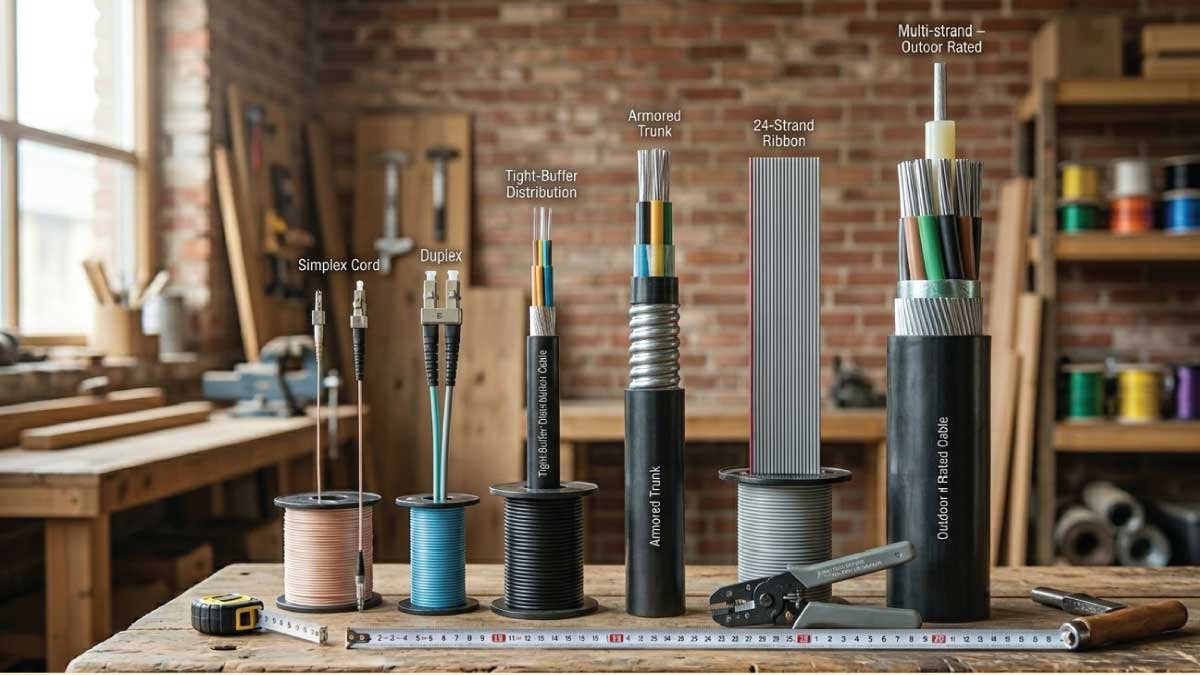
Fiber optic technology has become the backbone of modern communication systems. From high-speed internet and telecom networks to data centers and CCTV systems, fiber optic cables are everywhere. They transmit data using light signals, allowing extremely fast and reliable communication over long distances.
But when planning a fiber installation, one of the most important factors is cable size selection. Fiber optic cables come in different diameters, core counts, and constructions. Choosing the wrong size can lead to installation difficulties, signal loss, or unnecessary cost.
That is why engineers, technicians, and network planners often rely on a fiber optic cable size chart to choose the right type for a specific application.
In this detailed guide, we will break down fiber optic cable sizes, structures, and standard charts in a simple and practical way.
What Is a Fiber Optic Cable?
A fiber optic cable is a communication medium made of thin strands of glass or plastic that transmit data as pulses of light. Unlike copper cables that use electrical signals, fiber optics use light, which allows:
- Faster data transmission
- Longer distance communication
- Immunity to electromagnetic interference
- Higher bandwidth capacity
Each fiber strand is extremely thin—almost like a human hair—but multiple fibers are bundled together inside protective layers to form a cable.
Basic Structure of Fiber Optic Cable
Fiber optic cables are designed to transmit data using light signals with high speed and low loss. Their structure is made up of multiple layers, each serving a specific function such as guiding light, providing protection, and ensuring mechanical strength. Understanding these layers is important before studying fiber optic cable size charts.
1. Core
The core is the central part of the fiber optic cable made of very thin glass or plastic. It is the pathway where light signals travel. The quality and size of the core directly affect data transmission speed, bandwidth, and signal clarity over long distances in communication systems.
2. Cladding
The cladding surrounds the core and is designed to reflect light back into it using total internal reflection. This ensures that the light signal stays within the core without escaping. It helps maintain signal strength and reduces data loss during transmission across long-distance communication networks.
3. Buffer coating
The buffer coating is a protective layer applied around the cladding. It shields the fiber from moisture, scratches, and minor physical damage. This layer increases durability and makes handling easier during installation and maintenance, ensuring that the delicate fiber inside remains safe and functional.
4. Strength members
Strength members provide mechanical support and protect the fiber from stretching or breaking under tension. They are commonly made from materials like aramid yarn or steel. These components ensure that the cable can withstand pulling forces during installation and remain stable in harsh environments.
5. Outer jacket
The outer jacket is the final protective layer of the fiber optic cable. It protects all inner components from environmental damage such as heat, chemicals, and abrasion. This layer also determines the overall cable diameter and plays an important role in durability and long-term performance in different applications.
Fiber Optic Cable Size Chart (Standard Diameters)
Fiber optic cables are not only defined by core size but also by their overall outer diameter, which depends on fiber count, insulation, and application type. These sizes help determine installation flexibility, strength, and suitability for indoor, outdoor, or backbone networking systems.
1. Tight Buffered Indoor Fiber Cable Sizes
Tight buffered indoor cables are commonly used in controlled environments such as buildings, offices, and data centers. They are flexible, easy to install, and designed for short to medium-distance communication with reliable performance.
| Fiber Count | Cable Diameter (mm) | Application |
|---|---|---|
| 1 fiber | 2.0 – 2.5 mm | Patch cords, jumpers |
| 2 fibers | 3.0 – 3.5 mm | Duplex indoor cables |
| 4 fibers | 4.5 – 5.5 mm | Small LAN networks |
| 6–12 fibers | 5.5 – 7.0 mm | Office backbone |
| 24 fibers | 7.0 – 9.0 mm | Data centers |
2. Loose Tube Outdoor Fiber Cable Sizes
Loose tube cables are designed for outdoor environments where protection against weather, moisture, and physical stress is required. They are commonly used in telecom networks and long-distance communication systems.
| Fiber Count | Cable Diameter (mm) | Application |
|---|---|---|
| 12 fibers | 6.5 – 8.0 mm | FTTH distribution |
| 24 fibers | 8.0 – 10 mm | Urban networks |
| 48 fibers | 9.0 – 12 mm | Telecom backbone |
| 96 fibers | 12 – 15 mm | Long-distance networks |
| 144 fibers | 14 – 18 mm | High capacity trunk lines |
| 288 fibers | 18 – 24 mm | Major backbone systems |
3. Fiber Optic Drop Cable Sizes (FTTH)
Fiber drop cables are used to connect service providers directly to homes or small buildings. They are lightweight, flexible, and designed for last-mile connectivity in fiber-to-the-home (FTTH) systems.
| Type | Diameter | Usage |
|---|---|---|
| Flat drop cable (1–2 fiber) | 2 × 5 mm | Home internet connections |
| Round drop cable | 3 – 6 mm | Residential FTTH |
| Self-supporting drop cable | 5 – 8 mm | Aerial installations |
You May Also Like:
Fiber Core Size Chart (Single Mode vs Multi Mode)
Fiber size also refers to the core diameter, which determines how light travels through the cable. Different core sizes are used depending on distance, speed, and network type.
1. Single-mode fiber (SMF)
Single-mode fiber is designed for long-distance communication with very low signal loss. It uses laser light and is widely used in telecom and internet backbone networks.
Type Core Size Usage
OS1 / OS2 8–10 microns Long distance telecom, internet backbone
- Used for long-distance communication
- Very low signal loss
- Laser light source used
2. Multi-mode fiber (MMF)
Multi-mode fiber is used for shorter distance communication such as LAN networks and data centers. It is more cost-effective and uses LED or VCSEL light sources.
Type Core Size Usage
OM1 62.5 microns Older networks
OM2 50 microns Short distance LAN
OM3 50 microns High-speed data centers
OM4 50 microns 40G/100G networks
OM5 50 microns Advanced wavelength multiplexing
- Used for short distance communication
- LED or VCSEL light source
- Lower cost than single-mode
Fiber Cable Jacket Size and Material Types
The outer jacket of a fiber optic cable is a critical layer that determines its overall thickness, protection level, and durability. It protects the internal fibers from physical damage, moisture, temperature changes, and environmental exposure. Different jacket materials are used depending on whether the cable is installed indoors, outdoors, or in industrial environments.
Common jacket types:
1. PVC jacket
PVC (Polyvinyl Chloride) jackets are commonly used for indoor fiber cables. They are flexible, easy to handle, and cost-effective, making them suitable for general indoor installations where environmental exposure is minimal.
- Used in indoor environments
- Flexible and low cost
- Not suitable for outdoor exposure
2. LSZH (Low Smoke Zero Halogen)
LSZH jackets are designed for safety in enclosed spaces such as offices, buildings, and data centers. In case of fire, they produce minimal smoke and no toxic halogen gases, making them safer for human environments.
- Used in offices and buildings
- Produces low smoke in fire
- Safer for enclosed environments
3. PE (Polyethylene)
PE jackets are mainly used in outdoor fiber cables due to their strong resistance against moisture, sunlight, and environmental stress. They provide excellent durability for long-term external installations.
- Used for outdoor cables
- Resistant to moisture and sunlight
- Suitable for harsh weather conditions
4. Armored jacket
Armored jackets include an additional protective layer, usually made of steel or similar materials. This layer protects the cable from mechanical damage, rodent attacks, and underground pressure.
- Includes steel protection layer
- Used in underground or rodent-prone areas
- High mechanical protection
You May Also Like:
Fiber Optic Cable Size by Application
Fiber cable size varies depending on the application, installation environment, and required data capacity. Different industries use different cable thicknesses to balance performance, protection, and flexibility.
1. Data centers
Data centers require compact, high-density fiber cables to support fast and efficient data transmission between servers and networking equipment.
- 2 mm to 7 mm cables
- High fiber density
- Easy routing in trays
2. Telecom backbone
Telecom backbone networks use large-capacity fiber cables designed for long-distance communication and high data transmission loads.
- 12 mm to 24+ mm cables
- High fiber counts (96–288 fibers)
- Long-distance transmission
3. FTTH (Fiber to the Home)
FTTH systems use lightweight and flexible drop cables that connect homes and buildings directly to the fiber network.
- 2 mm to 6 mm drop cables
- Lightweight and flexible
- Easy installation in buildings
4. Industrial networks
Industrial fiber cables are designed for harsh environments where resistance to heat, vibration, and mechanical stress is required.
- 5 mm to 10 mm armored cables
- Resistant to harsh environments
5. Submarine cables
Submarine fiber cables are extremely large and heavily protected due to their underwater installation in ocean environments. They are designed for maximum durability and long-distance global communication.
- Very large diameter cables
- Multiple protective layers
- Designed for ocean floor communication
Loose Tube vs Tight Buffered Fiber Cables
Understanding cable construction type is important when selecting the correct fiber optic cable size and application. Each type offers different levels of protection, flexibility, and installation suitability.
1. Tight buffered cables
Tight buffered cables provide individual protection to each fiber, making them suitable for indoor applications where flexibility and easy handling are required.
- Each fiber has individual protection
- Smaller diameter
- Used indoors
- Easy to install and terminate
2. Loose tube cables
Loose tube cables contain multiple fibers inside gel-filled tubes, providing better protection against moisture, temperature changes, and environmental stress. They are ideal for outdoor and long-distance installations.
- Multiple fibers placed in gel-filled tubes
- Better protection from moisture and temperature
- Larger diameter
- Used outdoors and long-distance networks
You May Also Like:
Fiber Count vs Cable Size Relationship
One of the most important concepts in fiber optic design is the relationship between the number of fibers inside a cable and its overall diameter. In general, as fiber count increases, the cable becomes thicker because more fibers require more protective layers and internal space.
More fibers = larger cable diameter
However, modern manufacturing techniques such as compact buffering and high-density packing help reduce overall size, allowing more fibers to fit into smaller cable structures compared to older designs.
Example relationship:
2 fibers → ~3 mm cable
12 fibers → ~6–8 mm cable
48 fibers → ~10–12 mm cable
144 fibers → ~14–18 mm cable
This relationship is very useful for engineers and installers because it helps estimate space requirements in ducts, cable trays, and underground conduits. Proper planning ensures efficient installation, prevents overcrowding, and maintains long-term network reliability.
How to Choose the Right Fiber Optic Cable Size
Selecting the correct fiber optic cable size is important for performance, durability, and future scalability. The right choice depends on environmental conditions, network demand, installation space, and protection requirements. Proper selection ensures stable data transmission, reduced signal loss, and long-term reliability in communication systems.
1. Installation environment
The installation environment plays a major role in cable size selection. Indoor applications usually require smaller diameter cables because they are protected from harsh conditions. Outdoor installations need larger and more rugged cables with stronger protection layers to withstand weather, moisture, and physical stress.
2. Fiber count requirement
Fiber count determines the overall cable size. Higher network capacity requires more fibers inside a single cable, which increases its diameter. Large data centers and telecom networks often use high-fiber-count cables to support heavy traffic, while small networks can operate efficiently with fewer fibers and smaller cables.
3. Distance
Transmission distance affects both cable type and size. Short-distance connections typically use multi-mode fibers with smaller cables. Long-distance communication requires single-mode fibers, which often need better protection and structured cabling to maintain signal quality over extended ranges with minimal loss and high efficiency.
4. Mechanical protection
If the cable is exposed to physical risks such as crushing, pulling, or environmental damage, armored or reinforced cables are preferred. These cables have additional protective layers, making them thicker but much more durable. They are commonly used in industrial areas, underground installations, and outdoor environments.
5. Space availability
Available installation space such as ducts, conduits, or cable trays also limits cable size selection. In tight spaces, smaller diameter cables are preferred for easier routing and installation. Proper planning ensures efficient cable management without overcrowding or damaging other installed communication or electrical systems.
You May Also Like:
Common Fiber Optic Size Mistakes
Improper selection or handling of fiber optic cables can lead to performance issues, higher costs, and long-term maintenance problems. Many installation errors occur due to lack of planning or misunderstanding technical requirements. Avoiding these mistakes ensures better efficiency and system reliability.
1. Choosing too many fibers unnecessarily
Selecting cables with more fibers than required increases cost and results in bulky installations. This can also make cable management difficult. Proper planning based on actual and future needs helps maintain efficiency while avoiding unnecessary complexity and expense in network infrastructure.
2. Ignoring bend radius
Every fiber optic cable has a minimum bend radius. Bending it too sharply can cause signal loss or permanent damage to the fiber core. Proper installation techniques must be followed to maintain signal quality and prevent performance degradation over time.
3. Mixing indoor and outdoor cables
Indoor and outdoor fiber cables are designed for different environments. Using indoor cables outdoors can lead to quick degradation due to moisture, UV exposure, and temperature changes. Always choose cables designed specifically for the intended installation environment to ensure durability and performance.
4. Underestimating future expansion
Installing cables with limited fiber count may restrict future network expansion. As data demand grows, upgrading becomes difficult and costly. Planning for future scalability by selecting slightly higher-capacity cables ensures long-term flexibility and reduces the need for frequent replacements or system redesign.
Fiber Optic Cable Bend Radius (Important Factor)
The bend radius is an important design factor that determines how much a fiber optic cable can be bent without damaging the internal fibers or affecting signal quality. Cable size directly impacts flexibility, meaning thicker cables require a larger bending radius to prevent performance loss or physical stress.
Typical bend radius guidelines:
- Indoor cable: 10–20 times cable diameter
- Outdoor cable: 15–30 times cable diameter
Smaller cables are easier to bend and install in tight spaces, but they may offer slightly less mechanical protection compared to thicker, more rigid cable designs used in outdoor or industrial environments.
Practical Example of Cable Selection
A company is building a small office network and needs a reliable fiber optic system that supports multiple users while allowing future expansion. Proper cable selection ensures performance, scalability, and ease of installation.
Requirements:
- 24 users
- High-speed internet
- Future expansion required
Solution:
- 24-fiber tight buffered cable
- Diameter: ~6–7 mm
- Indoor LSZH jacket
This setup provides a balance between performance and flexibility, allowing easy installation in office environments while supporting future network upgrades without major redesign.
Final Thoughts
A fiber optic cable size chart is an essential tool for engineers, technicians, and network planners. It ensures that installations are properly designed for performance, space efficiency, and long-term reliability.
The key takeaway is that fiber optic cable size is determined by:
- Fiber count
- Construction type
- Application environment
- Protection requirements
In most real-world installations, cable diameters range from 2 mm for patch cords to over 24 mm for high-capacity backbone systems. Each size serves a specific purpose depending on data requirements and installation conditions.
Choosing the right size from the beginning reduces installation cost, improves network performance, and ensures long-term system stability. Whether for homes, offices, or large telecom networks, using a proper size chart helps achieve efficient and reliable fiber optic design.