
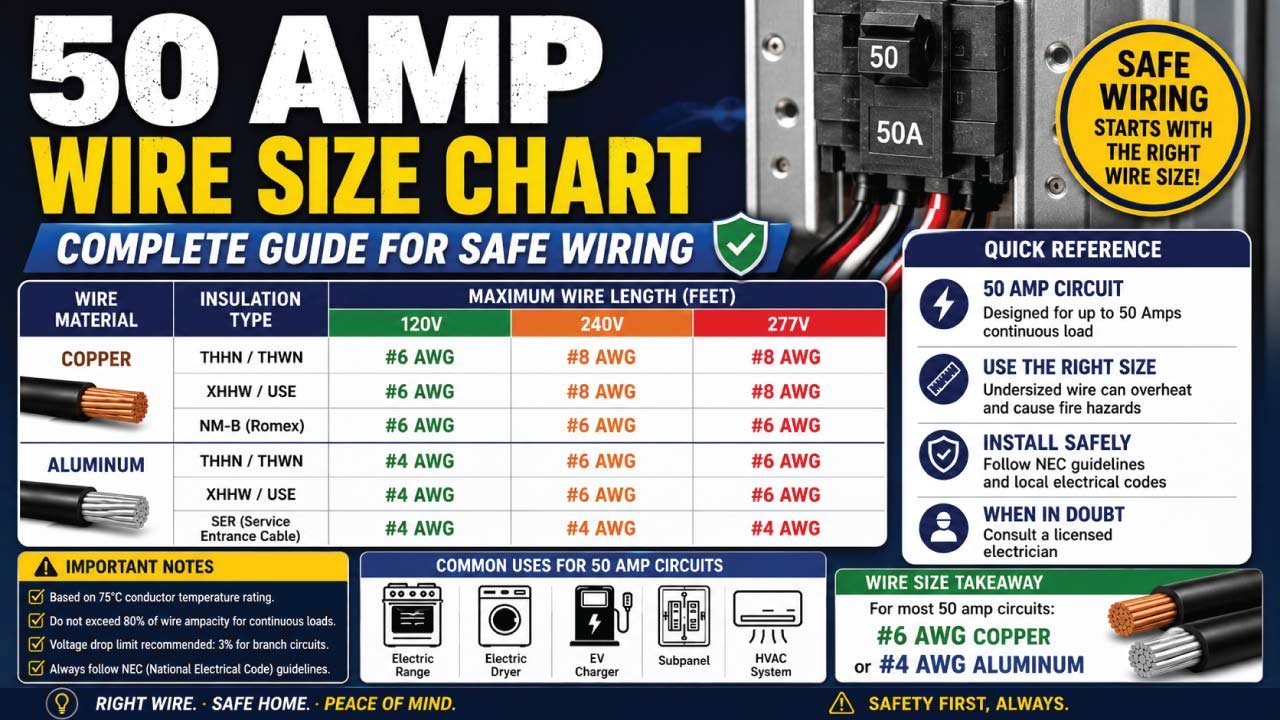
Choosing the correct wire size for a 50 amp circuit is extremely important for electrical safety, voltage performance, and code compliance. Using the wrong wire gauge can lead to overheating, voltage drop, breaker trips, equipment damage, or even electrical fires. Whether you are wiring an RV outlet, electric range, subpanel, welder, EV charger, or air conditioner, understanding the proper 50 amp wire size helps ensure safe and reliable operation.
This complete guide explains 50 amp wire sizing, ampacity charts, copper vs aluminum wire, breaker compatibility, voltage drop, wire types, and installation considerations.
What Is a 50 Amp Circuit?
A 50 amp circuit is an electrical circuit protected by a 50 amp breaker. It is designed to safely carry up to 50 amperes of electrical current without overheating.
50 amp circuits are commonly used for:
- RV hookups
- Electric ranges
- Subpanels
- Electric vehicle chargers
- Welders
- Hot tubs
- Large air conditioners
- Industrial equipment
These circuits usually operate on:
- 120V
- 240V
- Or 120/240V split-phase systems
Why Correct Wire Size Matters
Choosing the correct wire size is essential for electrical safety, system efficiency, and long-term reliability. Incorrect wire sizing can lead to overheating, power loss, and equipment failure, making it a key factor in any electrical installation.
1. Prevents Overheating
Using an undersized wire for high current loads causes excessive resistance, which generates heat. Over time, this heat can damage insulation, reduce wire lifespan, and even create fire hazards. Proper wire sizing ensures safe current flow without dangerous temperature buildup.
2. Reduces Voltage Drop
When wires are too small or too long, voltage loss increases along the circuit. This results in weaker power delivery to devices. Correct wire sizing helps maintain stable voltage levels, ensuring that electrical systems perform efficiently even over longer distances.
3. Improves Equipment Performance
Electrical equipment depends on a steady and consistent power supply. Proper wire sizing ensures that devices receive the correct voltage and current, preventing performance issues, malfunctions, and unnecessary wear on sensitive components.
4. Prevents Breaker Trips
Incorrect wire size can cause unstable current flow, leading to frequent circuit breaker trips. A properly sized wire supports smooth electrical flow, reducing overload conditions and ensuring uninterrupted operation of electrical systems.
5. Meets Electrical Codes
Electrical standards and safety codes require proper wire sizing for all installations. Following these guidelines ensures compliance with regulations, improves safety, and helps avoid legal or inspection issues in residential, commercial, or industrial wiring systems.
Standard 50 Amp Wire Size Chart
Below is a general 50 amp wire size chart for copper and aluminum conductors.
| Wire Material | Minimum Wire Size |
|---|---|
| Copper Wire | 6 AWG |
| Aluminum Wire | 4 AWG |
These sizes are commonly used under standard residential conditions.
50 Amp Copper Wire Size Chart
Copper wire is the most commonly used conductor because of its excellent conductivity and durability.
| Copper Wire Gauge | Amp Rating |
|---|---|
| 8 AWG | 40–55 amps |
| 6 AWG | 55–75 amps |
| 4 AWG | 70–95 amps |
For most residential 50 amp circuits:
Recommended Size: 6 AWG Copper Wire
50 Amp Aluminum Wire Size Chart
Aluminum wire requires larger sizes because it has lower conductivity than copper.
| Aluminum Wire Gauge | Amp Rating |
|---|---|
| 6 AWG | 40–50 amps |
| 4 AWG | 55–65 amps |
| 2 AWG | 75–90 amps |
For most 50 amp circuits:
Recommended Size: 4 AWG Aluminum Wire
Understanding AWG Wire Sizes
AWG (American Wire Gauge) is a standardized system used to measure the diameter and thickness of electrical wires. It is commonly used in electrical installations, electronics, automotive wiring, and industrial systems to ensure proper current flow and safety.
Understanding AWG sizes is important because wire thickness directly affects how much electrical current a wire can safely carry without overheating or causing damage.
Important Rule of AWG
In the AWG system, wire size works in reverse compared to many other measurements:
- Smaller AWG number = thicker wire
- Larger AWG number = thinner wire
Thicker wires have lower resistance, which allows them to carry more electrical current safely over longer distances.
Example Comparison
- 4 AWG is thicker than 6 AWG
- 6 AWG is thicker than 8 AWG
As the AWG number increases, the wire becomes thinner and its current-carrying capacity decreases.
Why Wire Thickness Matters
Thicker wires are capable of handling higher electrical loads without overheating. This makes them suitable for high-power applications such as heavy machinery, HVAC systems, and industrial equipment. Proper wire sizing is essential for safety, efficiency, and reliable electrical performance.
Common Applications for 50 Amp Circuits
50 amp circuits are commonly used in residential, commercial, and light industrial electrical systems where higher power demand is required. These circuits provide reliable energy delivery for heavy-duty appliances and equipment that cannot run on standard lower-amp wiring.
1. RV Power Hookups
Many large recreational vehicles require a 50 amp 120/240V connection for full functionality. This allows RVs to run multiple appliances such as air conditioning, heating, and kitchen equipment simultaneously without overloading the electrical system.
2. Electric Ranges
Modern electric stoves and ovens often depend on 50 amp circuits to handle high heat output. This ensures stable power delivery during cooking, allowing all heating elements to operate efficiently at the same time.
3. EV Chargers
Level 2 electric vehicle chargers commonly use 50 amp circuits for faster and more efficient charging. This setup provides enough power to significantly reduce charging time compared to standard household outlets.
4. Subpanels
Garage, workshop, or detached building subpanels frequently use 50 amp feeders. These circuits supply sufficient power to run multiple tools, lights, and small machinery safely and reliably without overloading the main panel.
5. Welders
Heavy-duty welding machines often require 50 amp service due to their high power consumption. A dedicated circuit ensures consistent performance, stable arc quality, and prevents interruptions during metal fabrication or repair work.
6. Hot Tubs and Spas
Many hot tubs and spa systems operate on dedicated 50 amp circuits. This provides enough power for heating, water pumps, and jets, ensuring smooth operation and maintaining consistent water temperature for user comfort.
50 Amp Wire Size by Distance
Wire length affects voltage drop. Longer runs may require thicker wire sizes.
50 Amp Copper Wire Distance Chart
| Distance | Recommended Copper Wire |
|---|---|
| Up to 50 feet | 6 AWG |
| 50–100 feet | 4 AWG |
| 100–150 feet | 2 AWG |
| Over 150 feet | 1 AWG or larger |
50 Amp Aluminum Wire Distance Chart
| Distance | Recommended Aluminum Wire |
|---|---|
| Up to 50 feet | 4 AWG |
| 50–100 feet | 2 AWG |
| 100–150 feet | 1/0 AWG |
| Over 150 feet | Larger conductors required |
What Is Voltage Drop?
Voltage drop occurs when electrical resistance reduces voltage along long wire runs.
Excessive voltage drop can cause:
- Poor equipment performance
- Overheating
- Reduced motor efficiency
- Appliance damage
- Dim lights
Electricians generally aim to keep voltage drop below:
Recommended Maximum:
- 3% for branch circuits
- 5% total system drop
50 Amp Breaker and Wire Compatibility
Circuit breakers and wire sizes must match properly.
| Breaker Size | Typical Copper Wire |
|---|---|
| 40 Amp | 8 AWG |
| 50 Amp | 6 AWG |
| 60 Amp | 4 AWG |
Never install undersized wire on a larger breaker.
Copper vs Aluminum Wire
Copper and aluminum are the two most commonly used materials for electrical wiring in residential, commercial, and industrial installations. Both have their own advantages and limitations, and the choice depends on factors such as cost, conductivity, weight, and installation requirements.
Copper Wire Advantages
Copper wire is widely preferred in most electrical applications due to its excellent electrical and mechanical properties.
- Better electrical conductivity, allowing efficient current flow
- Requires smaller wire sizes for the same current capacity
- Strong and reliable connections at terminals and joints
- High durability and long service life
- Excellent corrosion resistance in most environments
Copper Wire Disadvantages
Despite its performance benefits, copper also has some limitations.
- Higher material cost compared to aluminum
- Heavier weight, especially in large installations
Aluminum Wire Advantages
Aluminum wire is commonly used in power distribution and large-scale electrical systems where cost and weight are important considerations.
- Lower cost makes it economical for large projects
- Lightweight, easier to transport and install
- Suitable for large conductor sizes in power lines
Aluminum Wire Disadvantages
Aluminum wiring requires more careful installation and design considerations.
- Requires larger wire sizes to carry the same current as copper
- More expansion and contraction with temperature changes
- Often needs special connectors and anti-oxidation compounds for safe connections
Explore Our Latest Article:
50 Amp 240V Wire Size
Most 50 amp appliances operate on 240 volts.
For standard installations:
| Material | Recommended Size |
|---|---|
| Copper | 6 AWG |
| Aluminum | 4 AWG |
240V systems reduce current demand compared to 120V systems.
50 Amp RV Plug Wiring
A 50 amp RV plug is designed to safely supply high electrical power to recreational vehicles, allowing multiple appliances to run at the same time. This type of connection uses a four-wire system to support both 120V and 240V configurations inside the RV.
1. Hot 1
Hot 1 is one of the two live power conductors in a 50 amp RV plug. It carries 120 volts of electricity and powers one set of circuits inside the RV, such as outlets, lights, or appliances connected to one power leg.
2. Hot 2
Hot 2 is the second live conductor, also carrying 120 volts. It powers another separate set of circuits inside the RV. Together, Hot 1 and Hot 2 provide a combined 240V potential for heavy loads while still supplying independent 120V circuits.
3. Neutral
The neutral wire completes the electrical circuit and safely returns unused current back to the power source. It is essential for balancing the load between the two hot wires and supporting standard 120V appliances inside the RV.
4. Ground
The ground wire is a safety conductor that protects against electrical faults. It directs stray current safely into the earth, reducing the risk of electric shock and protecting both the RV and its occupants from electrical hazards.
Explore Our Latest Article:
Recommended Wire Type
For most 50 amp RV installations, the recommended cable is:
- 6/3 copper wire with ground
This includes two hot wires, one neutral, and one ground wire in a single cable assembly, ensuring safe and efficient power delivery.
Voltage Configuration
A 50 amp RV plug supports:
- 120V circuits for standard appliances and outlets
- 240V capability for high-demand electrical loads
This dual-voltage system allows RVs to operate multiple devices simultaneously while maintaining stable and safe electrical performance.
50 Amp EV Charger Wire Size
Electric vehicle chargers often require dedicated 50 amp circuits.
Common recommendations include:
| Distance | Copper Wire |
|---|---|
| Short runs | 6 AWG |
| Long runs | 4 AWG |
Some chargers may require larger conductors depending on continuous load requirements.
Continuous Load Rule
Electrical codes generally require continuous loads to use only 80% of breaker capacity.
For a 50 amp breaker:
50 \times 0.8 = 40
This means continuous loads should usually not exceed 40 amps.
Examples of continuous loads:
- EV chargers
- HVAC systems
- Industrial machinery
Underground 50 Amp Wiring
Underground installations require special wiring considerations.
Common Options
- UF-B direct burial cable
- THHN wire inside PVC conduit
Burial Depth
Typical minimum burial depths:
| Wiring Method | Minimum Depth |
|---|---|
| PVC conduit | 18 inches |
| Direct burial cable | 24 inches |
Local electrical codes may vary.
Explore Our Latest Article:
50 Amp Wire Size for Subpanels
Subpanels require properly sized feeder wires.
Typical residential feeder recommendations:
| Material | Wire Size |
|---|---|
| Copper | 6 AWG |
| Aluminum | 4 AWG |
Long distances may require larger conductors.
Common Wire Size Mistakes
Incorrect wire sizing and installation practices can lead to serious safety risks, equipment failure, and inefficient electrical performance. Understanding these common mistakes helps ensure safer and more reliable electrical systems.
1. Using Undersized Wire
One of the most dangerous mistakes is using wire that is too small for the electrical load. Undersized conductors cannot handle high current safely, leading to overheating, insulation damage, and in severe cases, fire hazards. Proper wire sizing is essential for safe current flow.
2. Ignoring Voltage Drop
Long wire runs can cause voltage drop if the conductor size is not properly calculated. This results in reduced power delivery to devices and poor performance. In many cases, thicker wires are required for longer distances to maintain stable and efficient voltage levels.
3. Mixing Wire Materials Incorrectly
Improperly connecting copper and aluminum wires can create corrosion and loose connections if not handled correctly. Special connectors rated for mixed materials must be used to ensure safe and stable electrical contact and to prevent overheating at connection points.
4. Wrong Breaker Size
Using a circuit breaker that does not match the wire’s capacity is a common installation error. An oversized breaker may allow excessive current through the wire, increasing the risk of overheating. The breaker must always be correctly matched to conductor ratings for safety.
5. Poor Connections
Loose or poorly tightened terminals increase electrical resistance, which generates heat and reduces efficiency. Over time, this can damage equipment and create fire risks. Properly secured and maintained connections are essential for stable and safe electrical performance.
Explore Our Latest Article:
Wire Insulation Temperature Ratings
Wire ampacity depends partly on insulation temperature ratings.
Common ratings include:
| Rating | Temperature |
|---|---|
| 60°C | Standard older systems |
| 75°C | Common residential rating |
| 90°C | Modern high-temperature insulation |
Higher temperature ratings may support greater ampacity.
Electrical Code Considerations
Electrical installations should comply with local electrical codes.
Common requirements include:
- Proper grounding
- Correct conductor sizing
- Breaker compatibility
- Approved conduit use
- GFCI protection where required
Many areas follow standards similar to the National Electrical Code (NEC).
Safety Tips for 50 Amp Wiring
Working with 50 amp wiring requires careful attention to safety because these circuits carry high electrical loads. Proper installation and handling reduce risks such as overheating, equipment damage, and electrical hazards.
1. Turn Off Power
Always disconnect the main power supply before starting any electrical work. This prevents accidental shocks and ensures a safe working environment. Verifying the circuit is completely de-energized is a critical first step in any wiring task.
2. Use Correct Breakers
The circuit breaker must always match the wire’s ampacity and load requirements. An incorrect breaker size can allow excessive current flow, leading to overheating and potential fire hazards. Proper matching ensures safe and stable circuit protection.
3. Follow Manufacturer Instructions
Different appliances may require specific wiring configurations for safe operation. Following manufacturer guidelines ensures correct installation, prevents compatibility issues, and helps maintain warranty coverage while ensuring the equipment operates efficiently and safely.
4. Use Proper Connectors
Using the right connectors is especially important when working with aluminum or mixed-metal wiring. Approved connectors prevent corrosion, improve conductivity, and reduce the risk of loose or overheating connections in high-load 50 amp circuits.
5. Inspect Connections Carefully
All electrical terminals and joints should be checked for tightness and stability. Loose connections can increase resistance, generate heat, and lead to equipment failure or fire hazards. Regular inspection ensures long-term safety and reliable performance.
6. Hire a Licensed Electrician
Because 50 amp circuits involve high power levels, professional installation is strongly recommended. A licensed electrician ensures proper wiring, code compliance, and safe system setup, reducing the risk of errors and improving overall electrical safety.
50 Amp Wire Size Quick Reference Chart
| Application | Recommended Copper Wire |
|---|---|
| RV Outlet | 6 AWG |
| Electric Range | 6 AWG |
| EV Charger | 6 AWG |
| Hot Tub | 6 AWG |
| Subpanel | 6 AWG |
| Long Distance Run | 4 AWG or larger |
Conclusion
Choosing the correct 50 amp wire size is essential for electrical safety, efficiency, and reliable performance. For most standard residential installations, 6 AWG copper wire or 4 AWG aluminum wire is commonly recommended for 50 amp circuits. However, wire length, voltage drop, insulation type, and continuous load requirements can affect final sizing decisions.
A proper 50 amp wire size chart helps homeowners, electricians, and contractors select safe conductor sizes for RV hookups, EV chargers, electric ranges, subpanels, and other high-power equipment. Always follow local electrical codes, manufacturer recommendations, and safe installation practices when working with electrical systems.
FAQ:
Q: What wire size is needed for a 50 amp circuit?
A: For most 50 amp circuits, the standard wire size is 6 AWG copper or 4 AWG aluminum. These sizes safely carry the electrical load without overheating. However, final selection may change based on wire length, insulation type, and voltage drop considerations in real installation conditions.
Q: Can I use 8 AWG wire for a 50 amp circuit?
A: No, 8 AWG wire is not suitable for a 50 amp circuit in most installations. It is rated for lower current and may overheat under heavy load. Using undersized wire increases fire risk, breaker trips, and equipment damage, so proper sizing according to electrical codes is necessary.
Q: What is the difference between copper and aluminum wire for 50 amps?
A: Copper wire offers higher conductivity, better strength, and uses smaller sizes like 6 AWG for 50 amps. Aluminum is cheaper and lighter but requires larger 4 AWG wire. Aluminum also needs special connectors and careful installation to prevent oxidation and maintain safe long-term electrical performance.
Q: How far can I run 50 amp wire without voltage drop?
A: For distances up to 50 feet, 6 AWG copper wire is usually sufficient. Between 50 to 100 feet, 4 AWG is recommended to reduce voltage drop. Longer runs may require even thicker wire to maintain stable voltage, efficiency, and safe operation of connected electrical devices.
Q: What breaker is required for 50 amp wire?
A: A 50 amp circuit requires a 50 amp double-pole breaker matched with correctly sized wire. The breaker protects the circuit from overload and overheating. Using a mismatched breaker with undersized wire is dangerous and can lead to fire hazards and serious electrical system failures.
Q: What type of wire is best for 50 amp circuits?
A: Common wire types include THHN for conduit wiring, NM-B for indoor use, UF-B for underground installations, SER cable for subpanels, and MC cable for industrial applications. The best type depends on environment, installation method, and electrical code requirements for safe performance.
Q: Can a 50 amp circuit run 240V appliances?
A: Yes, a 50 amp circuit can run 240V appliances such as electric ranges, EV chargers, hot tubs, and HVAC systems. It can also support 120/240V split-phase systems, allowing multiple appliances to operate safely with stable power distribution and efficient electrical performance.