
Choosing the correct bearing race size is one of the most important steps in ensuring smooth machine operation, reduced friction, and long service life. Whether you are working on automotive hubs, industrial machinery, bicycles, or CNC equipment, an incorrectly sized bearing race can lead to vibration, overheating, and early failure.
This detailed guide explains everything about bearing race size charts, how to read them, common standards, and practical sizing information so you can select the right fit every time.
What Is a Bearing Race?
A bearing race is the hardened steel ring that supports the rolling elements (balls or rollers) inside a bearing. There are typically two races:
- Inner race (fits on the shaft)
- Outer race (fits inside the housing)
Between these races, rolling elements move smoothly, reducing friction between rotating parts.
If either race is incorrectly sized, the bearing will not function properly, leading to:
- Excess vibration
- Excess heat generation
- Rapid wear and tear
- Mechanical failure
That’s why understanding a bearing race size chart is essential for engineers, mechanics, and technicians.
Why Bearing Race Size Matters
A bearing is not just a single part but a precision-engineered system where every dimension plays a critical role. The bearing race must match exact specifications to ensure smooth operation, stability, and long service life. Even minor size variations can significantly affect performance and reliability in mechanical systems.
Key Reasons Size Accuracy Is Critical
Proper bearing race sizing is essential because it directly influences how forces are distributed and how smoothly components operate under load. Incorrect sizing can lead to vibration, overheating, and early failure of machinery.
It ensures:
- Proper load distribution
- Accurate alignment between shaft and housing
- Reduced friction and energy loss
- Extended bearing lifespan
- Prevention of premature failure
Impact on High-Speed Applications
In high-speed machinery such as turbines, electric motors, and automotive engines, precision becomes even more important. Small deviations in bearing race size can create imbalance and increase operational stress.
Even a 0.01 mm mismatch can lead to serious issues such as noise, vibration, heat buildup, and reduced efficiency, ultimately affecting machine safety and performance.
How Bearing Race Sizes Are Measured
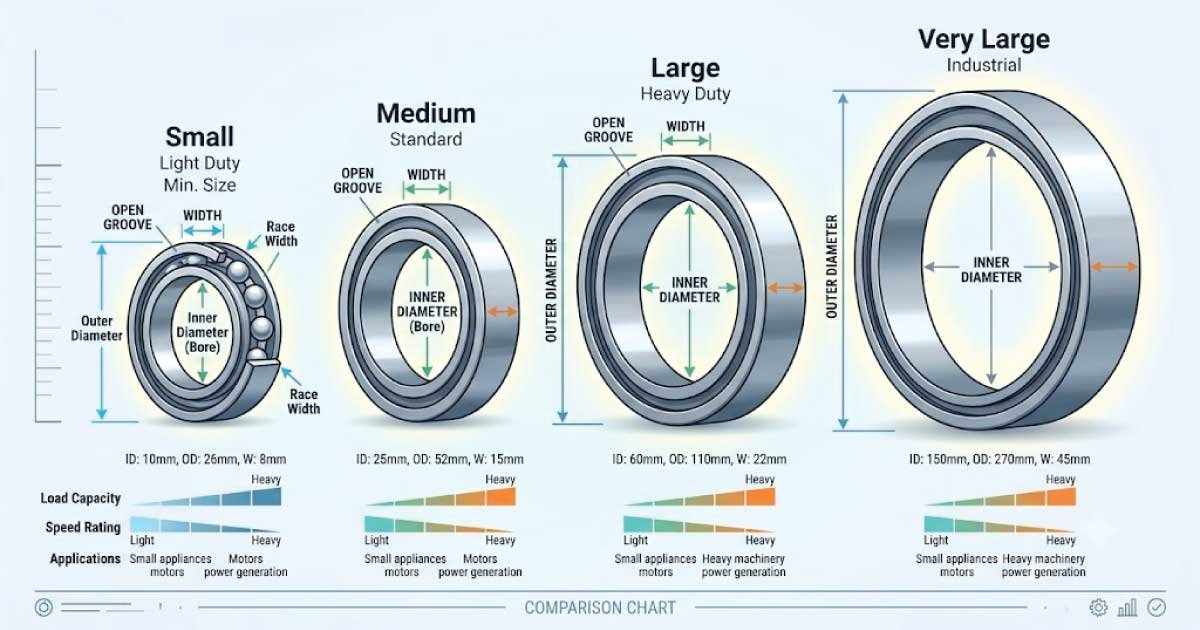
Bearing race sizes are defined using standard dimensional measurements that ensure proper fitment, alignment, and performance within mechanical systems. Accurate measurement is essential because even small deviations can lead to poor rotation, increased friction, or premature failure. The three primary dimensions used to define bearing race size are inner diameter, outer diameter, and width.
1. Inner Diameter (ID)
The inner diameter refers to the measurement of the inner race of the bearing. This is the section that fits directly onto the shaft. A correct inner diameter ensures a secure and stable fit, allowing smooth rotation without slipping. If the ID is too loose or too tight, it can cause misalignment, vibration, or damage to both the shaft and bearing.
2. Outer Diameter (OD)
The outer diameter is the measurement of the outer race of the bearing, which fits into the housing or mounting structure. Proper OD sizing ensures that the bearing is securely seated and properly aligned within the machine. An incorrect outer diameter can lead to instability, poor load distribution, and reduced operational efficiency.
3. Width (W)
The width of a bearing refers to its overall thickness from one side of the race to the other. This dimension affects load-carrying capacity and stability. A properly selected width ensures balanced load distribution across the bearing surfaces, improving durability and performance. Incorrect width sizing can reduce efficiency and increase wear over time.
4. Example:
A bearing labeled 6205 typically has:
- ID: 25 mm
- OD: 52 mm
- Width: 15 mm
These standardized numbers help users quickly identify compatible bearings.
Standard Bearing Race Size Chart (Metric Series)
Below is a simplified metric bearing race size chart commonly used in industrial applications:
| Bearing Number | Inner Diameter (mm) | Outer Diameter (mm) | Width (mm) |
|---|---|---|---|
| 6000 | 10 | 26 | 8 |
| 6001 | 12 | 28 | 8 |
| 6002 | 15 | 32 | 9 |
| 6003 | 17 | 35 | 10 |
| 6004 | 20 | 42 | 12 |
| 6005 | 25 | 47 | 12 |
| 6203 | 17 | 40 | 12 |
| 6204 | 20 | 47 | 14 |
| 6205 | 25 | 52 | 15 |
| 6206 | 30 | 62 | 16 |
| 6305 | 25 | 62 | 17 |
This chart is widely used for deep groove ball bearings in automotive, machinery, and electric motors.
Inch Series Bearing Race Size Chart
In the United States and some industrial applications, inch-based bearings are common.
| Bearing Code | Inner Diameter (inches) | Outer Diameter (inches) | Width (inches) |
|---|---|---|---|
| R4 | 0.25 | 0.625 | 0.196 |
| R6 | 0.375 | 0.875 | 0.281 |
| R8 | 0.5 | 1.125 | 0.312 |
| R10 | 0.625 | 1.375 | 0.344 |
| R12 | 0.75 | 1.625 | 0.437 |
Inch series bearings are often used in bicycles, skateboards, and light machinery.
Types of Bearing Races
Different bearing applications require different race designs to ensure proper load handling, alignment, and durability. Bearing races are essential components that support rolling elements and maintain smooth motion between moving parts. Understanding each type helps in selecting the right bearing for specific mechanical and industrial requirements.
1. Inner Race
The inner race is mounted directly onto the rotating shaft and moves along with it during operation. It must maintain a precise fit to ensure smooth rotation and proper load transfer without slippage or misalignment.
It is:
- Mounted on rotating shaft
- Must match shaft diameter precisely
- Usually interference fit
2. Outer Race
The outer race is fixed inside the bearing housing and provides a stable surface for rolling elements. It plays a key role in maintaining alignment and handling radial loads during operation.
It requires:
- Fixed installation in housing
- Precise housing bore fit
- Ability to handle radial load
3. Tapered Race
Tapered races are used in tapered roller bearings and are designed to handle both radial and axial loads. Their angled design allows them to perform well in heavy-duty and high-stress applications.
Common in:
- Automotive wheel hubs
- Heavy machinery systems
- Industrial equipment
4. Flanged Race
A flanged race includes an integrated flange that helps with axial positioning and prevents movement within the housing. This design is useful in compact systems where space and alignment control are important.
Used for:
- Axial positioning support
- Compact assemblies
- Precise alignment applications
How to Read a Bearing Race Size Code
Bearing size codes are standardized identification numbers used globally to define bearing type, dimensions, and internal bore size. Understanding these codes is important for selecting the correct bearing and ensuring proper fit, load handling, and machine performance.
Example: 6205
- 6 → Bearing type (deep groove ball bearing)
- 2 → Series (medium load capacity)
- 05 → Bore diameter code
How Bore Size Is Calculated
The last two digits of the code represent the bore diameter code. To convert it into actual size, a standard formula is used.
Multiply the last two digits by 5:
05 × 5 = 25 mm inner diameter
Key Understanding
This system simplifies identification and ensures compatibility across thousands of bearing designs worldwide. It helps engineers, technicians, and mechanics quickly select the correct bearing without needing full dimensional drawings every time.
Why This System Matters
- Standardized global sizing system
- Reduces selection errors
- Speeds up maintenance and replacement
- Ensures proper fit and performance in machinery
This coding system is widely used in automotive, industrial, and precision engineering applications to maintain consistency and reliability.
Materials Used in Bearing Races
Bearing races are manufactured using high-strength and wear-resistant materials because they must withstand continuous rolling contact, heavy loads, and high-speed operation. The choice of material directly affects durability, performance, corrosion resistance, and overall bearing life in different mechanical applications.
1. Chrome Steel (52100 Steel)
Chrome steel is the most commonly used material for bearing races due to its excellent hardness, wear resistance, and fatigue strength. It performs reliably under heavy loads and high-speed conditions, making it suitable for most industrial and automotive applications.
- High durability
- Excellent wear resistance
- Strong fatigue life
- Most widely used bearing material
2. Stainless Steel
Stainless steel bearing races are used in environments where corrosion resistance is critical. They perform well in moisture, chemicals, and outdoor conditions, making them ideal for hygienic or harsh environments.
- Corrosion-resistant applications
- Suitable for wet and chemical environments
- Long service life in harsh conditions
3. Ceramic
Ceramic materials are used in high-performance bearings where speed, precision, and low friction are essential. They generate less heat and can operate at higher speeds compared to metal races.
- High-speed applications
- Low friction and heat generation
- Lightweight and highly durable
4. Carbon Steel
Carbon steel is used in low-cost or light-duty applications where extreme performance is not required. It offers basic strength but lower wear resistance compared to advanced materials.
- Low-cost applications
- Basic strength and performance
- Suitable for light-duty machinery
5. Heat Treatment
In addition to material selection, heat treatment is applied to bearing races to improve hardness, wear resistance, and fatigue strength. This process significantly extends the service life of the bearing under demanding operating conditions.
Tolerances in Bearing Race Sizes
Precision is extremely important in bearing race manufacturing because even small dimensional variations can affect performance, noise levels, heat generation, and service life. Tolerances define the allowable limits of variation in size, ensuring that bearings fit correctly and operate smoothly under different load and speed conditions.
ISO P0 (Normal Tolerance)
ISO P0 is the standard tolerance level used in most general-purpose bearings. It provides acceptable accuracy for everyday mechanical applications where extreme precision is not required.
- Standard industrial applications
- Cost-effective option
- Suitable for general machinery
P6 (High Precision)
P6 tolerance offers tighter dimensional control compared to standard bearings. It improves rotational accuracy and reduces vibration, making it suitable for moderately demanding applications.
- Better accuracy than standard grade
- Reduced vibration
- Used in improved performance machinery
P5 (Very High Precision)
P5 bearings are designed for high-performance applications where precision and smooth operation are critical. They offer excellent dimensional accuracy and stability under load.
- High-speed machinery
- CNC equipment
- Precision engineering systems
P4 (Ultra Precision)
P4 tolerance represents ultra-precision bearings used in highly sensitive and high-speed applications. These bearings ensure maximum accuracy and minimal deviation during operation.
- Aerospace and robotics
- High-speed spindles
- Ultra-precise industrial systems
Importance of Tight Tolerances
Tighter tolerances result in smoother rotation, reduced noise, lower vibration, and improved efficiency. They are essential in high-speed and precision applications where even minor deviations can significantly affect performance and reliability.
Check Out Our Complete Guide:
Common Bearing Race Problems
Bearing race problems usually occur due to incorrect sizing, poor installation practices, or insufficient lubrication. Since bearing races are responsible for guiding rolling elements and maintaining smooth rotation, even small issues can lead to serious mechanical failures. Identifying these problems early helps improve reliability and extend equipment life.
1. Noise and Vibration
Noise and vibration are early warning signs of bearing race issues. They often occur when the race surface becomes uneven, misaligned, or improperly fitted, causing irregular movement of rolling elements and reducing system stability during operation.
2. Overheating
Overheating develops when friction increases inside the bearing system. This may result from poor lubrication, incorrect clearance, or damaged races. Excess heat reduces efficiency and accelerates wear, leading to faster component degradation.
3. Shaft Misalignment
Shaft misalignment occurs when the bearing race is not properly installed or sized. This creates uneven load distribution across the bearing surface, resulting in increased stress, reduced accuracy, and premature wear of mechanical components.
4. Bearing Seizure
Bearing seizure happens when excessive friction or lack of lubrication prevents smooth rotation. The bearing can lock completely, stopping motion and potentially causing severe damage to the shaft and surrounding parts.
5. Reduced Lifespan
Reduced lifespan is the final result of repeated bearing race issues. Improper selection, poor maintenance, and lubrication failures all contribute to early wear and system breakdown, significantly shortening the operational life of the bearing assembly.
Check Out Our Complete Guide:
Tips for Choosing the Right Bearing Race Size
Selecting the correct bearing race size is essential for ensuring smooth operation, reliability, and long service life of mechanical systems. Incorrect sizing can lead to vibration, overheating, or premature failure. Careful evaluation of specifications and operating conditions helps achieve optimal performance.
1. Always Check Manufacturer Specifications
Manufacturer specifications provide accurate details about bearing dimensions, load ratings, and tolerances. Following these guidelines ensures proper fitment and prevents compatibility issues during installation.
2. Use Precise Measuring Tools
Accurate measurement is critical when selecting bearing races. Tools such as micrometers, calipers, and precision gauges help ensure the correct internal and external dimensions are identified without error.
3. Match Load Rating with Application
The bearing race must be selected according to the load it will carry. Underestimating load requirements can lead to early wear, deformation, or failure of the bearing system.
4. Avoid Mixing Metric and Inch Systems
Mixing measurement systems can result in incorrect sizing and poor fitment. Always ensure consistency by using either metric or inch-based components throughout the system.
5. Consider Operating Speed and Temperature
Operating conditions such as speed and temperature significantly affect bearing performance. High-speed or high-temperature environments may require specialized materials and tighter tolerances for reliable operation.
Check Out Our Complete Guide:
Conclusion
A bearing race size chart is an essential tool for engineers, mechanics, and technicians working with rotating machinery. It ensures proper fitment, reduces mechanical failure, and increases efficiency across all types of applications.
Understanding bearing sizes, codes, materials, and tolerances helps you make the right choice whether you’re repairing an automotive wheel hub or designing industrial machinery.
When selected correctly, bearing races ensure smooth motion, reduced friction, and long-lasting performance—making them one of the most critical components in mechanical systems.
Check Out Our Complete Guide:
FAQs:
What is a bearing race and why is it important?
A bearing race is the hardened steel ring that supports rolling elements like balls or rollers inside a bearing assembly. It comes in inner and outer forms to guide smooth rotation between shaft and housing. Its importance lies in reducing friction, maintaining alignment, and supporting load transfer. Without correctly sized races, bearings quickly fail due to vibration, heat, and uneven wear.
How do I know the correct bearing race size?
The correct bearing race size is determined by measuring inner diameter, outer diameter, and width using precision tools like calipers or micrometers. These measurements are then matched with a standard bearing size chart. Always ensure accuracy because even small errors can cause poor fitting, vibration, or overheating. Manufacturer specifications should also be checked for exact compatibility before installation.
What happens if a bearing race is the wrong size?
If a bearing race is incorrectly sized, it can cause serious mechanical problems such as misalignment, excessive vibration, overheating, and rapid wear. The bearing may not seat properly in the housing or on the shaft, leading to instability. Over time, this results in reduced efficiency, noisy operation, and complete bearing failure, which can damage surrounding machine components as well.
What materials are used in bearing races?
Bearing races are commonly made from chrome steel (52100), stainless steel, carbon steel, and sometimes ceramic materials. Chrome steel is the most widely used due to its hardness, wear resistance, and durability. Stainless steel is preferred in corrosive environments, while ceramics are used in high-speed applications. Heat treatment is often applied to improve strength and extend service life.
How do I measure a bearing race correctly?
To measure a bearing race, first use a caliper to check the inner diameter, then measure the outer diameter across the widest points. Finally, measure the width or thickness. All readings should be precise and taken carefully without tilting the tool. After measuring, compare the values with a standard size chart to identify the correct bearing type.
What are common signs of bearing race failure?
Common signs of bearing race failure include unusual noise, vibration, overheating, and reduced machine efficiency. In severe cases, shaft misalignment or bearing seizure may occur. You may also notice visible wear marks, pitting, or surface damage on the race. These symptoms indicate improper sizing, poor lubrication, or contamination, and should be addressed immediately to avoid further damage.
Where are bearing races commonly used?
Bearing races are widely used in automotive wheel hubs, electric motors, gearboxes, CNC machines, bicycles, conveyor systems, and industrial pumps. They are essential in any system involving rotation and load transfer. Their role is to ensure smooth motion, reduce friction, and maintain alignment between moving parts. Proper sizing is critical in all these applications for safe and efficient operation.
How can I extend the life of a bearing race?
To extend bearing race life, ensure proper lubrication, correct installation, and regular maintenance. Avoid overloading and keep the system clean from dust and contaminants. Use accurate sizing based on manufacturer specifications and check alignment during operation. Operating within recommended speed and temperature limits also helps reduce wear and ensures smooth, long-lasting performance of the bearing system.