
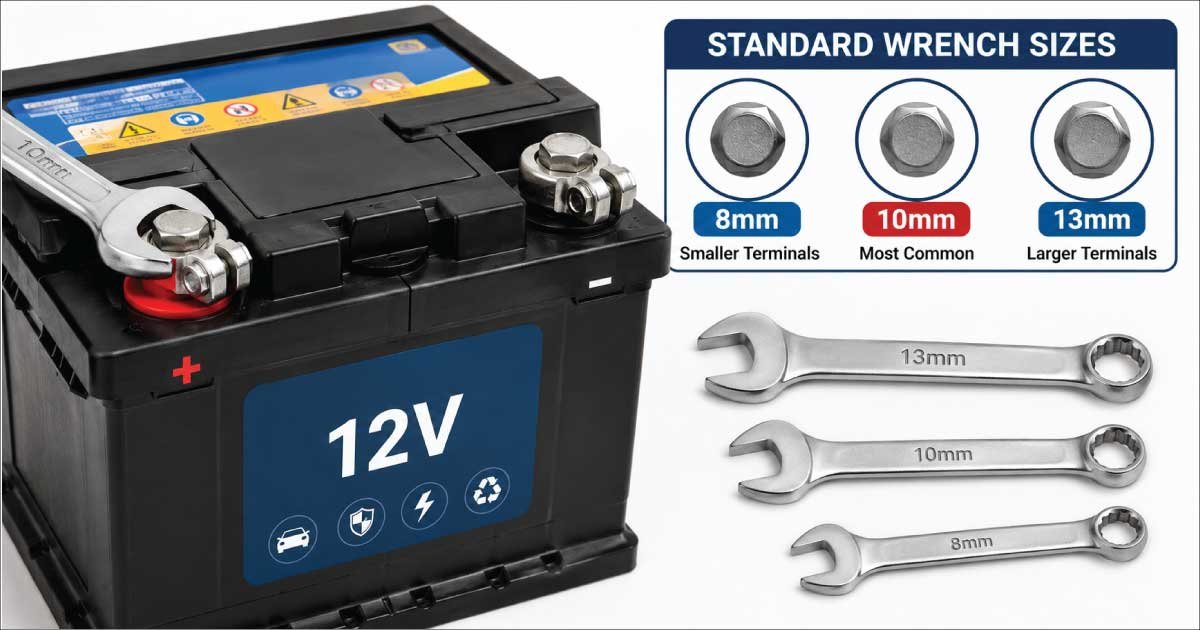
Replacing or disconnecting a car battery is one of the most common vehicle maintenance tasks. Whether you’re installing a new battery, cleaning corroded terminals, or jump-starting a vehicle, you’ll need the correct wrench to loosen and tighten the battery terminal bolts. One of the most frequently asked questions is, “What size wrench do I need for a car battery?”
The answer depends on your vehicle’s make and model, but the most common wrench sizes are 10 mm, 8 mm, and 13 mm. Among these, a 10 mm wrench or socket is by far the most widely used on modern passenger cars.
In this guide, you will learn which wrench sizes are commonly used for car batteries, how to identify the correct size for your vehicle, and tips for safely disconnecting and reconnecting a battery.
Why Does the Correct Wrench Size Matter?
Battery terminal bolts are designed to create a tight, stable electrical connection between the battery posts and the vehicle’s wiring system. These connections carry high current, so even a small mistake in tightening can lead to performance and safety issues. Using the correct wrench size ensures proper torque without damaging the hardware.
Using the wrong wrench can cause several problems:
- Round off the bolt head
- Damage the terminal clamp
- Make battery removal more difficult
- Increase the risk of poor electrical connections
Once a bolt head is rounded, it becomes very difficult to remove and may require cutting or special extraction tools. Proper tool selection helps avoid unnecessary damage and ensures long-term reliability of the battery connection.
Using the proper wrench ensures the battery terminals are tightened correctly and helps prevent electrical issues such as starting problems, dim lights, or intermittent power loss.
Most Common Wrench Sizes for Car Batteries
Battery terminal and hold-down hardware are designed in a few standard sizes across most vehicles. While there are variations, most passenger cars fall within a predictable range.
| Wrench Size | Common Use |
|---|---|
| 10 mm | Most modern cars and SUVs |
| 8 mm | Some compact cars and imports |
| 13 mm | Battery hold-down brackets |
| 12 mm | Some Asian vehicles |
| 1/2 inch | Older American vehicles |
| 7/16 inch | Older domestic vehicles |
A 10 mm wrench is the most commonly used size for battery terminals in modern vehicles. Most mechanics automatically reach for this size first because it fits a large percentage of cars on the road today.
Why Is a 10 mm Wrench So Common?
The 10 mm size has become an industry standard in many automotive applications, especially for battery terminal clamps. Manufacturers prefer it because it balances strength, space efficiency, and ease of service.
Key reasons include:
- Adequate clamping force for secure electrical contact
- Easy serviceability for technicians and DIY users
- Compact design suitable for tight engine bays
- Compatibility with standard automotive tool sets
Because of this widespread adoption, a 10 mm wrench or socket is one of the most essential tools in any basic car repair kit.
Battery Terminal Bolt vs. Battery Hold-Down Bolt
It is important to understand that not all battery-related bolts serve the same purpose. Confusing them can lead to using the wrong tool size.
1. Battery Terminal Bolts
Battery terminal bolts are used to tighten the clamps that connect directly to the battery posts (positive and negative terminals). These are responsible for maintaining electrical continuity.
Common wrench sizes include:
- 10 mm
- 8 mm
- 12 mm
These bolts are typically smaller because they only need to secure the clamp around the post, not hold the entire battery in place.
2. Battery Hold-Down Bolts
Battery hold-down bolts are used to secure the battery itself to the tray or mounting bracket. They are larger and designed for structural stability rather than electrical connection.
Common sizes include:
- 13 mm
- 12 mm
- 14 mm
- 1/2 inch
Because these bolts handle physical restraint, they are usually stronger and require larger tools for tightening and removal.
In many vehicles, two different wrench sizes are needed when performing a battery replacement or service.
Common Wrench Sizes by Vehicle Brand
While exact sizes can vary depending on model and year, most manufacturers follow consistent patterns for battery hardware design.
1. Toyota
Many Toyota vehicles commonly use:
- 10 mm terminal bolts
- 12 mm or 13 mm hold-down bolts
Popular models include:
- Corolla
- Camry
- RAV4
- Tacoma
Toyota tends to standardize small fasteners across models, making maintenance relatively simple.
2. Honda
Most Honda vehicles use:
- 10 mm battery terminals
- 10 mm or 12 mm battery hold-down hardware
Honda designs are generally compact, so 10 mm fasteners are very common throughout their lineup.
3. Ford
Ford commonly uses:
- 10 mm terminal clamps
- 13 mm hold-down bolts
Some trucks and larger vehicles may use slightly larger fasteners depending on battery size and mounting design.
4. Chevrolet (GM)
Many Chevrolet and GMC vehicles use:
- 10 mm battery terminal bolts
- 13 mm battery tray bolts
GM vehicles often follow similar sizing patterns across different models, though exceptions exist in heavy-duty trucks.
5. Nissan
Most Nissan vehicles use:
- 10 mm battery terminals
- 12 mm hold-down bolts
These sizes are common across sedans, SUVs, and compact models in the Nissan lineup.
6. Hyundai and Kia
Hyundai and Kia vehicles commonly use:
- 10 mm terminal bolts
- 12 mm battery hold-down bolts
These manufacturers often share platform designs, which leads to consistent fastener sizing across many models.
Always confirm the correct size for your specific model and year before starting any work, as small variations can exist depending on engine type and production changes.
 Advance your research now with
  Collet Sizes Chart: Latest 2026 Guide
Socket or Wrench: Which Is Better?
Both sockets and wrenches can be used effectively for car battery work, but each tool has strengths depending on space, comfort, and required torque. Choosing the right one can make the job faster, safer, and reduce the risk of damaging the fasteners.
1. Open-End Wrench
An open-end wrench is commonly used for quick adjustments and tight spaces where a socket cannot reach. It grips the bolt from two sides but remains open, making it easier to slip onto fasteners in confined engine bays.
Advantages:
- Fits into tight spaces
- Quick to use
- Lightweight and easy to carry
Disadvantages:
- More likely to slip off the bolt head
- Provides less leverage
- Higher risk of rounding the bolt
Open-end wrenches are useful for simple battery terminal loosening, but they require careful handling to avoid damage.
2. Box-End Wrench
A box-end wrench fully encloses the bolt head, providing a much more secure grip. This design reduces slipping and allows more torque to be applied safely.
Advantages:
- Better grip on bolt head
- Reduced chance of rounding the bolt
- Allows more torque than open-end wrenches
Box-end wrenches are generally safer than open-end types when working with battery terminals, especially if bolts are slightly tight or corroded.
3. Socket and Ratchet
A socket and ratchet system is often considered the most efficient and safest option for battery work. It provides full contact around the bolt head and allows quick removal without repositioning the tool repeatedly.
Advantages:
- Fast removal and installation
- Excellent grip on bolt head
- Easier to use on tight or corroded bolts
- Very low chance of damaging fasteners
For most battery-related tasks, a 10 mm deep socket with a ratchet is widely considered the best choice. It combines speed, control, and safety, making it ideal for both beginners and professionals.
How to Identify the Correct Wrench Size
If you are unsure which wrench size fits your battery terminals or hold-down bolts, there are a few simple and reliable methods to confirm the correct size.
1. Check the Owner’s Manual
The owner’s manual often includes detailed maintenance specifications, including battery-related fastener sizes. This is the most accurate and manufacturer-approved source of information.
It may include:
- Battery terminal bolt size
- Hold-down bracket bolt size
- Safety instructions for battery removal
2. Try a 10 mm Wrench First
Since 10 mm is the most common size used in modern vehicles, it is usually the best starting point. Most battery terminal bolts will fit this size.
The correct wrench should:
- Fit snugly over the bolt head
- Not wobble or slip
- Turn smoothly without forcing
If it feels loose or tight, try the next closest size.
3. Measure the Bolt Head
If you want precise confirmation, use a digital caliper or compare multiple wrenches directly on the bolt head until you find the correct fit.
Never force a wrench onto a bolt that does not fit properly, as this can:
- Round off the bolt head
- Damage the terminal clamp
- Make future removal difficult
Accuracy is more important than speed in this step.
How to Disconnect a Car Battery Safely
Disconnecting a car battery requires caution because it stores electrical energy that can cause sparks or damage if handled incorrectly. Following the correct steps ensures safety and prevents electrical system issues.
Step 1: Turn Off the Engine
Always begin by turning off the engine completely and removing the ignition key. This ensures that no electrical current is actively flowing through the system during disconnection.
Step 2: Wear Safety Equipment
Before starting, wear basic protective gear:
- Safety glasses
- Gloves
This protects you from accidental acid exposure, corrosion dust, and possible sparks near terminals.
Step 3: Disconnect the Negative Terminal First
Use the appropriate wrench (commonly 10 mm) to loosen the negative (–) terminal first. Once loosened, remove the cable and position it away from the battery so it cannot accidentally reconnect.
This step is critical because it reduces the risk of short circuits during the process.
Step 4: Disconnect the Positive Terminal
After the negative terminal is safely removed, repeat the process for the positive (+) terminal. This ensures the system is fully isolated from the electrical circuit.
Step 5: Remove the Battery Hold-Down
The battery is often secured with a hold-down bracket that prevents movement during driving. Use the correct socket or wrench—commonly 13 mm—to remove these fasteners.
Once released, carefully lift the battery out, as it can weigh between 30–50 pounds (14–23 kg) or more depending on the vehicle. Always lift with proper posture to avoid injury.
Advance your research now with Drill Size Chart: Complete Guide
Final Thoughts
So, what size wrench do you need for a car battery? In most cases, a 10 mm wrench or socket is the correct tool for loosening and tightening battery terminal bolts. For removing the battery hold-down bracket, you’ll often need a 13 mm wrench or socket, though sizes can vary by vehicle.
Before starting any battery service, gather the proper tools, wear appropriate safety gear, and follow the correct sequence for disconnecting and reconnecting the terminals. Using the right wrench not only makes the job easier but also helps protect your vehicle’s electrical system and ensures a secure, reliable battery connection.
Frequently Asked Questions
What size wrench fits most car battery terminals?
A 10 mm wrench fits the battery terminal bolts on most modern passenger vehicles, making it the most commonly used size for battery maintenance. However, some older or imported vehicles may use different sizes. Always check your vehicle’s owner’s manual or inspect the terminal before starting work.
What size socket removes the battery hold-down?
Many vehicles use a 13 mm socket to remove the battery hold-down bracket, but some models require a 12 mm, 14 mm, or 1/2-inch socket instead. Since battery mounting hardware varies by manufacturer, verify the correct size before attempting to remove the battery.
Can I use an adjustable wrench?
Yes, you can use an adjustable wrench if you don’t have the correct socket or wrench. However, it is not the best choice because it may slip or round off the fastener. A properly sized wrench or socket provides a tighter grip, making the job safer and more efficient.
Should I disconnect the positive or negative terminal first?
Always disconnect the negative (–) battery terminal first and reconnect it last. This reduces the risk of creating an electrical short if your tool accidentally contacts the vehicle’s metal frame. Following this simple procedure helps protect both you and your vehicle’s electrical system during battery maintenance.