
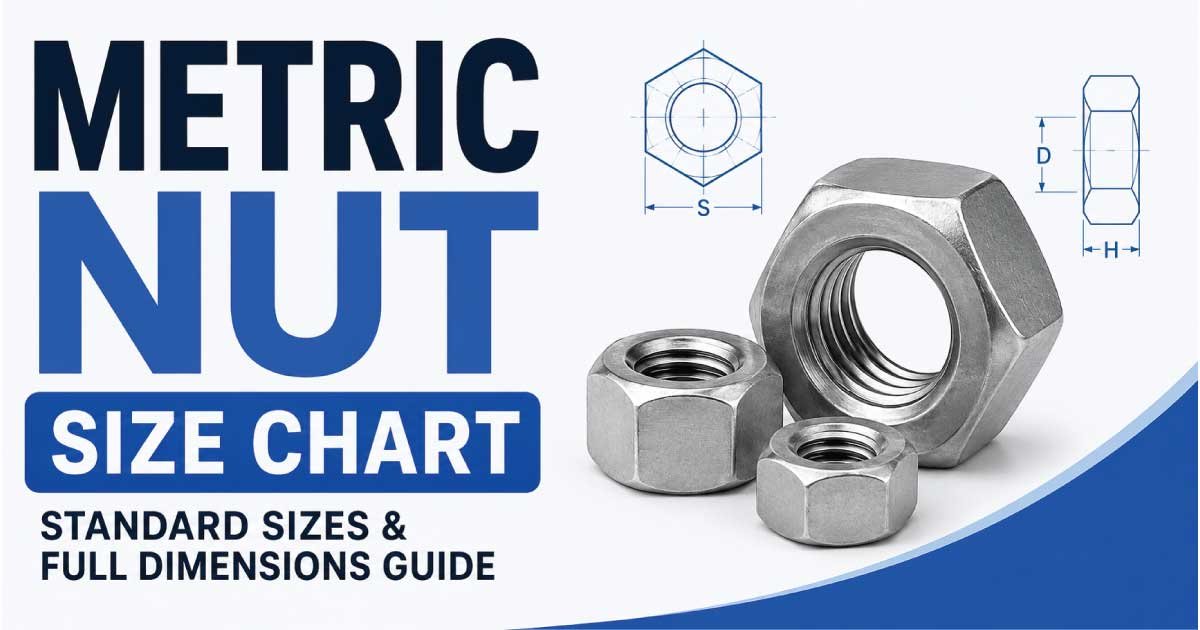
A metric nut size chart is a useful reference for identifying nuts by their metric thread size, nominal diameter, and corresponding wrench or spanner size. Metric nuts are commonly used with metric bolts, screws, and threaded studs in automotive, mechanical, construction, manufacturing, plumbing, and DIY applications.
Understanding metric nut sizes makes it easier to select the correct nut for a bolt and avoid problems caused by mismatched threads or incorrect wrench sizes. Metric fasteners are generally identified using measurements in millimeters, such as M6, M8, M10, M12, and M16. The “M” indicates a metric thread, while the number represents the nominal diameter of the threaded bolt in millimeters.
Below is a practical metric nut size chart followed by a complete guide explaining thread diameter, pitch, wrench size, nut thickness, thread compatibility, and how to measure metric nuts accurately.
Metric Nut Size Chart in mm
The following chart provides common metric nut sizes and their typical dimensions. Wrench sizes can vary depending on the nut standard and manufacturer, so always verify the applicable standard when precision is important.
| Metric Nut Size | Nominal Thread Diameter | Common Thread Pitch | Typical Wrench Size | Typical Nut Thickness |
|---|---|---|---|---|
| M3 | 3 mm | 0.5 mm | 5.5 mm | 2.4 mm |
| M4 | 4 mm | 0.7 mm | 7 mm | 3.2 mm |
| M5 | 5 mm | 0.8 mm | 8 mm | 4 mm |
| M6 | 6 mm | 1.0 mm | 10 mm | 5 mm |
| M8 | 8 mm | 1.25 mm | 13 mm | 6.5 mm |
| M10 | 10 mm | 1.5 mm | 16 mm | 8 mm |
| M12 | 12 mm | 1.75 mm | 18 mm | 10 mm |
| M14 | 14 mm | 2.0 mm | 21 mm | 11 mm |
| M16 | 16 mm | 2.0 mm | 24 mm | 13 mm |
| M18 | 18 mm | 2.5 mm | 27 mm | 15 mm |
| M20 | 20 mm | 2.5 mm | 30 mm | 16 mm |
| M22 | 22 mm | 2.5 mm | 34 mm | 18 mm |
| M24 | 24 mm | 3.0 mm | 36 mm | 19 mm |
| M27 | 27 mm | 3.0 mm | 41 mm | 22 mm |
| M30 | 30 mm | 3.5 mm | 46 mm | 24 mm |
| M33 | 33 mm | 3.5 mm | 50 mm | 26 mm |
| M36 | 36 mm | 4.0 mm | 55 mm | 29 mm |
| M39 | 39 mm | 4.0 mm | 60 mm | 31 mm |
| M42 | 42 mm | 4.5 mm | 65 mm | 34 mm |
| M45 | 45 mm | 4.5 mm | 70 mm | 36 mm |
| M48 | 48 mm | 5.0 mm | 75 mm | 38 mm |
What Does M Mean on a Metric Nut?
The letter M in a metric nut designation means that the nut uses a metric thread. The number following M represents the nominal diameter of the mating bolt’s thread in millimeters.
For example, an M10 nut is designed for a bolt with a nominal thread diameter of approximately 10 mm. An M10 nut does not mean that the nut itself measures exactly 10 mm across its outside surfaces. Instead, the M10 designation refers primarily to the internal thread diameter and the bolt it is designed to fit.
Common examples include:
- M5 nut — designed for a 5 mm nominal bolt thread
- M6 nut — designed for a 6 mm nominal bolt thread
- M8 nut — designed for an 8 mm nominal bolt thread
- M10 nut — designed for a 10 mm nominal bolt thread
- M12 nut — designed for a 12 mm nominal bolt thread
- M16 nut — designed for a 16 mm nominal bolt thread
- M20 nut — designed for a 20 mm nominal bolt thread
Metric Nut Sizes and Wrench Sizes
One of the most important distinctions when using a metric nut size chart is the difference between thread size and wrench size.
The metric designation, such as M8 or M12, identifies the thread size. The wrench size identifies the distance across the nut’s flats. These measurements are different.
For example, a typical M10 hex nut may require a 16 mm wrench, while an M12 nut may require an 18 mm wrench. Therefore, you should not select a socket simply by looking at the M-size.
The wrench size can also change depending on the nut standard. Older fasteners, heavy hex nuts, thin nuts, flange nuts, and specialized fasteners may have different across-flats dimensions.
Common Metric Nut Sizes
Metric nuts are available in a very wide range of sizes, but some sizes are used much more frequently than others.
M6 Nut Size
M6 nuts are common in machinery, furniture, automotive components, electrical equipment, brackets, and general hardware. An M6 nut normally mates with an M6 bolt and commonly uses a 10 mm wrench.
M8 Nut Size
The M8 nut is one of the most commonly encountered metric nuts. It is widely used in machinery, automotive assemblies, equipment, structural brackets, and general mechanical applications. A standard M8 hex nut commonly uses a 13 mm wrench.
M10 Nut Size
M10 nuts are frequently used in automotive, construction, machinery, and structural applications. A standard M10 nut commonly has a 16 mm across-flats dimension.
M12 Nut Size
M12 nuts are used where greater fastening strength is required. They are common in machinery, vehicles, structural assemblies, industrial equipment, and heavy-duty applications. A typical standard M12 hex nut uses an 18 mm wrench.
M16 Nut Size
M16 nuts are larger fasteners typically used for heavy machinery, structural connections, equipment frames, and demanding mechanical applications. A standard M16 nut commonly uses a 24 mm wrench.
M20 Nut Size
M20 nuts are used for large mechanical and structural connections. They are significantly larger than the common M6, M8, and M10 sizes and are typically tightened using a 30 mm wrench.
Metric Nut Thread Pitch Chart
Thread pitch is another important measurement when identifying a metric nut. Thread pitch is the distance from one thread crest to the next, measured in millimeters.
For example, an M10 × 1.5 nut has a nominal diameter of 10 mm and a thread pitch of 1.5 mm.
| Nut Size | Common Standard Pitch | Fine Pitch Examples |
|---|---|---|
| M4 | 0.7 mm | 0.5 mm |
| M5 | 0.8 mm | 0.5 mm |
| M6 | 1.0 mm | 0.75 mm |
| M8 | 1.25 mm | 1.0 mm |
| M10 | 1.5 mm | 1.25 mm |
| M12 | 1.75 mm | 1.5 mm |
| M14 | 2.0 mm | 1.5 mm |
| M16 | 2.0 mm | 1.5 mm |
| M18 | 2.5 mm | 2.0 mm |
| M20 | 2.5 mm | 2.0 mm |
| M24 | 3.0 mm | 2.0 mm |
| M30 | 3.5 mm | 2.0 mm |
A nut and bolt must have compatible thread diameter and pitch. An M10 standard-pitch nut should not automatically be assumed to fit every M10 bolt because M10 bolts can be manufactured with different thread pitches.
Also Read: Conduit Sizes Explained: Complete Selection Guide
Standard Metric Nut vs Fine Thread Nut
Metric nuts are available with different thread pitches. The most common type is generally referred to as a coarse thread, while fine-thread versions have a smaller distance between threads.
A coarse-thread nut is often preferred for general-purpose applications because it is easier to assemble and is generally more tolerant of minor damage or contamination.
Fine-thread nuts can be useful in applications where greater adjustment precision, specific mechanical properties, or particular design requirements call for a finer pitch.
For correct compatibility, always match:
- Nominal diameter
- Thread pitch
- Thread profile
- Thread standard
- Nut type
- Strength/class requirements
How to Measure a Metric Nut
If you have an unidentified nut, you can determine its approximate size using a few simple measurements.
1. Measure the Wrench Size
Use a ruler, caliper, or appropriate wrench to measure the distance across two opposite flat surfaces of the nut. This is called the across-flats measurement.
For example, if the nut measures approximately 13 mm across its flats, it may be a standard M8 hex nut.
However, wrench size alone does not positively identify the thread size because different nut standards can have similar or different across-flats dimensions.
2. Measure the Thread Diameter
Measure the outside diameter of the corresponding bolt or the internal thread area using a caliper. A bolt measuring approximately 8 mm across its major thread diameter is generally an M8 bolt.
The actual measured diameter can be slightly different from the nominal designation because of manufacturing tolerances.
3. Determine the Thread Pitch
Use a metric thread pitch gauge if available. Alternatively, you can compare the threads against a known bolt or carefully measure the distance between several thread crests.
Thread pitch is especially important when choosing between coarse and fine metric nuts.
Metric Nut Size vs Bolt Size
A metric nut size corresponds to the nominal diameter of the bolt with which it is designed to work.
For example:
M8 bolt + M8 nut = compatible nominal thread size
However, compatibility requires more than simply matching the M number. The thread pitch must also match.
For instance, an M10 × 1.5 nut is designed for an M10 × 1.5 bolt. It may not correctly fit an M10 × 1.25 bolt because the threads have different pitches.
This is why a metric nut and bolt size chart should include both diameter and pitch whenever accurate identification is required.
Metric Hex Nut Dimensions
The standard hex nut is one of the most widely used metric nut designs. Its six-sided shape allows it to be tightened using a wrench or socket.
Important dimensions include:
- Thread diameter: Nominal metric thread size
- Across flats: Distance between opposite flat sides
- Across corners: Distance between opposite corners
- Nut thickness: Overall height of the nut
- Thread pitch: Distance between adjacent threads
- Thread length: Internal threaded portion
These dimensions can vary according to the applicable nut standard and product type.
Metric Nut Size Chart for Wrenches
For quick workshop reference, the following common combinations are useful:
| Metric Nut | Common Wrench/Socket Size |
|---|---|
| M4 | 7 mm |
| M5 | 8 mm |
| M6 | 10 mm |
| M8 | 13 mm |
| M10 | 16 mm |
| M12 | 18 mm |
| M14 | 21 mm |
| M16 | 24 mm |
| M18 | 27 mm |
| M20 | 30 mm |
| M22 | 34 mm |
| M24 | 36 mm |
| M27 | 41 mm |
| M30 | 46 mm |
| M36 | 55 mm |
| M42 | 65 mm |
| M48 | 75 mm |
These are useful reference values for common standard hex nuts, but specialized nuts may use different wrench dimensions.
Also Read: M Drill Bit Size Guide: Complete Metric Chart
Metric Nut Size Chart for Automotive Applications
Metric fasteners are widely used in modern vehicles. Common automotive nut sizes include M6, M8, M10, M12, M14, and M16.
M6 and M8 nuts are often found on smaller brackets, covers, clamps, and components. M10 and M12 fasteners are frequently used for stronger mechanical connections, while M14 and M16 sizes may be found in larger structural or suspension-related applications depending on the vehicle design.
Automotive applications require particular attention to thread pitch, strength grade, corrosion resistance, and torque specifications. The correct nut should always meet the vehicle manufacturer’s specifications.
Metric Nut Grades and Strength Classes
Metric nuts can have different strength classes. The strength class indicates mechanical properties and helps determine whether a nut is appropriate for a particular application.
Common metric nut property classes include values such as 5, 6, 8, 10, and 12, depending on the applicable standard and nut type.
A higher property class generally indicates a nut capable of handling higher mechanical loads, but the nut must still be correctly matched with the bolt and application.
Do not assume that a larger nut is automatically stronger. Material, heat treatment, thread engagement, design, and property class all affect fastening performance.
Metric Nut Types
The standard hex nut is only one of many metric nut designs available.
Common types include:
- Hex nuts — General-purpose fastening
- Lock nuts — Help resist loosening
- Nylon insert lock nuts — Use a nylon section to increase resistance to rotation
- Flange nuts — Include an integrated flange for load distribution
- Wing nuts — Designed for hand tightening
- Cap nuts — Cover the end of a bolt
- Jam nuts — Thin nuts used for locking or limited-clearance applications
- Castle nuts — Used with specific locking arrangements
- Square nuts — Four-sided exterior design
- T-nuts — Common in certain fixtures and woodworking applications
Each type has a specific purpose, so selecting a nut involves more than choosing the correct metric diameter.
Why Metric Nut Size and Pitch Matter
Using the wrong nut can damage threads, reduce clamping force, or cause a fastening connection to fail. A nut that appears to fit initially may still have an incompatible thread pitch.
For reliable fastening, verify the following:
- Metric diameter
- Thread pitch
- Nut type
- Wrench size
- Material
- Property class
- Surface finish
- Application requirements
Correct identification is particularly important in machinery, automotive repair, structural work, and industrial applications.
Metric Nut Size Conversion
Metric and imperial nuts use different sizing systems. Metric nuts are identified primarily in millimeters, while imperial nuts are commonly identified using inch-based measurements and thread specifications.
For example, an M8 nut should not simply be replaced with an imperial nut because another nut has a similar outside diameter. The thread diameter and pitch are different systems, and forcing incompatible threads together can damage both components.
For replacement fasteners, it is best to use the same metric specification unless the equipment manufacturer specifically permits an alternative.
How to Choose the Correct Metric Nut
Choosing the correct metric nut begins with identifying the bolt. Check the bolt’s nominal diameter and thread pitch, then select a compatible nut.
For example, if the bolt is marked M12 × 1.75, look for a nut with the same M12 × 1.75 thread specification.
After confirming the thread, select the appropriate nut style and strength class for the application. Finally, check the required wrench size and installation torque.
For safety-critical assemblies, do not rely solely on a general metric nut size chart. Manufacturer specifications and relevant engineering standards should take priority.
Also Read: Tile Sizes Explained: Full Guide and Standard Chart
Frequently Asked Questions About Metric Nut Sizes
What size wrench fits an M8 nut?
A common standard M8 hex nut uses a 13 mm wrench or socket. However, specialized or non-standard M8 nuts may have different across-flats dimensions.
What size wrench fits an M10 nut?
A typical standard M10 hex nut uses a 16 mm wrench or socket.
What size wrench fits an M12 nut?
A common standard M12 hex nut uses an 18 mm wrench or socket.
Is an M10 nut 10 mm wide?
No. The M10 designation refers to the nominal thread diameter, not the width across the outside of the nut. A typical M10 hex nut is approximately 16 mm across its flats.
Does an M8 nut fit every M8 bolt?
Not necessarily. The thread pitch must also match. An M8 coarse-thread nut and an M8 fine-thread bolt may not be compatible.
What is the most common metric nut size?
M6, M8, M10, and M12 are among the most commonly encountered metric nut sizes in general mechanical and hardware applications. The most appropriate size depends on the equipment and fastening requirements.
How do I identify an unknown metric nut?
Measure its across-flats dimension, determine the approximate thread diameter, and measure the thread pitch. Comparing these measurements with a metric nut size chart can help identify the nut.
Final Thoughts on Metric Nut Sizes
A metric nut size chart provides a convenient way to identify common nut sizes, wrench dimensions, thread pitches, and basic dimensions. The most important point to remember is that the M number identifies the nominal thread diameter rather than the outside width of the nut.
For accurate selection, always check both metric thread diameter and pitch. An M6, M8, M10, or M12 designation alone may not provide enough information when multiple thread pitches are available.
Whether you are working on automotive repairs, machinery, construction projects, industrial equipment, or DIY applications, matching the correct metric nut size, thread pitch, nut type, and strength class helps create a reliable fastening connection.
Use the chart as a quick reference, but for safety-critical or precision applications, confirm the dimensions against the relevant fastener standard or manufacturer’s specifications.