
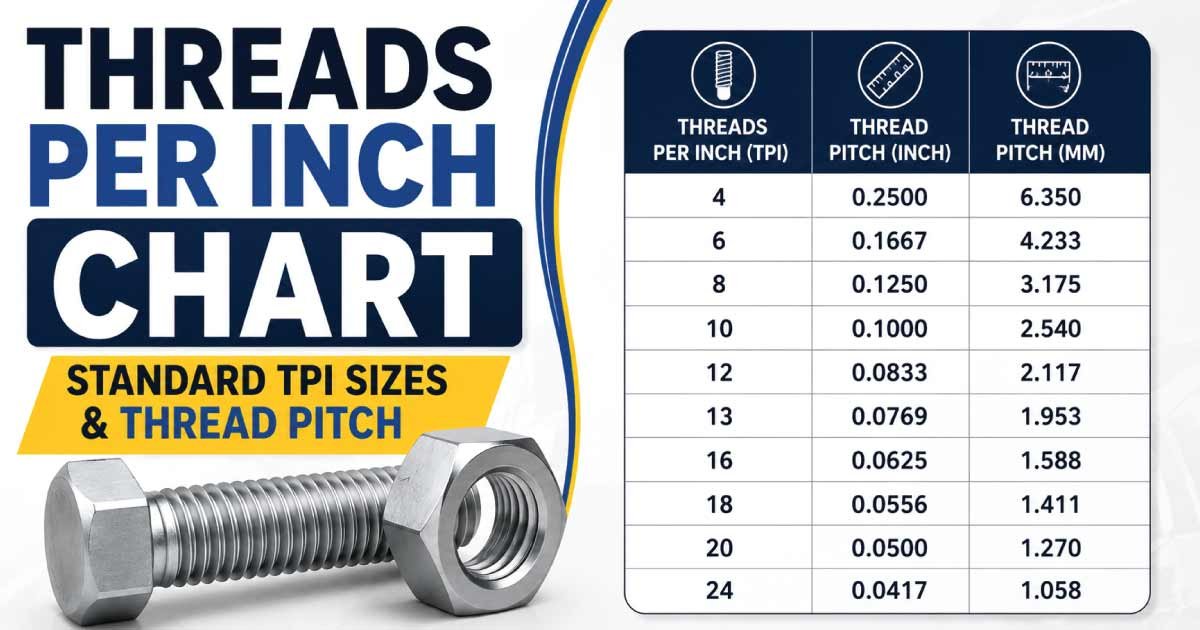
Threads are an essential part of bolts, screws, nuts, studs, threaded rods, machine fasteners, pipe fittings, and other mechanical components. When working with inch-based fasteners, one of the most important measurements is threads per inch, commonly abbreviated as TPI.
Threads per inch tells you how many thread peaks or thread intervals are present along one inch of a threaded section. For example, a fastener specified as 1/2-13 has a nominal diameter of 1/2 inch and 13 threads per inch.
Knowing the TPI is important when identifying an unknown fastener, selecting a replacement bolt, matching a nut, choosing a tap or die, comparing coarse and fine threads, and determining whether an imperial thread is compatible with a particular threaded hole.
This complete guide covers common threads per inch sizes, UNC, UNF, UNEF, thread pitch, TPI conversion, numbered screw sizes, measuring methods, metric comparisons, pipe-thread considerations, and practical fastener selection.
What Does Threads Per Inch Mean?
Threads per inch (TPI) is the number of thread intervals found within one inch of a threaded fastener.
It is primarily used with inch-based or imperial thread specifications.
For example:
- 8 TPI means approximately 8 thread intervals per inch
- 10 TPI means 10 thread intervals per inch
- 13 TPI means 13 thread intervals per inch
- 16 TPI means 16 thread intervals per inch
- 20 TPI means 20 thread intervals per inch
- 24 TPI means 24 thread intervals per inch
- 32 TPI means 32 thread intervals per inch
A higher TPI indicates more closely spaced threads.
A lower TPI indicates more widely spaced threads.
However, TPI does not identify a thread by itself. You also need the nominal diameter and thread series.
For example, 1/2-13 UNC provides much more information than simply saying 13 TPI.
Threads Per Inch Chart
The following chart provides common inch-based thread sizes and their standard coarse and fine thread counts.
| Nominal Size | UNC TPI | UNF TPI | UNEF TPI |
|---|---|---|---|
| #0 | 80 | 80 | — |
| #1 | 64 | 72 | — |
| #2 | 56 | 64 | — |
| #3 | 48 | 56 | — |
| #4 | 40 | 48 | — |
| #5 | 40 | 44 | — |
| #6 | 32 | 40 | — |
| #8 | 32 | 36 | — |
| #10 | 24 | 32 | — |
| #12 | 24 | 28 | — |
| 1/4 | 20 | 28 | 32 |
| 5/16 | 18 | 24 | 32 |
| 3/8 | 16 | 24 | 32 |
| 7/16 | 14 | 20 | 28 |
| 1/2 | 13 | 20 | 28 |
| 9/16 | 12 | 18 | 24 |
| 5/8 | 11 | 18 | 24 |
| 3/4 | 10 | 16 | 20 |
| 7/8 | 9 | 14 | 20 |
| 1 | 8 | 12 | 20 |
| 1-1/8 | 7 | 12 | 18 |
| 1-1/4 | 7 | 12 | 18 |
| 1-3/8 | 6 | 12 | 18 |
| 1-1/2 | 6 | 12 | 18 |
| 1-5/8 | 5 | 8 | 18 |
| 1-3/4 | 5 | 8 | 16 |
| 2 | 4.5 | 8 | 16 |
These are common Unified thread combinations. Specific standards, diameters, and applications may use additional thread specifications.
How to Read a Threads Per Inch Chart
A TPI chart normally contains three important pieces of information:
- Nominal diameter
- Threads per inch
- Thread series
For example:
1/2-13 UNC
means:
- Nominal diameter = 1/2 inch
- TPI = 13
- Thread series = Unified National Coarse
Similarly:
1/2-20 UNF
means:
- Nominal diameter = 1/2 inch
- TPI = 20
- Thread series = Unified National Fine
Both fasteners have the same nominal diameter, but the thread spacing is different.
What Is TPI on a Bolt?
TPI describes the spacing of the threads on an imperial bolt.
If a bolt has 20 TPI, there are 20 thread intervals in one inch.
For example:
1/4-20
means:
- 1/4-inch nominal diameter
- 20 threads per inch
The TPI number does not indicate the bolt length.
A bolt described as 1/4-20 × 2 has:
- 1/4-inch diameter
- 20 TPI
- 2-inch nominal length
This distinction is important because diameter, thread pitch, and length are separate dimensions.
TPI vs. Thread Pitch
TPI and thread pitch describe the same basic spacing concept using different units.
TPI is expressed as threads per inch.
Thread pitch is the distance from one thread crest to the next.
For inch threads:
Thread Pitch = 1 ÷ TPI
For example:
20 TPI
has a pitch of:
1 ÷ 20 = 0.050 inch
Therefore, the theoretical distance between adjacent thread crests is 0.050 inch.
TPI to Pitch Conversion Chart
| TPI | Pitch in Inches | Approx. Pitch in mm |
|---|---|---|
| 4 | 0.2500 | 6.350 |
| 5 | 0.2000 | 5.080 |
| 6 | 0.1667 | 4.233 |
| 7 | 0.1429 | 3.629 |
| 8 | 0.1250 | 3.175 |
| 9 | 0.1111 | 2.822 |
| 10 | 0.1000 | 2.540 |
| 11 | 0.0909 | 2.309 |
| 12 | 0.0833 | 2.117 |
| 13 | 0.0769 | 1.954 |
| 14 | 0.0714 | 1.814 |
| 16 | 0.0625 | 1.588 |
| 18 | 0.0556 | 1.411 |
| 20 | 0.0500 | 1.270 |
| 24 | 0.0417 | 1.058 |
| 28 | 0.0357 | 0.907 |
| 32 | 0.03125 | 0.794 |
| 36 | 0.0278 | 0.706 |
| 40 | 0.0250 | 0.635 |
| 48 | 0.0208 | 0.529 |
| 56 | 0.0179 | 0.454 |
| 64 | 0.0156 | 0.397 |
| 72 | 0.0139 | 0.353 |
| 80 | 0.0125 | 0.318 |
The millimeter values are mathematical conversions and should not be interpreted as evidence that a metric and imperial thread are interchangeable.
Common Threads Per Inch Sizes
Some TPI values are especially common in mechanical fasteners.
4 TPI
Very coarse threads are found on large-diameter or specialized threaded components.
8 TPI
8 TPI is common on larger-diameter coarse Unified threads, including 1-inch UNC.
10 TPI
10 TPI is commonly associated with 3/4-inch UNC.
12 TPI
12 TPI appears in several larger-diameter UNF combinations.
13 TPI
13 TPI is a well-known coarse thread for a 1/2-inch Unified fastener.
16 TPI
16 TPI is commonly associated with 3/8-inch UNC.
20 TPI
20 TPI is widely used in smaller and medium-sized inch fasteners.
24 TPI
24 TPI is a common fine-thread specification for several diameters.
28 TPI
28 TPI occurs in fine and extra-fine thread combinations.
32 TPI
32 TPI is common for smaller fasteners and fine threads.
UNC Threads Per Inch Chart
UNC means Unified National Coarse.
| Size | UNC TPI |
|---|---|
| #0 | 80 |
| #1 | 64 |
| #2 | 56 |
| #3 | 48 |
| #4 | 40 |
| #5 | 40 |
| #6 | 32 |
| #8 | 32 |
| #10 | 24 |
| #12 | 24 |
| 1/4 | 20 |
| 5/16 | 18 |
| 3/8 | 16 |
| 7/16 | 14 |
| 1/2 | 13 |
| 9/16 | 12 |
| 5/8 | 11 |
| 3/4 | 10 |
| 7/8 | 9 |
| 1 | 8 |
| 1-1/8 | 7 |
| 1-1/4 | 7 |
| 1-3/8 | 6 |
| 1-1/2 | 6 |
| 1-3/4 | 5 |
| 2 | 4.5 |
UNC is generally used for coarse-thread Unified fasteners.
UNF Threads Per Inch Chart
UNF means Unified National Fine.
| Size | UNF TPI |
|---|---|
| #1 | 72 |
| #2 | 64 |
| #3 | 56 |
| #4 | 48 |
| #5 | 44 |
| #6 | 40 |
| #8 | 36 |
| #10 | 32 |
| #12 | 28 |
| 1/4 | 28 |
| 5/16 | 24 |
| 3/8 | 24 |
| 7/16 | 20 |
| 1/2 | 20 |
| 9/16 | 18 |
| 5/8 | 18 |
| 3/4 | 16 |
| 7/8 | 14 |
| 1 | 12 |
| 1-1/8 | 12 |
| 1-1/4 | 12 |
| 1-3/8 | 12 |
| 1-1/2 | 12 |
| 1-3/4 | 8 |
| 2 | 8 |
UNF threads have more threads per inch than their corresponding UNC versions for the same nominal diameter.
UNEF Threads Per Inch Chart
UNEF means Unified National Extra Fine.
| Size | UNEF TPI |
|---|---|
| 1/4 | 32 |
| 5/16 | 32 |
| 3/8 | 32 |
| 7/16 | 28 |
| 1/2 | 28 |
| 9/16 | 24 |
| 5/8 | 24 |
| 3/4 | 20 |
| 7/8 | 20 |
| 1 | 20 |
| 1-1/8 | 18 |
| 1-1/4 | 18 |
| 1-3/8 | 18 |
| 1-1/2 | 18 |
| 1-5/8 | 18 |
| 1-3/4 | 16 |
| 2 | 16 |
Extra-fine threads are used where a smaller thread pitch is appropriate for the application.
Also Read:
Coarse vs. Fine Threads
One of the most important concepts when using a threads-per-inch chart is understanding coarse and fine threads.
For the same nominal diameter:
Coarse thread = fewer TPI
Fine thread = more TPI
For example:
1/2-13 UNC
has 13 TPI.
1/2-20 UNF
has 20 TPI.
The 20 TPI thread is finer because the threads are closer together.
Advantages of Coarse Threads
Coarse threads are commonly selected for general-purpose fastening.
They can provide:
- Faster installation
- Easier thread starting
- Good tolerance of minor contamination
- Good resistance to minor thread damage
- Practical general-purpose performance
- Straightforward assembly
Coarse threads are often useful when quick assembly and robust handling are important.
Advantages of Fine Threads
Fine threads have smaller thread spacing.
Potential advantages include:
- More threads over a given length
- Greater adjustment precision
- Fine adjustment of fastener position
- Useful characteristics for certain mechanical applications
- Potentially greater stripping resistance in some materials because of increased thread engagement per unit length
However, fine threads are not automatically better than coarse threads. Selection depends on the application and engineering requirements.
What Is the Most Common TPI for 1/4-Inch Threads?
A 1/4-inch fastener commonly uses:
1/4-20 UNC
for coarse threads.
A common fine-thread version is:
1/4-28 UNF
An extra-fine version is:
1/4-32 UNEF
This is an excellent example of why knowing the diameter alone is not enough.
All three have a nominal diameter of 1/4 inch, but their TPI values are different.
What Is the Most Common TPI for 3/8-Inch Threads?
Common 3/8-inch Unified thread combinations include:
- 3/8-16 UNC
- 3/8-24 UNF
- 3/8-32 UNEF
The diameter remains 3/8 inch while the thread spacing changes.
A nut must have the matching thread specification.
What Is the Most Common TPI for 1/2-Inch Threads?
Common 1/2-inch thread specifications include:
- 1/2-13 UNC
- 1/2-20 UNF
- 1/2-28 UNEF
The most commonly recognized coarse combination is 1/2-13 UNC.
What Is the Most Common TPI for 5/8-Inch Threads?
Common 5/8-inch Unified combinations include:
- 5/8-11 UNC
- 5/8-18 UNF
- 5/8-24 UNEF
The coarse version has fewer threads per inch than the fine and extra-fine versions.
What Is the Most Common TPI for 3/4-Inch Threads?
Common combinations include:
- 3/4-10 UNC
- 3/4-16 UNF
- 3/4-20 UNEF
Again, the diameter is the same while TPI changes according to the thread series.
Threads Per Inch Chart for Common Bolts
| Bolt Diameter | UNC | UNF | UNEF |
|---|---|---|---|
| 1/4 in | 20 | 28 | 32 |
| 5/16 in | 18 | 24 | 32 |
| 3/8 in | 16 | 24 | 32 |
| 7/16 in | 14 | 20 | 28 |
| 1/2 in | 13 | 20 | 28 |
| 9/16 in | 12 | 18 | 24 |
| 5/8 in | 11 | 18 | 24 |
| 3/4 in | 10 | 16 | 20 |
| 7/8 in | 9 | 14 | 20 |
| 1 in | 8 | 12 | 20 |
| 1-1/8 in | 7 | 12 | 18 |
| 1-1/4 in | 7 | 12 | 18 |
| 1-3/8 in | 6 | 12 | 18 |
| 1-1/2 in | 6 | 12 | 18 |
| 1-3/4 in | 5 | 8 | 16 |
| 2 in | 4.5 | 8 | 16 |
Also Read:
How to Measure Threads Per Inch
There are several methods for determining TPI.
Use an Inch Thread Pitch Gauge
A thread pitch gauge is the easiest and most reliable method for identifying common threads.
Select a blade marked with TPI and place its teeth against the bolt threads.
The correct blade should align closely with the thread profile without visible gaps.
Count the Threads
You can also count the threads manually.
Measure exactly one inch of threaded length and count the thread intervals.
For example:
16 threads in one inch = 16 TPI
If the available threaded section is shorter than one inch, use a proportional calculation.
How to Calculate TPI From a Short Section
Suppose you measure a 1/2-inch section and count 10 thread intervals.
The calculation is:
10 ÷ 0.5 = 20 TPI
Therefore, the thread is approximately 20 TPI.
For a 1/4-inch measurement containing 5 thread intervals:
5 ÷ 0.25 = 20 TPI
This method can help identify a thread when a full inch of thread is not available.
How to Identify an Unknown Thread
When you have an unknown bolt or threaded component, follow a systematic process.
Measure the Outside Diameter
Use a caliper to measure across the external threads.
Determine Metric or Imperial
Compare the measurement with common metric and inch diameters.
Determine TPI
Use a thread pitch gauge.
Compare With a Standard Chart
Match the diameter and TPI against UNC, UNF, UNEF, or another applicable thread standard.
Check the Nut
A correctly matched nut should engage smoothly by hand.
Do not force the nut if resistance occurs immediately.
Example of Thread Identification
Suppose an unknown bolt measures approximately:
0.500 inch diameter
and you determine that it has:
13 TPI
The likely specification is:
1/2-13 UNC
Now suppose another bolt also measures approximately 0.500 inch but has:
20 TPI
The likely specification is:
1/2-20 UNF
The diameter alone would not distinguish these two fasteners.
TPI and Metric Threads
Metric threads are normally identified using pitch in millimeters rather than threads per inch.
For example:
M8 × 1.25
means:
- 8 mm nominal diameter
- 1.25 mm pitch
You can mathematically convert metric pitch to an equivalent TPI value:
TPI = 25.4 ÷ Pitch in mm
For 1.25 mm:
25.4 ÷ 1.25 = 20.32 TPI
But M8 × 1.25 is not automatically interchangeable with a 20 TPI imperial thread.
The diameter and exact thread geometry are different.
Metric Pitch to Threads Per Inch Chart
| Metric Pitch | Approx. TPI |
|---|---|
| 0.25 mm | 101.60 |
| 0.30 mm | 84.67 |
| 0.35 mm | 72.57 |
| 0.40 mm | 63.50 |
| 0.45 mm | 56.44 |
| 0.50 mm | 50.80 |
| 0.60 mm | 42.33 |
| 0.70 mm | 36.29 |
| 0.75 mm | 33.87 |
| 0.80 mm | 31.75 |
| 1.00 mm | 25.40 |
| 1.25 mm | 20.32 |
| 1.50 mm | 16.93 |
| 1.75 mm | 14.51 |
| 2.00 mm | 12.70 |
| 2.50 mm | 10.16 |
| 3.00 mm | 8.47 |
| 3.50 mm | 7.26 |
| 4.00 mm | 6.35 |
These values are conversions, not recommendations for cross-system substitution.
Also Read:
TPI and Imperial Thread Pitch
For inch threads, TPI can be converted to pitch in millimeters.
The formula is:
Pitch in mm = 25.4 ÷ TPI
For example:
16 TPI
25.4 ÷ 16 = 1.5875 mm
20 TPI
25.4 ÷ 20 = 1.27 mm
24 TPI
25.4 ÷ 24 = 1.058 mm
32 TPI
25.4 ÷ 32 = 0.79375 mm
This can be useful when comparing thread spacing with metric specifications.
TPI and Bolt Diameter
TPI should always be considered alongside nominal diameter.
For example, these are completely different specifications:
- 1/4-20
- 5/16-20
- 3/8-20
- 1/2-20
They all have 20 TPI, but their nominal diameters are different.
Therefore:
TPI alone does not identify a bolt.
A complete identification normally includes:
Diameter + TPI + Thread Series + Length
TPI and Nut Compatibility
A nut and bolt must have compatible threads.
For example:
1/2-13 UNC bolt → 1/2-13 UNC nut
A:
1/2-20 UNF nut
is not the correct match.
Even though both components have a nominal 1/2-inch diameter, their thread pitches differ.
Using an incorrect nut can result in:
- Cross-threading
- Damaged threads
- Improper clamping
- Reduced joint strength
- Difficult disassembly
Always verify the complete thread specification.
TPI and Thread Engagement
Thread engagement is the amount of mating thread contact between a bolt and nut or between a bolt and tapped hole.
TPI influences how many threads are present over a particular length.
For example, a 20 TPI thread has more threads in a given length than a 13 TPI thread.
However, the required engagement length depends on the materials, loading, thread diameter, strength, and joint design.
Do not assume that a higher TPI automatically means that less engagement is required.
TPI and Fastener Strength
TPI is only one part of fastener design.
Bolt strength also depends on:
- Nominal diameter
- Material
- Grade
- Heat treatment
- Tensile strength
- Yield strength
- Thread geometry
- Thread engagement
- Joint configuration
- Applied load
A high-strength fastener and a low-strength fastener can have the same TPI while having very different mechanical properties.
For load-bearing connections, use the specified fastener grade and applicable engineering requirements.
Threads Per Inch for Taps and Dies
TPI is especially important when selecting taps and dies for inch threads.
A tap must match:
- Diameter
- TPI
- Thread series
- Thread form
- Required tolerance
For example, a tap intended for 1/4-20 UNC is not the correct tap for 1/4-28 UNF.
Similarly, a die must match the external thread specification that needs to be produced or repaired.
Using the wrong TPI can damage the workpiece and produce an incompatible thread.
TPI and Thread Repair
When repairing damaged threads, identifying the original TPI is essential.
Before using a thread chaser, tap, or die:
- Measure the diameter.
- Determine TPI.
- Identify the thread series.
- Verify the original specification.
- Select the correct repair tool.
A repair tool with a similar-looking but different pitch can permanently alter the thread.
TPI for Pipe Threads
TPI is also used to describe some pipe threads, but pipe-thread identification requires additional information.
Examples include:
- NPT
- NPS
- BSPP
- BSPT
Pipe threads may differ in:
- Thread form
- Taper
- Thread angle
- Nominal size
- TPI
- Standard
Therefore, counting the threads alone is not sufficient for identifying a pipe fitting.
For example, two pipe threads can have similar TPI values while using different thread standards and being incompatible.
Threads Per Inch vs. Pipe Size
Pipe thread size is particularly confusing because nominal pipe size does not necessarily equal the measured outside diameter.
A pipe fitting marked with a nominal size should be identified using the relevant pipe-thread standard.
When identifying a pipe thread, consider:
- Nominal size
- Outside diameter
- TPI
- Taper
- Thread profile
- Thread standard
This is different from identifying a standard machine bolt.
Common TPI Mistakes
Mistake 1: Using TPI as the Diameter
TPI describes thread spacing. It does not describe bolt diameter.
Mistake 2: Ignoring Thread Series
The same diameter can have multiple TPI options.
Mistake 3: Confusing UNC and UNF
For a given diameter, UNC and UNF have different thread spacing.
Mistake 4: Mixing Metric and Imperial Threads
Similar measurements do not mean that threads are interchangeable.
Mistake 5: Counting Threads Over the Wrong Distance
TPI is based on one inch, so measurements over shorter sections must be converted correctly.
Mistake 6: Forcing a Nut
If a nut does not start smoothly, stop and verify the thread specification.
Mistake 7: Identifying Pipe Threads by TPI Alone
Pipe-thread standards include more dimensions than TPI.
How to Choose the Correct Threads Per Inch
If you are replacing an existing fastener, the best approach is to identify the original specification.
Check:
- Nominal diameter
- TPI
- Thread series
- Bolt length
- Material
- Strength grade
- Thread direction
- Thread engagement
- Nut or tapped-hole specification
- Applicable standard
For a new application, the TPI should be selected according to the engineering requirements rather than simply choosing the most common value.
Threads Per Inch Chart for Common Fasteners
| Fastener Size | Coarse TPI | Fine TPI | Extra Fine TPI |
|---|---|---|---|
| 1/4 in | 20 | 28 | 32 |
| 5/16 in | 18 | 24 | 32 |
| 3/8 in | 16 | 24 | 32 |
| 7/16 in | 14 | 20 | 28 |
| 1/2 in | 13 | 20 | 28 |
| 9/16 in | 12 | 18 | 24 |
| 5/8 in | 11 | 18 | 24 |
| 3/4 in | 10 | 16 | 20 |
| 7/8 in | 9 | 14 | 20 |
| 1 in | 8 | 12 | 20 |
| 1-1/8 in | 7 | 12 | 18 |
| 1-1/4 in | 7 | 12 | 18 |
| 1-3/8 in | 6 | 12 | 18 |
| 1-1/2 in | 6 | 12 | 18 |
| 1-3/4 in | 5 | 8 | 16 |
| 2 in | 4.5 | 8 | 16 |
Quick Threads Per Inch Reference
| TPI | Thread Character |
|---|---|
| 4–6 | Very coarse, commonly larger diameters |
| 7–10 | Coarse larger fasteners |
| 11–14 | Common medium/large coarse threads |
| 16–20 | Common general-purpose range |
| 24–28 | Common fine-thread range |
| 32–40 | Fine threads and smaller fasteners |
| 48–64 | Fine threads on smaller fasteners |
| 72–80 | Very fine threads on small fasteners |
This is a general reference rather than a complete thread-standard classification.
Frequently Asked Questions About Threads Per Inch
What does TPI stand for?
TPI stands for Threads Per Inch. It describes the number of thread intervals found along one inch of a threaded component.
What does 20 TPI mean?
20 TPI means the thread has 20 thread intervals per inch. Its theoretical pitch is 0.050 inch, or approximately 1.27 mm.
Is higher TPI a finer thread?
Yes. For the same nominal diameter, a higher TPI generally means a finer thread because the threads are closer together.
What is the difference between 1/2-13 and 1/2-20?
Both have a nominal diameter of 1/2 inch. The 1/2-13 thread has 13 TPI and is commonly UNC, while 1/2-20 has 20 TPI and is commonly UNF.
What is UNC?
UNC means Unified National Coarse. It is a standard coarse thread series for inch-based fasteners.
What is UNF?
UNF means Unified National Fine. It provides finer threads than UNC for the same nominal diameter.
What is UNEF?
UNEF means Unified National Extra Fine. It uses an even finer thread for applicable diameters.
How do I measure threads per inch?
The easiest method is to use an inch thread pitch gauge. You can also count thread intervals over a measured distance and calculate TPI.
Can I calculate TPI from pitch?
Yes. For pitch measured in millimeters:
TPI = 25.4 ÷ Pitch in mm
Can I convert TPI into millimeters?
Yes. The pitch in millimeters is:
Pitch = 25.4 ÷ TPI
Does TPI determine bolt diameter?
No. TPI only describes thread spacing. Diameter must be measured separately.
Can two bolts with the same TPI use the same nut?
Not necessarily. They must have compatible diameter, thread profile, series, and other dimensional requirements.
Can metric and imperial threads be interchangeable?
Generally, they should not be assumed interchangeable. Even when pitch values appear close, the diameter and thread geometry may differ.
What is 1/4-20?
1/4-20 means a 1/4-inch nominal diameter and 20 threads per inch. It is a common UNC thread specification.
What is 3/8-16?
3/8-16 identifies a 3/8-inch nominal diameter with 16 threads per inch, commonly a UNC thread.
What is 1/2-13?
1/2-13 identifies a 1/2-inch nominal diameter with 13 threads per inch, commonly specified as 1/2-13 UNC.
What is 5/8-11?
5/8-11 identifies a 5/8-inch nominal diameter with 11 threads per inch and is commonly a UNC thread.
Is TPI used for metric bolts?
Metric bolts are normally specified by thread pitch in millimeters rather than TPI. TPI can be mathematically calculated for comparison, but it is not the normal metric designation.
Final Thoughts on Threads Per Inch
Threads per inch is one of the most useful measurements for identifying and selecting imperial threaded fasteners. It describes thread spacing and helps distinguish coarse, fine, and extra-fine thread configurations.
However, TPI should never be used alone to identify a fastener. A complete thread specification normally requires the nominal diameter, TPI, and thread series. For example, 1/2-13 UNC identifies a 1/2-inch diameter, 13 TPI, Unified National Coarse thread.
The most useful common combinations include 1/4-20, 1/4-28, 5/16-18, 5/16-24, 3/8-16, 3/8-24, 1/2-13, 1/2-20, 5/8-11, 5/8-18, 3/4-10, and 3/4-16.
When identifying an unknown fastener, measure the outside diameter, determine the threads per inch, and compare both measurements with an appropriate thread standard. If you are replacing a bolt, also verify its length, material, strength grade, head style, and application requirements.
For critical structural, automotive, pressure, or industrial applications, always verify the complete fastener specification rather than relying on a TPI chart alone.