
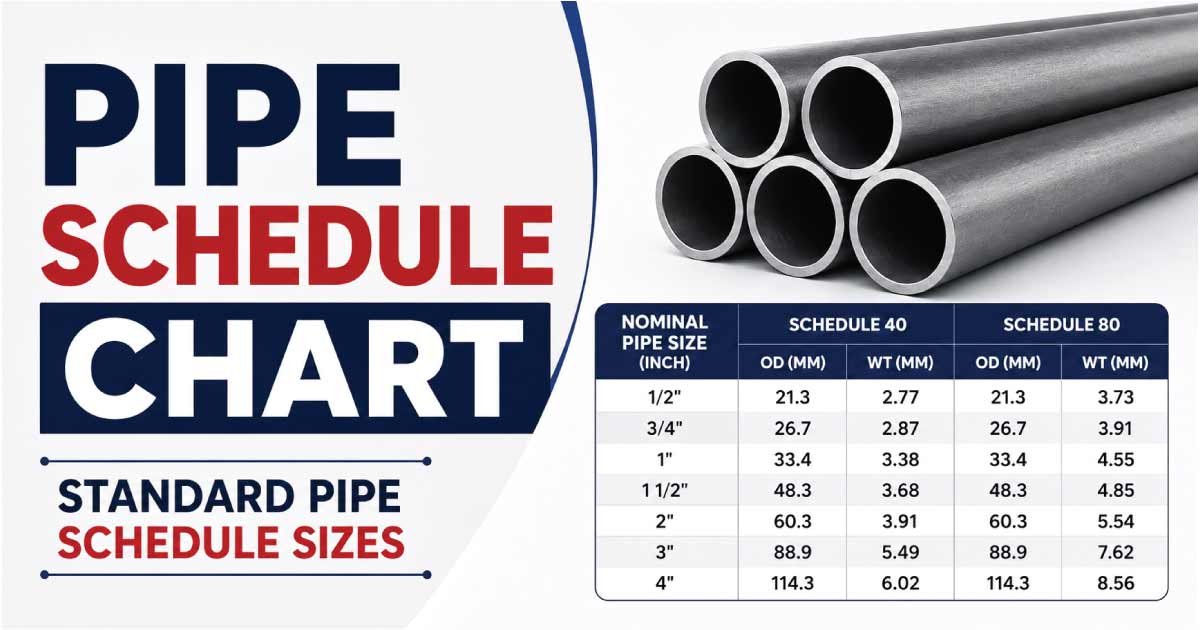
Pipe schedule is an important part of pipe sizing because it identifies the wall thickness of many standardized pipes. The nominal pipe size alone does not tell you the actual wall thickness or inside diameter. A single nominal pipe size can be manufactured with several different schedules, resulting in different internal diameters, weights, and pressure capabilities.
Understanding pipe schedules is useful when selecting pipes for plumbing, water systems, industrial piping, mechanical equipment, process systems, structural applications, and other installations.
This complete guide explains pipe schedules, Schedule 10, Schedule 40, Schedule 80, Schedule 160, XXS, wall thickness, inside diameter, outside diameter, and how to read a pipe schedule chart.
What Is Pipe Schedule?
Pipe schedule is a standardized designation used to identify the wall thickness of certain pipe sizes.
Common pipe schedules include:
- Schedule 5
- Schedule 10
- Schedule 20
- Schedule 30
- Schedule 40
- Schedule 60
- Schedule 80
- Schedule 100
- Schedule 120
- Schedule 140
- Schedule 160
There are also special designations such as STD, XS, and XXS for certain pipe sizes.
For a given nominal pipe size, a higher schedule generally means a thicker pipe wall.
For example, a 2-inch Schedule 80 pipe has a thicker wall than a 2-inch Schedule 40 pipe. The outside diameter remains the same for the same nominal pipe size, while the inside diameter becomes smaller.
Pipe Schedule Chart
The following chart provides common nominal pipe sizes and commonly encountered schedule wall thicknesses.
| NPS | OD | Schedule 10 | Schedule 40 | Schedule 80 |
|---|---|---|---|---|
| 1/2 | 21.3 mm | 2.11 mm | 2.77 mm | 3.73 mm |
| 3/4 | 26.7 mm | 2.11 mm | 2.87 mm | 3.91 mm |
| 1 | 33.4 mm | 2.77 mm | 3.38 mm | 4.55 mm |
| 1-1/4 | 42.2 mm | 2.77 mm | 3.56 mm | 4.85 mm |
| 1-1/2 | 48.3 mm | 2.77 mm | 3.68 mm | 5.08 mm |
| 2 | 60.3 mm | 2.77 mm | 3.91 mm | 5.54 mm |
| 2-1/2 | 73.0 mm | 3.05 mm | 5.16 mm | 7.01 mm |
| 3 | 88.9 mm | 3.05 mm | 5.49 mm | 7.62 mm |
| 4 | 114.3 mm | 3.05 mm | 6.02 mm | 8.56 mm |
| 5 | 141.3 mm | 3.40 mm | 6.55 mm | 9.53 mm |
| 6 | 168.3 mm | 3.40 mm | 7.11 mm | 10.97 mm |
| 8 | 219.1 mm | 3.76 mm | 8.18 mm | 12.70 mm |
| 10 | 273.1 mm | 4.19 mm | 9.27 mm | 15.09 mm |
| 12 | 323.9 mm | 4.57 mm | 9.53 mm | 17.48 mm |
These are common reference dimensions for standard steel pipe. Exact dimensions should be checked against the applicable piping standard and material specification.
What Does Schedule 40 Mean?
Schedule 40, often written SCH 40, is one of the most widely used pipe wall classifications.
Schedule 40 does not mean that the pipe wall is 40 mm thick or that it has a universal pressure rating of 40.
The actual wall thickness depends on the nominal pipe size.
For example:
- 1/2-inch Schedule 40 → approximately 2.77 mm wall
- 1-inch Schedule 40 → approximately 3.38 mm wall
- 2-inch Schedule 40 → approximately 3.91 mm wall
- 4-inch Schedule 40 → approximately 6.02 mm wall
- 6-inch Schedule 40 → approximately 7.11 mm wall
Therefore, Schedule 40 is a classification rather than a single wall thickness.
What Does Schedule 80 Mean?
Schedule 80, or SCH 80, generally indicates a thicker wall than Schedule 40 for the same nominal pipe size.
For example, a 2-inch pipe has an outside diameter of approximately 60.3 mm whether it is Schedule 40 or Schedule 80.
However:
- 2-inch Schedule 40 wall → approximately 3.91 mm
- 2-inch Schedule 80 wall → approximately 5.54 mm
The Schedule 80 pipe therefore has a smaller inside diameter.
Schedule 80 is often selected where the application requires greater wall thickness, mechanical durability, or a different pressure capability.
Schedule 10 vs. Schedule 40 vs. Schedule 80
The main difference between these schedules is wall thickness.
| Schedule | General Wall Thickness | Typical Use |
|---|---|---|
| Schedule 10 | Thin | Lower-weight applications and certain process systems |
| Schedule 40 | Medium | General-purpose piping |
| Schedule 80 | Thick | Higher wall thickness and demanding applications |
| Schedule 160 | Very thick | High-pressure or specialized applications |
The appropriate schedule should be selected according to the actual design requirements rather than assuming that the thickest pipe is always the best choice.
Schedule 40 Pipe Size Chart
| NPS | Outside Diameter | Wall Thickness | Approx. Inside Diameter |
|---|---|---|---|
| 1/2 | 21.3 mm | 2.77 mm | 15.76 mm |
| 3/4 | 26.7 mm | 2.87 mm | 20.96 mm |
| 1 | 33.4 mm | 3.38 mm | 26.64 mm |
| 1-1/4 | 42.2 mm | 3.56 mm | 35.08 mm |
| 1-1/2 | 48.3 mm | 3.68 mm | 40.94 mm |
| 2 | 60.3 mm | 3.91 mm | 52.48 mm |
| 2-1/2 | 73.0 mm | 5.16 mm | 62.68 mm |
| 3 | 88.9 mm | 5.49 mm | 77.92 mm |
| 4 | 114.3 mm | 6.02 mm | 102.26 mm |
| 5 | 141.3 mm | 6.55 mm | 128.20 mm |
| 6 | 168.3 mm | 7.11 mm | 154.08 mm |
| 8 | 219.1 mm | 8.18 mm | 202.74 mm |
| 10 | 273.1 mm | 9.27 mm | 254.56 mm |
| 12 | 323.9 mm | 9.53 mm | 304.84 mm |
The inside diameter values are calculated from nominal outside diameter and nominal wall thickness. Actual manufactured dimensions can vary within applicable tolerances.
Schedule 80 Pipe Size Chart
| NPS | Outside Diameter | Wall Thickness | Approx. Inside Diameter |
|---|---|---|---|
| 1/2 | 21.3 mm | 3.73 mm | 13.84 mm |
| 3/4 | 26.7 mm | 3.91 mm | 18.88 mm |
| 1 | 33.4 mm | 4.55 mm | 24.30 mm |
| 1-1/4 | 42.2 mm | 4.85 mm | 32.50 mm |
| 1-1/2 | 48.3 mm | 5.08 mm | 38.14 mm |
| 2 | 60.3 mm | 5.54 mm | 49.22 mm |
| 2-1/2 | 73.0 mm | 7.01 mm | 58.98 mm |
| 3 | 88.9 mm | 7.62 mm | 73.66 mm |
| 4 | 114.3 mm | 8.56 mm | 97.18 mm |
| 5 | 141.3 mm | 9.53 mm | 122.24 mm |
| 6 | 168.3 mm | 10.97 mm | 146.36 mm |
| 8 | 219.1 mm | 12.70 mm | 193.70 mm |
| 10 | 273.1 mm | 15.09 mm | 242.92 mm |
| 12 | 323.9 mm | 17.48 mm | 288.94 mm |
Schedule 80 generally provides a thicker wall and smaller internal diameter than Schedule 40 for the same nominal pipe size.
Schedule 10 Pipe Size Chart
Schedule 10 is generally a lighter-wall option than Schedule 40.
| NPS | Outside Diameter | Wall Thickness |
|---|---|---|
| 1/2 | 21.3 mm | 2.11 mm |
| 3/4 | 26.7 mm | 2.11 mm |
| 1 | 33.4 mm | 2.77 mm |
| 1-1/4 | 42.2 mm | 2.77 mm |
| 1-1/2 | 48.3 mm | 2.77 mm |
| 2 | 60.3 mm | 2.77 mm |
| 2-1/2 | 73.0 mm | 3.05 mm |
| 3 | 88.9 mm | 3.05 mm |
| 4 | 114.3 mm | 3.05 mm |
| 6 | 168.3 mm | 3.40 mm |
| 8 | 219.1 mm | 3.76 mm |
| 10 | 273.1 mm | 4.19 mm |
| 12 | 323.9 mm | 4.57 mm |
Schedule 10 can be useful where the design allows a thinner wall and lower material weight.
Also Read:
What Is Schedule 160 Pipe?
Schedule 160 is a very thick-wall pipe classification.
It is available for many smaller and medium nominal pipe sizes and can provide a substantial wall thickness compared with common schedules.
For example, a 2-inch Schedule 160 pipe has a much thicker wall than a 2-inch Schedule 40 pipe.
Because the wall is thicker, the internal diameter is smaller.
Schedule 160 is used in applications where the design requires the corresponding dimensions and pressure capability of the selected pipe material and specification.
The schedule itself should not be treated as a universal pressure rating.
What Are STD, XS, and XXS Pipe?
Some pipe specifications use terms other than numerical schedules.
STD Pipe
STD means Standard Weight.
It is a traditional designation for certain pipe wall thicknesses.
XS Pipe
XS means Extra Strong.
It indicates a heavier wall than standard-weight pipe for applicable sizes.
XXS Pipe
XXS means Double Extra Strong.
It represents a very heavy wall designation for applicable pipe sizes.
These traditional designations overlap with some schedule dimensions for certain sizes, but they should not be assumed to be identical across every nominal pipe size.
Pipe Schedule and Outside Diameter
One of the most important characteristics of standard pipe is that the outside diameter generally remains constant across different schedules for the same NPS.
For example, common 2-inch steel pipe has an outside diameter of approximately:
60.3 mm
This applies to different schedules, while the wall thickness changes.
For example:
| 2-Inch Pipe | Wall Thickness |
|---|---|
| Schedule 10 | 2.77 mm |
| Schedule 40 | 3.91 mm |
| Schedule 80 | 5.54 mm |
| Schedule 160 | Approximately 8.74 mm |
Therefore, the schedule changes the inside diameter rather than normally changing the nominal outside diameter.
Pipe Schedule and Inside Diameter
Inside diameter can be estimated using:
ID = OD − 2 × Wall Thickness
For a 2-inch Schedule 40 pipe:
60.3 − (2 × 3.91) = 52.48 mm
For a 2-inch Schedule 80 pipe:
60.3 − (2 × 5.54) = 49.22 mm
This difference can affect:
- Flow area
- Fluid velocity
- Pressure loss
- Pump requirements
- System capacity
Therefore, changing pipe schedule can affect hydraulic performance even when the nominal pipe size remains unchanged.
Does a Higher Pipe Schedule Mean Higher Pressure?
Generally, a thicker pipe wall can provide greater pressure capability, but pipe schedule alone is not a pressure rating.
The allowable pressure depends on factors such as:
- Pipe material
- Yield strength
- Tensile strength
- Operating temperature
- Wall thickness
- Outside diameter
- Corrosion allowance
- Manufacturing standard
- Joint efficiency
- Design code
For example, Schedule 40 carbon steel pipe and Schedule 40 stainless steel pipe should not automatically be assumed to have identical pressure ratings.
Always use the applicable engineering calculation or manufacturer’s pressure-rating information.
Also Read:
Pipe Schedule and Weight
A higher schedule generally means more material and therefore greater pipe weight per unit length.
For the same nominal size:
Schedule 80 > Schedule 40 > Schedule 10
in terms of wall thickness and generally weight per unit length.
The heavier pipe can increase:
- Material cost
- Transportation cost
- Handling requirements
- Support requirements
- Installation effort
However, a thicker pipe may be necessary for the intended operating conditions.
Pipe Schedule and Flow Capacity
Because higher schedules generally have thicker walls, the internal diameter becomes smaller.
For the same NPS:
Higher schedule → thicker wall → smaller ID → smaller flow area
For systems transporting liquids or gases, this can increase flow resistance and pressure loss.
Pipe sizing should therefore consider both mechanical requirements and hydraulic requirements.
A Schedule 80 pipe may be mechanically appropriate but hydraulically less favorable than a Schedule 40 pipe of the same nominal size if the system does not require the additional wall thickness.
Pipe Schedule vs. Pipe Class
Pipe schedule and pipe class are different concepts.
Pipe Schedule
Schedule primarily describes the wall thickness for applicable standardized pipe dimensions.
Pipe Class
A piping class or pressure class can define a broader collection of requirements, including:
- Materials
- Pressure-temperature ratings
- Valves
- Flanges
- Fittings
- Gaskets
- Bolting
- Construction requirements
Do not confuse a pipe schedule with a flange pressure class or valve pressure class.
Pipe Schedule vs. Pressure Rating
A pipe schedule should not be used by itself to determine the maximum safe working pressure.
For example, saying that a pipe is Schedule 80 does not provide enough information to calculate its safe operating pressure.
You also need to know:
- Pipe material
- Grade
- Temperature
- Actual dimensions
- Applicable design standard
- Corrosion allowance
- Joint configuration
- Design safety requirements
For critical systems, pressure calculations should be performed according to the applicable piping code.
How to Read a Pipe Schedule Chart
A pipe schedule chart usually contains several columns.
For example:
| NPS | OD | Schedule | Wall | ID |
|---|---|---|---|---|
| 2 in | 60.3 mm | 40 | 3.91 mm | 52.48 mm |
This tells you:
- Nominal size = 2 inches
- Outside diameter = 60.3 mm
- Schedule = 40
- Wall thickness = 3.91 mm
- Approximate inside diameter = 52.48 mm
This information is much more useful than simply knowing that the pipe is called “2-inch pipe.”
Also Read:
How to Identify Pipe Schedule
If you need to identify the schedule of an existing pipe, start by looking for markings printed or stamped on the pipe.
Possible markings may include:
- NPS
- Schedule
- Pipe standard
- Material grade
- Manufacturer
- Heat number
- Pressure specification
If no marking is available, measure:
- Outside diameter
- Wall thickness
- Pipe material
- Nominal size
Then compare the measurements with a recognized dimensional standard.
For accurate identification, wall thickness should ideally be measured using an appropriate instrument because corrosion, coating, manufacturing tolerances, and surface condition can affect measurements.
How to Calculate Pipe Inside Diameter
If the outside diameter and wall thickness are known, the approximate inside diameter can be calculated as:
Inside Diameter = Outside Diameter − 2 × Wall Thickness
For example:
OD = 114.3 mm
Wall = 6.02 mm
Therefore:
114.3 − 12.04 = 102.26 mm
The calculated value represents the nominal internal diameter based on the nominal dimensions.
Actual pipe dimensions can vary according to manufacturing tolerances.
Common Pipe Schedule Mistakes
Assuming Schedule 40 Means 40 mm Wall
It does not. Schedule 40 is a standardized designation, not a wall thickness measurement.
Assuming All Schedule 40 Pipes Have the Same Wall Thickness
Wall thickness changes with nominal pipe size.
Assuming Higher Schedule Means Higher Flow
The opposite can occur because a thicker wall reduces internal diameter.
Using Schedule as a Pressure Rating
Schedule alone does not determine allowable working pressure.
Ignoring Pipe Material
Pressure capability depends heavily on material and temperature.
Confusing OD With Nominal Size
A 2-inch NPS pipe has an outside diameter of approximately 60.3 mm, not 50.8 mm.
How to Choose the Correct Pipe Schedule
Selecting a pipe schedule requires consideration of both mechanical and flow requirements.
Check:
- Nominal pipe size
- Outside diameter
- Required inside diameter
- Wall thickness
- Operating pressure
- Operating temperature
- Pipe material
- Corrosion allowance
- Fluid characteristics
- Flow requirements
- Applicable piping code
- Fitting and valve compatibility
For residential plumbing, follow the applicable plumbing code and manufacturer’s requirements. Industrial piping should be selected according to the relevant engineering specifications and piping standards.
Quick Pipe Schedule Comparison
| NPS | OD | SCH 10 Wall | SCH 40 Wall | SCH 80 Wall |
|---|---|---|---|---|
| 1/2 | 21.3 mm | 2.11 mm | 2.77 mm | 3.73 mm |
| 3/4 | 26.7 mm | 2.11 mm | 2.87 mm | 3.91 mm |
| 1 | 33.4 mm | 2.77 mm | 3.38 mm | 4.55 mm |
| 1-1/2 | 48.3 mm | 2.77 mm | 3.68 mm | 5.08 mm |
| 2 | 60.3 mm | 2.77 mm | 3.91 mm | 5.54 mm |
| 3 | 88.9 mm | 3.05 mm | 5.49 mm | 7.62 mm |
| 4 | 114.3 mm | 3.05 mm | 6.02 mm | 8.56 mm |
| 6 | 168.3 mm | 3.40 mm | 7.11 mm | 10.97 mm |
| 8 | 219.1 mm | 3.76 mm | 8.18 mm | 12.70 mm |
| 10 | 273.1 mm | 4.19 mm | 9.27 mm | 15.09 mm |
| 12 | 323.9 mm | 4.57 mm | 9.53 mm | 17.48 mm |
Frequently Asked Questions About Pipe Schedules
What does pipe schedule mean?
Pipe schedule is a standardized designation associated with pipe wall thickness for applicable nominal pipe sizes.
What is Schedule 40 pipe?
Schedule 40 is a common standard wall classification used for many types of pipe. Its actual wall thickness varies according to nominal pipe size.
Is Schedule 80 thicker than Schedule 40?
Yes. For the same nominal pipe size, Schedule 80 generally has a thicker wall than Schedule 40.
Does Schedule 80 have the same outside diameter as Schedule 40?
For the same NPS, standard steel pipe schedules generally use the same nominal outside diameter while changing wall thickness.
Does a higher schedule mean a higher pressure rating?
Not by itself. Pressure capability depends on material, temperature, dimensions, design standard, and other factors.
Does Schedule 80 reduce flow?
For the same nominal pipe size, Schedule 80 has a thicker wall and therefore a smaller internal diameter than Schedule 40. This can reduce flow area and increase pressure loss under the same conditions.
What is the difference between Schedule 10 and Schedule 40?
Schedule 10 generally has a thinner wall than Schedule 40 for the same nominal size.
What is the difference between Schedule 40 and Schedule 80?
Schedule 80 generally has a thicker wall, smaller inside diameter, and greater weight than Schedule 40 of the same nominal size.
What does SCH mean on pipe?
SCH is an abbreviation for schedule. For example, SCH 40 means Schedule 40.
How do I find the pipe schedule?
Check the pipe markings first. If the schedule is not marked, measure the outside diameter and wall thickness and compare the results with the applicable pipe dimensional standard.
Final Thoughts on Pipe Schedule
Pipe schedule is an important part of understanding pipe dimensions, but it should not be confused with nominal size, wall thickness, or pressure rating.
For a given nominal pipe size, different schedules generally have the same outside diameter but different wall thicknesses. A higher schedule usually means a thicker wall and smaller internal diameter.
The most commonly encountered schedules include Schedule 10, Schedule 40, and Schedule 80, while heavier classifications such as Schedule 160, XS, and XXS are used for specific applications and pipe sizes.
When selecting pipe, consider the complete system rather than choosing a schedule based only on pressure or wall thickness. The correct selection depends on pipe size, material, wall thickness, pressure, temperature, flow requirements, corrosion allowance, fittings, and applicable standards.
For accurate engineering or safety-critical applications, always verify pipe dimensions and allowable pressure using the relevant standard and manufacturer’s technical data.