
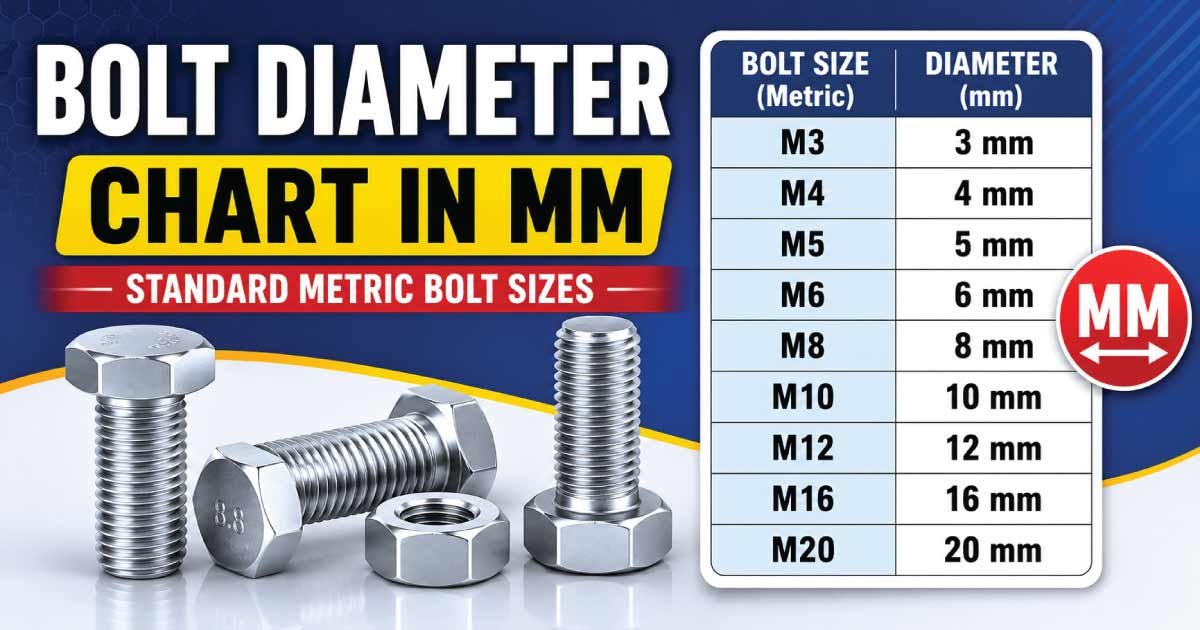
Understanding bolt diameter is essential when selecting the correct fastener for construction, automotive repairs, machinery, fabrication, furniture, equipment, and general mechanical applications. The diameter determines the basic size of the bolt and must match the corresponding nut, threaded hole, washer, and application requirements.
Bolt diameters are commonly specified in millimeters for metric fasteners and in inches or fractional sizes for imperial fasteners. When working with metric bolts, the diameter is usually identified by the letter M followed by the nominal diameter.
For example, an M10 bolt has a nominal diameter of 10 mm.
This complete guide explains bolt diameter, nominal diameter, actual measurements, common metric bolt diameters, metric-to-inch comparisons, thread pitch, how to measure a bolt, and how to select the correct diameter.
What Is Bolt Diameter?
Bolt diameter is the nominal measurement used to identify the size of a threaded bolt.
For a metric bolt, the designation normally begins with M followed by the nominal diameter.
Examples include:
- M4 = 4 mm nominal diameter
- M5 = 5 mm nominal diameter
- M6 = 6 mm nominal diameter
- M8 = 8 mm nominal diameter
- M10 = 10 mm nominal diameter
- M12 = 12 mm nominal diameter
- M16 = 16 mm nominal diameter
- M20 = 20 mm nominal diameter
The nominal diameter generally corresponds to the approximate major diameter of the external thread.
The actual measured diameter can be slightly different because of manufacturing tolerances and the specific thread class.
Bolt Diameter Chart in mm
The following chart provides common metric bolt diameters.
| Bolt Size | Nominal Diameter | Common Coarse Pitch |
|---|---|---|
| M3 | 3 mm | 0.50 mm |
| M4 | 4 mm | 0.70 mm |
| M5 | 5 mm | 0.80 mm |
| M6 | 6 mm | 1.00 mm |
| M7 | 7 mm | 1.00 mm |
| M8 | 8 mm | 1.25 mm |
| M10 | 10 mm | 1.50 mm |
| M12 | 12 mm | 1.75 mm |
| M14 | 14 mm | 2.00 mm |
| M16 | 16 mm | 2.00 mm |
| M18 | 18 mm | 2.50 mm |
| M20 | 20 mm | 2.50 mm |
| M22 | 22 mm | 2.50 mm |
| M24 | 24 mm | 3.00 mm |
| M27 | 27 mm | 3.00 mm |
| M30 | 30 mm | 3.50 mm |
| M33 | 33 mm | 3.50 mm |
| M36 | 36 mm | 4.00 mm |
| M39 | 39 mm | 4.00 mm |
| M42 | 42 mm | 4.50 mm |
| M45 | 45 mm | 4.50 mm |
| M48 | 48 mm | 5.00 mm |
| M52 | 52 mm | 5.00 mm |
| M56 | 56 mm | 5.50 mm |
| M60 | 60 mm | 5.50 mm |
| M64 | 64 mm | 6.00 mm |
The pitch column shows common coarse pitches. Many metric diameters are also available with fine and extra-fine pitches.
Common Bolt Diameter Sizes
Some metric bolt diameters are encountered much more frequently than others.
M4 Bolt
An M4 bolt has a nominal diameter of 4 mm and is commonly used for small mechanical components, equipment, electronics, brackets, and light assemblies.
M5 Bolt
M5 bolts have a nominal diameter of 5 mm and are used in equipment, machinery, brackets, panels, and general hardware.
M6 Bolt
M6 is a common small-to-medium metric fastener size used in machinery, automotive components, equipment, furniture, and fabrication.
M8 Bolt
M8 bolts have an 8 mm nominal diameter and are widely used for machinery, mounting brackets, automotive applications, equipment, and general construction.
M10 Bolt
M10 is a common medium-size fastener used in machinery, automotive systems, structural components, brackets, and mechanical assemblies.
M12 Bolt
M12 bolts are commonly used where greater fastening capacity is required, including machinery, automotive components, structural assemblies, and heavy-duty equipment.
M16 and Larger Bolts
M16, M20, M24, M30, and larger bolts are frequently used in heavy machinery, structural steelwork, industrial equipment, large mechanical assemblies, and high-load applications.
Bolt Diameter vs. Bolt Size
The terms bolt diameter and bolt size are sometimes used interchangeably, but they can refer to different characteristics.
For example, an M10 × 60 bolt has:
- Diameter = 10 mm
- Length = 60 mm
Therefore, M10 identifies the nominal diameter, while 60 mm identifies the nominal length.
A complete bolt specification may also include:
- Thread pitch
- Length
- Head style
- Material
- Grade or property class
- Finish
- Thread length
For example:
M10 × 1.5 × 60
means a 10 mm nominal diameter, 1.5 mm pitch, and 60 mm nominal length.
How Bolt Diameter Is Measured
Measuring bolt diameter is relatively straightforward.
Step 1: Use a Caliper
Place the caliper across the threaded portion of the bolt.
Measure across the thread crests rather than the valleys.
Step 2: Record the Measurement
If the measurement is close to 8 mm, the bolt may be an M8.
If it is close to 10 mm, it may be an M10.
Step 3: Measure the Thread Pitch
Diameter alone does not completely identify a metric bolt.
Use a thread pitch gauge or carefully measure the distance between adjacent thread crests.
Step 4: Compare With a Standard
Compare the measured diameter and pitch with a recognized metric thread specification.
Also Read:
Nominal Diameter vs. Actual Bolt Diameter
A bolt marked M10 is specified as having a 10 mm nominal diameter, but a measurement with a caliper may not produce exactly 10.000 mm.
Manufacturing tolerances and thread tolerances affect the actual measured major diameter.
The same principle applies to other metric bolt sizes.
Therefore, a measurement such as 9.8 mm or slightly above or below 10 mm does not automatically mean that the bolt is not an M10.
For accurate identification, consider both diameter and thread pitch.
Metric Bolt Diameter Chart From M3 to M30
| Metric Bolt | Diameter (mm) | Common Coarse Pitch |
|---|---|---|
| M3 | 3 | 0.50 |
| M4 | 4 | 0.70 |
| M5 | 5 | 0.80 |
| M6 | 6 | 1.00 |
| M7 | 7 | 1.00 |
| M8 | 8 | 1.25 |
| M10 | 10 | 1.50 |
| M12 | 12 | 1.75 |
| M14 | 14 | 2.00 |
| M16 | 16 | 2.00 |
| M18 | 18 | 2.50 |
| M20 | 20 | 2.50 |
| M22 | 22 | 2.50 |
| M24 | 24 | 3.00 |
| M27 | 27 | 3.00 |
| M30 | 30 | 3.50 |
This is a useful quick-reference table for common metric fasteners.
Metric Bolt Diameter to Inch Conversion
Metric bolt diameters can be converted to inches using:
1 inch = 25.4 mm
Therefore:
Diameter in inches = Diameter in mm ÷ 25.4
Common conversions include:
| Metric Diameter | Inches |
|---|---|
| 3 mm | 0.1181 in |
| 4 mm | 0.1575 in |
| 5 mm | 0.1969 in |
| 6 mm | 0.2362 in |
| 8 mm | 0.3150 in |
| 10 mm | 0.3937 in |
| 12 mm | 0.4724 in |
| 14 mm | 0.5512 in |
| 16 mm | 0.6299 in |
| 18 mm | 0.7087 in |
| 20 mm | 0.7874 in |
| 22 mm | 0.8661 in |
| 24 mm | 0.9449 in |
| 25 mm | 0.9843 in |
| 30 mm | 1.1811 in |
| 36 mm | 1.4173 in |
| 40 mm | 1.5748 in |
| 50 mm | 1.9685 in |
These are mathematical conversions and should not be interpreted as indicating that the metric bolt is interchangeable with an imperial bolt of a similar diameter.
Metric Bolt Diameter vs. Imperial Bolt Diameter
Metric and imperial fasteners can have similar diameters.
For example:
- M6 = 6.00 mm
- 1/4 inch = 6.35 mm
- M8 = 8.00 mm
- 5/16 inch = 7.94 mm
- M10 = 10.00 mm
- 3/8 inch = 9.53 mm
- M12 = 12.00 mm
- 1/2 inch = 12.70 mm
These similarities can cause confusion.
However, diameter alone does not determine thread compatibility. Thread pitch, threads per inch, thread form, and other specifications must also match.
A metric nut should not be forced onto an imperial bolt simply because their diameters appear close.
Also Read:
Bolt Diameter and Thread Pitch
Bolt diameter and thread pitch are two separate measurements.
Diameter describes the nominal size of the bolt.
Pitch describes the distance between adjacent threads.
For example:
M12 × 1.75
means:
- Nominal diameter = 12 mm
- Thread pitch = 1.75 mm
An M12 bolt can also be manufactured with a different pitch, such as a fine pitch.
Therefore, identifying a bolt as simply “M12” may not provide enough information for selecting a matching nut.
Coarse vs. Fine Metric Bolt Threads
Metric bolts are available in coarse and fine thread versions.
Coarse Threads
Coarse threads have a larger pitch.
Common advantages include:
- Faster assembly
- Easier starting
- Better tolerance of minor contamination
- Reduced sensitivity to minor thread damage
- Good general-purpose performance
Fine Threads
Fine threads have a smaller pitch.
They can provide:
- More threads per unit length
- Greater adjustment precision
- Potentially improved resistance to loosening in some applications
- Suitability for certain thin-section or specialized applications
The correct choice depends on the application and engineering requirements.
Bolt Diameter and Tensile Strength
Bolt diameter is an important factor in determining a fastener’s load capacity, but diameter alone does not determine bolt strength.
Strength also depends on:
- Material
- Property class
- Tensile strength
- Yield strength
- Thread size
- Thread engagement
- Loading conditions
- Installation torque
- Joint design
For example, an M10 bolt made from a high-strength material can have significantly different mechanical properties from an M10 bolt made from a lower-strength material.
Therefore, do not select a bolt based solely on diameter when designing a load-bearing joint.
Bolt Diameter and Tensile Stress Area
For threaded fasteners, the tensile load capacity is related to the tensile stress area, not simply the full nominal cross-sectional area of the unthreaded shaft.
The threads reduce the effective load-bearing cross-sectional area.
This is why engineering fastener calculations use standardized tensile stress-area values.
For critical connections, use the applicable fastener standard and engineering calculations rather than estimating strength from nominal diameter alone.
Bolt Diameter and Nut Compatibility
A nut must match the bolt’s complete thread specification.
For example, an M10 nut must be compatible with the specific M10 thread pitch.
An M10 × 1.5 bolt and an M10 × 1.25 bolt have the same nominal diameter but different pitches.
The wrong nut may start incorrectly, bind, or damage the threads.
Always verify:
- Diameter
- Pitch
- Thread series
- Thread direction
- Applicable standard
Bolt Diameter and Washer Size
Washers are also available in different sizes.
A washer designed for an M10 bolt typically has a hole suitable for that fastener, but the exact inside diameter, outside diameter, and thickness depend on the washer standard.
The washer should provide suitable bearing area beneath the bolt head or nut.
For structural or engineered connections, use the specified washer type and dimensions.
Bolt Diameter Chart for Common Applications
| Bolt Diameter | Common Examples of Use |
|---|---|
| M3 | Electronics, small equipment |
| M4 | Small machinery and brackets |
| M5 | Equipment, panels, hardware |
| M6 | Machinery, automotive, furniture |
| M8 | Machinery, brackets, automotive |
| M10 | Mechanical assemblies, equipment |
| M12 | Heavy equipment, machinery |
| M14 | Automotive and industrial applications |
| M16 | Structural and heavy machinery |
| M20 | Heavy machinery and structural work |
| M24 | Structural and industrial applications |
| M30 | Heavy structural and mechanical applications |
Actual fastener selection should always be based on the engineering requirements of the specific application.
Also Read:
How to Identify an Unknown Bolt Diameter
If the bolt has no visible marking, follow a simple identification process.
1. Measure the Threaded Diameter
Use a caliper to measure across the thread crests.
2. Compare the Measurement
Determine which nominal metric diameter is closest.
3. Measure Thread Pitch
Use a metric thread pitch gauge.
4. Check the Bolt Head
Metric bolts often have property-class markings on the head. These markings can help identify mechanical strength but do not replace dimensional measurements.
5. Test the Matching Nut Carefully
If you have a known matching nut, it can help confirm the thread. Never force a nut onto an uncertain thread.
Common Bolt Diameter Mistakes
Measuring the Bolt Head
Bolt diameter refers to the shaft/thread diameter, not the width across the bolt head.
Ignoring Thread Pitch
Two bolts can have the same diameter but different pitches.
Confusing Metric and Imperial Sizes
M8 and 5/16-inch bolts are close in diameter but are not automatically interchangeable.
Assuming Every M10 Bolt Has the Same Pitch
M10 is a diameter designation. Different thread pitches are available.
Choosing Diameter Without Considering Strength
The correct bolt diameter must also meet the load and joint requirements.
Forcing an Incorrect Nut
Cross-threading can damage both the bolt and nut.
How to Choose the Correct Bolt Diameter
When selecting a bolt for an existing application, first determine the required diameter.
Consider:
- Hole diameter
- Required clamping force
- Applied load
- Bolt material
- Property class
- Thread pitch
- Thread engagement
- Bolt length
- Washer requirements
- Nut compatibility
- Operating environment
- Applicable engineering standard
For critical structural, automotive, pressure, or safety-related applications, follow the specified fastener grade and engineering requirements.
Bolt Diameter Chart: Quick Reference
| Bolt | Diameter mm | Common Pitch mm |
|---|---|---|
| M4 | 4 | 0.70 |
| M5 | 5 | 0.80 |
| M6 | 6 | 1.00 |
| M8 | 8 | 1.25 |
| M10 | 10 | 1.50 |
| M12 | 12 | 1.75 |
| M14 | 14 | 2.00 |
| M16 | 16 | 2.00 |
| M18 | 18 | 2.50 |
| M20 | 20 | 2.50 |
| M22 | 22 | 2.50 |
| M24 | 24 | 3.00 |
| M27 | 27 | 3.00 |
| M30 | 30 | 3.50 |
| M36 | 36 | 4.00 |
| M42 | 42 | 4.50 |
| M48 | 48 | 5.00 |
| M52 | 52 | 5.00 |
| M60 | 60 | 5.50 |
Frequently Asked Questions About Bolt Diameter
What is the diameter of an M8 bolt?
An M8 bolt has a nominal diameter of 8 mm.
What is the diameter of an M10 bolt?
An M10 bolt has a nominal diameter of 10 mm.
What is the diameter of an M12 bolt?
An M12 bolt has a nominal diameter of 12 mm.
What does M10 mean on a bolt?
M10 identifies a metric bolt with a nominal thread diameter of 10 mm. The complete specification may also need the thread pitch and length.
How do I measure bolt diameter in mm?
Use a caliper to measure across the threaded portion of the bolt, preferably across the thread crests.
Is M8 the same as 5/16 inch?
No. M8 is 8 mm, while 5/16 inch is approximately 7.94 mm. Their thread pitches can also differ, so they should not automatically be substituted.
Is M10 the same as 3/8 inch?
No. M10 is 10 mm, while 3/8 inch is approximately 9.53 mm. They use different metric and imperial thread systems.
What is the most common metric bolt diameter?
M6, M8, M10, and M12 are among the commonly encountered metric bolt diameters, although the most appropriate size depends on the application.
Does bolt diameter determine bolt strength?
Diameter is an important factor, but strength also depends on material, property class, thread geometry, engagement, loading, and joint design.
Does M12 mean the bolt is 12 mm long?
No. M12 refers to the nominal diameter, not the length. An M12 bolt can have many different lengths.
Final Thoughts on Bolt Diameter
Bolt diameter is one of the most important dimensions when selecting a metric fastener. Common sizes range from small bolts such as M3 and M4 to larger industrial fasteners such as M24, M30, M36, M48, and beyond.
Remember that the diameter designation does not provide the complete bolt specification. A bolt such as M10 × 1.5 × 60 provides three important dimensions: 10 mm nominal diameter, 1.5 mm thread pitch, and 60 mm length.
When identifying an existing bolt, measure the threaded diameter and determine the thread pitch rather than relying on diameter alone. Also check whether the fastener is metric or imperial before selecting a replacement nut.
For general reference, the most important metric bolt diameters are M4, M5, M6, M8, M10, M12, M14, M16, M18, M20, M22, M24, and M30.
For structural, automotive, industrial, or safety-critical applications, always verify the required diameter, thread specification, material, property class, and applicable standard before installing or replacing a bolt.