
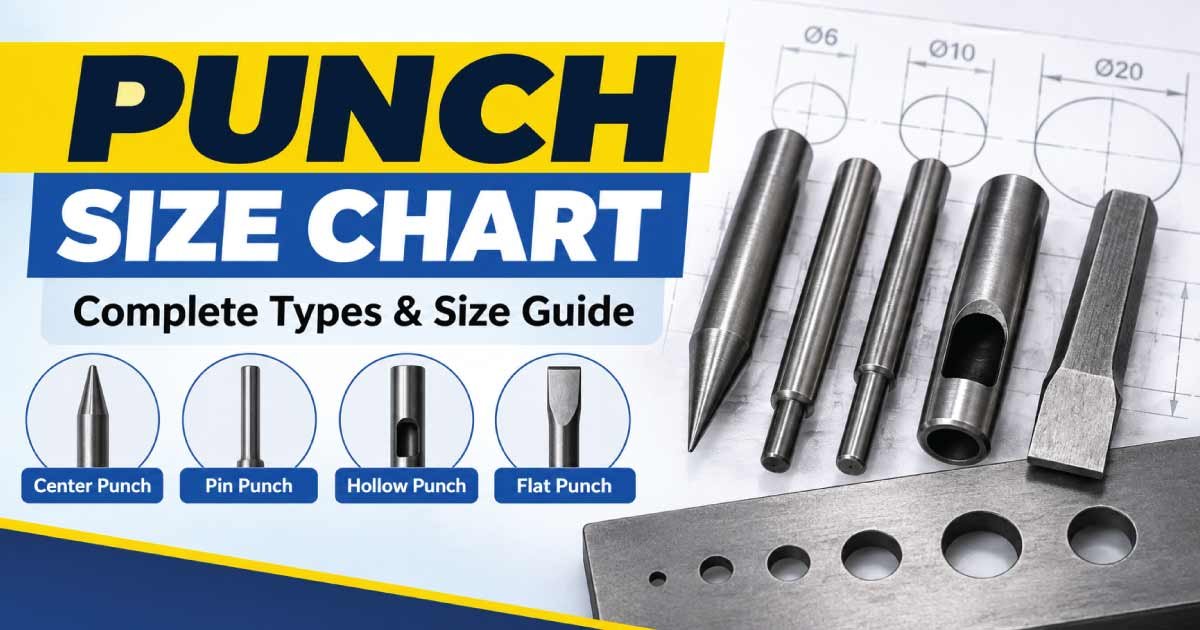
Choosing the right punch size is important when you need to create a precise hole, mark a location, remove a pin, or transfer an existing hole pattern. A punch size chart makes it easier to compare punch diameters and select the appropriate tool for the job.
The word “punch” covers several different tools. Hole punches, hollow punches, leather punches, pin punches, center punches, transfer punches, and drift punches all serve different purposes, so their sizing systems cannot always be compared directly.
This guide explains the most common punch types, how punch sizes are measured, common diameter ranges, metric and inch conversions, and how to choose the correct punch for different materials and applications. Because manufacturers use different dimensions and tool designs, always verify exact specifications before purchasing or using a punch for precision work.
What Is a Punch?
A punch is a hand tool or machine tool designed to mark, pierce, cut, drive, remove, or shape material. Depending on its design, the working end may be pointed, cylindrical, hollow, flat, or specially shaped.
Punches are widely used in:
- Metalworking
- Automotive repair
- Machinery maintenance
- Leatherworking
- Electrical work
- Sheet-metal fabrication
- Woodworking
- Jewelry making
- General DIY projects
- Mechanical assembly and disassembly
The required punch size depends on the task. A leather hole punch, for example, is normally identified by the diameter of the hole it cuts, while a pin punch is generally identified by the diameter of its shaft or working end.
That distinction is important when reading a punch size chart.
Why Punch Size Matters
Using the wrong size can produce an oversized hole, damage the workpiece, distort a component, or make removal and assembly more difficult.
For precision work, consider both the punch diameter and the geometry of its working end rather than selecting a tool based only on its overall length.
Common Types of Punches
There is no single universal punch-size system. Different punch designs are intended for different operations.
Hole Punches
Hole punches create round openings in materials such as leather, rubber, fabric, gasket material, plastic, and thin sheet materials.
They are commonly available as:
- Hand-held plier-style punches
- Revolving punches
- Single-hole punches
- Hollow punches
- Drive punches
- Punch-and-die sets
Hole punch size normally refers to the diameter of the resulting hole.
Hollow Punches
A hollow punch has a sharpened circular cutting edge. It cuts a clean circular hole when struck with a suitable mallet or used with an appropriate press.
Hollow punches are frequently used for:
- Gaskets
- Leather
- Rubber
- Cork
- Fiber
- Plastic
- Thin sheet materials
Because the cutting edge is exposed, correct support and technique are important.
Pin Punches
Pin punches are designed primarily for driving pins, shafts, and similar components after the initial movement has been started.
Unlike a cutting punch, a pin punch normally has a flat or slightly shaped working end rather than a sharpened cutting edge.
Pin punch sizes are commonly specified by the diameter of the working shaft.
Center Punches
A center punch creates a small indentation in metal or another suitable material. The indentation helps position a drill bit and reduces the tendency of the bit to wander.
Center punches generally have a pointed working end rather than a cutting diameter intended to produce a finished hole.
Transfer Punches
A transfer punch is used to transfer the location of an existing hole onto another workpiece. It has a long, tapered body with a pointed end.
These tools are particularly useful when:
- Aligning mounting holes
- Transferring patterns
- Marking hole centers
- Fabricating brackets
- Reproducing existing hole locations
The size of a transfer punch generally relates to the body or tip dimensions, so manufacturer specifications should be checked carefully.
Punch Size Chart by Type
Because different punch types are measured differently, the following chart provides a practical overview rather than suggesting that all punch diameters are interchangeable.
| Punch Type | Typical Size Description | Primary Function |
|---|---|---|
| Hole punch | Hole diameter | Cutting round holes |
| Hollow punch | Cutting diameter | Cutting clean holes |
| Leather punch | Hole diameter | Leather and soft materials |
| Pin punch | Working diameter | Driving pins |
| Center punch | Tip geometry | Marking drill locations |
| Transfer punch | Body/tip dimensions | Transferring hole locations |
| Drift punch | Working diameter | Aligning or removing parts |
| Prick punch | Point size | Fine marking |
| Automatic center punch | Tip diameter/geometry | Impact marking |
This distinction is essential: a 6 mm hole punch and a 6 mm pin punch are not necessarily equivalent tools, even though both may be described using a 6 mm dimension.
Common Hole Punch Size Chart
Hole and leather punches are often selected according to the diameter of the hole required.
The following sizes are common examples used in general-purpose punch sets.
| Punch Size (mm) | Approx. Size (in.) | Typical Application |
|---|---|---|
| 1.0 mm | 0.0394 in | Small holes |
| 1.5 mm | 0.0591 in | Fine leatherwork |
| 2.0 mm | 0.0787 in | Small fasteners |
| 2.5 mm | 0.0984 in | Leather and crafts |
| 3.0 mm | 0.1181 in | Small hardware |
| 3.5 mm | 0.1378 in | General leatherwork |
| 4.0 mm | 0.1575 in | Rivets and hardware |
| 5.0 mm | 0.1969 in | General-purpose holes |
| 6.0 mm | 0.2362 in | Larger hardware |
| 7.0 mm | 0.2756 in | Strap and material holes |
| 8.0 mm | 0.3150 in | Larger fasteners |
| 10.0 mm | 0.3937 in | Large round openings |
| 12.0 mm | 0.4724 in | Larger applications |
These are diameter references, not universal manufacturer specifications. Actual commercially available sizes vary by punch type and manufacturer.
Fractional Punch Size Chart
Some punches are specified in fractional inches, particularly tools intended for inch-based workshop applications.
| Fractional Size | Decimal Inch | Approx. Metric |
|---|---|---|
| 1/16 in | 0.0625 | 1.59 mm |
| 3/32 in | 0.0938 | 2.38 mm |
| 1/8 in | 0.1250 | 3.18 mm |
| 5/32 in | 0.1563 | 3.97 mm |
| 3/16 in | 0.1875 | 4.76 mm |
| 7/32 in | 0.2188 | 5.56 mm |
| 1/4 in | 0.2500 | 6.35 mm |
| 5/16 in | 0.3125 | 7.94 mm |
| 3/8 in | 0.3750 | 9.53 mm |
| 7/16 in | 0.4375 | 11.11 mm |
| 1/2 in | 0.5000 | 12.70 mm |
| 5/8 in | 0.6250 | 15.88 mm |
| 3/4 in | 0.7500 | 19.05 mm |
| 7/8 in | 0.8750 | 22.23 mm |
| 1 in | 1.0000 | 25.40 mm |
The metric values are mathematical conversions. A metric punch close to an imperial size should not automatically be treated as an exact replacement.
Punch Size Conversion: Metric to Inches
Converting punch sizes is straightforward when the dimension is given as a diameter.
Use:
Inches = millimeters ÷ 25.4
For example, a 10 mm punch converts to:
10 ÷ 25.4 = 0.3937 inch
To convert inches to millimeters:
Millimeters = inches × 25.4
For example, a 1/4-inch punch converts to:
0.250 × 25.4 = 6.35 mm
These calculations provide exact mathematical conversions, but commercially available punch sizes may not correspond exactly to the converted value.
Why Close Sizes May Not Be Interchangeable
Suppose you need a 6 mm hole. A 1/4-inch punch produces a nominal diameter of 6.35 mm.
The difference is only 0.35 mm, but that can be significant when the hole is intended for a particular rivet, grommet, fastener, or component.
For precision applications, use the specified diameter rather than simply choosing the closest size.
How Punch Sizes Are Measured
The measurement method depends on the punch design.
Measuring a Hole Punch
For a hole punch, the important dimension is normally the cutting diameter.
You can identify it by:
- Checking the marking on the punch.
- Checking the manufacturer’s specifications.
- Measuring the cutting edge with suitable measuring equipment.
- Measuring a test hole when appropriate.
For a sharpened hollow punch, measuring the outside diameter alone may not tell you the exact finished-hole diameter because wall thickness and cutting geometry also matter.
Measuring a Pin Punch
For a pin punch, measure the working shaft diameter rather than the handle.
A digital caliper can provide a useful general measurement, but precision applications may require more accurate measuring equipment.
Measuring a Center Punch
Center punches are not normally selected by a simple hole diameter. The important characteristics can include:
- Tip geometry
- Point angle
- Tip diameter
- Overall dimensions
- Adjustment mechanism on automatic models
The intended marking operation should determine the appropriate tool.
How to Choose the Right Punch Size
The best punch depends on the material, operation, and required result.
1. Determine What You Need the Punch to Do
Start by identifying the operation:
- Cutting a hole
- Marking a center
- Driving a pin
- Removing a component
- Aligning holes
- Transferring a hole pattern
This immediately narrows the correct punch category.
2. Measure the Required Diameter
If you need to create a hole, determine the required finished diameter before selecting the punch.
For example, if a grommet requires a specific opening, use the manufacturer’s recommended hole diameter rather than guessing from the outside diameter of the grommet.
3. Consider Material Thickness
Material thickness affects the appropriate punch design.
Thin leather, rubber, gasket material, and sheet stock may require a cutting punch. A thick or hard material may require a different tool or a press-based operation.
Never assume that a punch suitable for soft material is appropriate for hardened steel or another material beyond its intended use.
4. Match the Punch to the Material
Consider whether you are working with:
- Leather
- Rubber
- Plastic
- Gasket material
- Sheet metal
- Wood
- Steel components
- Aluminum
The material’s hardness, thickness, and construction all affect the tool choice.
Also Read:
Leather Punch Size Guide
Leatherworking is one of the most common applications for small round punches.
The required size depends on the hardware and design.
Small Leather Punches
Small diameters are useful for:
- Fine stitching holes
- Small rivets
- Small snaps
- Craft projects
- Thin leather
Medium Leather Punches
Medium sizes are commonly useful for:
- Belt holes
- Larger rivets
- Buckles
- Straps
- General leather projects
Large Leather Punches
Larger diameters can be used for:
- Large grommets
- Oversized hardware
- Cable openings
- Decorative holes
- Specialized leather projects
For hardware installation, measure the hardware manufacturer’s specified hole requirement rather than relying solely on the hardware’s outside dimensions.
Also Read:
Pin Punch Size Guide
Pin punches are primarily intended for mechanical assembly and disassembly.
They are often supplied in sets so that the user can select a diameter appropriate for the pin being removed or installed.
When choosing a pin punch:
- Match the working diameter to the pin.
- Avoid using a punch that is substantially smaller than the pin if it can cause deformation.
- Avoid forcing a punch that is too large into the hole.
- Use the correct striking tool and technique.
- Support the workpiece properly.
A punch should transfer force to the component without unnecessarily damaging the surrounding surface.
Pin Punch vs. Drift Punch
These tools are sometimes confused.
A pin punch is generally used to drive pins after they have been started.
A drift punch has a tapered working end and is commonly used for alignment and moving components into position.
The taper means a drift punch should not automatically be substituted for a precision-diameter pin punch.
Also Read:
Center Punch Size and Selection
A center punch creates an indentation that helps locate a drill.
This is particularly useful when drilling metal because a drill bit can otherwise move away from the intended location when starting on a flat surface.
Manual Center Punch
A traditional center punch is struck with a hammer. The user controls the impact force.
Automatic Center Punch
An automatic center punch contains an internal spring-loaded mechanism. Pressing the tool against the workpiece releases an impact without requiring a separate hammer.
Automatic punches are convenient for controlled marking and repetitive work, but the adjustable impact range and tip design vary by model.
Punches for Sheet Metal
Sheet-metal work may require specialized punches rather than conventional hand punches.
Depending on the application, tools may include:
- Hand punches
- Hollow punches
- Knockout punches
- Chassis punches
- Step punches
- Punch-and-die systems
For electrical panels and enclosures, knockout punches are commonly used to create clean openings for conduit and fittings.
The required knockout size should correspond to the fitting or component specification. Importantly, the nominal size of a conduit or fitting does not necessarily equal the physical diameter of the hole that must be punched.
Always follow the tool and component manufacturer’s hole-size requirements.
Punch Size vs. Fastener Size
One of the most common mistakes is assuming that a punch should have the same diameter as the fastener.
That is not always correct.
For example, when installing a rivet, grommet, snap, or similar component, the required hole may be based on the manufacturer’s recommended installation diameter.
The correct process is:
- Identify the component.
- Check its required hole diameter.
- Select the appropriate punch.
- Test the fit when appropriate.
- Make the final hole.
For critical assemblies, do not rely on visual estimation.
Common Punch Selection Mistakes
Using the Wrong Punch Type
A pin punch is not a substitute for a cutting punch, and a center punch is not intended to create a finished hole.
Always match the tool design to the operation.
Choosing by Overall Length
A longer punch is not automatically better. Overall length affects reach and handling, but the working diameter and tip design are usually more important when selecting a size.
Ignoring Material Thickness
A punch designed for thin leather may not perform properly on thick or hard material.
Using a Close Metric/Imperial Size
A 6 mm punch and a 1/4-inch punch are different sizes. The difference may be insignificant in a rough application but important for a precision fit.
Failing to Support the Workpiece
When cutting with a hollow punch, improper support can damage the punch edge, work surface, or material.
Use an appropriate cutting surface recommended for the tool and material.
Tips for Using Punches Safely and Effectively
Good technique improves both the result and tool life.
- Wear appropriate eye protection when striking punches.
- Inspect the punch before use.
- Do not use a punch with a badly damaged or mushroomed striking end.
- Keep cutting edges properly maintained.
- Secure the workpiece where appropriate.
- Use a suitable hammer or mallet for the tool.
- Use an appropriate cutting board beneath cutting punches.
- Keep fingers away from the striking and cutting area.
- Do not use a punch for an application beyond its intended design.
- Follow the manufacturer’s instructions for specialized punch-and-die systems.
For hardened or heavily loaded components, use tooling specifically designed for the material and operation.
Punch Size Chart: Quick Reference
The following table provides a compact reference for common round punch diameters.
| Diameter (mm) | Decimal Inch | Nearest Common Fraction |
|---|---|---|
| 2 mm | 0.0787 in | 5/64 in ≈ |
| 3 mm | 0.1181 in | 1/8 in ≈ |
| 4 mm | 0.1575 in | 5/32 in ≈ |
| 5 mm | 0.1969 in | 3/16 in ≈ |
| 6 mm | 0.2362 in | 1/4 in ≈ |
| 8 mm | 0.3150 in | 5/16 in ≈ |
| 10 mm | 0.3937 in | 3/8 in ≈ |
| 12 mm | 0.4724 in | 15/32 in ≈ |
| 16 mm | 0.6299 in | 5/8 in ≈ |
| 20 mm | 0.7874 in | 25/32 in ≈ |
| 25 mm | 0.9843 in | 1 in ≈ |
The fraction column is intended only as a comparison reference. It does not mean the fractional size is an exact equivalent.
Frequently Asked Questions About Punch Sizes
What does punch size mean?
Punch size can refer to different dimensions depending on the tool. For hole and leather punches, it commonly refers to the diameter of the hole produced. For pin punches, it generally refers to the working shaft diameter.
Always check how the manufacturer defines the size.
What are the most common leather punch sizes?
Leather punch sets commonly contain multiple small and medium diameters so users can match different rivets, snaps, stitching applications, and other hardware.
There is no single universal set of sizes. The best selection depends on the hardware and material being used.
What size punch do I need for a rivet?
Use the hole diameter recommended by the rivet manufacturer. The correct hole is generally related to the rivet’s design and installation requirements rather than simply matching the punch to the rivet’s visible diameter.
Is a hole punch size the same as its outside diameter?
Not necessarily. A cutting punch’s dimensions can include wall thickness, outside diameter, inside diameter, and cutting geometry. The manufacturer’s stated finished-hole diameter is the most useful specification when selecting a hole punch.
What is the difference between a pin punch and a center punch?
A pin punch is designed to drive or remove pins, while a center punch is designed to create an indentation for locating a hole, particularly before drilling.
Their shapes and intended applications are different.
What size punch is used for sheet metal?
The appropriate size depends on the required opening and the specific punch system. Knockout punches, chassis punches, and other sheet-metal tools are available in various sizes.
For an enclosure or fitting, use the manufacturer’s specified hole diameter.
Can I use a punch instead of a drill?
For some soft materials, a cutting punch can create a clean hole without drilling. However, punches are not universal replacements for drills.
The appropriate tool depends on the material, thickness, required hole geometry, and desired accuracy.
How do I convert punch sizes from mm to inches?
Divide the millimeter measurement by 25.4.
For example:
8 mm ÷ 25.4 = 0.3150 inch
For inch-to-metric conversion, multiply the inch measurement by 25.4.
Final Thoughts on Punch Sizes
A good punch size chart helps you compare diameters and understand which punch is appropriate for a particular operation. However, punch sizes should always be considered alongside the type of punch, working-end geometry, material, thickness, and intended application.
Hole and leather punches are usually selected by the required hole diameter, while pin punches are selected by working diameter and center punches by their marking characteristics. Specialized tools such as transfer, drift, and knockout punches have their own sizing considerations.
For routine work, a multi-size punch set can cover a wide range of applications. For precision work, however, verify the required dimensions against the component manufacturer’s specifications or the tool manufacturer’s documentation.
The safest approach is simple: identify the operation first, determine the required dimension, then choose the punch designed for that specific job.