
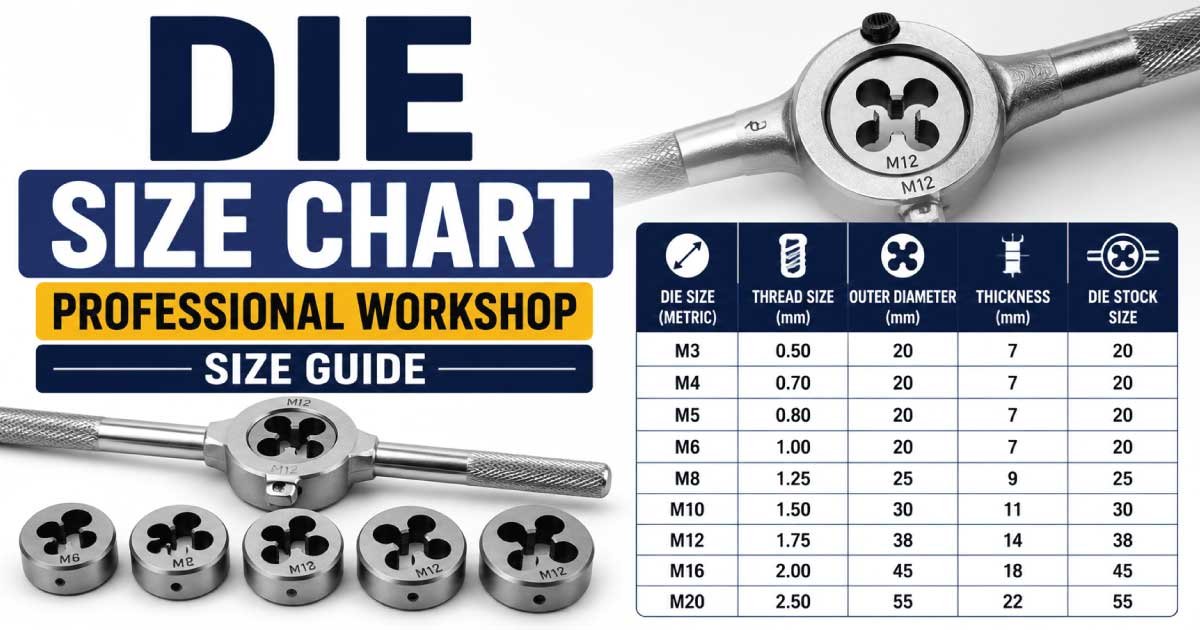
In machining and manufacturing industries, dies are essential tools used to cut, shape, or form materials—most commonly for creating threads on bolts, rods, and pipes. Whether you are working in a workshop, factory, or engineering environment, understanding the die size chart is crucial for selecting the correct die for precise and accurate threading operations.
A wrong die size can lead to loose threads, damaged fasteners, or complete failure of mechanical assemblies. This guide explains everything about die sizes, standard charts, types of dies, how they work, and how to choose the right one for your application.
What Is a Die?
A die is a precision cutting tool used to create external threads on cylindrical metal surfaces such as rods, pipes, and bolts. It works like a threading mold that shapes the material into accurate screw threads for proper mechanical fastening and assembly.
Dies are commonly used in mechanical workshops, automotive repair, manufacturing industries, construction fabrication, and maintenance operations. They help ensure strong and precise threaded connections between bolts, nuts, and other mechanical components.
Key Uses:
- Mechanical workshops
- Automotive repair work
- Manufacturing industries
- Construction fabrication
- Maintenance and repair operations
They ensure threaded parts fit accurately and perform reliably in different mechanical systems.
Why Die Size Matters
Selecting the correct die size is very important because threading accuracy depends directly on proper sizing. Even a small mismatch can create serious problems in fitting, strength, and overall performance of mechanical parts.
Incorrect die size can lead to poor thread engagement, loose or tight fitting bolts, damaged workpieces, reduced structural strength, and safety risks in mechanical systems where precision is essential.
Correct die size ensures:
- Accurate thread pitch
- Smooth assembly
- Strong mechanical connection
- Long-lasting performance
How Die Sizes Are Measured
Die sizes are defined using two primary parameters that determine how external threads are cut on rods or bolts. These measurements ensure proper fit, strength, and compatibility with nuts or threaded components in mechanical systems.
1. Thread Diameter
This refers to the outer diameter of the rod or bolt that will be threaded. The die must match this size accurately to produce correct threads.
Examples:
- M6 die → 6 mm rod diameter
- M10 die → 10 mm rod diameter
If the diameter does not match, the threads will be incorrect and unusable.
2. Thread Pitch
Thread pitch is the distance between adjacent threads. It determines how fine or coarse the threading will be and affects strength and precision.
- Coarse thread → stronger, commonly used in general applications
- Fine thread → more precise, used in specialized applications
Example:
- M10 × 1.5 → 10 mm diameter, 1.5 mm pitch
Correct pitch selection ensures proper engagement and smooth fastening.
Standard Metric Die Size Chart
Below is a commonly used metric die size chart in workshops, manufacturing units, and industrial threading operations. It helps ensure correct selection for different engineering applications.
🔩 Metric Die Size Chart
| Die Size | Diameter (mm) | Thread Pitch (mm) | Typical Use |
|---|---|---|---|
| M2 | 2 mm | 0.4 | Electronics, small screws |
| M3 | 3 mm | 0.5 | Light mechanical work |
| M4 | 4 mm | 0.7 | Machinery components |
| M5 | 5 mm | 0.8 | General fabrication |
| M6 | 6 mm | 1.0 | Automotive parts |
| M8 | 8 mm | 1.25 | Structural fittings |
| M10 | 10 mm | 1.5 | Heavy mechanical use |
| M12 | 12 mm | 1.75 | Industrial machinery |
| M14 | 14 mm | 2.0 | Construction hardware |
| M16 | 16 mm | 2.0 | Heavy-duty applications |
| M20 | 20 mm | 2.5 | Large structural work |
Imperial (Inch) Die Size Chart
In some regions like the USA, imperial measurements are still widely used.
🔧 Inch Die Size Chart
| Die Size | Diameter (inch) | Threads Per Inch (TPI) | Application |
|---|---|---|---|
| 1/4″ | 0.250″ | 20–28 TPI | Light duty |
| 5/16″ | 0.312″ | 18–24 TPI | Small machinery |
| 3/8″ | 0.375″ | 16–24 TPI | General use |
| 7/16″ | 0.437″ | 14–20 TPI | Mechanical fittings |
| 1/2″ | 0.500″ | 13–20 TPI | Automotive parts |
| 5/8″ | 0.625″ | 11–18 TPI | Heavy equipment |
| 3/4″ | 0.750″ | 10–16 TPI | Structural work |
| 1″ | 1.000″ | 8–14 TPI | Industrial use |
Types of Dies
Different types of dies are designed for specific threading applications, depending on the work material, accuracy requirement, and production type. Each die type serves a unique purpose in manufacturing, repair, and maintenance tasks. Understanding these types helps improve efficiency, accuracy, and tool life in machining and mechanical operations.
1. Solid Die
A solid die is a single-piece threading tool used for cutting external threads with high accuracy. It has a fixed diameter, which means it cannot be adjusted once manufactured. This type is widely used in mass production environments where consistent thread quality is essential. Solid dies are known for durability, stability, and precision performance in repetitive industrial tasks.
- Fixed size
- High precision
- Used for production work
2. Adjustable Die
An adjustable die allows slight modifications in thread size, making it suitable for different tolerances. It is commonly used when working with worn or slightly damaged threads that need correction. This die provides flexibility, making it a practical choice for repair workshops and maintenance jobs where exact sizing may vary slightly during operation.
- Can be slightly adjusted for tolerance
- Useful for worn threads
- Common in repair work
3. Split Die
A split die is designed with a cut or split that allows minor adjustments in diameter during use. This feature provides better control over thread fitting and makes it easier to correct small sizing errors. It is widely used in maintenance and repair applications where flexibility and precision adjustment are required for different shaft or rod sizes.
- Has a split opening for flexibility
- Allows minor size adjustments
- Ideal for maintenance work
4. Circular Die (Die Nut)
A circular die, also known as a die nut, has a compact round shape and is commonly used with a die stock for manual threading. It is simple to handle and convenient for light threading operations. This type is especially useful in fieldwork and small-scale repairs where portability and ease of use are more important than high-volume production.
- Compact round shape
- Used in die stocks
- Easy to use in manual threading
Materials Used in Dies
Dies are manufactured using strong and wear-resistant materials to handle high cutting forces during threading operations. The choice of material directly affects durability, heat resistance, and performance. Different materials are selected based on whether the application is light-duty, heavy-duty, or high-speed industrial production.
Common Materials:
1. High-Speed Steel (HSS)
High-Speed Steel is the most commonly used material for manufacturing dies due to its excellent balance of hardness and toughness. It can withstand high temperatures generated during cutting without losing strength. HSS dies are widely used in industrial applications where precision and durability are important for continuous production work.
- Most widely used
- Heat resistant
- Suitable for industrial use
2. Carbon Steel
Carbon steel dies are used for light-duty applications where high strength is not required. They are more affordable compared to other materials but tend to wear out faster under heavy loads. These dies are suitable for occasional use, basic repair tasks, and low-volume threading operations in workshops.
- Used for light-duty applications
- Affordable but less durable
- Suitable for basic work
3. Alloy Steel
Alloy steel dies are designed for heavy-duty machining tasks where higher strength and durability are required. The added alloying elements improve toughness, wear resistance, and overall performance. These dies are commonly used in industrial environments where consistent and reliable threading is needed under demanding conditions.
- High strength
- Used for heavy-duty machining
- Better wear resistance
4. Tungsten Carbide (Advanced Dies)
Tungsten carbide dies are extremely hard and wear-resistant tools used in high-speed production lines. They offer exceptional cutting performance and long service life, even under extreme conditions. These advanced dies are ideal for industries requiring precision, speed, and minimal tool replacement during continuous manufacturing processes.
- Extremely hard
- Used in high-speed production lines
- Very long tool life
How to Choose the Right Die Size
Selecting the correct die size is not just about matching numbers on a chart. It requires understanding the rod dimensions, thread standards, and material behavior. A small mistake in selection can lead to poor threading, weak joints, or tool damage during operation in mechanical and industrial applications.
1. Check Rod Diameter
Selecting the correct rod diameter is the most important step because the die must fit perfectly over the material. Even a slight mismatch can damage threads or cause uneven cutting. Always measure the rod accurately using calipers before starting the threading process for best precision and smooth performance.
- The rod must match the die size exactly.
2. Identify Thread Type
Thread type determines compatibility between fasteners and components. Metric threads are commonly used in modern machinery, while imperial threads are standard in older systems. Understanding both helps avoid mismatching issues. Always confirm the required standard before selecting a die to ensure proper fit and mechanical strength in assemblies.
- Metric (M series)
- Imperial (inch-based)
3. Choose Thread Pitch
Thread pitch affects how tightly or loosely a bolt fits into a threaded hole. Coarse threads are stronger and better for quick assembly, while fine threads provide better precision and grip. Choosing the right pitch ensures durability, stability, and proper load distribution in mechanical applications.
- Coarse or fine depending on application.
4. Material Type
The material of the workpiece plays a major role in die selection. Harder materials like stainless steel require strong dies such as HSS or carbide to withstand pressure. Softer materials can use standard dies. Choosing the right material prevents wear, breakage, and ensures long-lasting tool performance.
- Harder materials require stronger dies like HSS or carbide.
5. Application Purpose
The purpose of use determines which type of die is suitable. Repair work often requires adjustable dies for flexibility, while production work demands solid dies for accuracy and speed. Matching the die type to the task improves efficiency, reduces errors, and ensures consistent threading quality.
- Repair work → adjustable dies
- Production work → solid dies
✅ Check Our Complete Guide 👉 Surface Plate Size Chart: Complete Guide 2026 (With PDF )
Step-by-Step Guide to Using a Die
Using a die correctly ensures clean threads, longer tool life, and safe operation. Following each step carefully reduces mistakes and improves the quality of the finished thread. Proper preparation, alignment, and lubrication are key factors for achieving smooth and accurate results in metalworking tasks.
Step 1: Prepare the Rod
Before threading, the rod must be properly prepared. Cut it to the required length and smooth the edges to remove sharp burrs. A clean and even surface helps the die start smoothly and prevents damage. Proper preparation ensures accurate threading and reduces tool stress during operation.
- Cut and smooth the rod end before threading.
Step 2: Secure in Die Stock
The die must be firmly placed inside the die stock or holder tool before starting work. Proper alignment ensures stability and prevents slipping during operation. A securely held die improves accuracy, reduces vibration, and allows controlled cutting for clean and precise thread formation.
- Place the die firmly in the holder tool.
Step 3: Apply Lubrication
Lubrication is essential for reducing heat and friction during threading. Cutting oil helps the die move smoothly over the metal surface and prevents tool wear. It also improves thread quality and extends die life. Always apply sufficient lubricant before starting the threading process.
- Use cutting oil to reduce friction.
Step 4: Start Threading
Begin turning the die slowly and evenly onto the rod. Apply steady pressure without forcing the tool. Proper alignment is crucial to avoid crooked threads. Slow and controlled movement ensures clean cutting, reduces errors, and produces strong and accurate threads on the workpiece.
- Turn the die slowly and evenly.
Step 5: Reverse Periodically
While threading, it is important to reverse the die slightly after every few turns. This helps break and remove metal chips that can block cutting. Regular back-turning improves cutting efficiency, prevents tool jamming, and ensures smoother and cleaner thread formation throughout the process.
- Turn backward slightly to remove metal chips.
Step 6: Finish and Clean
After completing the threading process, carefully remove the die from the rod. Clean the newly formed threads to remove debris and burrs. A final inspection ensures accuracy and smoothness. Proper finishing improves performance and prepares the threaded part for assembly or further use.
- Remove burrs and clean the threads.
✅ Check Our Complete Guide 👉 Micrometer Size and Reading Chart: Quick Beginner’s Guide
Common Mistakes When Using Dies
Mistakes during die usage can damage both the tool and the workpiece. Understanding common errors helps improve safety and efficiency. Proper technique, correct sizing, and careful handling are essential to avoid thread defects and ensure long-lasting results in mechanical operations.
1. Wrong Size Selection
Choosing the incorrect die size leads to poor thread fitting and mechanical failure. It may cause loose or overly tight connections. Always verify measurements before starting to ensure compatibility and proper performance in assembly and structural applications.
- Leads to incorrect thread fitting.
2. No Lubrication
Skipping lubrication increases friction, heat, and tool wear. It can also damage the die and produce rough threads. Using cutting oil is essential for smooth operation and longer tool life during threading tasks.
- Causes tool wear and poor finish.
3. Excessive Force
Applying too much force while threading can break the die or damage the rod. Dies are designed for controlled cutting, not pressure-based forcing. Gentle and steady movement ensures better results and tool safety.
- Can break the die or damage threads.
4. Misalignment
Improper alignment between die and rod leads to crooked or uneven threads. This reduces strength and makes assembly difficult. Always ensure the die is straight before starting the threading process.
- Results in crooked or damaged threads.
5. Reusing Damaged Dies
Using worn or damaged dies produces low-quality threads and increases failure risk. Damaged tools should be replaced immediately to maintain accuracy, safety, and efficiency in mechanical operations.
- Leads to poor-quality threading.
Applications of Dies
Dies are widely used across various industries for creating precise external threads. They play an important role in manufacturing, construction, and repair work. Their versatility makes them essential tools for producing strong and reliable threaded components in mechanical systems.
🔩 Automotive Industry
Dies are extensively used in automotive manufacturing for creating bolts, screws, and engine components. They ensure strong and precise threading, which is critical for vehicle safety and performance. Proper threading improves assembly reliability and durability of automotive parts.
- Bolt and screw manufacturing
- Engine component threading
🏗️ Construction Industry
In construction, dies are used for threading structural steel and anchor bolts. These threaded components provide strong connections in buildings and infrastructure projects. Accurate threading ensures safety, stability, and long-lasting structural performance in demanding environments.
- Structural steel fastening
- Anchor bolt threading
⚙️ Manufacturing Industry
Manufacturing industries rely on dies for producing machine parts and assembly line components. They ensure consistent threading quality, which is essential for mass production. This improves efficiency and reduces production errors in industrial processes.
- Machine parts production
- Assembly line components
🔧 Repair Workshops
Repair workshops use dies to restore damaged threads and create custom fittings. This helps extend the life of mechanical parts and reduces replacement costs. Adjustable dies are commonly used for flexibility in repair tasks.
- Restoring damaged threads
- Custom fabrication
- Maintenance of Dies
Proper maintenance increases tool life and performance.
Maintenance tips:
Clean after every use
Apply rust protection oil
Store in dry containers
Avoid dropping or impact damage
Inspect for wear regularly
Advantages of Using Proper Die Sizes
Using the correct die size is essential for achieving high-quality threading results. It ensures accuracy, strength, and efficiency in mechanical operations. Proper selection also reduces waste, improves tool life, and supports smooth assembly in various industrial applications.
- Accurate threading
- Strong mechanical joints
- Smooth assembly process
- Reduced material waste
- Increased tool life
Final Thoughts
The die size chart is an essential reference for engineers, machinists, and workshop professionals. Understanding die sizes ensures accurate threading, safe assembly, and long-lasting mechanical performance.
While charts provide a standard reference, always consider:
- Material type
- Thread pitch
- Application requirements
- Tool condition
A correctly selected die not only improves efficiency but also ensures precision and reliability in every mechanical project.
✅ Check Our Complete Guide 👉 M Stud Size and Thread Pitch Chart for Machinists