
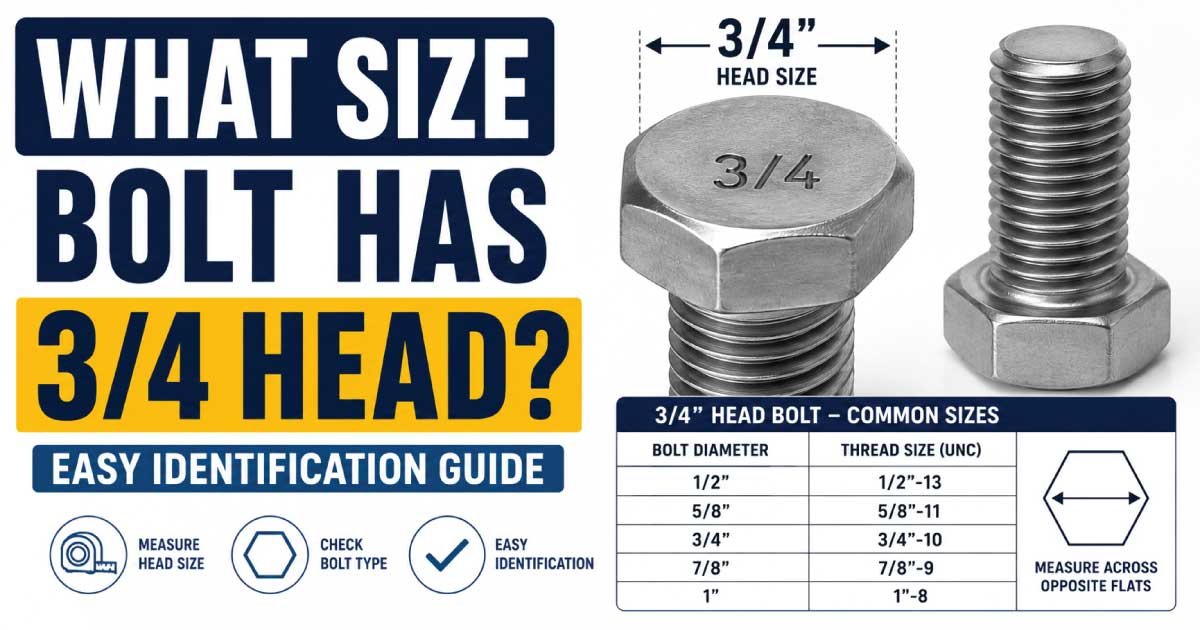
If you have ever worked on a vehicle, assembled heavy equipment, or completed a DIY project, you may have come across a bolt with a 3/4-inch head and wondered, “What size bolt has a 3/4 head?” While it seems like a simple question, the answer isn’t always straightforward.
A common misconception is that the size of a bolt head is the same as the bolt’s thread diameter. In reality, the head size and thread size are two different measurements. A bolt with a 3/4-inch hex head could have different thread diameters depending on the bolt standard, grade, and manufacturer.
This guide explains how bolt head sizes relate to thread sizes, which bolts commonly use a 3/4-inch head, how to identify the correct bolt, and why understanding these measurements matters.
Applications of Bolts with 3/4-Inch Heads
Bolts that require a 3/4-inch wrench are commonly used in heavy-duty mechanical systems where high strength and torque resistance are required. These bolts are designed to handle significant loads and vibration, making them essential in automotive, construction, and industrial applications.
Common Applications
- Automotive suspension systems
- Engine mounting brackets
- Trailer hitches and towing systems
- Agricultural machinery components
- Steel structural connections
- Industrial equipment assemblies
- Construction frameworks
- Heavy machinery joints
- Utility trailers and transport systems
- Mechanical assemblies in workshops
Many pickup trucks and SUVs also use these bolts in chassis and suspension areas due to their strength and durability under load.
✅ Check Our Complete Guide 👉 Extension Cord Size Guide with Chart (Latest 2026 Guide)
How to Identify the Actual Bolt Size
Identifying a bolt only by its head size is not enough because the head size does not directly indicate thread diameter. You must measure the bolt properly to determine its actual specification for replacement or installation.
Step 1: Measure the Thread Diameter
Use a digital caliper to measure the outer diameter of the threaded section. This is the most important step in identifying bolt size accurately.
- Around 1/2 inch → likely a 1/2-inch SAE bolt
- Around 12 mm → likely an M12 metric bolt
This measurement helps distinguish between metric and imperial systems.
Step 2: Measure the Thread Pitch
Thread pitch defines how tightly or loosely the threads are spaced, and it differs between metric and SAE systems.
For metric bolts, measure the distance between threads:
- M12 × 1.25
- M12 × 1.5
- M12 × 1.75
For SAE bolts, count threads per inch (TPI):
- 1/2″-13 UNC (coarse thread)
- 1/2″-20 UNF (fine thread)
Correct pitch identification is essential for proper fitting and safety.
Step 3: Measure the Bolt Length
Measure the total length of the bolt from the underside of the head to the tip of the threaded end. This ensures correct replacement and proper engagement in the material.
For special bolt types like countersunk or flat-head bolts, measure from the top surface of the head instead.
Accurate length measurement prevents installation issues and ensures secure fastening in mechanical and structural applications.
Common Thread Sizes for a 1/2-Inch Bolt
If a bolt has a 3/4-inch head in SAE systems, it is often associated with a 1/2-inch diameter bolt. These bolts come in standard thread patterns that determine how they engage with nuts or tapped holes in mechanical assemblies and structures.
Coarse Thread (UNC)
1/2″-13
Thirteen threads per inch provide strong engagement and durability, making this type suitable for general-purpose fastening in construction, automotive repairs, and machinery where ease of assembly and resistance to stripping are important.
Fine Thread (UNF)
1/2″-20
Twenty threads per inch offer tighter adjustment and higher clamping precision, commonly used in high-strength applications, performance vehicles, and precision equipment where vibration resistance and accurate torque control are required.
Measuring Without a Caliper
Even without precision tools like a caliper, you can still estimate bolt size using simple workshop methods. These techniques are useful for quick identification during repairs, maintenance, or replacement tasks where exact instruments are not available.
Common Methods
- Ruler or measuring tape for approximate diameter and length
- Open-end wrench set to match head size
- Thread pitch gauge for estimating thread spacing
- Bolt sizing board for quick comparison
- Matching with a known nut or fastener
Although these methods are not highly precise, they are often sufficient for basic home repairs and non-critical mechanical work where exact tolerances are less critical.
✅ Check Our Complete Guide 👉 AWG wire Size Chart: Your Complete 2026 Guide + PDF
Why Knowing the Bolt Size Matters
Correct bolt identification is essential for safety, reliability, and long-term performance in any mechanical or structural system. Even small mismatches in size or thread type can lead to serious mechanical failure or damage.
Potential Problems from Incorrect Size
- Loose or unstable joints
- Stripped or damaged threads
- Reduced clamping force
- Premature component failure
- Damage to machinery or equipment
- Safety hazards during operation
To ensure proper performance, always match all key specifications carefully:
- Thread diameter
- Thread pitch
- Bolt length
- Strength grade
- Head style
Accurate matching ensures secure fastening, improved durability, and safe operation in all applications.
Common Mistakes
Many people make errors when identifying bolts, especially when working without proper measurement tools. These mistakes can lead to incorrect replacements, poor fitting, and even mechanical failure in automotive, construction, and machinery applications where precision fastening is required.
Confusing Head Size with Bolt Diameter
A 3/4-inch wrench size does not represent the bolt’s actual diameter. The head size only refers to the tool fitting, while the thread diameter is significantly smaller and must be measured separately for accurate identification.
Mixing Metric and SAE Fasteners
A 19 mm wrench is close to a 3/4-inch head, but metric and SAE bolts are not interchangeable. Differences in thread pitch and sizing standards can cause improper fitting and damage if mixed incorrectly during installation.
Ignoring Thread Pitch
Bolts with the same diameter can have different thread spacing. Ignoring thread pitch may result in cross-threading, loose connections, or inability to properly secure the fastener, especially in precision or high-load mechanical systems.
Using Adjustable Wrenches
Adjustable wrenches often slip or apply uneven pressure, increasing the risk of rounding off bolt heads. A correctly sized socket or fixed wrench ensures better grip, safer torque application, and reduced damage during tightening or loosening.
Tips for Selecting the Correct Replacement Bolt
Choosing the correct replacement bolt requires careful attention to multiple specifications to ensure safe and reliable fastening in mechanical or structural applications. Each detail plays an important role in proper fit and performance.
Key Selection Steps
- Measure the thread diameter accurately
- Determine the correct thread pitch
- Check the required bolt length
- Verify the strength grade or bolt rating
- Match the correct head style (hex, flange, etc.)
- Confirm the wrench or socket size
Keeping the original bolt with you when purchasing a replacement is often the simplest and most reliable method. It helps ensure exact matching and avoids compatibility issues during installation or repair work.
Final Thoughts
A 3/4-inch bolt head most commonly corresponds to a 1/2-inch SAE hex bolt, but head sizes can vary depending on the bolt standard, manufacturer, and application. In the metric system, an M12 bolt typically uses a 19 mm hex head, which is nearly identical in size to 3/4 inch.
When replacing or identifying a bolt, don’t rely solely on the wrench size. Measure the thread diameter, determine the thread pitch, verify the bolt length, and confirm the appropriate strength grade. Taking a few extra minutes to identify the correct fastener will help ensure a secure fit, prevent thread damage, and keep your equipment operating safely.
✅ Check Our Complete Guide 👉 M Washer Size Chart: Complete Dimensions Guide (2026)
Frequently Asked Questions
What size bolt usually has a 3/4-inch head?
In standard SAE (inch-series) hardware, a 1/2-inch bolt typically has a 3/4-inch hex head, making it one of the most common bolt and wrench combinations. However, head sizes can vary depending on the bolt type, strength grade, and manufacturer, so it is always wise to verify the dimensions before selecting a wrench.
Is a 19 mm socket the same as a 3/4-inch socket?
Not exactly. A 3/4-inch socket measures approximately 19.05 mm, while a 19 mm socket is exactly 19 millimeters. The difference is very small, and the two may fit in some situations. However, using the correct socket size provides a better grip and reduces the risk of damaging the fastener.
Can different manufacturers use different head sizes?
Yes. Although many bolts follow standard SAE or metric dimensions, some manufacturers produce heavy-duty, structural, flange, or specialty bolts with different head sizes. These variations are often designed to improve strength, meet industry standards, or suit specific applications, so always confirm the required wrench size before use.
Why doesn’t my 3/4-inch wrench fit every bolt?
A 3/4-inch wrench may not fit every bolt because the fastener could be metric, damaged, corroded, or manufactured to a different standard. Wear, rust, paint buildup, or specialty bolt designs can also affect the fit. Always identify the bolt type and accurately measure the head before choosing a wrench.