
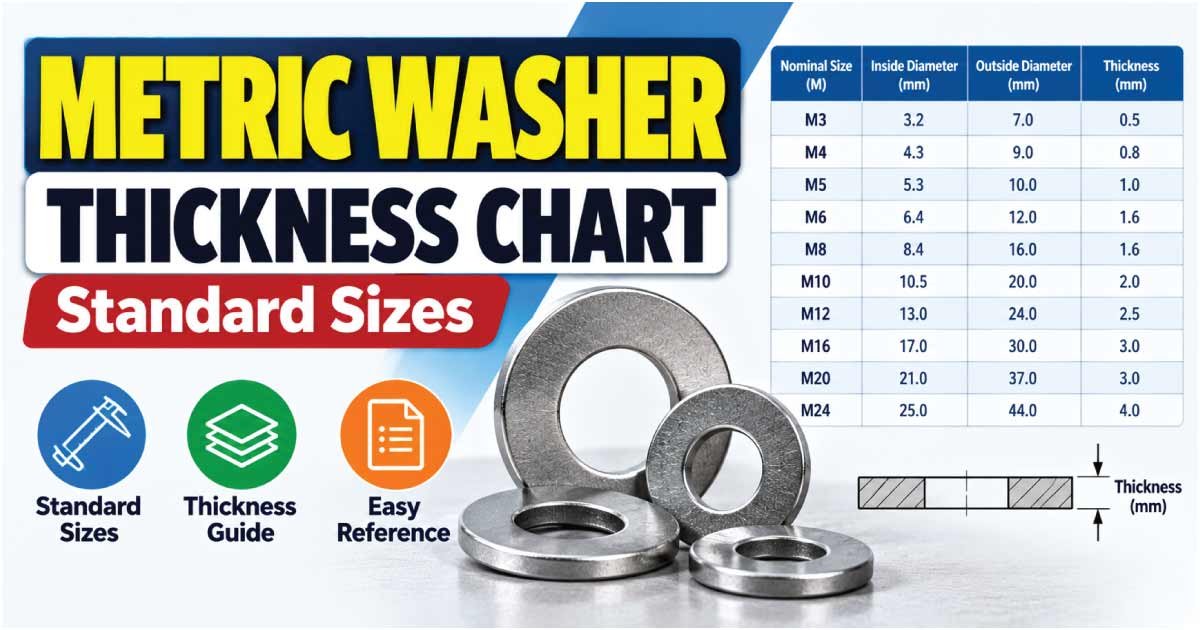
A metric washer thickness chart is useful when you need to select a washer that fits a metric bolt or screw while providing the correct bearing area and thickness. A washer is more than a simple flat metal disc: its inside diameter, outside diameter, thickness, material, hardness, and applicable standard all affect how it performs.
For common metric fasteners, ISO 7089 provides dimensions for plain washers in the normal series, product grade A. The standard covers nominal sizes from M1.6 through M64, with both preferred and non-preferred sizes.
This guide focuses on the commonly used M3 through M30 range and explains nominal washer thickness, thickness tolerances, hole diameter, outside diameter, how to measure a washer, and how to choose the right size for your application.
Metric Washer Thickness Chart
The table below gives the standard nominal dimensions for ISO 7089 normal-series plain washers. The nominal thickness is the target thickness, while the minimum and maximum values show the permitted thickness range.
All dimensions are in millimeters (mm). The values below are based on ISO 7089 dimensional data.
| Metric Size | Hole Diameter, Nominal (mm) | Outside Diameter, Nominal (mm) | Nominal Thickness (mm) | Thickness Min. (mm) | Thickness Max. (mm) |
|---|---|---|---|---|---|
| M3 | 3.20 | 7.00 | 0.50 | 0.45 | 0.55 |
| M4 | 4.30 | 9.00 | 0.80 | 0.70 | 0.90 |
| M5 | 5.30 | 10.00 | 1.00 | 0.90 | 1.10 |
| M6 | 6.40 | 12.00 | 1.60 | 1.40 | 1.80 |
| M8 | 8.40 | 16.00 | 1.60 | 1.40 | 1.80 |
| M10 | 10.50 | 20.00 | 2.00 | 1.80 | 2.20 |
| M12 | 13.00 | 24.00 | 2.50 | 2.30 | 2.70 |
| M14 | 15.00 | 28.00 | 2.50 | 2.30 | 2.70 |
| M16 | 17.00 | 30.00 | 3.00 | 2.70 | 3.30 |
| M18 | 19.00 | 34.00 | 3.00 | 2.70 | 3.30 |
| M20 | 21.00 | 37.00 | 3.00 | 2.70 | 3.30 |
| M22 | 23.00 | 39.00 | 3.00 | 2.70 | 3.30 |
| M24 | 25.00 | 44.00 | 4.00 | 3.70 | 4.30 |
| M27 | 28.00 | 50.00 | 4.00 | 3.70 | 4.30 |
| M30 | 31.00 | 56.00 | 4.00 | 3.70 | 4.30 |
The dimensional pattern is important. Washer thickness does not increase by a fixed amount for every metric size. For example, M6 and M8 washers are both nominally 1.6 mm thick, while M16 through M22 washers are nominally 3.0 mm thick.
What Is Metric Washer Thickness?
Metric washer thickness is the distance measured through the washer from one flat face to the opposite face. It is normally specified in millimeters.
For example, an ISO 7089 M10 plain washer has a nominal thickness of 2.0 mm, with a specified thickness range of approximately 1.8 to 2.2 mm.
The word nominal is important. It does not necessarily mean that every washer will measure exactly 2.000 mm. Manufacturing tolerances allow the actual thickness to vary within the specified limits.
Nominal Thickness vs. Actual Thickness
A washer specified as 3.0 mm thick may therefore have an actual measured thickness somewhat above or below 3.0 mm while remaining within the applicable tolerance.
This matters when a washer is being used in an assembly with tight dimensional requirements. If the total stack height is important, use the manufacturer’s dimensional specification rather than assuming that the nominal value represents the exact measured thickness.
Why Washer Thickness Matters
Thickness can affect:
- Load distribution beneath the nut or bolt head
- Overall fastener stack height
- Resistance to deformation
- Clearance within an assembly
- Contact pressure on the clamped material
- Compatibility with the selected fastener and washer standard
A thicker washer is not automatically a better washer. The appropriate thickness depends on the washer design, fastener, load, material, and application.
Metric Washer Dimensions Explained
Thickness is only one part of a washer’s dimensions. To identify a washer correctly, you generally need to consider three primary measurements: inside diameter, outside diameter, and thickness.
Inside or Hole Diameter
The hole is the opening through the center of the washer. In ISO 7089 terminology, the clearance-hole dimension is represented by d1.
For an M10 ISO 7089 washer, the nominal clearance-hole diameter is 10.5 mm, rather than exactly 10 mm. This provides clearance around the nominal M10 fastener diameter.
Outside Diameter
The outside diameter is the total diameter across the washer. It determines how much surface area the washer provides beneath the fastener.
For example:
- M6 washer: 12 mm outside diameter
- M8 washer: 16 mm outside diameter
- M10 washer: 20 mm outside diameter
- M12 washer: 24 mm outside diameter
These dimensions follow the ISO 7089 normal-series geometry.
Thickness
Thickness is measured through the body of the washer. For the same ISO 7089 series:
- M3 = 0.5 mm nominal
- M4 = 0.8 mm nominal
- M5 = 1.0 mm nominal
- M6 = 1.6 mm nominal
- M8 = 1.6 mm nominal
- M10 = 2.0 mm nominal
- M12 = 2.5 mm nominal
- M16 = 3.0 mm nominal
- M24 = 4.0 mm nominal
- M30 = 4.0 mm nominal
These values illustrate why washer size should not be selected based on bolt diameter alone.
ISO 7089 Washer Thickness Standards
ISO 7089 specifies plain washers in the normal series with product grade A. The standard includes dimensional requirements and applies to specified hardness classes and materials according to the standard’s requirements.
It is particularly useful when a washer needs to be specified consistently rather than simply described as an “M10 washer.”
Preferred and Non-Preferred Sizes
ISO 7089 separates dimensions into preferred and non-preferred sizes. Some sizes appear in parentheses in standard tables because they are non-preferred.
For example, M14, M18, M22, and M27 are listed as non-preferred sizes in the ISO 7089 dimensional table, while M12, M16, M20, M24, and M30 are preferred sizes.
This distinction can matter when designing standardized assemblies or purchasing large quantities of fasteners.
ISO 7089 vs. Generic “Metric Washer”
A product described simply as an M10 washer does not necessarily provide enough information for a precision application. Different washer types and standards can have different outside diameters and thicknesses.
When dimensions are critical, specify the applicable standard, such as ISO 7089, along with material, finish, and other required properties.
How to Measure Metric Washer Thickness
If you have an unidentified washer and need to determine its size, measure all three main dimensions rather than thickness alone.
Step 1: Measure the Thickness
Use a digital caliper or micrometer to measure the distance between the two flat faces.
For better accuracy:
- Clean dirt, rust, and debris from the washer.
- Place the measuring tool squarely against the washer.
- Avoid squeezing a soft or damaged washer excessively.
- Take measurements at several locations if accuracy is important.
- Compare the result with the appropriate standard or manufacturer specification.
A micrometer can be preferable when very small thickness differences matter.
Step 2: Measure the Hole
Measure the internal opening across the washer. A caliper can provide a practical measurement, although the nominal size should ultimately be compared with the applicable standard.
Do not assume that a washer with a 10 mm nominal fastener designation has a 10.00 mm hole. Standardized clearance holes are commonly larger than the nominal thread diameter.
Step 3: Measure the Outside Diameter
Measure straight across the widest part of the washer from outside edge to outside edge.
The combination of hole diameter + outside diameter + thickness provides a much more reliable identification than thickness alone.
How to Choose the Correct Metric Washer Thickness
Choosing a washer starts with the fastener, but it should not end there.
Match the Washer to the Fastener
First identify the nominal bolt or screw size. An M8 bolt will commonly be paired with an M8 washer, but the exact washer dimensions still depend on the washer standard and type.
For a standardized assembly, verify:
- Nominal fastener size
- Washer standard
- Hole diameter
- Outside diameter
- Thickness
- Material
- Hardness where applicable
- Surface finish or coating
- Operating environment
Consider the Bearing Surface
One major function of a flat washer is to distribute the force from the fastener over a larger area.
If the material under the fastener is relatively soft, damaged, thin, or prone to deformation, the available bearing area can become particularly important. A washer with a larger outside diameter may be more appropriate than a standard washer, depending on the engineering requirements.
However, simply selecting a thicker washer does not necessarily solve a bearing-area problem. Outside diameter and washer design can be just as important as thickness.
Consider Available Clearance
The washer must fit into the available space around the fastener.
A large-diameter washer may provide greater bearing area but may interfere with nearby components, edges, recesses, or other hardware. Always check the physical envelope of the assembly before selecting a larger washer.
Also Read:
Common Metric Washer Types
Not every washer is a standard flat washer. Thickness requirements vary significantly between washer types.
Plain or Flat Washers
Plain washers are the most straightforward type. They provide a flat bearing surface between the fastener and the clamped component.
ISO 7089 covers the normal series of plain washers with product grade A.
Large Outside-Diameter Washers
Large-diameter washers provide greater bearing coverage than conventional washers for a given fastener size.
They can be useful where the supporting material has a larger area that needs to be protected, but the correct standard and application requirements should be checked before substitution.
Spring Washers
Spring washers are designed differently from ordinary flat washers. Their dimensions and function should not be confused with those of ISO 7089 plain washers.
If a design specifically calls for a spring washer, use the applicable spring-washer specification rather than selecting a flat washer based only on thickness.
Sealing Washers
Sealing washers can incorporate elastomeric or other sealing elements. Their total thickness and construction can differ significantly from conventional metal flat washers.
For sealing applications, consider both the metal washer dimensions and the sealing element’s requirements.
Also Read:
Metric Washer Thickness vs. Outside Diameter
A common mistake is to assume that a thicker washer always has a larger outside diameter.
The ISO 7089 chart shows that these dimensions change according to the standard’s design rather than following a simple one-to-one formula. For example, M6 and M8 both use a nominal thickness of 1.6 mm, but their outside diameters are 12 mm and 16 mm respectively.
Similarly, M16, M18, M20, and M22 all use a nominal thickness of 3.0 mm, while their outside diameters increase from 30 mm to 39 mm.
This is why a washer should be specified by its complete dimensional requirements, not by thickness alone.
Metric Washer Thickness Tolerances
Tolerance is an important part of technical washer specifications.
For the ISO 7089 sizes covered in the chart, the permitted thickness range changes according to the nominal thickness. Examples include:
| Nominal Thickness (mm) | Minimum (mm) | Maximum (mm) |
|---|---|---|
| 0.50 | 0.45 | 0.55 |
| 0.80 | 0.70 | 0.90 |
| 1.00 | 0.90 | 1.10 |
| 1.60 | 1.40 | 1.80 |
| 2.00 | 1.80 | 2.20 |
| 2.50 | 2.30 | 2.70 |
| 3.00 | 2.70 | 3.30 |
| 4.00 | 3.70 | 4.30 |
| 5.00 | 4.40 | 5.60 |
| 6.00 | 5.40 | 6.60 |
| 8.00 | 7.00 | 9.00 |
| 10.00 | 9.00 | 11.00 |
These values are based on the ISO 7089 dimensional table and illustrate that the acceptable thickness variation is defined by the standard rather than by an arbitrary percentage.
For a critical assembly, always use the current applicable standard or supplier documentation rather than relying on a general chart.
Also Read:
Common Mistakes When Selecting Washer Thickness
Several simple mistakes can result in the wrong washer being selected.
Choosing by Bolt Diameter Only
Knowing that a bolt is M10 tells you the nominal fastener size, but it does not identify every relevant washer characteristic.
You should also verify the washer standard and dimensions.
Assuming Nominal Means Exact
An M10 washer with a nominal thickness of 2.0 mm does not necessarily measure exactly 2.000 mm. Manufacturing tolerances are part of the specification.
Confusing Washer Type
A flat washer, spring washer, sealing washer, and large outside-diameter washer may all be associated with the same nominal fastener size but have different designs and dimensions.
Ignoring Material and Hardness
Two washers can have similar dimensions but different mechanical properties. Material, hardness, coating, corrosion resistance, and application conditions can all matter.
Mixing Standards Without Checking Dimensions
A washer from one dimensional standard should not automatically be treated as interchangeable with a washer from another standard.
When a replacement is needed, compare the actual dimensional and performance requirements.
Quick Metric Washer Selection Guide
Use this checklist when selecting a standard metric washer:
- Identify the bolt or screw size.
- Select the required washer type.
- Check the applicable dimensional standard.
- Verify the inside or clearance-hole diameter.
- Check the outside diameter and available space.
- Select the required nominal thickness.
- Check thickness tolerances if dimensional accuracy matters.
- Confirm material and hardness requirements.
- Check coating or corrosion-resistance requirements.
- Verify the final washer against the manufacturer’s specification.
For general-purpose mechanical work, a standard plain washer may be sufficient. For engineered assemblies, however, the complete specification should be verified rather than selecting a washer based on appearance.
Frequently Asked Questions
What is the standard thickness of an M10 washer?
For an ISO 7089 normal-series plain washer, the nominal thickness for M10 is 2.0 mm. The specified thickness range is approximately 1.8 to 2.2 mm.
How thick is an M8 metric washer?
An ISO 7089 normal-series M8 washer has a nominal thickness of 1.6 mm, with a specified range of approximately 1.4 to 1.8 mm.
How thick is an M6 washer?
The nominal thickness of an ISO 7089 M6 washer is 1.6 mm. Its specified minimum and maximum thicknesses are approximately 1.4 mm and 1.8 mm.
What is the thickness of an M12 washer?
An ISO 7089 M12 plain washer has a nominal thickness of 2.5 mm, with a thickness range of approximately 2.3 to 2.7 mm.
Is an M10 washer exactly 10 mm thick?
No. The M10 designation refers to the nominal fastener size, not washer thickness. An ISO 7089 M10 washer has a nominal thickness of 2.0 mm and a nominal clearance-hole diameter of 10.5 mm.
How do I identify an unknown metric washer?
Measure its hole diameter, outside diameter, and thickness, then compare those measurements with the appropriate washer standard. Measuring only thickness is usually not enough for reliable identification.
Can I use a thicker washer instead of a standard washer?
Not automatically. A thicker washer can change the fastener stack height and may have different mechanical characteristics. If the application is engineered or load-critical, use the washer specified by the design or applicable standard.
Conclusion
A metric washer thickness chart provides a quick way to compare standard washer dimensions, but thickness is only one part of correct washer selection. For ISO 7089 normal-series plain washers, common sizes such as M3 through M30 have defined relationships between hole diameter, outside diameter, nominal thickness, and allowable thickness variation.
For everyday selection, start with the metric fastener size and then verify the washer’s standard, hole diameter, outside diameter, thickness, material, and application requirements. When exact fit or performance matters, use the applicable standard or manufacturer’s technical documentation rather than relying on nominal dimensions alone.
With those measurements in hand, you can select a washer that fits the fastener correctly and provides the intended bearing surface for the assembly.