
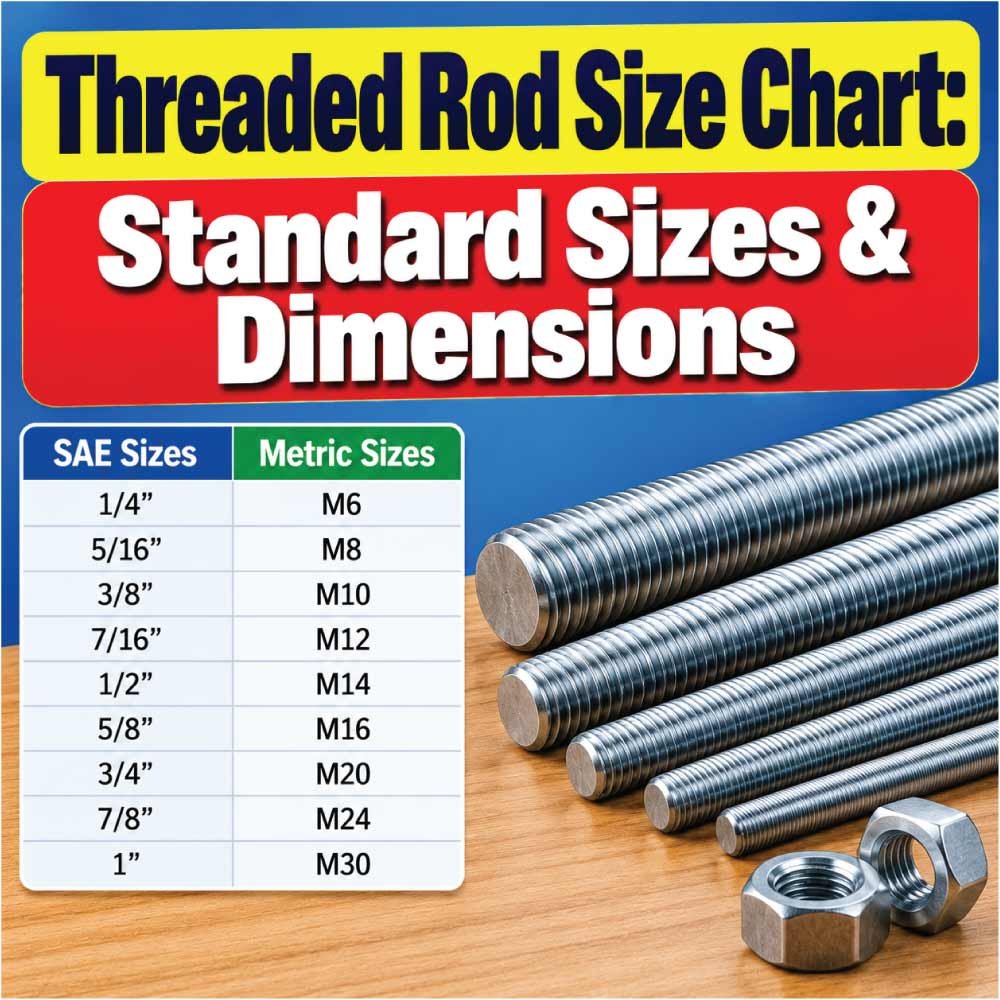
Threaded rod is a versatile fastening component used when a continuous threaded connection is needed along part or all of an assembly. Choosing the correct rod requires more than matching the outside diameter. Threaded rod size, thread pitch, thread series, material, length, and application all affect fit and performance.
This threaded rod size chart covers commonly encountered metric and SAE threaded rod sizes, including nominal diameters, thread pitches, and inch equivalents. It also explains how to measure threaded rod, understand thread markings, choose the right size, and avoid common sizing mistakes.
Because dimensions can vary by standard and manufacturer, the charts should be used as a practical reference rather than a substitute for the applicable specification or manufacturer’s product documentation.
What Is a Threaded Rod?
A threaded rod, sometimes called fully threaded rod, all-thread, threaded bar, or threaded stud, is a straight metal rod with external threads. Unlike a conventional bolt, it normally does not have a permanent head and can be cut to the required length.
Threaded rods are commonly installed with nuts, washers, couplers, brackets, anchors, or threaded inserts. Depending on the design, a rod can provide a connection between two components, suspend equipment, reinforce an assembly, or transfer clamping forces.
Threaded rod is available in many diameters, thread pitches, lengths, materials, and finishes. Common materials include:
- Carbon steel
- Stainless steel
- Alloy steel
- Brass
- Other specialty materials for specific environments
The most important dimensions are the nominal diameter and thread pitch. Length is also important when determining how much rod is required for an installation.
Threaded Rod Size Chart: Metric Sizes
Metric threaded rod is normally identified by its nominal outside diameter followed by the thread pitch. For example, M10 × 1.5 indicates a nominal diameter of approximately 10 mm and a 1.5 mm thread pitch.
The following chart lists common coarse metric sizes. Actual available lengths, grades, finishes, and tolerances depend on the manufacturer and applicable standard.
| Metric Size | Nominal Diameter (mm) | Common Coarse Pitch (mm) | Approx. Inch Diameter | Typical Uses |
|---|---|---|---|---|
| M3 | 3 | 0.50 | 0.118″ | Small assemblies |
| M4 | 4 | 0.70 | 0.157″ | Light-duty fastening |
| M5 | 5 | 0.80 | 0.197″ | General small hardware |
| M6 | 6 | 1.00 | 0.236″ | Brackets and fixtures |
| M8 | 8 | 1.25 | 0.315″ | General construction |
| M10 | 10 | 1.50 | 0.394″ | Mounting and support |
| M12 | 12 | 1.75 | 0.472″ | Structural and mechanical work |
| M14 | 14 | 2.00 | 0.551″ | Heavy-duty assemblies |
| M16 | 16 | 2.00 | 0.630″ | Structural connections |
| M18 | 18 | 2.50 | 0.709″ | Heavy mechanical applications |
| M20 | 20 | 2.50 | 0.787″ | Heavy-duty fastening |
| M22 | 22 | 2.50 | 0.866″ | Structural applications |
| M24 | 24 | 3.00 | 0.945″ | Heavy structural work |
| M27 | 27 | 3.00 | 1.063″ | Heavy-duty connections |
| M30 | 30 | 3.50 | 1.181″ | Large structural assemblies |
The coarse pitch shown is the commonly associated coarse thread for each size. Metric standards can also provide fine and extra-fine pitches, so the diameter alone does not completely identify a threaded rod.
For example, an M10 rod could have a different pitch from the common M10 × 1.5 coarse configuration. The matching nut must have the same nominal diameter and pitch.
SAE and Inch Threaded Rod Size Chart
In the United States, threaded rod is commonly specified using inch-based thread systems. A typical designation might be 1/2″-13 UNC, where 1/2 inch is the nominal diameter and 13 is the number of threads per inch.
UNC means Unified National Coarse, while UNF means Unified National Fine.
| Nominal Size | Diameter (in.) | Diameter (mm, approx.) | UNC Threads per Inch | UNF Threads per Inch |
|---|---|---|---|---|
| #6 | 0.138″ | 3.51 | 32 | 40 |
| #8 | 0.164″ | 4.17 | 32 | 36 |
| #10 | 0.190″ | 4.83 | 24 | 32 |
| 1/4″ | 0.250″ | 6.35 | 20 | 28 |
| 5/16″ | 0.3125″ | 7.94 | 18 | 24 |
| 3/8″ | 0.375″ | 9.53 | 16 | 24 |
| 7/16″ | 0.4375″ | 11.11 | 14 | 20 |
| 1/2″ | 0.500″ | 12.70 | 13 | 20 |
| 9/16″ | 0.5625″ | 14.29 | 12 | 18 |
| 5/8″ | 0.625″ | 15.88 | 11 | 18 |
| 3/4″ | 0.750″ | 19.05 | 10 | 16 |
| 7/8″ | 0.875″ | 22.23 | 9 | 14 |
| 1″ | 1.000″ | 25.40 | 8 | 12 |
The table shows commonly encountered UNC and UNF thread counts. Some diameters and thread series can have additional configurations, so always verify the exact specification before ordering replacement hardware.
A 1/2″-13 rod and a 1/2″-20 rod are not interchangeable, even though both have a nominal diameter of 1/2 inch.
Metric vs. SAE Threaded Rod Sizes
Metric and inch threaded rods can look very similar, particularly when their diameters are close. However, their threads are specified differently and should not be mixed.
Metric thread pitch is expressed as the distance between adjacent thread peaks in millimeters. Inch threads are generally expressed as threads per inch (TPI).
For example:
- M12 × 1.75 = 12 mm nominal diameter and 1.75 mm pitch
- 1/2″-13 UNC = 1/2 inch nominal diameter and 13 threads per inch
- M16 × 2.0 = 16 mm nominal diameter and 2.0 mm pitch
- 5/8″-11 UNC = 5/8 inch nominal diameter and 11 threads per inch
Although some metric and inch sizes are close in diameter, the thread geometry and pitch differ. Trying to force an incompatible nut onto a rod can damage the threads.
Common Threaded Rod Dimensions
Threaded rod dimensions are not limited to diameter and pitch. Buyers often need to specify overall length, thread form, material, grade, finish, and tolerance.
1. Nominal Diameter
The nominal diameter identifies the approximate major diameter of the external thread.
Common metric diameters include M6, M8, M10, M12, M16, M20, and M24. Common inch diameters include 1/4, 3/8, 1/2, 5/8, 3/4, and 1 inch.
The measured outside diameter may be slightly different from the nominal designation because threaded fasteners are manufactured according to dimensional tolerances.
2. Thread Pitch
Pitch is the distance from one thread crest to the corresponding point on the next thread, measured parallel to the rod axis.
For metric threads, pitch is expressed in millimeters. For inch threads, thread density is normally expressed as threads per inch.
Pitch determines which nut or threaded component will fit the rod.
3. Overall Length
Threaded rods are produced in various lengths, and long stock rods can be cut to suit an installation. Depending on the supplier, commonly available stock lengths may include approximately 1 m, 2 m, 3 m, or other standard lengths.
There is no universal length that applies to every threaded rod size. Always check the manufacturer’s product dimensions before ordering.
4. Thread Form and Series
The thread series identifies the specific thread system being used. Examples include:
- Metric ISO threads
- UNC
- UNF
- Other inch thread forms
- Specialty or application-specific threads
The diameter and pitch should always be considered together with the thread standard.
How to Measure Threaded Rod Size
If the original rod has no visible identification, you can determine its approximate size with basic measuring tools.
1. Measure the Outside Diameter
Use a caliper to measure across the threaded portion at the largest diameter.
For an inch rod, a measurement close to 0.500 inch suggests a nominal 1/2-inch rod. A measurement close to 12 mm suggests an M12 rod.
Because thread tolerances can affect the measurement, do not rely on diameter alone.
2. Determine the Thread Pitch
For metric rod, use a thread-pitch gauge or measure the distance between several thread crests.
For example, if ten thread intervals cover approximately 15 mm, the pitch is approximately:
15 ÷ 10 = 1.5 mm
That suggests a thread pitch of approximately 1.5 mm.
For inch threads, count the number of threads across one inch or use an inch thread gauge to determine the TPI.
3. Check the Existing Nut
If the rod is part of an existing assembly, the original nut can provide useful information. A properly fitting nut should screw onto the rod smoothly by hand for several turns.
Do not force a nut that appears to fit only partially. Similar-looking metric and inch threads can sometimes engage enough to cause confusion while still being incompatible.
4. Measure the Required Length
Measure the complete length required for the installation. If the rod is going through multiple components, account for:
- Component thickness
- Washer thickness
- Nut height
- Required thread engagement
- Additional length needed for adjustment
When cutting a longer threaded rod, remember that the cut end may require cleaning or thread restoration before a nut can be installed.
How to Choose the Correct Threaded Rod Size
Selecting threaded rod should begin with the application rather than simply choosing the largest available diameter.
1. Match the Thread
The first requirement is compatibility. Match:
- Nominal diameter
- Thread pitch or TPI
- Thread series
- Applicable thread standard
A nut designed for M12 × 1.75 should not be substituted with a similar-looking inch nut.
2. Consider the Load
The rod diameter and material should be appropriate for the loads involved. A larger diameter can provide a greater load-carrying cross-sectional area, but diameter alone does not determine allowable load.
Actual capacity depends on factors such as:
- Material and grade
- Thread geometry
- Effective tensile area
- Load direction
- Installation conditions
- Thread engagement
- Bending effects
- Connection design
- Safety requirements
For structural or safety-critical applications, use engineering calculations and the manufacturer’s rated data rather than selecting a size based only on a chart.
3. Choose the Right Material
Carbon steel is widely used for general fastening applications. Stainless steel is often selected where corrosion resistance is important.
The environment should be considered carefully. Outdoor, wet, chemical, high-temperature, and corrosive applications may require a particular material or surface treatment.
4. Select the Correct Length
The rod should provide sufficient engagement through the connected components without leaving excessive unnecessary material.
For assemblies requiring adjustment, additional length may be useful. For permanent installations, the required projection should be determined by the design.
Also Read:
Threaded Rod Materials and Finishes
The same nominal size can be supplied in different materials and finishes.
Carbon Steel
Carbon steel threaded rod is commonly used for general construction, mounting, fabrication, and mechanical fastening. Different grades can have significantly different mechanical properties.
Stainless Steel
Stainless threaded rod is useful where corrosion resistance is important. Common stainless grades include 304 and 316, although the appropriate grade depends on the environment and application.
Zinc-Plated Steel
Zinc plating provides a protective surface and is widely used for general-purpose fastening. The level of corrosion protection depends on the coating and environment.
Other Materials
Special applications may use brass or other alloys. Material selection should be based on strength, corrosion resistance, temperature, electrical properties, compatibility with mating materials, and applicable specifications.
Also Read:
Threaded Rod Applications
Threaded rod is used in a wide variety of mechanical, construction, electrical, and fabrication applications.
Common examples include:
- Suspending pipes and conduit
- Supporting cable trays
- Hanging mechanical equipment
- Mounting brackets
- Fabricating frames
- Joining structural components
- Creating adjustable supports
- Anchoring assemblies
- Connecting threaded components
- Building custom fixtures
- Reinforcing fabricated assemblies
Long rods are particularly useful when a connection needs continuous adjustment along the threaded length.
Threaded Rod vs. Threaded Stud
Threaded rod and threaded studs are related products, but they are not always used in the same way.
A threaded rod is commonly supplied as a long piece with threads extending along its length. It can be cut into shorter sections as needed.
A stud is generally manufactured for a specific connection and may have different thread configurations at its ends or a defined overall length.
Choose a threaded rod when you need flexibility in cutting and positioning. A purpose-made stud may be preferable where a specific engineered connection requires controlled dimensions and thread configurations.
Also Read:
Coarse vs. Fine Threaded Rod
Thread pitch is an important choice when multiple versions of the same nominal diameter are available.
Coarse Threads
Coarse threads have a larger pitch and fewer threads per unit length.
They are commonly preferred for general-purpose fastening because they are relatively easy to assemble and are generally less susceptible to cross-threading during routine installation.
Fine Threads
Fine threads have a smaller pitch and more threads per unit length.
They can be useful in applications where the design specifically calls for a fine thread, including situations where more precise adjustment or particular mechanical characteristics are desired.
The important rule is simple: use the thread series and pitch specified by the design or mating component rather than assuming that coarse thread is always preferable.
Common Threaded Rod Sizing Mistakes
Incorrect identification can lead to damaged threads, loose connections, or an unsuitable assembly.
Avoid these common mistakes:
Matching diameter but ignoring pitch: M10 × 1.5 and another M10 pitch are not necessarily interchangeable.
Mixing metric and inch hardware: Similar diameters do not mean compatible threads.
Using diameter as a strength rating: Material, grade, effective thread area, and loading conditions also matter.
Ignoring corrosion: A suitable diameter can still be inappropriate for a corrosive environment.
Assuming all rods have the same length: Stock lengths vary by supplier and product.
Forcing an incompatible nut: Resistance or binding is a warning to stop and verify the thread.
Ignoring the applicable standard: Dimensional and mechanical requirements can differ between standards.
Using general charts for critical designs: Engineering specifications should take priority over reference charts.
Threaded Rod Size Conversion Reference
The following table provides approximate comparisons between common metric diameters and nearby inch nominal sizes. These are diameter comparisons only, not thread-compatibility recommendations.
| Metric Diameter | Approx. Inch Diameter | Nearby Inch Size | Important Note |
|---|---|---|---|
| M6 | 0.236″ | 1/4″ | Not interchangeable |
| M8 | 0.315″ | 5/16″ | Not interchangeable |
| M10 | 0.394″ | 3/8″ | Not interchangeable |
| M12 | 0.472″ | 1/2″ | Not interchangeable |
| M16 | 0.630″ | 5/8″ | Not interchangeable |
| M20 | 0.787″ | 3/4″ | Not interchangeable |
| M24 | 0.945″ | 1″ | Not interchangeable |
| M30 | 1.181″ | 1-1/8″ | Not interchangeable |
The purpose of this table is to help identify approximate physical size. It should not be used to select a replacement nut or mating threaded component.
Frequently Asked Questions About Threaded Rod Sizes
What are the most common threaded rod sizes?
Common metric sizes include M6, M8, M10, M12, M16, M20, and M24. Common inch sizes include 1/4, 5/16, 3/8, 1/2, 5/8, 3/4, 7/8, and 1 inch. Availability depends on the supplier, material, thread standard, and application.
How is threaded rod size measured?
Measure the approximate outside diameter of the threaded portion and determine the thread pitch using a thread gauge or by measuring multiple thread intervals. Then identify whether the thread is metric or inch-based.
What does M10 × 1.5 mean?
M10 × 1.5 identifies a metric thread with a nominal diameter of 10 mm and a thread pitch of 1.5 mm.
What does 1/2″-13 mean?
It means the rod has a nominal diameter of 1/2 inch and 13 threads per inch. If identified as UNC, it is a 1/2″-13 Unified National Coarse thread.
Can metric and SAE threaded rods be used together?
Generally, they should not be treated as interchangeable. Even when their diameters are close, the thread pitch and geometry can differ. Always use a matching nut or mating component.
Is a larger threaded rod always stronger?
No. Diameter is important, but strength also depends on material, grade, thread geometry, effective tensile area, loading conditions, installation, and connection design.
Can threaded rod be cut to length?
Yes, many standard threaded rods can be cut to the required length. After cutting, the end should be properly cleaned and the threads checked so that the mating nut can start correctly.
What is all-thread?
“All-thread” is a common term for a rod with continuous external threading. In many applications, it is used interchangeably with threaded rod or fully threaded rod.
Final Threaded Rod Size Selection Guide
A threaded rod size chart is useful for identifying common diameters and thread configurations, but selecting the correct product requires more than matching a number.
Start by identifying the thread system, nominal diameter, and pitch. Then confirm the required length, material, grade, finish, and application requirements. For metric hardware, specify the diameter and pitch, such as M12 × 1.75. For inch hardware, specify the diameter and thread series, such as 1/2″-13 UNC.
For ordinary fastening and fabrication work, these charts provide a convenient starting point. For structural, pressure, lifting, machinery, or other safety-critical applications, verify the complete specification and use manufacturer or engineering data.
The key takeaway is simple: the correct threaded rod is the one that matches the mating thread and application requirements—not simply the one with the closest diameter.