
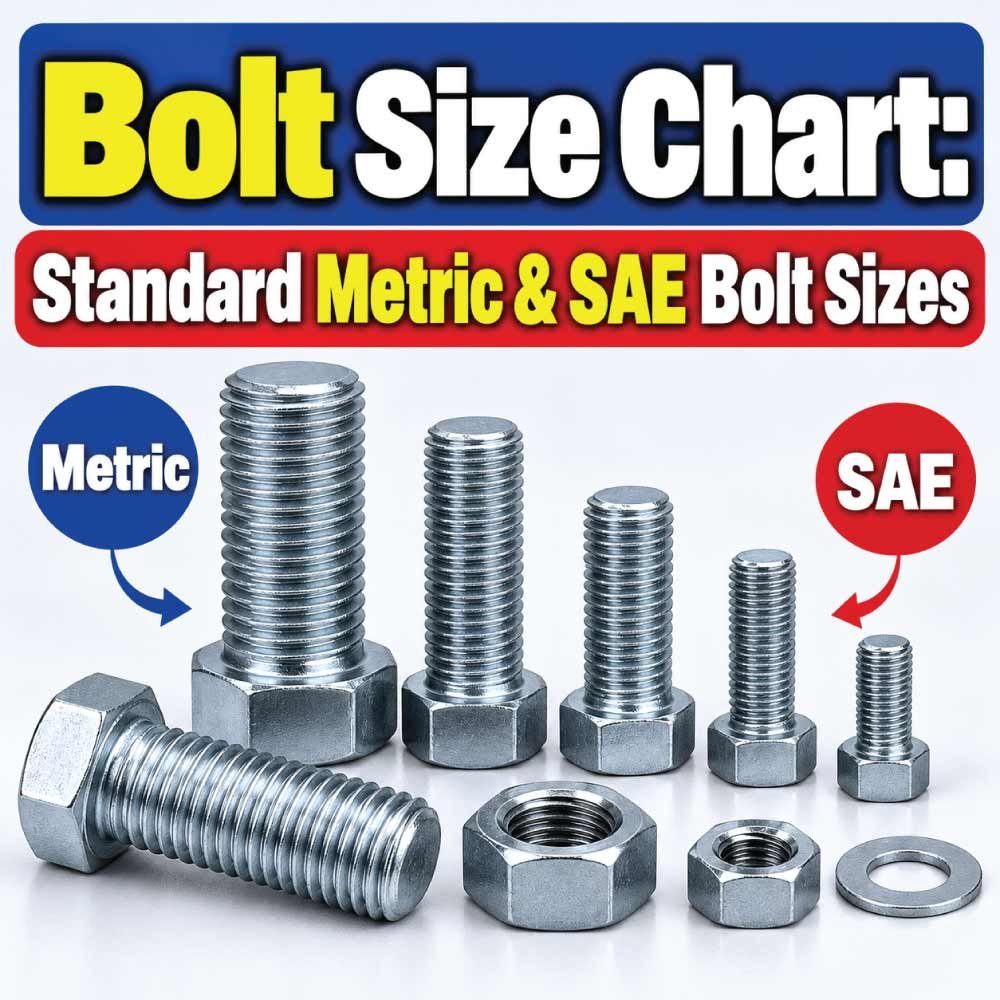
A bolt may look simple, but choosing the correct size involves more than measuring its overall length. Bolt diameter, thread pitch, thread length, head size, bolt grade, and measurement system all affect whether a fastener will fit and perform correctly. The two systems most commonly encountered are metric bolt sizes and SAE/inch bolt sizes.
This bolt size chart provides a practical reference for common metric and SAE bolts, including nominal diameter, thread information, typical lengths, and identification methods. It also explains how to measure a bolt, how metric and SAE sizes differ, and how to choose the correct fastener for an application.
Whether you are replacing a missing fastener, repairing machinery, working on an automobile, or organizing a hardware collection, the tables below can help you identify the right bolt more confidently.
What Is a Bolt Size?
Bolt size describes the key dimensions used to identify a bolt and determine whether it is suitable for a particular threaded hole or nut. The most important measurements are diameter and length, while thread pitch or thread count determines whether the bolt will properly engage with the mating thread.
A bolt is commonly identified using a combination such as M8 × 1.25 × 50 mm. In this example:
- M8 = metric nominal diameter of 8 mm
- 1.25 mm = thread pitch
- 50 mm = bolt length
An SAE bolt may instead be identified as 1/2-13 × 2 in, meaning:
- 1/2 in = nominal bolt diameter
- 13 = 13 threads per inch
- 2 in = bolt length
The term bolt size therefore does not refer to only one measurement.
Important Bolt Dimensions
The main dimensions to consider include:
Nominal diameter: The approximate outside diameter of the bolt thread.
Length: Measured according to the bolt’s standard measurement method.
Thread pitch: The distance between threads on a metric bolt.
Threads per inch (TPI): Number of threads per inch on an SAE/inch bolt.
Thread length: The portion of the shank that is threaded.
Head dimensions: Important when selecting a wrench or socket.
Thread type: Determines compatibility with the mating nut or threaded hole.
Metric Bolt Size Chart
Metric bolts are identified using millimeters and normally use the letter M followed by the nominal thread diameter. Common sizes include M4, M5, M6, M8, M10, M12, M14, M16, M20, and larger sizes.
The following chart provides common coarse-thread metric sizes. Exact dimensions, thread forms, head dimensions, and available lengths can vary according to the applicable fastener standard and bolt type.
| Metric Size | Nominal Diameter (mm) | Common Coarse Pitch (mm) | Common Applications |
|---|---|---|---|
| M4 | 4 | 0.70 | Small equipment, electronics |
| M5 | 5 | 0.80 | Light machinery, brackets |
| M6 | 6 | 1.00 | Automotive, equipment |
| M8 | 8 | 1.25 | Machinery, automotive |
| M10 | 10 | 1.50 | Machinery, structural assemblies |
| M12 | 12 | 1.75 | Automotive, machinery |
| M14 | 14 | 2.00 | Heavy equipment |
| M16 | 16 | 2.00 | Machinery, structural applications |
| M18 | 18 | 2.50 | Heavy machinery |
| M20 | 20 | 2.50 | Heavy-duty assemblies |
| M22 | 22 | 2.50 | Heavy equipment |
| M24 | 24 | 3.00 | Structural and industrial applications |
The pitch values above represent common coarse metric threads rather than every possible thread option. A bolt can also have a fine or extra-fine thread, so never assume the pitch from diameter alone when thread compatibility is critical.
What Does M8 Mean on a Bolt?
M8 means the bolt has a nominal metric thread diameter of approximately 8 mm.
It does not specify the bolt’s length. For example, M8 bolts may be available in many different lengths. The complete designation could be M8 × 1.25 × 30 mm, M8 × 1.25 × 50 mm, or another length depending on the application.
SAE Bolt Size Chart
SAE is commonly used as a general term for inch-based fastener sizes, although different inch fastener standards can apply depending on the bolt and application.
In an inch bolt designation, the diameter is expressed in inches and thread pitch is commonly represented by threads per inch (TPI).
| SAE/Inch Size | Nominal Diameter (in) | Common Coarse TPI | Common Fine TPI |
|---|---|---|---|
| #6 | 0.138 | 32 | 40 |
| #8 | 0.164 | 32 | 36 |
| #10 | 0.190 | 24 | 32 |
| 1/4 in | 0.250 | 20 | 28 |
| 5/16 in | 0.3125 | 18 | 24 |
| 3/8 in | 0.375 | 16 | 24 |
| 7/16 in | 0.4375 | 14 | 20 |
| 1/2 in | 0.500 | 13 | 20 |
| 9/16 in | 0.5625 | 12 | 18 |
| 5/8 in | 0.625 | 11 | 18 |
| 3/4 in | 0.750 | 10 | 16 |
| 7/8 in | 0.875 | 9 | 14 |
| 1 in | 1.000 | 8 | 12 |
The smaller #6, #8, and #10 designations are screw-size numbers rather than fractional-inch diameters. For larger bolts, fractional diameter designations are common.
Metric vs SAE Bolt Sizes
The biggest difference between metric and SAE bolts is the measurement system.
Metric bolts use millimeters, while inch fasteners use inches and commonly specify thread count as TPI.
| Feature | Metric Bolt | SAE/Inch Bolt |
|---|---|---|
| Diameter | Millimeters | Inches |
| Thread specification | Pitch in mm | Threads per inch |
| Example | M10 × 1.5 | 3/8-16 |
| Thread pitch direction | Higher pitch number means greater thread spacing | Lower TPI means greater thread spacing |
| Common identification | M + diameter + pitch | Diameter + TPI |
| Typical wrench system | Metric | Inch/SAE |
A metric M10 bolt is not interchangeable with an inch bolt that happens to have a similar measured diameter. Even when two bolts appear close in size, their threads may have different pitch, diameter, or engagement characteristics.
Can You Substitute SAE and Metric Bolts?
Generally, do not substitute one for the other simply because the diameter looks similar.
For example, a metric and inch bolt may fit through the same clearance hole, but that does not mean their threads will safely mate with the same nut or threaded hole.
Always verify:
- Nominal diameter
- Thread pitch or TPI
- Thread form
- Length
- Grade or property class
- Head style
- Application requirements
For safety-critical assemblies, use the specified fastener rather than relying on approximate metric-to-SAE equivalents.
Metric Bolt Length Chart
Bolt length is one of the most important measurements when replacing a fastener. Common metric bolt lengths are specified in millimeters.
The available lengths depend on the bolt diameter, style, standard, manufacturer, and application.
| Diameter | Example Common Lengths (mm) |
|---|---|
| M4 | 6, 8, 10, 12, 16, 20, 25, 30 |
| M5 | 8, 10, 12, 16, 20, 25, 30, 40 |
| M6 | 10, 12, 16, 20, 25, 30, 40, 50 |
| M8 | 12, 16, 20, 25, 30, 40, 50, 60, 70 |
| M10 | 16, 20, 25, 30, 40, 50, 60, 70, 80 |
| M12 | 20, 25, 30, 40, 50, 60, 70, 80, 100 |
| M16 | 30, 40, 50, 60, 70, 80, 100, 120 |
| M20 | 40, 50, 60, 70, 80, 100, 120, 150 |
These are representative common lengths, not a universal availability list.
How Is Bolt Length Measured?
For most hex-head bolts, length is measured from the bearing surface under the head to the end of the bolt.
A practical method is:
- Place the bolt on a flat surface.
- Position a ruler or caliper along the bolt’s axis.
- Measure from the underside of the head.
- Continue to the tip of the bolt.
- Record the measurement in millimeters or inches.
Countersunk and flat-head screws are different because their length is generally measured from the top of the head to the tip.
How to Measure a Bolt Correctly
If you have an unidentified bolt, you can determine most of its important dimensions with a caliper, ruler, and thread gauge.
1. Measure the Diameter
Use a caliper to measure across the outside of the threaded portion.
The measurement will usually be close to a standard nominal diameter.
For example:
- Around 6 mm → potentially M6
- Around 8 mm → potentially M8
- Around 10 mm → potentially M10
- Around 12 mm → potentially M12
For inch bolts, compare the measurement against fractional-inch sizes.
Do not identify the bolt from diameter alone.
2. Measure the Length
Measure the bolt according to the appropriate head-style convention.
For a typical hex-head bolt, measure from under the head to the tip.
3. Determine the Thread Pitch
For metric threads, measure the distance between adjacent thread peaks. A metric thread gauge makes this much easier.
For inch threads, determine the threads per inch.
A thread gauge is particularly useful because visually similar threads can be difficult to distinguish accurately.
4. Check the Thread Type
A bolt can have the correct diameter but still be incompatible because of a different pitch.
For example, metric coarse and metric fine threads can have the same nominal diameter but different pitches.
Likewise, an inch bolt can be available in coarse and fine thread configurations.
5. Check the Head and Grade
If the replacement must fit an existing socket or wrench, measure the head dimensions or identify the applicable bolt standard.
Also check markings on the head. Metric and inch high-strength fasteners can use different marking systems, so head markings should not be interpreted without considering the relevant standard.
Also Read:
Understanding Bolt Thread Pitch
Thread pitch describes the spacing between threads on a metric fastener. It is measured in millimeters from one thread crest to the next.
For example, a thread pitch of 1.5 mm means adjacent thread crests are separated by 1.5 mm.
In inch systems, the equivalent concept is commonly expressed as threads per inch.
Coarse vs Fine Threads
Both metric and inch fasteners can have coarse and fine threads.
Coarse threads generally have greater spacing between threads, while fine threads have smaller spacing and more threads over the same length.
The correct choice depends on the application, material, assembly requirements, and applicable fastener specification.
Fine threads may be selected where a particular adjustment or engagement characteristic is required, while coarse threads are widely used for general fastening.
The important rule is simple: match the thread specification to the mating component.
Common Metric Bolt Sizes and Uses
Different bolt diameters are commonly encountered in different types of work.
Small Metric Bolts: M4 to M6
M4 and M5 fasteners are common in smaller equipment, brackets, enclosures, and assemblies.
M6 bolts are more substantial and appear frequently in machinery, automotive components, mounting brackets, and general mechanical work.
Medium Metric Bolts: M8 to M12
M8, M10, and M12 are among the most frequently encountered metric bolt diameters.
They are used in:
- Automotive assemblies
- Machinery
- Equipment frames
- Mounting brackets
- Mechanical components
- General fabrication
The required grade and length depend on the specific application.
Large Metric Bolts: M14 and Above
Larger bolts such as M14, M16, M20, M22, and M24 are common in heavy machinery, structural assemblies, industrial equipment, and other applications where larger fasteners are specified.
A larger diameter does not automatically make a bolt suitable for every heavy-duty application. Material grade, property class, joint design, preload, and installation requirements also matter.
Also Read:
Common SAE Bolt Sizes and Uses
Common inch bolt sizes include 1/4, 5/16, 3/8, 7/16, 1/2, 5/8, 3/4, 7/8, and 1 inch.
Smaller inch sizes are frequently found in machinery, equipment, furniture hardware, older vehicles, and general repair work. Larger sizes are used where the design calls for larger fasteners.
When identifying an SAE bolt, check both diameter and TPI.
For example:
1/2-13 means a nominal diameter of 1/2 inch and 13 threads per inch.
A 1/2-20 bolt has the same nominal diameter but a different thread pitch. These should not be treated as interchangeable.
Bolt Grade and Strength
Size is only one part of selecting a bolt. Strength classification is equally important when the joint carries significant loads.
Metric bolts may be identified by property classes such as 8.8, 10.9, or 12.9, while inch fasteners may use SAE or ASTM-related grade markings depending on the fastener specification.
The exact mechanical properties depend on the applicable standard and product specification.
Why Bolt Grade Matters
Two bolts can have identical diameter and length but significantly different strength characteristics.
When replacing a bolt in an engineered or load-bearing assembly:
- Match the specified grade or property class.
- Do not replace a high-strength bolt with an ordinary low-strength bolt.
- Follow the manufacturer’s torque and installation instructions.
- Consider the washer and nut specification as part of the complete joint.
- Use the applicable engineering or fastener standard when requirements are critical.
Also Read:
How to Choose the Correct Bolt Size
Choosing a bolt should be based on the complete fastening requirement rather than diameter alone.
Check the Existing Thread
If replacing an existing bolt, determine whether the mating hole or nut is metric or inch-based.
Never force a bolt into a threaded hole. Resistance during initial engagement can indicate an incorrect thread.
Select the Correct Diameter
The bolt diameter should correspond to the design requirements and mating component.
For replacement work, the safest approach is usually to identify the original specification rather than simply choosing a bolt that looks similar.
Choose the Correct Length
The bolt must provide sufficient thread engagement without being unnecessarily long.
Too-short fasteners may not provide adequate engagement. Excessively long bolts can interfere with surrounding components or create clearance problems.
Match the Strength Grade
For machinery, vehicles, structural components, and other loaded joints, use the specified bolt grade or property class.
Match the Head Style
Common bolt head styles include:
- Hex head
- Socket head
- Flange head
- Carriage head
- Eye bolt
- U-bolt
- Other specialized designs
The head style affects installation, clearance, wrench access, and application suitability.
Common Bolt Selection Mistakes
Many fastening problems come from selecting a bolt based on only one dimension.
Avoid these common mistakes:
Choosing by diameter only: Similar diameters can have incompatible threads.
Ignoring thread pitch: Metric coarse and fine threads are not interchangeable.
Mixing metric and inch threads: A close visual match is not enough.
Using the wrong length: Insufficient engagement or excessive protrusion can cause problems.
Ignoring strength class: A bolt’s size does not define its complete strength.
Forcing a mismatched bolt: Cross-threading can damage the bolt and threaded hole.
Assuming all M10 bolts have the same pitch: Different metric pitches are available.
Assuming socket size identifies bolt diameter: Head dimensions vary by bolt type and standard.
Ignoring manufacturer requirements: Specialized equipment may require a specific fastener specification.
Bolt Size Conversion: Metric and SAE
There is no perfect one-to-one conversion between all metric and SAE bolt sizes.
Some diameters are physically close, but their threads may not match.
| Metric Diameter | Approx. Inch Diameter | Nearby Common Inch Size |
|---|---|---|
| M6 | 0.236 in | 1/4 in |
| M8 | 0.315 in | 5/16 in |
| M10 | 0.394 in | 3/8 in |
| M12 | 0.472 in | 7/16 or 1/2 in |
| M16 | 0.630 in | 5/8 in |
| M20 | 0.787 in | 3/4 in |
| M24 | 0.945 in | 1 in |
These comparisons are diameter approximations only, not thread-compatible substitutions.
For example, M8 is close in diameter to 5/16 inch, but an M8 threaded fastener should not be assumed to replace a 5/16-inch bolt.
Bolt Size Chart for Quick Reference
For everyday identification, the following condensed chart brings together common metric and inch sizes.
| Metric Size | Diameter (mm) | Common Coarse Pitch (mm) | Inch Size | Diameter (in) |
|---|---|---|---|---|
| M6 | 6 | 1.00 | 1/4 in | 0.250 |
| M8 | 8 | 1.25 | 5/16 in | 0.3125 |
| M10 | 10 | 1.50 | 3/8 in | 0.375 |
| M12 | 12 | 1.75 | 7/16 in | 0.4375 |
| M14 | 14 | 2.00 | 1/2 in | 0.500 |
| M16 | 16 | 2.00 | 5/8 in | 0.625 |
| M20 | 20 | 2.50 | 3/4 in | 0.750 |
| M22 | 22 | 2.50 | 7/8 in | 0.875 |
| M24 | 24 | 3.00 | 1 in | 1.000 |
Use this table as a quick reference for approximate diameter comparisons. For actual replacement, always verify the complete thread specification.
Frequently Asked Questions About Bolt Sizes
What is the most common metric bolt size?
There is no single universal most common size because usage varies by industry. M6, M8, M10, and M12 are widely encountered in general mechanical, automotive, equipment, and fabrication applications.
What is the most common SAE bolt size?
Common inch sizes include 1/4, 5/16, 3/8, 7/16, 1/2, and 5/8 inch. The appropriate size depends on the equipment and fastening application.
How do I know if a bolt is metric or SAE?
Measure its diameter and thread pitch. Metric threads are specified by millimeters and pitch, while inch threads commonly use inches and TPI. A thread gauge provides a much more reliable identification than visual inspection alone.
Does bolt length include the head?
For most conventional hex-head bolts, the stated length is measured from under the head to the end of the bolt. Head-style exceptions exist, so use the applicable fastener standard when precision matters.
Can I use a metric bolt in an SAE nut?
Generally, no. Even if the diameters appear similar, the threads may have different pitch and form. Use a nut designed for the same thread specification as the bolt.
What does M10 × 1.5 mean?
It means a metric bolt with a 10 mm nominal diameter and a 1.5 mm thread pitch. If a length is included, it follows the thread specification, such as M10 × 1.5 × 50 mm.
What does 3/8-16 mean?
It indicates an inch bolt with a 3/8-inch nominal diameter and 16 threads per inch.
Is a higher bolt grade always better?
Not necessarily. The correct grade depends on the joint design and application. Using a different grade can affect preload, installation, compatibility, and joint performance. Follow the specified fastener requirements rather than choosing solely on the highest available strength.
Final Takeaway
A reliable bolt size chart is useful for quickly comparing common metric and SAE fasteners, but accurate bolt identification requires more than diameter. Check the diameter, length, thread pitch or TPI, thread type, head style, and strength classification before selecting a replacement.
Metric bolts use millimeters and thread pitch, while SAE/inch bolts use inches and commonly specify threads per inch. Although some metric and inch diameters are physically close, they should not be considered interchangeable unless the complete fastening specification confirms compatibility.
For ordinary repairs, a caliper and thread gauge can make identification much easier. For automotive, structural, industrial, or safety-critical applications, always follow the original specification, applicable standard, or manufacturer’s documentation.