
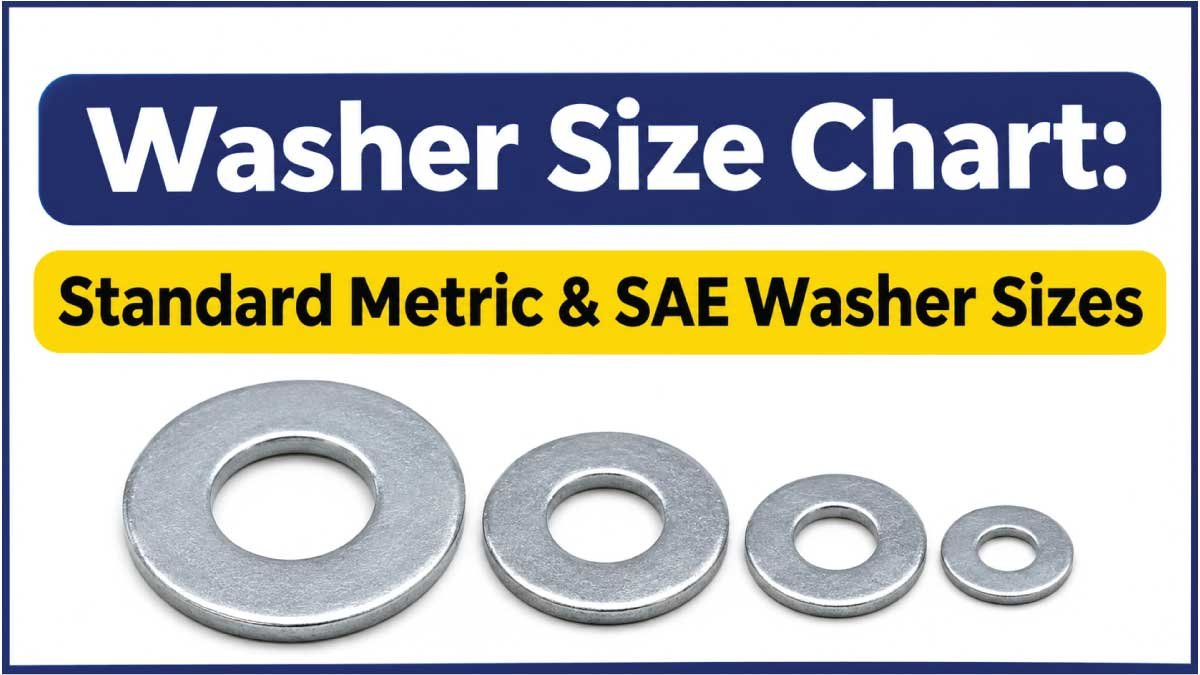
Choosing the right washer is not simply a matter of matching the bolt diameter. A washer must have a suitable inside diameter (ID), outside diameter (OD), thickness, material, and load-bearing area for the application. The correct dimensions can also vary depending on the washer type and manufacturing standard.
This washer size chart provides a practical reference for common metric and SAE washer sizes, including nominal bolt size, inside diameter, outside diameter, and typical thickness. It also explains how to measure a washer, how metric and SAE sizes differ, and how to select the correct washer for a specific fastener.
Because washer dimensions vary between standards such as ISO, DIN, ASME, and SAE, the values below should be treated as common reference dimensions rather than a substitute for the specification of a particular washer.
What Is a Washer?
A washer is a flat or specially shaped component placed around a bolt, screw, or other fastener. Its primary purpose is to distribute the load of the fastener over a larger surface area.
A typical flat washer has three important dimensions:
- Inside diameter (ID): The diameter of the central hole.
- Outside diameter (OD): The overall diameter of the washer.
- Thickness: The distance from one flat face to the other.
For example, an M8 washer is designed for an approximately 8 mm nominal bolt size, but its actual hole, outside diameter, and thickness depend on the washer standard and type.
Washers can also perform other functions. They may help protect a surface from damage, provide a larger bearing surface, reduce the chance of a fastener pulling through a softer material, or help distribute clamping forces.
Common washer types include:
- Flat washers
- Fender washers
- Large OD washers
- Lock washers
- Split lock washers
- Structural washers
- Countersunk washers
- Sealing washers
- Shoulder washers
This article focuses primarily on standard flat washers, because their dimensions are the most commonly searched when someone needs a washer size chart.
Metric Washer Size Chart
Metric washers are generally identified by the nominal metric fastener size they are intended to accommodate, such as M4, M5, M6, M8, M10, or M12.
The following chart gives representative dimensions for common metric flat washers. Actual dimensions can differ by the applicable standard, washer series, and manufacturer.
| Nominal Washer Size | Bolt Size (mm) | Approx. Inside Diameter (mm) | Approx. Outside Diameter (mm) | Typical Thickness (mm) |
|---|---|---|---|---|
| M3 | 3 | 3.2 | 7 | 0.5 |
| M4 | 4 | 4.3 | 9 | 0.8 |
| M5 | 5 | 5.3 | 10 | 1.0 |
| M6 | 6 | 6.4 | 12 | 1.6 |
| M8 | 8 | 8.4 | 16 | 1.6 |
| M10 | 10 | 10.5 | 20 | 2.0 |
| M12 | 12 | 13 | 24 | 2.5 |
| M14 | 14 | 15 | 28 | 2.5 |
| M16 | 16 | 17 | 30 | 3.0 |
| M18 | 18 | 19 | 34 | 3.0 |
| M20 | 20 | 21 | 37 | 3.0 |
| M22 | 22 | 23 | 39 | 3.0 |
| M24 | 24 | 25 | 44 | 4.0 |
These dimensions are useful for identifying the general size relationship between the fastener and washer. However, a washer marked for M8 is not guaranteed to have identical OD or thickness across every standard.
For precision applications, always check the drawing, product specification, or applicable standard.
Common SAE Washer Size Chart
SAE washers are associated with inch-based fasteners. Instead of an M-size designation, they are commonly selected according to the nominal diameter of the bolt, such as 1/4 inch, 5/16 inch, 3/8 inch, 1/2 inch, or 3/4 inch.
The term SAE is often used commercially for relatively narrow OD flat washers, but washer dimensions can vary by specification. The chart below is therefore a practical reference rather than a universal dimensional standard.
| Nominal Bolt Size | Bolt Diameter (in.) | Approx. Inside Diameter (in.) | Approx. Outside Diameter (in.) | Typical Thickness (in.) |
|---|---|---|---|---|
| #6 | 0.138 | 0.156 | 0.375 | 0.016–0.032 |
| #8 | 0.164 | 0.188 | 0.375 | 0.016–0.032 |
| #10 | 0.190 | 0.203 | 0.438 | 0.032–0.063 |
| 1/4 | 0.250 | 0.281 | 0.562 | 0.032–0.063 |
| 5/16 | 0.313 | 0.344 | 0.688 | 0.032–0.063 |
| 3/8 | 0.375 | 0.406 | 0.812 | 0.032–0.063 |
| 7/16 | 0.438 | 0.469 | 0.922 | 0.047–0.094 |
| 1/2 | 0.500 | 0.531 | 1.062 | 0.063–0.125 |
| 5/8 | 0.625 | 0.656 | 1.312 | 0.063–0.125 |
| 3/4 | 0.750 | 0.781 | 1.469 | 0.063–0.125 |
| 7/8 | 0.875 | 0.906 | 1.750 | 0.063–0.125 |
| 1 | 1.000 | 1.062 | 2.000 | 0.094–0.188 |
The thickness values shown as ranges emphasize an important point: washer thickness is not determined solely by bolt diameter. Manufacturers can supply different thicknesses for different washer series and applications.
Metric vs SAE Washer Sizes
The most obvious difference between metric and SAE washers is the measurement system.
Metric washers are designed around millimeter-based fastener sizes, while SAE and other inch-based washer specifications are designed around inch-based fasteners.
For example:
- An M6 washer is intended for a nominal 6 mm fastener.
- A 1/4-inch washer is intended for a nominal 1/4-inch fastener.
- An M10 washer is intended for a nominal 10 mm fastener.
- A 3/8-inch washer is intended for a nominal 3/8-inch fastener.
Although some metric and inch sizes appear close, they should not automatically be treated as interchangeable.
| Metric Size | Approx. Inch Equivalent | Common Inch Size Nearby |
|---|---|---|
| M4 | 0.157 in. | #8 |
| M5 | 0.197 in. | #10 |
| M6 | 0.236 in. | 1/4 in. |
| M8 | 0.315 in. | 5/16 in. |
| M10 | 0.394 in. | 3/8 in. |
| M12 | 0.472 in. | 1/2 in. |
| M16 | 0.630 in. | 5/8 in. |
| M20 | 0.787 in. | 3/4 in. |
| M24 | 0.945 in. | 1 in. |
These comparisons are not recommendations for substitution. Thread diameter is only one factor, and the washer’s actual hole and bearing dimensions may make one size unsuitable for another fastener.
Washer Dimensions You Need to Know
Understanding the three basic washer dimensions makes it much easier to select the correct component.
1. Inside Diameter
The inside diameter is the measurement across the washer’s central hole.
It needs to be large enough to allow the bolt or screw to pass through without binding. However, an excessively large hole may reduce the washer’s effective bearing area and can allow the washer to shift significantly during assembly.
For a standard washer, the hole is normally specified with the intended nominal fastener size in mind rather than being exactly equal to the bolt’s measured shaft diameter.
2. Outside Diameter
The outside diameter determines how much surface area the washer covers.
A larger OD provides a larger bearing area. This can be useful when fastening through:
- Wood
- Plastic
- Sheet metal
- Composite materials
- Soft or easily damaged surfaces
A standard narrow washer and a large OD washer may both fit an M8 bolt, but they provide very different bearing areas.
3. Thickness
Thickness affects the washer’s stiffness, durability, and load distribution.
Thin washers can be suitable for ordinary fastening applications, while thicker washers may be preferred when greater rigidity or load distribution is required.
However, simply choosing the thickest washer available is not always appropriate. The correct thickness depends on the application, fastener assembly, available clearance, and relevant specification.
How to Measure a Washer
If you have an unidentified washer and need to determine its size, you can measure it with a caliper or micrometer.
Measure the Inside Diameter
Place the caliper jaws inside the central hole and expand them until they touch opposite sides.
Record the measurement in millimeters or inches.
For example, if the hole measures approximately 8.4 mm, it may correspond to a washer intended for an M8 fastener, depending on its standard.
Measure the Outside Diameter
Close the caliper around the outside edges of the washer.
Do not measure diagonally. Measure straight across the center for the most useful dimensional reference.
Measure the Thickness
Place the washer between the flat faces of the caliper jaws and measure its thickness.
Avoid applying excessive pressure because a thin washer can deform slightly.
Measure All Three
For reliable identification, record:
- Inside diameter
- Outside diameter
- Thickness
Then compare those measurements with the manufacturer’s dimensional chart or applicable standard.
How to Choose the Correct Washer Size
Selecting a washer starts with the fastener but should not end there.
Match the Nominal Fastener Size
First identify whether the fastener is metric or inch-based.
A metric bolt may be marked or identified as M6, M8, M10, and so on. An inch fastener may be identified as 1/4-20, 3/8-16, 1/2-13, or another size and thread specification.
The washer should be compatible with the fastener diameter.
Check the Hole Diameter
The washer hole should provide adequate clearance for the fastener.
A hole that is too small will not fit over the bolt. A hole that is unnecessarily large may reduce the effectiveness of the washer for the particular joint.
Consider the Outside Diameter
Think about the material being clamped.
If the bolt head or nut would otherwise concentrate force on a relatively small area, a washer with a larger bearing surface may be appropriate.
Consider Thickness
Choose a thickness appropriate for the washer standard and application.
For demanding structural or mechanical assemblies, do not substitute a generic washer simply because its diameter appears correct. The washer’s strength, hardness, material, and specification may all matter.
Check Material Compatibility
Washers are available in materials such as:
- Carbon steel
- Stainless steel
- Zinc-plated steel
- Brass
- Aluminum
- Nylon and other polymers
The material should suit the environment and the fastener assembly. Corrosion resistance, temperature, electrical insulation, and mechanical strength may all influence the selection.
Also Read:
Standard Flat Washers vs Large OD Washers
Not every washer needs to have the same outside diameter.
A standard flat washer is designed for general-purpose fastening. A large OD washer, sometimes called a fender washer depending on its dimensions and application, has a larger outside diameter relative to its hole.
This provides additional surface coverage.
Large OD washers can be useful when fastening through materials that may deform under concentrated pressure, particularly thin sheet material.
For example, imagine an M6 bolt passing through a relatively thin panel. A normal M6 washer may provide adequate bearing area in one application, while a much larger washer could be more appropriate where the panel is prone to distortion.
The key principle is simple: match the washer’s bearing area to the joint and material rather than selecting solely by bolt diameter.
Washer Standards and Why Dimensions Vary
One reason people find conflicting washer size charts online is that there is no single universal dimensional table covering every washer.
Different standards and product series can specify different dimensions.
You may encounter references to:
- ISO
- DIN
- ASME
- SAE
- Manufacturer-specific specifications
Even when two washers are both described as M8, their outside diameter or thickness may differ because they belong to different dimensional series.
This matters when the washer must fit within a particular space or provide a specified bearing surface.
For a general repair or everyday fastening job, a commercially available washer of the correct type may be sufficient. For engineered assemblies, however, the drawing or governing standard should take precedence over a general washer size chart.
Also Read:
Common Washer Types and Their Uses
Flat Washers
Flat washers are the most common type and are used to distribute clamping force and protect mating surfaces.
They are available in many metric and inch sizes.
Fender Washers
Fender washers have a relatively large outside diameter and are commonly used where greater surface coverage is needed.
They are often useful with thin materials.
Lock Washers
Lock washers are designed for specific locking or anti-rotation purposes. Examples include split lock washers and other specialized designs.
They should not automatically be treated as equivalent to a standard flat washer.
Sealing Washers
These washers incorporate a sealing element or are made from a material suitable for sealing applications. They are commonly used where preventing fluid or moisture leakage is part of the joint requirement.
Shoulder Washers
Shoulder washers electrically or mechanically isolate a fastener from the surrounding component in applications where a conventional flat washer cannot perform the required function.
Also Read:
Washer Size Chart: Quick Selection Guide
When you already know the bolt size, this simplified guide can help you start your selection.
| Fastener | Washer Type to Consider | Primary Dimension to Check | Typical Purpose |
|---|---|---|---|
| M4 | Standard flat | ID, OD | General fastening |
| M5 | Standard flat | ID, OD | General fastening |
| M6 | Flat or large OD | ID, OD | Panels and assemblies |
| M8 | Flat or large OD | ID, OD, thickness | Machinery and general use |
| M10 | Flat or heavy-duty | ID, OD, thickness | Higher-load joints |
| M12 | Flat or heavy-duty | ID, OD, thickness | Machinery and structural use |
| 1/4 in. | SAE flat | ID, OD | General inch fasteners |
| 5/16 in. | SAE flat | ID, OD | General fastening |
| 3/8 in. | SAE flat | ID, OD | Machinery and equipment |
| 1/2 in. | SAE/heavy-duty | ID, OD, thickness | Higher-load assemblies |
This is a selection starting point, not a replacement for the applicable washer specification.
Why Washer Size Matters
Using the wrong washer can create problems even when the bolt itself is correct.
A washer that is too small may provide insufficient bearing area. A washer with an oversized hole may not adequately support the fastener assembly. An unsuitable material can also introduce corrosion or compatibility problems.
The washer helps manage the interface between the fastener head or nut and the material being clamped.
A properly selected washer can:
- Spread the clamping load.
- Reduce localized surface pressure.
- Protect softer surfaces.
- Provide a consistent bearing surface.
- Improve the suitability of the joint for the intended application.
However, a washer cannot compensate for an incorrectly designed or improperly tightened joint.
Common Washer Size Mistakes
Choosing by Bolt Diameter Alone
An M8 washer is not defined only by the fact that it fits an M8 bolt. The OD and thickness are also important.
Assuming All M8 Washers Are Identical
Different standards and washer series can have different dimensions.
Always check the complete specification when dimensions matter.
Mixing Metric and SAE Sizes
Some sizes are numerically close, but that does not mean they are interchangeable.
For example, an M6 fastener is close in diameter to a 1/4-inch fastener, but their dimensions and thread systems are different.
Ignoring Material
A stainless steel washer and a zinc-plated carbon-steel washer may have different performance characteristics.
Consider the environment before selecting the material.
Using a Very Large Washer Without Checking Clearance
A large OD washer may distribute force effectively but can interfere with nearby components, recesses, edges, or other hardware.
How to Read a Washer Size Specification
A washer specification may list dimensions in a format such as:
M8 × 16 × 1.6 mm
The exact notation can vary, but a dimensional description commonly represents:
- M8: Intended nominal fastener size
- 16 mm: Outside diameter
- 1.6 mm: Thickness
The inside diameter is normally provided separately in a dimensional table.
For inch washers, specifications may similarly provide a nominal fastener size followed by the washer’s dimensional details.
When purchasing replacement washers, compare the complete dimensional specification, not just the label on the package.
Frequently Asked Questions
What is the most common washer size?
There is no single most common washer size for every application. Sizes such as M6, M8, M10, 1/4 inch, 5/16 inch, and 3/8 inch are widely encountered in general mechanical and hardware applications, but the appropriate size depends on the fastener and joint.
Does an M8 washer fit an M8 bolt?
Yes, an appropriately specified M8 washer is designed for an M8 nominal fastener. However, verify the washer’s actual inside diameter, outside diameter, and thickness when dimensional accuracy is important.
What is the difference between metric and SAE washers?
Metric washers are associated with metric fastener sizes measured in millimeters, while SAE and other inch-based washer specifications are associated with inch fasteners. Their dimensions should not be assumed interchangeable.
How do I know what size washer I have?
Measure the inside diameter, outside diameter, and thickness with a caliper. Then compare those measurements with a dimensional chart or the manufacturer’s specification.
Should the washer be bigger than the bolt head?
The washer should provide an appropriate bearing surface under the bolt head or nut. Its outside diameter must be compatible with the fastener and joint. A larger washer can sometimes be beneficial, but it should not interfere with surrounding components.
Are thicker washers stronger?
Not necessarily in every application. Thickness is only one characteristic. Material, hardness, outside diameter, manufacturing specification, and intended application also influence washer performance.
Can I use an SAE washer on a metric bolt?
Physical fit may sometimes appear possible, but it should not be assumed to be an acceptable substitution. Check the hole size, bearing dimensions, material, thickness, and requirements of the application before substituting.
What washer should I use for soft material?
A washer with a larger bearing area may help distribute load over soft or thin material. Large OD washers are often considered for this purpose, but the correct choice depends on the material and joint design.
Practical Washer Selection Checklist
Before installing a washer, check these points:
- Identify the fastener: Metric or inch-based?
- Confirm nominal diameter: M6, M8, 1/4 inch, 3/8 inch, etc.
- Measure the washer ID: Make sure it accommodates the fastener.
- Check OD: Ensure it provides sufficient bearing area.
- Check thickness: Confirm it matches the intended washer series and application.
- Check material: Consider corrosion, temperature, strength, and compatibility.
- Confirm clearance: Make sure the washer will not interfere with surrounding parts.
- Check the standard: Use the specified ISO, DIN, ASME, SAE, or manufacturer dimensions when required.
- For critical assemblies: Follow the engineering drawing or manufacturer’s installation instructions.
This process is much more reliable than selecting a washer based only on appearance.
Final Takeaway
A good washer size chart is useful for quickly identifying the relationship between a washer and its fastener, but the nominal size is only the starting point. The inside diameter, outside diameter, thickness, material, washer type, and applicable standard all contribute to selecting the right component.
For common hardware, metric sizes such as M4 through M24 and inch sizes such as 1/4 through 1 inch cover many everyday fastening requirements. For precision, structural, or safety-critical applications, use the dimensional requirements of the relevant standard or manufacturer rather than relying solely on a general chart.
When in doubt, measure the existing washer or fastener, compare all three key washer dimensions, and verify the specification before installation.