
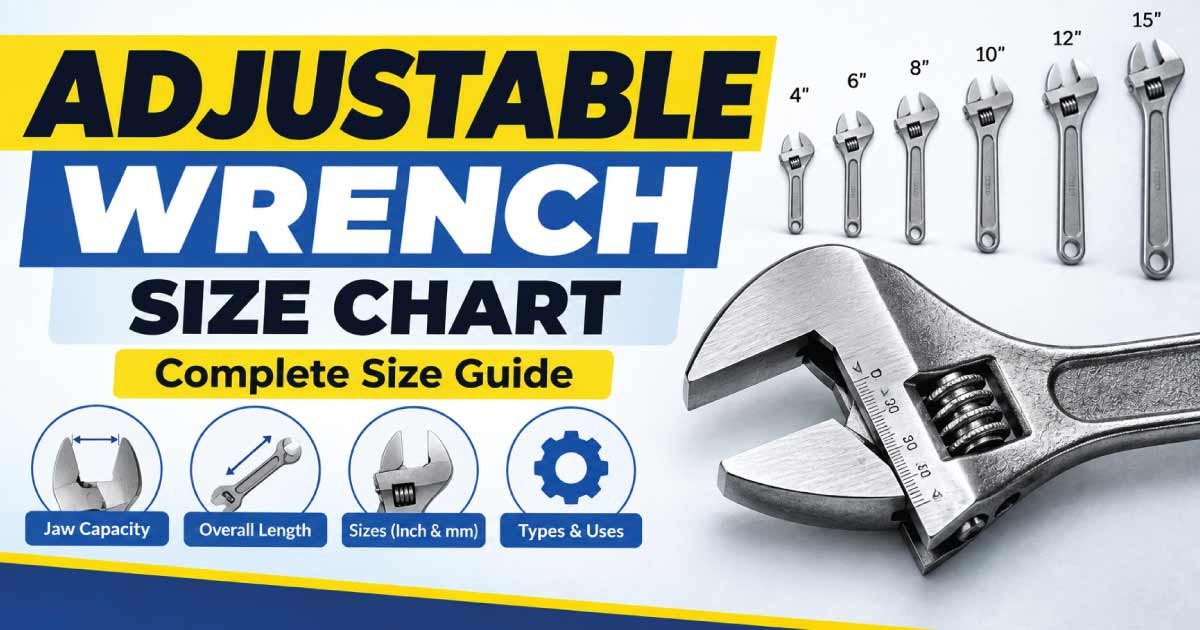
Below is a publication-ready article structured around the main search intent: understanding adjustable wrench sizes, comparing common lengths, interpreting jaw capacity, and choosing the right wrench for different jobs.
An adjustable wrench is one of the most versatile hand tools because its movable jaw allows one wrench to work with many different fastener sizes. However, choosing the right wrench is not simply a matter of picking the longest tool. Wrench length, jaw capacity, jaw opening, handle size, and the type of work all affect which adjustable wrench is appropriate.
This adjustable wrench size chart explains common wrench sizes in inches and millimeters, how adjustable wrench sizing works, how to measure one correctly, and which size is best for plumbing, automotive, mechanical, household, and general maintenance tasks. It also explains the difference between wrench length and jaw capacity so you can select the right tool without relying on guesswork.
What Is an Adjustable Wrench?
An adjustable wrench is a hand tool with a fixed jaw and a movable jaw. The movable jaw is controlled by a worm gear, allowing the opening to be increased or decreased to fit different nuts, bolts, fittings, and other fasteners.
Unlike a fixed-size combination wrench or open-end wrench, one adjustable wrench can accommodate a range of fastener sizes.
Adjustable wrenches are commonly used for:
- Plumbing fittings
- Automotive repairs
- Machinery maintenance
- Bicycle and equipment repairs
- Household maintenance
- General mechanical work
- Installation and assembly tasks
The size of an adjustable wrench normally refers to its overall length, rather than the maximum fastener size it can grip. For example, a 10-inch adjustable wrench is approximately 10 inches long from the head to the end of the handle.
Its actual jaw capacity can vary considerably between manufacturers and designs.
Adjustable Wrench Size Chart
The following chart shows common nominal adjustable wrench lengths and their approximate metric equivalents. Metric values are rounded conversions and should not be interpreted as exact manufacturer specifications.
| Nominal Wrench Size | Approx. Length (mm) | Typical Use | General Category |
|---|---|---|---|
| 4 in | 102 mm | Small repairs, light assembly | Compact |
| 6 in | 152 mm | Household and light mechanical work | Small |
| 8 in | 203 mm | General maintenance and automotive work | Medium |
| 10 in | 254 mm | Plumbing and mechanical work | Large |
| 12 in | 305 mm | Larger fittings and heavy-duty work | Extra Large |
| 15 in | 381 mm | Large mechanical and plumbing applications | Heavy Duty |
| 18 in | 457 mm | Very large fittings and industrial work | Heavy Duty |
| 24 in | 610 mm | Large industrial applications | Extra Heavy Duty |
These are nominal length categories, not universal jaw-opening specifications. A 10-inch adjustable wrench from one manufacturer may have a different maximum jaw capacity than another 10-inch wrench.
For that reason, always check the manufacturer’s specifications when the maximum opening is critical.
Common Adjustable Wrench Sizes Explained
Different wrench lengths are suited to different working conditions. A smaller wrench is easier to carry and maneuver, while a larger wrench generally provides a longer handle and greater leverage.
4-Inch Adjustable Wrench
A 4-inch adjustable wrench is designed for compact work where a larger wrench would be difficult to position.
It is useful for:
- Small hardware
- Tight spaces
- Light assembly
- Small plumbing components
- Electronics and equipment maintenance where appropriate
- Tool kits and emergency kits
Its compact size makes it convenient, but it is not intended to replace larger adjustable wrenches when greater jaw capacity or leverage is required.
6-Inch Adjustable Wrench
The 6-inch adjustable wrench is one of the more convenient sizes for general household work.
It offers a good combination of portability and accessibility. It can be useful for:
- Household repairs
- Small plumbing jobs
- Appliance maintenance
- Bicycle and equipment adjustments
- Light mechanical work
It is also easy to store in a toolbox or portable repair kit.
8-Inch Adjustable Wrench
An 8-inch adjustable wrench is a popular general-purpose size. It provides more handle length and working capacity than smaller models without becoming excessively large.
Typical applications include:
- Automotive maintenance
- Plumbing repairs
- Mechanical assembly
- General workshop tasks
- Fastener adjustment
- Equipment maintenance
For many general-purpose toolboxes, an 8-inch model is a practical middle-ground choice.
10-Inch Adjustable Wrench
A 10-inch adjustable wrench provides additional leverage and is commonly selected for larger fasteners and fittings.
It is often useful for:
- Plumbing work
- Automotive repairs
- Machinery maintenance
- Larger nuts and bolts
- General mechanical applications
The longer handle can make it easier to apply torque, but users should still avoid using an adjustable wrench as a substitute for a properly sized fixed wrench when high torque or precise fastener engagement is required.
12-Inch Adjustable Wrench
A 12-inch adjustable wrench is designed for larger work. Its longer handle provides greater leverage than compact models.
Common applications include:
- Large plumbing fittings
- Mechanical maintenance
- Industrial equipment
- Larger fasteners
- Heavy-duty repair work
Because of its size, it is less convenient in confined spaces.
15-Inch and Larger Adjustable Wrenches
Adjustable wrenches measuring 15 inches, 18 inches, 24 inches, or more are generally intended for large-scale mechanical, plumbing, maintenance, or industrial applications.
They provide substantial leverage, but their larger size can make them difficult to use around crowded components.
Large adjustable wrenches should therefore be selected according to the actual fitting, available clearance, required torque, and manufacturer recommendations.
How Adjustable Wrench Sizes Work
One of the most common misunderstandings is assuming that an adjustable wrench’s size directly represents the largest nut it can handle.
It does not.
The wrench size usually refers to the tool’s overall length. The maximum fastener size depends on the wrench’s jaw opening.
For example, two 10-inch adjustable wrenches may have different jaw capacities. One may be designed with a wider opening, while another may prioritize a slimmer head for access in confined areas.
The most important measurements are therefore:
- Overall length
- Maximum jaw opening
- Minimum jaw opening
- Jaw thickness
- Head width
- Handle dimensions
When purchasing a wrench, check both the nominal length and the manufacturer’s stated jaw capacity.
Adjustable Wrench Jaw Capacity
Jaw capacity describes how wide the adjustable wrench can open.
It is particularly important when you need to grip a large nut, bolt head, pipe fitting, or other hexagonal component.
A wrench with a larger nominal length does not automatically have a proportionally larger jaw opening. Different designs can have different capacities.
Why Jaw Opening Matters
Suppose you need to work on a large hexagonal fitting. A compact 6-inch wrench might physically reach the fitting but may not open wide enough to grip it.
In that situation, you need a wrench with a sufficient maximum jaw opening, regardless of the handle length.
For precise work, compare the required fastener width across flats with the manufacturer’s maximum jaw-opening specification.
Do Not Confuse Jaw Capacity With Wrench Length
These measurements describe different things:
| Measurement | What It Means | Why It Matters |
|---|---|---|
| Wrench length | Overall tool length | Affects leverage and access |
| Jaw opening | Maximum adjustable gap | Determines fastener compatibility |
| Head thickness | Thickness of wrench head | Affects clearance |
| Jaw width | Width of gripping surfaces | Affects access and contact |
| Handle length | Usable gripping area | Influences handling and leverage |
A good adjustable wrench size guide should therefore consider more than length alone.
SAE vs Metric Adjustable Wrench Sizes
Unlike fixed combination wrenches, adjustable wrenches do not normally have a separate SAE size and metric size for every fastener.
An adjustable wrench can generally be opened to fit either SAE or metric fasteners, provided the fastener falls within the wrench’s jaw capacity.
SAE fasteners are commonly specified in fractions of an inch, while metric fasteners are specified in millimeters.
For example, a fixed wrench might be labeled 1/2 inch or 13 mm. An adjustable wrench does not need to carry one of those fixed fastener sizes because its jaw can be adjusted.
Why Accurate Adjustment Matters
Although an adjustable wrench can work with many SAE and metric fasteners, the jaw should be adjusted closely around the fastener.
A loose fit can cause:
- Slipping
- Rounded corners
- Damage to the fastener
- Damage to the wrench
- Loss of control
For critical or high-torque work, a properly sized fixed wrench or socket is generally preferable because it provides a more precise fit.
How to Measure an Adjustable Wrench
If you already own an adjustable wrench and want to determine its size, start by measuring its overall length.
1. Measure Overall Length
Place the wrench on a flat surface and measure from the end of the handle to the farthest point of the wrench head.
Record the measurement in inches or millimeters.
For example:
- Approximately 150 mm = about 6 inches
- Approximately 200 mm = about 8 inches
- Approximately 250 mm = about 10 inches
- Approximately 300 mm = about 12 inches
These are rounded conversions.
2. Measure Maximum Jaw Opening
Open the movable jaw as far as it will go and measure the distance between the gripping surfaces.
A caliper can provide a more accurate measurement than a standard ruler.
3. Check Manufacturer Markings
Many adjustable wrenches have their size or brand information stamped on the handle.
If the wrench has a model number, checking the manufacturer’s product documentation is often the best way to determine its original specifications.
Also Read:
How to Choose the Right Adjustable Wrench Size
Selecting the correct adjustable wrench involves balancing jaw capacity, access, leverage, and the size of the fastener.
Choose Based on the Fastener
First determine the width of the nut, bolt head, or fitting you need to turn.
The wrench must have enough jaw opening to accommodate it.
Do not select a wrench solely because its handle looks large enough.
Consider Working Space
A large wrench may have enough capacity but still be unsuitable if there is limited room around the fastener.
For confined spaces, a smaller or slim-profile adjustable wrench may be easier to position.
Consider Required Leverage
Longer handles generally provide more leverage.
A rough relationship can be understood through the torque equation:
Torque = Force × Lever Arm
Increasing the effective handle length can increase the torque produced by the same applied force.
However, this does not mean you should use an excessively large wrench to force a stubborn fastener. If high torque is required, use the appropriate tool and follow the manufacturer’s recommendations.
Consider Frequency of Use
For a general-purpose toolbox, an 8-inch adjustable wrench is often a practical starting point because it balances portability, access, and leverage.
A broader selection may include:
- 6-inch for compact work
- 8-inch for general-purpose work
- 10-inch for larger maintenance tasks
- 12-inch for larger fittings
- Larger sizes for specialized applications
Also Read:
Adjustable Wrench Size by Application
The ideal size depends on the task rather than a single universal recommendation.
| Application | Commonly Useful Size Range | Important Consideration |
|---|---|---|
| Household repairs | 6–8 in | Compactness and access |
| General maintenance | 8–10 in | Versatility |
| Automotive work | 8–12 in | Jaw capacity and clearance |
| Plumbing | 8–12 in | Fitting size and access |
| Large plumbing | 12 in and larger | Jaw opening and leverage |
| Machinery maintenance | 8–15 in | Fastener size and clearance |
| Industrial work | 12 in and larger | Manufacturer specifications |
| Tight spaces | 4–6 in | Compact head and handle |
These ranges are general guidance. The actual wrench should always be selected according to the fastener dimensions and working environment.
Types of Adjustable Wrenches
Not every adjustable wrench has the same design. Different versions are optimized for different applications.
Standard Adjustable Wrench
The standard adjustable wrench has a movable jaw controlled by a worm screw.
It is suitable for:
- General maintenance
- Household repairs
- Automotive work
- Mechanical assembly
- Plumbing applications
This is the most familiar adjustable wrench design.
Wide-Jaw Adjustable Wrench
Wide-jaw models are designed to provide greater opening capacity relative to their overall length.
They can be useful when you need to work on larger fittings but do not want an excessively long handle.
Slim-Profile Adjustable Wrench
Slim-profile designs have a narrower head or jaws to improve access around crowded components.
They are useful where a standard wrench head cannot fit easily.
Ratcheting Adjustable Wrench
Some specialized adjustable wrenches incorporate a ratcheting mechanism. These can reduce the need to repeatedly remove and reposition the tool.
However, they should be evaluated according to the manufacturer’s rated application and torque limitations.
Also Read:
Adjustable Wrench vs Fixed Wrench
An adjustable wrench offers flexibility, while a fixed wrench usually provides a more precise fit.
| Feature | Adjustable Wrench | Fixed Wrench |
|---|---|---|
| Multiple fastener sizes | Excellent | Requires multiple tools |
| Fastener fit | Adjustable | Precisely sized |
| Portability | Good | Depends on set size |
| Tight-space access | Varies by design | Often excellent |
| High-torque work | Application dependent | Generally preferred when correctly sized |
| Convenience | High | High for known sizes |
| Risk of slipping | Higher if poorly adjusted | Lower with correct size |
An adjustable wrench is especially valuable when you need flexibility or do not know the exact fastener size beforehand.
For repeated work on known fasteners, however, a properly sized fixed wrench or socket can offer a better fit.
Advantages of an Adjustable Wrench
The main benefit is versatility. One tool can cover a range of fastener sizes.
Other advantages include:
- Versatility: One wrench can replace several fixed sizes for many general tasks.
- Portability: A small selection of adjustable wrenches can cover many applications.
- Convenience: The jaw can be adjusted quickly.
- Space saving: Fewer individual tools may be required.
- Useful for unknown sizes: You can adjust the wrench to the fastener rather than knowing the exact size beforehand.
These characteristics make adjustable wrenches especially useful for maintenance kits and general-purpose toolboxes.
Limitations of Adjustable Wrenches
Adjustable wrenches are versatile, but they are not the ideal choice for every job.
Potential limitations include:
- The movable jaw can shift if it is not properly adjusted.
- Incorrect adjustment can damage fastener corners.
- The head may be thicker than a comparable fixed wrench.
- Jaw capacity varies by model.
- They may be less suitable for high-torque applications.
- Large models can be difficult to use in confined spaces.
For a tight or damaged fastener, using the correct fixed-size wrench or socket is often a better approach.
How to Use an Adjustable Wrench Correctly
Correct adjustment is important for both safety and fastener protection.
Step 1: Select the Appropriate Size
Choose a wrench with enough jaw capacity for the fastener without using a significantly oversized tool unnecessarily.
Step 2: Adjust the Movable Jaw
Turn the adjustment mechanism until the jaws are slightly wider than the fastener.
Step 3: Seat the Wrench Fully
Position the jaws squarely on the fastener. The gripping surfaces should contact the flat sides rather than the corners.
Step 4: Remove Excess Jaw Clearance
Turn the adjustment mechanism until the movable jaw fits snugly against the fastener.
Avoid leaving unnecessary space between the jaw and fastener.
Step 5: Apply Force Properly
Apply force in a controlled manner and keep the wrench properly aligned with the fastener.
Do not use a pipe or other extension on the handle unless the wrench manufacturer specifically permits that use.
Common Adjustable Wrench Mistakes
Even a correctly sized wrench can damage a fastener if used incorrectly.
Using the Wrong Size
A wrench that cannot open wide enough will not properly grip the fastener.
Leaving the Jaw Loose
Excessive clearance can allow the movable jaw to shift and increase the possibility of slipping.
Gripping the Corners
The jaws should contact the flats of a hexagonal fastener. Gripping corners can increase the likelihood of rounding them.
Using an Adjustable Wrench for Excessive Torque
Adjustable wrenches are not automatically suitable for every high-torque application. When the application calls for a specific torque value, use the appropriate torque-rated tool.
Ignoring Clearance
A wrench may have sufficient jaw capacity but still fail to fit around a component because of head thickness or surrounding obstacles.
Adjustable Wrench Size Chart: Quick Selection Guide
Use this simplified guide when choosing a wrench for general work.
| Wrench Length | Best General Use | Main Advantage |
|---|---|---|
| 4 in | Small, compact repairs | Maximum portability |
| 6 in | Household and light work | Easy access |
| 8 in | General maintenance | Balanced size |
| 10 in | Plumbing and automotive work | More leverage |
| 12 in | Larger fittings | Greater leverage |
| 15 in | Heavy-duty applications | Large working range |
| 18 in | Large mechanical work | High leverage |
| 24 in | Large industrial work | Very high leverage |
Remember that jaw capacity is separate from nominal wrench length. Always verify the manufacturer’s jaw-opening specification if the fastener is close to the tool’s maximum capacity.
Frequently Asked Questions
What is the most common adjustable wrench size?
There is no single universal size, but 8-inch adjustable wrenches are widely useful as general-purpose tools because they provide a practical balance between portability, access, and leverage.
What size adjustable wrench is best for plumbing?
For general plumbing work, 8-inch and 10-inch models are commonly useful, while 12-inch or larger tools may be appropriate for larger fittings. The correct choice ultimately depends on fitting size and available space.
Is an adjustable wrench measured by jaw size?
Usually, the nominal adjustable wrench size refers to its overall length, not its jaw opening. Jaw capacity is a separate specification that varies between models.
Can an adjustable wrench be used on metric bolts?
Yes. An adjustable wrench can generally be used on metric or inch-based fasteners as long as the jaws can open to the required size and are correctly positioned on the fastener.
Is a longer adjustable wrench better?
Not necessarily. A longer wrench can provide greater leverage, but it may be harder to use in tight spaces. The best size depends on the fastener, required force, jaw capacity, and working clearance.
What is the difference between an 8-inch and 10-inch adjustable wrench?
The primary difference is their nominal overall length. A 10-inch wrench generally provides a longer handle than an 8-inch model, but jaw capacity and head design can vary by manufacturer, so length alone should not be used to determine maximum fastener size.
How do I know what size adjustable wrench I need?
First determine the size of the fastener and the available working space. Then select an adjustable wrench whose jaw capacity exceeds the fastener size while providing an appropriate handle length for the task.
Can an adjustable wrench replace a complete wrench set?
It can cover many general-purpose tasks, but it should not be considered a complete replacement for a fixed wrench or socket set. Fixed tools generally provide a more precise fit and can be preferable for repeated or high-torque applications.
Final Takeaway
The best adjustable wrench size depends on more than the number printed on its handle. Overall length determines the general size of the tool, while jaw capacity determines the range of fasteners it can actually grip.
For everyday maintenance, smaller models such as 6-inch and 8-inch wrenches provide useful portability and access. 10-inch and 12-inch adjustable wrenches offer additional reach and leverage for larger tasks, while 15-inch and larger models are better suited to specialized heavy-duty applications.
When choosing an adjustable wrench, check the fastener size, maximum jaw opening, handle length, head profile, working clearance, and intended application. Adjust the jaws snugly around the fastener and use a properly sized fixed wrench or socket whenever a precise fit is important.
An adjustable wrench is ultimately a versatile tool, but selecting the correct size and using it properly is what makes that versatility useful.