
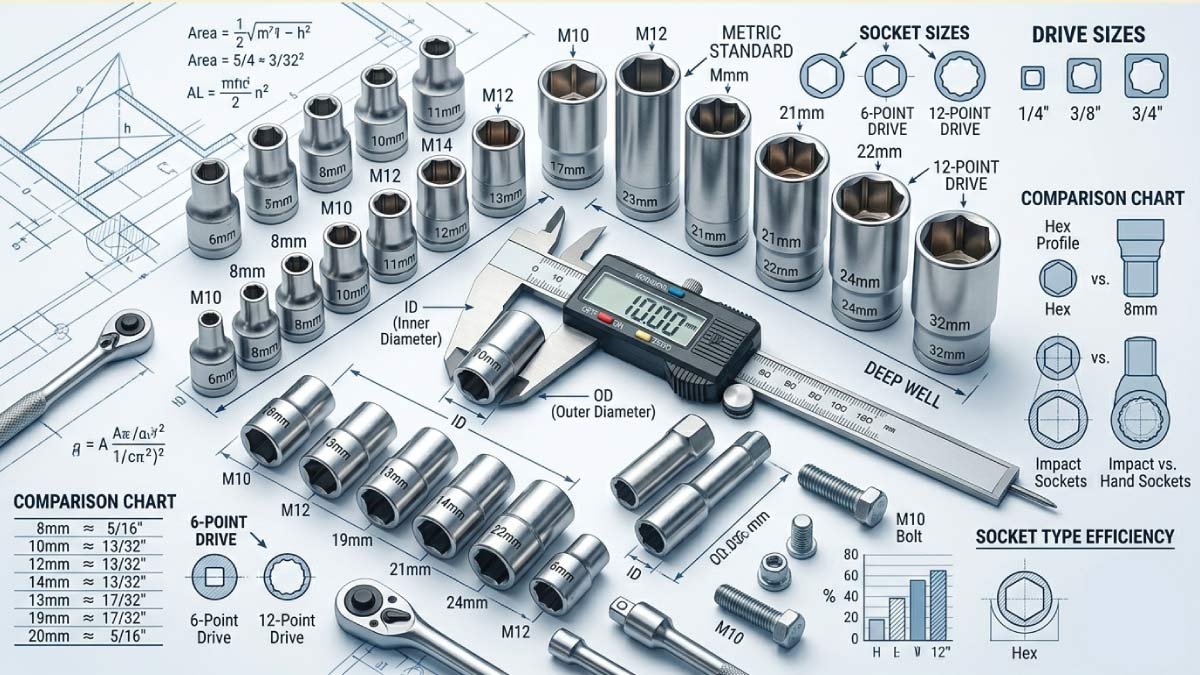
Metric sockets—often called “M socket sizes” in workshops are one of the most essential tool standards in mechanical, automotive, and industrial work. Whether you are repairing a car engine, assembling machinery, or working on home maintenance, you will almost always deal with metric bolt heads that require the correct socket size.
At first, metric socket sizes seem simple: just match the socket to the bolt. But in practice, things are more detailed. A small mismatch can round off bolt heads, damage fasteners, or make removal extremely difficult.
I have personally seen this happen during a vehicle repair where a slightly incorrect socket (just 1 mm off) slipped under torque and damaged a stubborn bolt head. What should have been a 5-minute job turned into drilling out the bolt. That’s why understanding metric socket dimensions properly is so important.
This guide explains the M socket size chart, standard metric socket dimensions, bolt matching, and how to choose the right socket for safe and efficient work.
What Are Metric (M) Socket Sizes?
“Metric socket sizes” refer to sockets designed to fit metric hex bolts and nuts, where all dimensions are measured in millimeters (mm). These sockets are widely used in automotive repair, machinery maintenance, construction, and industrial assembly work because most modern fasteners follow the metric system.
For example:
M6 bolt → typically needs 10 mm socket
M8 bolt → typically needs 13 mm socket
M10 bolt → typically needs 17 mm socket
Here, “M” refers to the metric thread size of the bolt, not the socket itself. The socket size is based on the actual head size of the bolt.
Understand Metric Socket Measurement (AF System)
Metric sockets are measured using the across flats (AF) system, which is the standard method for identifying hex bolt and nut sizes.
What is AF?
AF = distance between two opposite flat sides of a hex bolt head.
Example:
A 13 mm socket fits a bolt head that is 13 mm across flats.
This system ensures compatibility and accuracy in fastening applications and is widely used in:
- Automotive industry
- Machinery maintenance
- Construction tools
- Manufacturing equipment
Standard M Socket Size Chart (Metric Socket Dimensions)
Here is a practical and widely used metric socket size chart used in most mechanical and industrial applications.
| Metric Bolt Size (M) | Typical Socket Size (mm) | Common Use |
|---|---|---|
| M3 | 5.5 mm | Electronics, small brackets |
| M4 | 7 mm | Light mechanical work |
| M5 | 8 mm | Small assemblies |
| M6 | 10 mm | Automotive panels, brackets |
| M7 | 11 mm | Specialized machinery |
| M8 | 13 mm | Car engines, general repairs |
| M10 | 17 mm | Structural and automotive use |
| M12 | 19 mm | Heavy-duty fastening |
| M14 | 22 mm | Suspension, machinery |
| M16 | 24 mm | Industrial equipment |
| M18 | 27 mm | Heavy structural work |
| M20 | 30 mm | Large machinery |
| M22 | 32 mm | Industrial applications |
| M24 | 36 mm | Heavy engineering |
These are standard socket sizes used in most mechanical environments.
You May Also Like:
Common Metric Socket Set Sizes
Most socket wrench sets are designed to cover a wide range of mechanical applications, from small precision work to heavy industrial fastening. These sets are grouped based on size range so users can quickly select the right tool for the job.
1. Small socket sets
Small socket sets include the most compact sizes used for delicate and lightweight mechanical tasks. These are commonly found in electronics repair, bicycle maintenance, and small equipment servicing where precision is more important than high torque.
- 4 mm to 13 mm
- used for electronics, bikes, small repairs
2. Medium socket sets
Medium socket sets are the most widely used in automotive and general workshop environments. They cover the majority of everyday mechanical tasks and are considered the standard range for vehicle and machine maintenance.
- 10 mm to 19 mm
- most common automotive range
3. Large socket sets
Large socket sets are designed for heavy-duty applications where high torque and large fasteners are involved. These are commonly used in construction, industrial machinery, and commercial vehicle maintenance.
- 17 mm to 36 mm+
- used in heavy machinery and construction
Most Common Metric Socket Sizes in Workshops
Some socket sizes are used significantly more often than others, making them essential in nearly every workshop. These are considered “must-have” sizes for automotive and mechanical work.
10 mm socket
The 10 mm socket is one of the most frequently used—and often misplaced—tools in any workshop. Despite its small size, it appears in many different applications.
Known as the “most lost socket” in workshops.
Used for:
- car body panels
- engine covers
- brackets
13 mm socket
The 13 mm socket is extremely common in automotive and general mechanical work. It is used in a wide range of engine and structural components.
Very common in:
- automotive engines
- suspension components
- general mechanical work
17 mm socket
The 17 mm socket is widely used for medium to heavy fastening tasks, especially in automotive and structural applications.
Used for:
- wheel nuts (light vehicles)
- structural bolts
- engine mounts
19 mm socket
The 19 mm socket is typically used in heavier mechanical systems where stronger fastening is required, particularly in suspension and load-bearing components.
Common in:
- suspension systems
- heavy vehicle bolts
Deep Socket vs Shallow Socket
Sockets come in different lengths depending on the type of fastening job. The two most common types are shallow sockets and deep sockets, and each is designed for specific working conditions in mechanical and automotive applications.
1. Shallow sockets
Shallow sockets are standard-length sockets used for general fastening tasks where bolts are easily accessible. They are commonly used in open spaces and allow quick tightening or loosening of fasteners without obstruction.
- Standard depth
- Used in open spaces
- Quick fastening
2. Deep sockets
Deep sockets have an extended body that allows them to reach longer bolts, studs, or recessed fasteners. They are especially useful in areas where standard sockets cannot reach due to limited space or extended bolt length.
- Longer body
- Used for long bolts or studs
- Access in tight spaces
Example:
Wheel nuts often require deep sockets due to the length of the studs and recessed mounting design.
You May Also Like:
Socket Drive Sizes
It is important to understand that socket size (which fits the bolt) is different from drive size (which connects to the ratchet or impact tool). Drive size determines the strength and torque capacity of the tool system.
1/4 inch drive
The 1/4 inch drive is used for small sockets and precision applications where low torque is required. It is commonly used in electronics, small mechanical assemblies, and light repair work.
- small sockets (4–13 mm)
- precision work
3/8 inch drive
The 3/8 inch drive is the most commonly used socket drive size in automotive and general mechanical work. It provides a balance between strength and versatility.
- medium sockets (10–19 mm)
- most automotive use
1/2 inch drive
The 1/2 inch drive is used for larger sockets and higher torque applications. It is commonly found in vehicle repair, suspension work, and heavy mechanical systems.
- large sockets (17 mm and above)
- heavy-duty work
3/4 inch drive
The 3/4 inch drive is designed for industrial and extremely heavy-duty applications where very high torque is required for large bolts and machinery.
- industrial use
- very large bolts
How to Choose the Right Metric Socket Size
Selecting the correct metric socket size is essential for safe, efficient, and damage-free mechanical work. Using the right socket ensures proper grip on the bolt head, accurate torque application, and prevents rounding or slipping during tightening or loosening.
Step 1: Identify bolt size
The first step is to check the bolt marking or specification. Metric bolts are marked with an “M” followed by a number that indicates the thread diameter.
Check bolt marking:
- M6, M8, M10, etc.
This helps you understand the general size category of the fastener before selecting the socket.
Step 2: Match AF socket size
Next, match the bolt size with the correct across-flats (AF) socket size using a standard reference chart. This ensures the socket fits the bolt head perfectly.
Use standard chart:
- M6 → 10 mm
- M8 → 13 mm
- M10 → 17 mm
This step is critical because correct AF matching prevents stripping and ensures proper torque transfer.
Step 3: Check clearance
Before using the socket, always check the available working space around the bolt. Even if the socket size is correct, surrounding components can affect accessibility.
Ensure socket fits around:
- surrounding components
- tight spaces
In confined areas, you may need a deep socket or a shorter tool setup for proper access.
Step 4: Choose drive size
The final step is selecting the correct drive size based on the torque requirement and bolt size. This ensures the tool can safely handle the required force without damage.
Match torque requirement:
- small bolts → 1/4 inch drive
- medium bolts → 3/8 inch drive
- large bolts → 1/2 inch drive
Choosing the right metric socket size is not just about fitting the bolt—it is about ensuring safety, efficiency, and tool longevity. Following these four steps helps prevent mechanical damage, improves workflow, and ensures reliable results in both workshop and industrial environments.
You May Also Like:
Common Problems with Incorrect Socket Size
Using the wrong socket size is a common issue in mechanical and automotive work. Even a small mismatch can lead to serious damage to bolts, tools, and fasteners. Proper socket selection ensures safe torque application, better grip, and longer tool life during assembly and maintenance tasks.
1. Rounded bolt heads
Rounded bolt heads occur when the socket does not fit tightly on the fastener. This is usually caused by using a slightly oversized socket or worn socket edges. Once the bolt head is rounded, it becomes very difficult to remove, often requiring cutting or specialized extraction tools.
2. Slipping under torque
Socket slipping happens when excessive force is applied with a poor or loose-fitting socket. Low-quality sockets or incorrect sizing increase the risk of sudden slippage during tightening or loosening. This not only damages the bolt but can also cause injury or reduce control over the tool.
3. Difficulty removing bolts
Using the wrong socket size reduces grip strength on the bolt head. This makes it harder to loosen tightly fastened or rusted bolts. Instead of turning smoothly, the socket may slip or partially engage, increasing effort and potentially damaging both the tool and the fastener.
4. Damage to fasteners
Incorrect socket fit can permanently damage bolt heads and threads. Once the fastener is damaged, it may no longer be reusable and must be replaced. This increases repair time and cost, especially in precision machinery where accurate fastening is essential for safe and reliable operation.
Metric vs Imperial Socket Sizes
Socket sizes are manufactured in two main measurement systems: metric and imperial. Using the correct system is essential because even small differences in measurement can cause poor fitting, slipping, or damage to fasteners.
1. Metric sockets (mm)
Metric sockets are measured in millimeters and are the global standard in modern mechanical design and manufacturing. Most vehicles and industrial equipment today are built using metric fasteners.
Used in:
- Europe
- Asia
- modern vehicles
2. Imperial sockets (inches)
Imperial sockets are measured in inches and are mostly used in older systems or specific industries, especially in North America. They are less common in modern equipment but still widely found in legacy machinery.
Used in:
- older American systems
- specific machinery
Mixing both systems can lead to incorrect fitting, rounded bolts, and tool damage, so it is important to always confirm the measurement system before working.
Impact Socket vs Standard Socket
Sockets are also categorized based on their strength and intended tool usage. The two main types are standard sockets and impact sockets, each designed for different levels of torque and mechanical stress.
1. Standard socket
Standard sockets are designed for manual tools such as ratchets and hand wrenches. They are suitable for general maintenance work but should not be used with high-torque power tools.
- chrome finish
- not designed for impact tools
- used with hand ratchets
2. Impact socket
Impact sockets are built for heavy-duty use with impact wrenches and power tools. They are made from stronger materials and designed to withstand sudden torque loads and vibration.
- black oxide finish
- stronger material
- used with impact wrench
Always use impact sockets with power tools to prevent cracking or tool failure.
You May Also Like:
Material of Sockets
The material of a socket determines its strength, durability, and resistance to wear. Different materials are used depending on whether the socket is for manual or impact applications.
1. Chrome vanadium steel
Chrome vanadium steel is the most common material used for standard sockets. It offers a good balance of strength, durability, and corrosion resistance for everyday mechanical work.
- most common
- strong and durable
- corrosion resistant
2. Chrome molybdenum steel
Chrome molybdenum steel is used in impact sockets due to its superior strength and ability to withstand high shock loads without cracking or deforming.
- used in impact sockets
- high strength
- shock resistant
Socket Size and Torque Relationship
Socket size is directly related to the amount of torque a fastener can handle. Larger sockets are used for bigger bolts that require higher tightening force, while smaller sockets are used for light-duty applications.
Example:
- 10 mm socket → low torque bolts
- 19 mm socket → medium torque
- 32 mm socket → high torque industrial bolts
Using a small socket for high torque applications can cause tool breakage, bolt rounding, or serious safety risks during operation.
Quick Metric Socket Size Reference
This quick reference table helps you match common metric bolt sizes with their typical socket sizes. It is widely used in workshops, automotive repair, and general mechanical maintenance for fast identification.
| Bolt Size | Socket Size |
|---|---|
| M5 | 8 mm |
| M6 | 10 mm |
| M8 | 13 mm |
| M10 | 17 mm |
| M12 | 19 mm |
| M14 | 22 mm |
| M16 | 24 mm |
| M20 | 30 mm |
Practical Workshop Advice
In real workshop environments, you don’t need a full range of socket sizes for every job. Most everyday mechanical and automotive tasks are completed using a small set of commonly used sockets.
The most frequently used sizes include:
- 10 mm
- 13 mm
- 17 mm
- 19 mm
These four socket sizes alone cover a large percentage of vehicle repairs, engine work, and general mechanical maintenance. Keeping them easily accessible significantly improves efficiency and reduces time wasted searching for tools.
Common Mistakes When Using Metric Sockets
Metric sockets are widely used in mechanical, automotive, and industrial work, but incorrect usage can easily damage bolts, reduce tool life, and create safety risks. Many problems occur due to poor socket condition, wrong selection, or ignoring fastener condition during operation.
1. Using worn sockets
Worn sockets lose their sharp edges, which reduces grip on the bolt head. This increases the chance of slipping, rounding fasteners, and damaging both the socket and bolt. Regular inspection and replacement of worn sockets is important to maintain safe and effective torque application.
2. Applying wrong drive size
Using a socket with an incorrect drive size or pairing it with an undersized ratchet can lead to tool failure. Small drive tools are not designed to handle high torque, which may result in bending, breakage, or loss of control during tightening or loosening operations.
3. Ignoring bolt condition
Bolt condition plays a major role in socket selection. Rusty or corroded bolts require a strong and secure grip. In such cases, 6-point sockets are preferred because they provide better contact and reduce the risk of slipping compared to 12-point designs, especially in heavy-duty applications.
4. Using 12-point sockets on high torque bolts
12-point sockets are convenient for tight spaces but are not ideal for high torque applications. They have less surface contact with the bolt, increasing the risk of rounding. For heavy-duty or high-load fastening, 6-point sockets are safer and provide stronger grip and better torque distribution.
Final Thoughts
Metric socket sizes may seem simple, but they are one of the most critical parts of mechanical work. Choosing the correct size ensures safety, efficiency, and prevents damage to fasteners.
The correct M socket size chart helps you quickly match:
- bolt size (M rating)
- socket AF dimension (mm)
- drive size (torque level)
The key rule is simple:
Always match the socket exactly to the bolt size—never force a near fit.
For most mechanical and automotive work, a basic set covering 8 mm to 19 mm will handle the majority of tasks efficiently.
When used correctly, metric sockets make fastening and loosening bolts fast, safe, and reliable in any workshop or repair environment.