
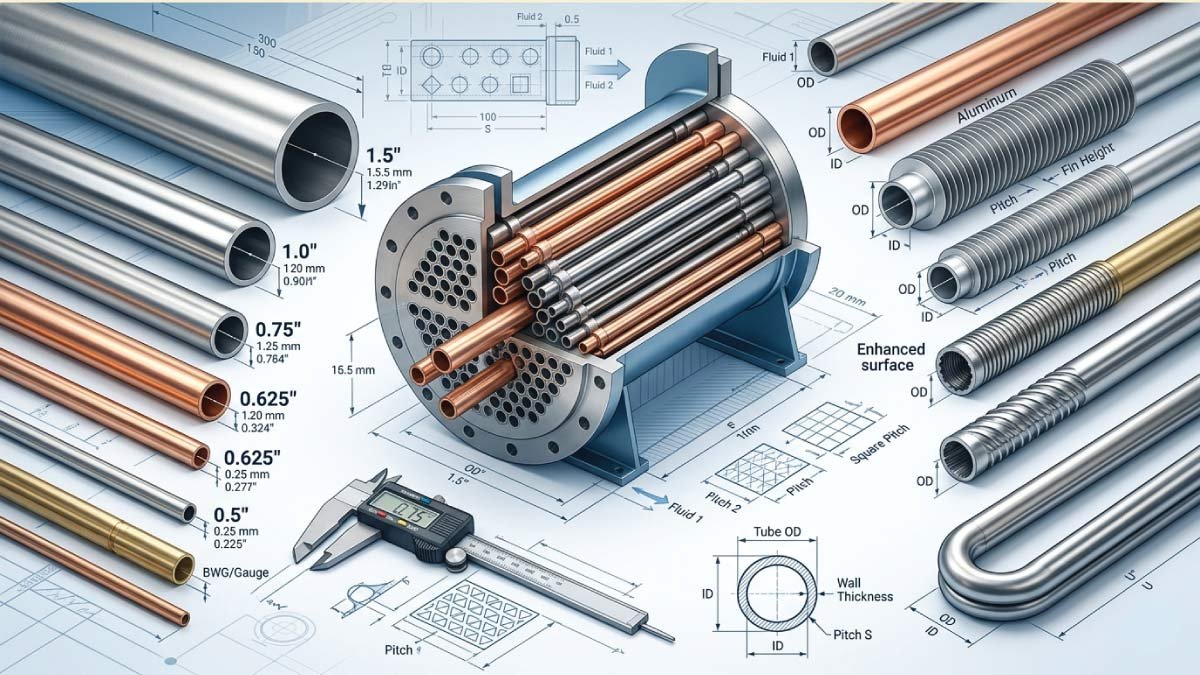
Heat exchangers are used in almost every industrial system where heat needs to be transferred efficiently between two fluids. You will find them in power plants, chemical industries, HVAC systems, refrigeration units, oil refineries, and even in food processing plants.
One of the most important design elements in any heat exchanger is the tube size. The diameter, thickness, and length of the tubes directly affect heat transfer efficiency, pressure drop, flow rate, and maintenance requirements.
That is why engineers, designers, and maintenance teams often rely on a heat exchanger tube size chart when selecting or replacing tubes.
In this guide, we will break down standard tube sizes, explain how sizing works, and provide a practical reference chart you can use in real-world applications.
What Is a Heat Exchanger Tube?
A heat exchanger tube is a hollow cylindrical component where one fluid flows inside the tube while another fluid flows outside it. Heat is transferred through the tube wall without mixing the fluids.
There are two main types of heat exchangers where tubes are commonly used:
- Shell and tube heat exchangers
- Double pipe heat exchangers
Among these, shell and tube systems are the most widely used in industrial applications.
Why Tube Size Matters in Heat Exchangers
Tube size is not just a basic design parameter—it is a critical performance factor that directly affects how efficiently a heat exchanger operates. In thermal systems, even small changes in tube dimensions can significantly influence heat transfer, pressure behavior, and long-term reliability of the equipment.
Choosing the wrong tube size can lead to:
- Poor heat transfer efficiency
- Excessive pressure drop
- Flow instability
- Increased fouling and scaling
- Higher maintenance costs
When tube dimensions are not properly matched to the system requirements, fluid flow becomes inefficient, energy losses increase, and the exchanger may require frequent cleaning or repairs.
On the other hand, a properly selected tube size improves:
- Thermal efficiency
- Energy savings
- Flow balance
- Equipment lifespan
Correct sizing ensures smooth fluid movement, optimal heat exchange, and reduced operational stress on the system components. This leads to better performance and lower long-term operating costs.
So before designing or repairing a system, engineers always refer to a standardized tube size chart to ensure accurate selection, safe operation, and maximum efficiency.
Heat Exchanger Tube Size Chart (Standard Sizes)
Below is a general reference chart for commonly used heat exchanger tubes in industrial applications. These standard sizes help engineers select the correct tube dimensions based on heat transfer requirements, pressure conditions, and system design.
1. Standard Tube Outer Diameter (OD) Sizes
The outer diameter (OD) of a tube is one of the most important parameters in heat exchanger design because it directly affects heat transfer surface area and fluid flow characteristics. Smaller diameters are used for compact systems, while larger diameters are preferred for high-flow industrial applications.
| Tube OD (inches) | Tube OD (mm) | Common Applications |
|---|---|---|
| 3/8 inch | 9.5 mm | Small HVAC systems, compact exchangers |
| 1/2 inch | 12.7 mm | HVAC, refrigeration, light duty exchangers |
| 5/8 inch | 15.9 mm | Medium duty industrial exchangers |
| 3/4 inch | 19.05 mm | Chemical plants, oil cooling systems |
| 1 inch | 25.4 mm | Heavy industrial heat exchangers |
| 1.25 inch | 31.75 mm | High flow applications |
| 1.5 inch | 38.1 mm | Large industrial systems |
2. Standard Tube Wall Thickness (BWG / Gauge)
Wall thickness determines the strength and pressure resistance of heat exchanger tubes. Thicker walls are used in high-pressure systems, while thinner walls are suitable for low-pressure and lightweight applications.
| BWG (Birmingham Wire Gauge) | Wall Thickness (mm) | Usage |
|---|---|---|
| 24 BWG | 0.56 mm | Light duty, low pressure |
| 22 BWG | 0.71 mm | HVAC and refrigeration |
| 20 BWG | 0.89 mm | Medium pressure systems |
| 18 BWG | 1.24 mm | Industrial use |
| 16 BWG | 1.65 mm | High pressure applications |
| 14 BWG | 2.11 mm | Very high pressure systems |
3. Standard Tube Lengths
Tube length affects overall heat exchanger size, efficiency, and installation requirements. Longer tubes provide more surface area for heat transfer, making them suitable for large industrial systems.
| Tube Length (ft) | Tube Length (m) | Application |
|---|---|---|
| 6 ft | 1.83 m | Compact heat exchangers |
| 8 ft | 2.44 m | Standard HVAC units |
| 10 ft | 3.05 m | Industrial systems |
| 12 ft | 3.66 m | Large shell & tube exchangers |
| 20 ft | 6.1 m | Power plant heat exchangers |
You May Also Like:
Common Heat Exchanger Tube Materials
Heat exchanger tubes are designed to transfer heat efficiently between fluids, and their performance depends greatly on material selection. Different materials offer varying levels of thermal conductivity, corrosion resistance, and mechanical strength. Choosing the right material ensures efficiency, durability, and safe operation in industrial applications.
1. Copper tubes
Copper tubes are widely used due to their excellent thermal conductivity, which allows fast and efficient heat transfer. They are commonly found in HVAC systems, air conditioners, and refrigeration units. However, copper is not suitable for highly corrosive environments, as it can degrade when exposed to certain chemicals or harsh conditions.
2. Stainless steel tubes
Stainless steel tubes offer high corrosion resistance, making them ideal for chemical processing, food industries, and pharmaceutical applications. Although their thermal conductivity is lower than copper, they provide excellent durability and long service life. These tubes are preferred in environments where hygiene and resistance to corrosion are critical.
3. Carbon steel tubes
Carbon steel tubes are strong, durable, and cost-effective, making them suitable for oil and gas industries and power plants. They can withstand high pressure and temperature conditions. However, they require protective coatings or treatments in corrosive environments to prevent rusting and ensure long-term performance.
4. Titanium tubes
Titanium tubes offer extremely high corrosion resistance, especially in marine and chemical applications. They perform well in aggressive environments such as seawater and strong chemicals. Although more expensive than other materials, titanium provides exceptional durability, lightweight strength, and long service life, making it ideal for specialized industrial use.
How to Choose the Right Tube Size
Selecting the correct heat exchanger tube size is essential for achieving efficient heat transfer, stable flow, and long-term system performance. The ideal size depends on fluid behavior, operating pressure, thermal requirements, and maintenance conditions. Proper selection helps reduce energy loss, pressure issues, and maintenance problems.
1. Flow rate
Flow rate is one of the most important factors in tube sizing. Higher flow rates require larger tube diameters to reduce resistance and avoid pressure drop. Low flow systems typically use 3/8” or 1/2” tubes, medium flow uses 5/8” or 3/4”, while high flow applications often require 1” or larger tubes.
2. Heat transfer requirement
Heat transfer efficiency is affected by tube size. Smaller tubes provide a larger surface area relative to volume, which improves heat transfer performance. However, they are more prone to fouling and blockage. Engineers must balance efficiency with cleanliness and operational stability when selecting tube dimensions.
3. Pressure drop
Pressure drop increases when fluid faces resistance inside smaller diameter tubes. This can reduce system efficiency and increase energy consumption. Larger tubes allow smoother flow and lower pressure loss. In systems where energy efficiency is critical, engineers often prefer slightly larger tubes to maintain stable performance.
4. Fouling tendency
Fluids containing impurities, particles, or scaling materials can easily block small tubes. In such cases, larger diameter tubes are preferred to reduce the risk of clogging. This improves system reliability and reduces downtime caused by frequent cleaning or maintenance in industrial heat exchanger systems.
5. Maintenance accessibility
Maintenance is easier when tube size is larger. Bigger tubes allow for mechanical cleaning tools and chemical cleaning processes to pass through more effectively. This ensures better long-term performance, reduced maintenance effort, and improved efficiency, especially in systems that require regular cleaning cycles for optimal operation.
You May Also Like:
Shell and Tube Heat Exchanger Tube Layout Basics
In a shell and tube heat exchanger, multiple tubes are placed inside a cylindrical shell to transfer heat between two fluids without mixing them. The performance of the system depends heavily on how these tubes are arranged, their spacing, and the overall bundle design. Proper layout selection improves efficiency, reduces fouling, and ensures easier maintenance.
Key design factors include:
- Tube pitch (distance between tubes)
- Tube layout (triangular or square pattern)
- Number of tube passes
- Tube bundle arrangement
Common tube layout patterns
1. Triangular pitch
The triangular tube layout is widely used where maximum heat transfer is required in a compact space. The close packing of tubes increases surface area, improving thermal performance, but it can make mechanical cleaning more difficult.
- Higher heat transfer efficiency
- Compact design
- Difficult to clean mechanically
2. Square pitch
The square tube layout provides more spacing between tubes, making it easier to access and clean the system. Although it slightly reduces heat transfer efficiency compared to triangular layouts, it is preferred in systems where fouling and maintenance are major concerns.
- Easier cleaning
- Slightly lower heat transfer efficiency
- Preferred in fouling-prone systems
Tube Diameter vs Heat Transfer Efficiency
Tube size plays a major role in determining both thermal performance and flow characteristics inside a heat exchanger. Engineers must balance efficiency, pressure drop, and maintenance requirements when selecting tube dimensions.
Smaller tubes:
- Higher heat transfer coefficient
- Compact design
- Higher pressure drop
- More prone to fouling
Larger tubes:
- Lower pressure drop
- Easier maintenance
- Reduced heat transfer efficiency per unit volume
Engineers must carefully balance these factors based on system requirements to achieve optimal performance and reliability.
Practical Example of Tube Sizing
Let’s say an engineer is designing a shell and tube heat exchanger for a chemical cooling system where both performance and maintenance are important considerations.
Requirements:
- Medium flow rate liquid
- Moderate fouling risk
- High thermal efficiency required
Selection process:
- Tube size: 3/4 inch OD
- Wall thickness: 16 BWG
- Material: stainless steel
- Layout: square pitch (for easier cleaning)
This combination ensures good heat transfer efficiency while also maintaining easy maintenance and long-term operational reliability in industrial conditions.
You May Also Like:
Heat Exchanger Tube Size Selection Mistakes
Proper tube size selection is critical for efficient heat exchanger performance. However, many design and operational problems occur when engineers focus only on one factor or ignore fluid conditions. These mistakes can lead to clogging, energy loss, poor heat transfer, and reduced system lifespan.
1. Choosing too small tubes
Selecting tubes that are too small is a common mistake in heat exchanger design. While smaller tubes improve heat transfer area, they also increase the risk of clogging and fouling. This leads to frequent maintenance, reduced flow efficiency, and higher operational downtime in industrial systems.
2. Ignoring fluid properties
Fluid characteristics such as viscosity, impurities, and scaling tendency must always be considered. Thick or dirty fluids require larger tube diameters to flow smoothly. Ignoring these properties can result in blockages, uneven heat transfer, and increased pressure drop, ultimately reducing the efficiency and reliability of the system.
3. Overemphasis on efficiency only
Focusing only on maximizing heat transfer efficiency can lead to poor overall system performance. While smaller tubes may increase efficiency, they also increase pressure drop and energy consumption. A balanced design approach is necessary to ensure both effective heat transfer and stable fluid flow throughout the system.
4. Using wrong material with correct size
Even if the tube size is correct, using the wrong material can cause system failure. Materials must be selected based on corrosion resistance, temperature, and chemical compatibility. Without proper material selection, tubes may corrode or degrade quickly, leading to leaks, reduced efficiency, and costly maintenance issues.
Industrial Applications of Different Tube Sizes
Different industries use specific heat exchanger tube sizes based on flow rate, pressure conditions, and thermal efficiency requirements. The selection of tube diameter directly affects performance, durability, and maintenance requirements in real-world systems.
1. HVAC systems
HVAC systems generally use smaller diameter tubes because the focus is on compact design, energy efficiency, and space optimization. These systems operate under moderate pressure and require efficient heat transfer in limited installation space.
- Typically 3/8” to 1/2” tubes
- Focus on compact design and efficiency
2. Oil refineries
Oil refineries use medium to large diameter tubes to handle high flow rates, temperature variations, and continuous operation. These systems require strong materials and reliable performance under harsh industrial conditions.
- 3/4” to 1” tubes
- High durability and flow capacity
3. Chemical plants
Chemical processing units require corrosion-resistant materials due to aggressive fluids and chemical reactions. Tube sizes are selected to balance flow efficiency and resistance to fouling and corrosion.
- 1/2” to 1” tubes
- Corrosion-resistant materials required
4. Power plants
Power generation systems operate under extreme pressure and temperature conditions, requiring larger and stronger tubes. These tubes ensure efficient heat transfer in high-capacity systems.
- Large diameter tubes (1” and above)
- High pressure and temperature conditions
You May Also Like:
Tube Thickness and Pressure Relationship
Wall thickness is a key factor in determining how much internal pressure a tube can safely withstand. It directly impacts safety, durability, and overall system performance in heat exchangers.
Thicker tubes:
- Handle higher internal pressure
- Resist mechanical damage
- Reduce risk of rupture
But they also:
- Reduce heat transfer slightly
- Increase material cost
That is why BWG selection is always based on system pressure rating and operational requirements rather than size alone.
Maintenance Considerations
Tube size also plays an important role in long-term maintenance planning. It affects cleaning methods, inspection ease, and overall operational cost.
Small tubes:
- Harder to clean mechanically
- Require chemical cleaning
Large tubes:
- Easier inspection and cleaning
- Better for fouling-heavy systems
Maintenance cost should always be considered during the design phase to ensure efficient and economical operation over the equipment’s lifetime.
Final Thoughts
A heat exchanger tube size chart is more than just a reference table, it is a critical engineering tool that ensures system efficiency, safety, and durability in real-world applications.
The right tube size depends on multiple factors including:
- Flow rate
- Pressure drop
- Heat transfer requirement
- Fluid type
- Maintenance needs
There is no universal “best size”—only the most suitable size for a specific application and operating condition.
In most industrial systems, common tube sizes range from 3/8 inch to 1.5 inch OD, with 3/4 inch stainless steel tubes being one of the most widely used standards in shell and tube heat exchangers.
When properly selected, tube size improves thermal performance, reduces operating costs, and extends equipment life, making it one of the most important decisions in heat exchanger design.