
Stainless steel tubing is one of the most versatile and widely used materials in modern engineering, manufacturing, construction, food processing, and industrial applications. Its excellent corrosion resistance, strength, durability, and attractive appearance make it a preferred choice for projects that require long-lasting performance.
Whether you are designing a structural framework, manufacturing equipment, building a handrail system, or installing industrial piping, understanding stainless steel tube dimensions is essential. Stainless steel tubes are available in various diameters, wall thicknesses, and shapes, making proper size selection critical for performance and cost efficiency.
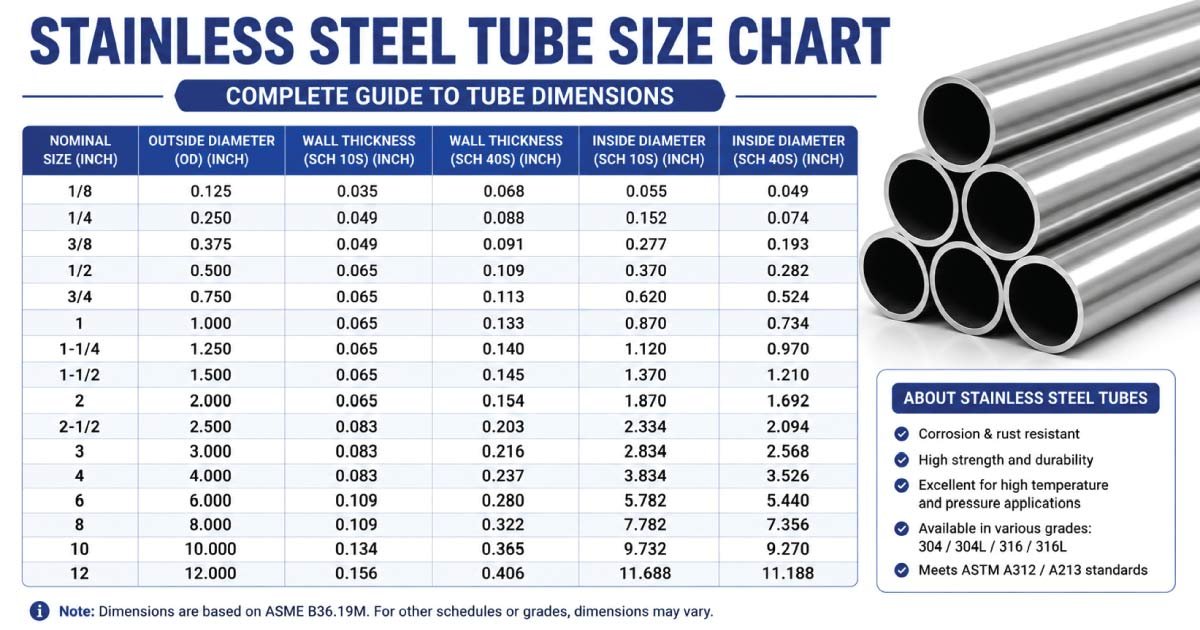
This guide explains stainless steel tube sizing, common dimensions, wall thickness standards, tube schedules, and includes a detailed stainless steel tube size chart for easy reference.
What Is Stainless Steel Tubing?
Stainless steel tubing is a hollow metal product manufactured from stainless steel alloys that contain chromium and other elements designed to resist corrosion and oxidation.
Unlike ordinary carbon steel, stainless steel forms a protective oxide layer that helps prevent rust and deterioration.
Stainless steel tubes are commonly used in:
- Construction projects
- Food processing equipment
- Pharmaceutical facilities
- Chemical processing plants
- Automotive systems
- Aerospace applications
- Handrails and architectural structures
- Heat exchangers
Their combination of strength and corrosion resistance makes them suitable for demanding environments.
Why Stainless Steel Tube Size Matters
Choosing the correct stainless steel tube size is essential for achieving the desired strength, flow capacity, and overall system efficiency. Tube size affects structural performance, fluid movement, installation requirements, and long-term operating costs across industrial, construction, and mechanical applications.
An undersized tube may:
- Fail under load
- Restrict fluid flow
- Reduce efficiency
- Increase maintenance costs
Using a tube that is too small can create performance issues and shorten the lifespan of the system.
An oversized tube may:
- Increase material costs
- Add unnecessary weight
- Complicate installation
Larger tubes often provide no additional benefit if the application does not require the extra capacity or strength.
Proper sizing helps optimize performance while minimizing expenses, ensuring a reliable and cost-effective stainless steel tube system.
Understand The Stainless Steel Tube Dimensions
Before using a stainless steel tube size chart, it is important to understand the key measurements used to identify tube dimensions. These measurements determine strength, weight, flow capacity, and compatibility with fittings, making them essential when selecting the right tubing for a project.
Outside Diameter (OD)
Outside Diameter refers to the measurement across the outer surface of the tube. For round stainless steel tubing, OD is the primary dimension used for sizing and selecting compatible components.
- Measurement across the external surface of the tube
- Primary sizing method for round tubing
Wall Thickness
Wall thickness describes the thickness of the tube wall and directly affects strength, durability, and pressure-handling capability. Selecting the proper wall thickness is important for structural and fluid-handling applications.
Common wall thicknesses include:
- 0.049 inch
- 0.065 inch
- 0.083 inch
- 0.120 inch
- 0.188 inch
- 0.250 inch
Thicker walls generally provide greater strength and pressure resistance.
Inside Diameter (ID)
Inside Diameter is the measurement of the open space inside the tube through which fluids, gases, or materials can pass. It plays a major role in determining flow capacity and overall tube weight.
Formula:
- Inside Diameter = Outside Diameter − (2 × Wall Thickness)
Inside diameter affects fluid flow capacity, pressure characteristics, and the overall performance of the tubing system.
Types of Stainless Steel Tubes
Stainless steel tubes are available in different forms to meet various structural, industrial, and fluid-handling requirements. The two main types are seamless and welded tubes, each offering unique advantages depending on pressure demands, budget, and application requirements.
Seamless Stainless Steel Tubes
Seamless stainless steel tubes are manufactured without a welded joint, resulting in a uniform structure throughout the tube. They are commonly selected for demanding applications where strength, reliability, and pressure resistance are critical.
Advantages include:
- Higher pressure resistance
- Uniform strength
- Better reliability
Common applications:
- Chemical processing
- Oil and gas systems
- High-pressure equipment
Welded Stainless Steel Tubes
Welded stainless steel tubes are produced by rolling stainless steel strips into a tube shape and welding the seam. They are widely used because they offer excellent performance at a lower cost than seamless tubes.
Advantages include:
- Lower cost
- Wide availability
- Consistent dimensions
Common applications:
- Structural frameworks
- Architectural projects
- General industrial use
Common Stainless Steel Grades
The performance of a stainless steel tube depends largely on the material grade used. Different grades offer varying levels of corrosion resistance, strength, and temperature tolerance, making them suitable for specific industrial and structural applications.
304 Stainless Steel
304 stainless steel is the most commonly used grade due to its excellent balance of corrosion resistance, durability, and affordability. It is suitable for a wide range of general-purpose applications.
Benefits include:
- Excellent corrosion resistance
- Good weldability
- Affordable cost
316 Stainless Steel
316 stainless steel contains additional molybdenum, which improves its resistance to corrosion, especially in harsh and marine environments. It is preferred where exposure to chemicals or saltwater is common.
Common applications include:
- Marine environments
- Chemical processing
- Pharmaceutical industries
321 Stainless Steel
321 stainless steel is designed for elevated-temperature applications and offers improved resistance to heat-related corrosion. It performs well in environments where high temperatures are continuously present.
Commonly used in:
- Aerospace systems
- High-temperature equipment
Round Stainless Steel Tube Size Chart
The following chart lists common round stainless steel tube dimensions.
| Outside Diameter (OD) | Wall Thickness | Approx. Inside Diameter (ID) |
|---|---|---|
| 1/2 inch | 0.065 inch | 0.370 inch |
| 3/4 inch | 0.065 inch | 0.620 inch |
| 1 inch | 0.065 inch | 0.870 inch |
| 1 inch | 0.120 inch | 0.760 inch |
| 1-1/4 inch | 0.120 inch | 1.010 inch |
| 1-1/2 inch | 0.120 inch | 1.260 inch |
| 2 inch | 0.120 inch | 1.760 inch |
| 2 inch | 0.188 inch | 1.624 inch |
| 3 inch | 0.188 inch | 2.624 inch |
| 4 inch | 0.250 inch | 3.500 inch |
These sizes are commonly used in industrial and structural applications.
Square Stainless Steel Tube Size Chart
Square tubing is widely used in construction and fabrication.
| Tube Size | Wall Thickness |
|---|---|
| 1″ × 1″ | 0.065″ |
| 1″ × 1″ | 0.120″ |
| 1-1/2″ × 1-1/2″ | 0.120″ |
| 2″ × 2″ | 0.120″ |
| 2″ × 2″ | 0.188″ |
| 3″ × 3″ | 0.188″ |
| 4″ × 4″ | 0.250″ |
| 6″ × 6″ | 0.250″ |
Square tubes provide excellent structural stability and clean aesthetics.
Rectangular Stainless Steel Tube Size Chart
Rectangular tubing is commonly selected for applications requiring increased strength in one direction.
| Tube Size | Wall Thickness |
|---|---|
| 2″ × 1″ | 0.120″ |
| 3″ × 2″ | 0.120″ |
| 4″ × 2″ | 0.120″ |
| 4″ × 3″ | 0.188″ |
| 5″ × 3″ | 0.188″ |
| 6″ × 4″ | 0.250″ |
| 8″ × 4″ | 0.250″ |
These sizes are frequently used in equipment frames and construction projects.
Stainless Steel Tube Gauge Chart
Many manufacturers use gauge numbers to indicate wall thickness.
| Gauge | Approximate Thickness |
|---|---|
| 20 Gauge | 0.0359 inch |
| 18 Gauge | 0.0478 inch |
| 16 Gauge | 0.0598 inch |
| 14 Gauge | 0.0747 inch |
| 12 Gauge | 0.1046 inch |
| 11 Gauge | 0.1196 inch |
| 10 Gauge | 0.1345 inch |
| 7 Gauge | 0.1793 inch |
Lower gauge numbers correspond to thicker walls.
How to Measure Stainless Steel Tube Size
Accurate measurement of stainless steel tubing is essential for ensuring proper fit, performance, and compatibility with fittings and equipment. By measuring key dimensions correctly, you can identify the tube size and verify that it meets the requirements of your project or application.
1. Measure the Outside Diameter
Begin by measuring the outside diameter (OD) of the stainless steel tube. Use a vernier caliper for the most accurate results, although a measuring tape can also be used for larger tubes. The outside diameter is one of the primary dimensions used to identify tubing size and select compatible fittings.
2. Measure Wall Thickness
Next, measure the wall thickness using a caliper or a specialized thickness gauge. This measurement determines the strength, weight, and pressure-handling capability of the tube. Accurate wall thickness data is important for selecting tubing that meets structural or fluid transport requirements.
3. Calculate Inside Diameter
The inside diameter (ID) represents the internal opening of the tube and is important for determining flow capacity. It can be calculated using the following formula:
Inside Diameter = Outside Diameter − (2 × Wall Thickness)
This calculation provides the actual internal space available for fluids, gases, or other materials moving through the tube.
4. Confirm Specifications
After taking measurements, compare the results with manufacturer specifications and standard size charts. This step helps verify the tube size, wall thickness, and dimensional accuracy. Confirming specifications ensures compatibility with fittings, valves, and system components while reducing the risk of installation errors.
Stainless Steel Tube Standards
Stainless steel tubes are manufactured according to recognized industry standards that ensure quality, safety, and performance. These standards establish requirements for dimensions, materials, testing procedures, and manufacturing methods used across various industries.
1. ASTM Standards
ASTM standards are among the most widely used specifications for stainless steel tubing. They provide guidelines for material properties, dimensions, and performance requirements to ensure consistent product quality.
Common ASTM standards include:
- ASTM A269
- ASTM A312
- ASTM A554
- ASTM A213
These standards define dimensions, material composition, and performance requirements for different stainless steel tube applications.
2. ASME Standards
ASME standards are commonly applied in pressure piping and mechanical systems. They help ensure that tubing used in critical applications meets required safety and performance criteria.
- Widely used in pressure piping systems
- Supports safe and reliable operation
3. ISO Standards
ISO standards provide internationally recognized specifications that promote consistency across global markets. They help ensure compatibility, quality control, and uniform manufacturing practices.
- Supports international consistency
- Improves compatibility between systems
- Facilitates global standardization
Following these standards helps ensure stainless steel tubing delivers reliable performance, safety, and long service life in a wide range of applications.
Advantages of Stainless Steel Tubing
Stainless steel tubing is widely used in construction, manufacturing, food processing, and industrial applications because of its durability and performance. It combines strength, corrosion resistance, and an attractive appearance, making it a reliable choice for both functional and decorative purposes.
1. Excellent Corrosion Resistance
One of the greatest advantages of stainless steel tubing is its ability to resist corrosion and rust. It performs exceptionally well in humid, wet, and chemically aggressive environments. This resistance helps maintain structural integrity and appearance, making it suitable for outdoor, marine, and industrial applications.
2. High Strength
Stainless steel tubing offers excellent strength and load-bearing capacity. It can withstand heavy loads, impact, and mechanical stress without deforming easily. This makes it a preferred material for structural frameworks, industrial equipment, and applications where durability and safety are important.
3. Heat Resistance
Many grades of stainless steel maintain their strength and performance even at elevated temperatures. This makes stainless steel tubing suitable for heat exchangers, exhaust systems, processing equipment, and other high-temperature environments where ordinary materials may weaken or fail.
4. Attractive Appearance
The clean and polished finish of stainless steel tubing provides an attractive, modern appearance. Because of its aesthetic appeal, it is frequently used in architectural projects, handrails, decorative structures, and commercial interiors where both appearance and durability are valued.
5. Low Maintenance
Stainless steel requires very little maintenance compared to many other metals. Its corrosion resistance reduces the need for protective coatings, painting, or frequent repairs. Simple cleaning is often enough to maintain its appearance and performance over many years of service.
6. Long Service Life
When properly installed and used in suitable conditions, stainless steel tubing can last for decades. Its combination of strength, corrosion resistance, and durability minimizes replacement and maintenance costs, making it a cost-effective long-term solution for a wide range of applications.
Conclusion
Understanding stainless steel tube dimensions is essential for construction, manufacturing, industrial processing, and engineering projects. Stainless steel tubes are available in numerous shapes, sizes, wall thicknesses, and grades, allowing them to meet a wide range of structural and mechanical requirements.
The stainless steel tube size charts provided in this guide offer a practical reference for selecting the correct dimensions for your application. By considering outside diameter, wall thickness, material grade, and intended use, you can confidently choose the right stainless steel tube and ensure reliable performance for many years.
Also Read: 👉 Understanding pipe thread sizes is essential for creating secure, leak-free plumbing connections. This Pipe Thread Size Chart guide explains standard pipe thread dimensions, thread types, and measurement methods in a simple format. Learn how to identify the correct thread size and avoid fitting compatibility issues. Read the full post to access detailed charts, practical examples, and a downloadable PDF guide for easy reference.