
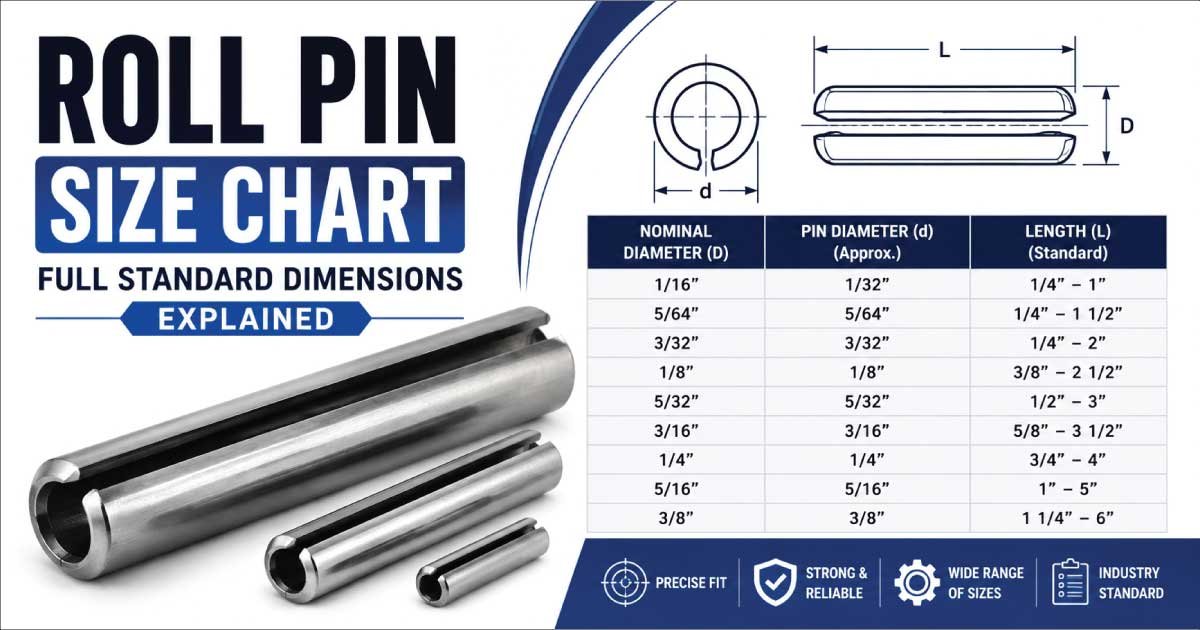
Roll pins are small but extremely strong mechanical fasteners used in a wide range of engineering, automotive, aerospace, and industrial applications. They are designed to hold parts together, maintain alignment, and absorb vibration in assemblies where precision and durability are important.
Understanding the roll pin size chart is essential for selecting the correct pin for your application. Choosing the wrong size can lead to loose fittings, cracked components, or complete joint failure.
In this complete guide, we will cover everything about roll pins including their types, measurements, standard size charts, applications, installation methods, and how to select the right size for your project.
What Is a Roll Pin?
A roll pin, also called a spring pin, is a cylindrical fastener made from hardened spring steel. It features a hollow body with a slit or coiled structure that allows it to compress during insertion and then expand inside the hole. This spring action creates a strong, vibration-resistant locking effect in mechanical assemblies.
Key Characteristics of Roll Pins
Roll pins are designed to provide flexibility, strength, and reliability in demanding applications. Their unique structure allows them to absorb shock and maintain tight holding power even under vibration. They are widely used in machinery, automotive systems, and precision tools where secure fastening is essential.
- Hollow cylindrical design
- Slotted or coiled structure
- Made from hardened spring steel
- Self-retaining under pressure
Why Roll Pin Size Matters
Choosing the correct roll pin size is essential for ensuring mechanical safety, performance, and durability. If the size is incorrect, the pin may fail to hold properly, leading to mechanical issues or system failure. Proper sizing ensures stability, strength, and long-term reliability in all types of assemblies.
Incorrect sizing can cause:
- Loose or weak joints
- Excessive wear on components
- Pin deformation or breakage
- Misalignment in assemblies
- Vibration-related failure
Correct sizing ensures:
- Secure press-fit installation
- Proper load distribution
- Long service life
- Resistance to vibration and shock
Even a very small size mismatch can affect performance significantly, especially in high-speed or heavy-load applications where precision is critical.
How Roll Pin Sizes Are Measured
Roll pin sizing is based on specific measurements that determine fit and performance. Understanding these dimensions helps in selecting the correct pin for different mechanical applications. Proper measurement ensures accurate installation and prevents issues such as looseness or excessive stress on components.
1. Diameter
The diameter refers to the nominal outside size of the roll pin before it is compressed. This measurement is the most important factor when selecting a pin. It must closely match the drilled hole size to ensure proper compression and secure fit.
- This is the nominal outside diameter of the pin before compression.
2. Length
Length defines the total size of the roll pin from one end to the other. It determines how deep the pin will secure the components together. Choosing the correct length ensures proper engagement and mechanical stability in assemblies.
- The total length of the pin from end to end.
3. Hole Size (Important Factor)
Roll pins are installed into slightly smaller drilled holes to create a tight fit. This controlled compression ensures strong retention and vibration resistance. Proper hole sizing is essential for preventing damage during installation and maintaining long-term performance.
- Roll pins are installed into drilled holes that are slightly smaller than the pin diameter, allowing compression during insertion.
Example:
- 6 mm roll pin → requires ~5.9 mm hole (depending on tolerance)
Standard Roll Pin Size Chart (Metric)
Metric roll pin sizes are widely used in modern machinery, automotive systems, and industrial equipment. These sizes ensure compatibility with international engineering standards and provide accurate fitting for various mechanical applications.
🔩 Roll Pin Size Chart (Metric)
| Roll Pin Diameter | Length Range (mm) | Recommended Hole Size | Typical Application |
|---|---|---|---|
| 1.5 mm | 6 – 20 mm | 1.4 – 1.5 mm | Small electronics, precision tools |
| 2.0 mm | 8 – 25 mm | 1.9 – 2.0 mm | Light mechanical assemblies |
| 3.0 mm | 10 – 40 mm | 2.9 – 3.0 mm | General machinery |
| 4.0 mm | 15 – 50 mm | 3.9 – 4.0 mm | Automotive components |
| 5.0 mm | 20 – 60 mm | 4.9 – 5.0 mm | Medium-duty equipment |
| 6.0 mm | 25 – 80 mm | 5.9 – 6.0 mm | Heavy machinery |
| 8.0 mm | 30 – 100 mm | 7.9 – 8.0 mm | Industrial applications |
| 10.0 mm | 40 – 120 mm | 9.9 – 10.0 mm | Structural and high-load systems |
Standard Roll Pin Size Chart (Imperial)
Imperial roll pin sizes are still widely used in older machinery, aerospace systems, and some industrial equipment. These measurements are based on inches and are commonly found in US-based mechanical designs and repair work.
🔧 Roll Pin Size Chart (Inch)
| Roll Pin Size | Diameter (inch) | Length Range | Common Use |
|---|---|---|---|
| 1/16″ | 0.062″ | 1/4″–1″ | Small precision devices |
| 3/32″ | 0.093″ | 1/4″–1.5″ | Light mechanical use |
| 1/8″ | 0.125″ | 1/2″–2″ | General machinery |
| 5/32″ | 0.156″ | 1″–2.5″ | Automotive components |
| 3/16″ | 0.187″ | 1.5″–3″ | Medium-duty assemblies |
| 1/4″ | 0.250″ | 2″–4″ | Heavy-duty applications |
| 5/16″ | 0.312″ | 3″–5″ | Industrial machinery |
Types of Roll Pins
Roll pins are available in different designs to suit various mechanical and industrial applications. Each type has unique structural features that affect flexibility, strength, and performance. Choosing the correct type ensures better load handling, vibration resistance, and durability in assemblies.
1. Slotted Roll Pins
Slotted roll pins are the most commonly used type in mechanical systems. They have a single slot running along their length, which allows them to compress easily during installation. Their simple design makes them cost-effective and suitable for general-purpose fastening applications.
- Single slot along length
- Flexible and easy to compress
- Most commonly used type
- Suitable for general applications
2. Coiled Roll Pins
Coiled roll pins are made from tightly wound steel coils that give them superior strength and flexibility. They distribute stress more evenly than slotted pins, making them ideal for demanding environments. Their design allows better vibration absorption and longer service life in heavy-duty applications.
- Made from tightly wound steel coils
- Stronger and more flexible than slotted pins
- Better vibration absorption
- Used in heavy-duty applications
Materials Used in Roll Pins
Roll pins are manufactured using different materials depending on their application requirements. The choice of material affects strength, corrosion resistance, and durability. Selecting the right material ensures reliable performance in various environmental and mechanical conditions.
1. Spring Steel
Spring steel is the most widely used material for roll pins due to its high elasticity and strength. It allows the pin to compress and expand without losing shape, making it ideal for vibration-heavy applications in machinery and automotive systems.
- Most common material
- High elasticity and strength
- Ideal for vibration resistance
2. Stainless Steel
Stainless steel roll pins are designed for environments where corrosion resistance is important. They perform well in marine, outdoor, and humid conditions. Their durability ensures long service life even when exposed to moisture and harsh weather conditions.
- Corrosion-resistant
- Used in marine and outdoor environments
- Long-lasting performance
3. Alloy Steel
Alloy steel roll pins offer high strength and durability, making them suitable for heavy-duty machinery. They can withstand high stress and load conditions, making them ideal for industrial applications where maximum reliability is required.
- High strength
- Used in heavy-duty machinery
How to Choose the Right Roll Pin Size
Selecting the correct roll pin size is essential for ensuring proper fit, strength, and long-term performance. Several factors must be considered before choosing a pin to avoid failure, misalignment, or mechanical damage during operation.
1. Measure Hole Diameter
Accurate measurement of the hole diameter is the first and most important step. The hole must be slightly smaller than the roll pin to allow proper compression during installation. This ensures a tight and secure fit.
- The hole should match the recommended roll pin size for proper compression.
2. Determine Load Requirements
The load acting on the assembly plays a major role in pin selection. Heavier loads require stronger and thicker pins to prevent bending, breakage, or failure under stress. Proper load analysis ensures safety and durability.
- Heavier loads require thicker and stronger pins.
3. Select Correct Length
The length of the roll pin must be sufficient to pass completely through the connected parts. A properly chosen length ensures firm holding and prevents movement between components, improving overall assembly strength.
- The pin must fully pass through the components and provide secure retention.
4. Consider Material Environment
Environmental conditions affect the performance and lifespan of roll pins. Choosing the right material ensures resistance to corrosion, wear, and environmental damage, improving reliability in different working conditions.
- Wet or outdoor → stainless steel
- Dry industrial → spring steel
5. Check Assembly Type
Different machines and assemblies require different levels of precision and vibration resistance. Understanding the application type helps in selecting the most suitable roll pin for optimal performance and safety.
- Different machines require different tolerances and vibration resistance levels.
🚀 Read Our Latest Guide 👉 Elbow Fitting Size Chart (2026) Complete Guide + PDF
Step-by-Step Installation of Roll Pins
Proper installation of roll pins is essential for achieving a secure and long-lasting fit. When installed correctly, they provide strong holding power and vibration resistance. Following a structured method ensures safety, accuracy, and prevents damage to both the pin and the mechanical components.
Step 1: Align Holes
Accurate alignment of all components is the first and most critical step. Misaligned holes can cause difficulty during insertion and may damage the pin or parts. Proper alignment ensures smooth installation and correct positioning of the roll pin inside the assembly.
- Ensure all components are properly aligned.
Step 2: Select Correct Pin Size
Choosing the correct roll pin size is essential for proper compression and holding strength. The diameter and length must match the hole specifications exactly. Incorrect sizing can lead to weak joints or installation failure during assembly.
- Match diameter and length with hole specifications.
Step 3: Position the Pin
Once the correct size is selected, place the roll pin at the entry point of the hole. Proper positioning ensures smooth insertion and prevents misalignment. This step prepares the pin for controlled driving into the assembly.
- Place the roll pin at the entry of the hole.
Step 4: Drive the Pin
Use a hammer or press tool to gently drive the roll pin into the hole. Apply steady and controlled force to avoid deformation. The pin should compress slightly and move smoothly into position without excessive force.
- Use a hammer or press tool to insert the pin.
Step 5: Check Flush Fit
After installation, ensure the roll pin is fully seated and flush with the surface. A proper fit confirms correct installation and secure locking. This step ensures stability and prevents movement during operation.
- Ensure the pin is fully seated and secure.
Common Mistakes When Using Roll Pins
Mistakes during installation or selection can reduce performance and cause mechanical failure. Understanding common errors helps improve safety, durability, and efficiency in engineering applications. Proper attention to detail ensures reliable fastening and long service life.
1. Incorrect Hole Size
Using the wrong hole size can make installation difficult or prevent proper compression. It may also reduce holding strength and lead to failure under load. Always verify hole dimensions before installation.
- Leads to poor compression or difficulty inserting.
2. Using Wrong Diameter
Selecting an incorrect pin diameter can result in weak joints or damage to components. A loose fit reduces strength, while an oversized pin can cause cracking or deformation of parts.
- Can cause weak holding strength or material damage.
3. Improper Installation Force
Applying excessive force during installation can deform the pin or damage surrounding components. Controlled pressure ensures smooth insertion and maintains the structural integrity of both pin and assembly.
- Excess force may deform the pin or part.
4. Reusing Old Pins
Old or previously used roll pins lose elasticity over time. Reusing them reduces holding strength and increases the risk of failure, especially in high-stress or vibration-heavy applications.
- Reduces elasticity and holding strength.
5. Ignoring Material Compatibility
Using the wrong material for the environment can lead to corrosion, wear, or early failure. Always match material type with operating conditions for better durability and performance.
- Can lead to corrosion or early failure.
Applications of Roll Pins
Roll pins are widely used across multiple industries due to their strength, flexibility, and vibration resistance. They play a key role in securing components in mechanical systems where precise alignment and durability are required.
🚗 Automotive Industry
Roll pins are essential in automotive systems for securing moving parts and maintaining alignment under vibration and load conditions. They ensure stability in critical vehicle components.
- Gear assemblies
- Steering systems
- Transmission components
⚙️ Machinery Industry
In machinery, roll pins are used to connect shafts, couplings, and moving parts. They help maintain alignment and ensure smooth operation in industrial equipment.
- Shafts and couplings
- Alignment systems
- Moving assemblies
🏗️ Construction Equipment
Roll pins are used in heavy construction machinery where strong joints and vibration resistance are required. They help maintain structural stability under high loads.
- Heavy machinery joints
- Hydraulic systems
🛠️ Manufacturing Industry
Manufacturing systems use roll pins in tools and assembly lines for precise positioning and secure fastening. They improve efficiency and reduce mechanical failure.
- Tool fixtures
- Assembly line equipment
🚜 Agricultural Machinery
Agricultural equipment relies on roll pins for durable performance in harsh environments. They help secure moving parts in tractors and harvesting machines.
- Tractor components
- Harvesting systems
🚀 Read Our Latest Guide 👉 Crankshaft Bearing Size Chart (2026 Guide) + PDF
Advantages of Roll Pins
Roll pins offer several important benefits that make them widely used in engineering and mechanical systems. Their design ensures reliability, ease of use, and cost-effectiveness in both light and heavy-duty applications.
- Excellent vibration resistance
- Easy installation
- Low cost
- Reusable in some cases
- Strong holding force
- Compact design
Maintenance and Inspection
Although roll pins are durable, regular inspection is necessary in critical applications to ensure continued safety and performance. Early detection of wear or damage prevents unexpected mechanical failure.
Proper maintenance helps extend service life and maintain system reliability under demanding conditions.
Check for:
- Wear or deformation
- Rust or corrosion
- Loose fitting
- Cracks or fatigue
If any damage is found, the roll pin should be replaced immediately to maintain safety and performance in the system.
Final Thoughts
The roll pin size chart is an essential reference for engineers, mechanics, and manufacturers. These small components play a big role in ensuring mechanical stability, alignment, and vibration resistance.
To summarize:
- Always match pin size with hole diameter
- Choose correct length for secure fit
- Use coiled pins for high-vibration applications
- Select stainless steel for corrosive environments
A properly selected roll pin ensures long-lasting, safe, and reliable mechanical performance in any system.
🚀 Read Our Latest Guide 👉 Camshaft Size with Chart: Complete Guide for 2026