
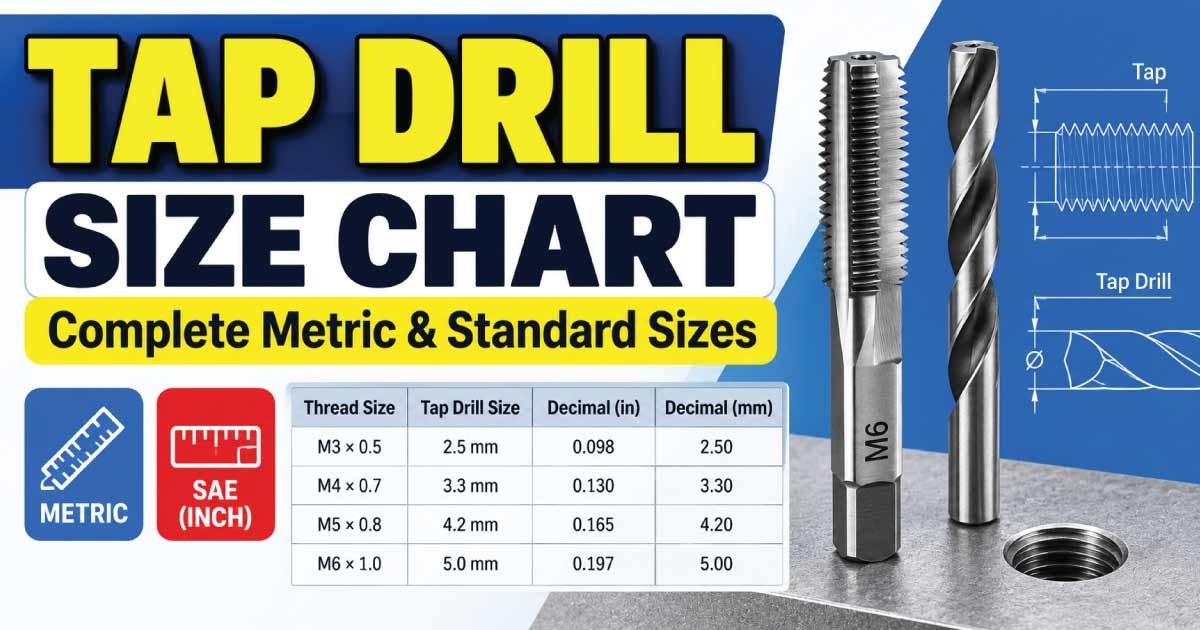
A tap drill size chart is one of the most useful references for creating threaded holes accurately. Choosing a drill that is too large can produce weak threads, while a hole that is too small can make tapping difficult and increase the risk of tap breakage.
This guide covers metric tap drill sizes, standard inch sizes, fractional drills, numbered drills, letter drills, thread pitch, tapping percentages, and practical drill selection. It also explains how to calculate a tap drill size when the exact combination is not listed in a chart.
What Is a Tap Drill Size?
A tap drill size is the diameter of the hole drilled before using a tap to cut internal threads. The drill creates the opening that provides enough material for the tap to form or cut the desired thread.
For example, an M8 × 1.25 metric tap has a nominal diameter of 8 mm and a thread pitch of 1.25 mm. A commonly used starting drill size is 6.8 mm.
The tap drill is therefore smaller than the tap’s nominal diameter because the remaining material forms the internal thread.
The correct drill size depends on several factors:
- Tap nominal diameter
- Thread pitch
- Thread standard
- Desired percentage of thread
- Material being tapped
- Type of tap
- Whether the tap is cutting or forming threads
- Application requirements
A tap drill chart provides a convenient starting point, but for critical work, the tap manufacturer’s recommendations should take priority.
Metric Tap Drill Size Chart
Metric threads are identified using the letter M, followed by the nominal thread diameter and pitch. For example, M10 × 1.5 means a 10 mm nominal diameter with a 1.5 mm pitch.
For a conventional cutting tap, a commonly used approximation is:
Tap drill diameter ≈ Major diameter − Thread pitch
Thus:
M10 − 1.5 = 8.5 mm
The following chart covers commonly encountered coarse metric thread sizes.
| Metric Tap | Thread Pitch (mm) | Common Tap Drill (mm) |
|---|---|---|
| M3 × 0.5 | 0.50 | 2.5 |
| M4 × 0.7 | 0.70 | 3.3 |
| M5 × 0.8 | 0.80 | 4.2 |
| M6 × 1.0 | 1.00 | 5.0 |
| M8 × 1.25 | 1.25 | 6.8 |
| M10 × 1.5 | 1.50 | 8.5 |
| M12 × 1.75 | 1.75 | 10.2 |
| M14 × 2.0 | 2.00 | 12.0 |
| M16 × 2.0 | 2.00 | 14.0 |
| M18 × 2.5 | 2.50 | 15.5 |
| M20 × 2.5 | 2.50 | 17.5 |
| M22 × 2.5 | 2.50 | 19.5 |
| M24 × 3.0 | 3.00 | 21.0 |
| M27 × 3.0 | 3.00 | 24.0 |
| M30 × 3.5 | 3.50 | 26.5 |
These are commonly used nominal tap-drill values for standard metric cutting threads. Actual recommendations can vary with thread percentage, material, tapping method, and manufacturer.
Metric Fine Thread Tap Drill Sizes
Metric fine threads have a smaller pitch than their coarse counterparts. Because the pitch changes, the tap drill diameter also changes.
For example, M10 can be specified with different pitches such as M10 × 1.5, M10 × 1.25, or M10 × 1.0.
| Metric Tap | Pitch (mm) | Common Tap Drill (mm) |
|---|---|---|
| M6 × 0.75 | 0.75 | 5.2 |
| M8 × 1.0 | 1.00 | 7.0 |
| M10 × 1.0 | 1.00 | 9.0 |
| M10 × 1.25 | 1.25 | 8.8 |
| M12 × 1.25 | 1.25 | 10.8 |
| M12 × 1.5 | 1.50 | 10.5 |
| M14 × 1.5 | 1.50 | 12.5 |
| M16 × 1.5 | 1.50 | 14.5 |
| M18 × 1.5 | 1.50 | 16.5 |
| M20 × 1.5 | 1.50 | 18.5 |
| M20 × 2.0 | 2.00 | 18.0 |
| M24 × 2.0 | 2.00 | 22.0 |
| M24 × 1.5 | 1.50 | 22.5 |
| M30 × 2.0 | 2.00 | 28.0 |
When working with fine threads, always verify the exact pitch before selecting the drill. The same nominal diameter can require several different tap drill sizes.
Standard Tap Drill Size Chart
“Standard” tap sizes generally refers to inch-based thread systems, including UNC, UNF, and other Unified thread forms.
Unlike metric threads, inch threads are commonly identified by threads per inch, or TPI.
For example:
- 1/4-20 UNC = 1/4-inch diameter and 20 threads per inch
- 1/4-28 UNF = 1/4-inch diameter and 28 threads per inch
- 3/8-16 UNC = 3/8-inch diameter and 16 threads per inch
Because the pitch changes with TPI, the tap drill changes as well.
| Tap Size | Thread Type | TPI | Common Tap Drill |
|---|---|---|---|
| #6-32 | UNC | 32 | #36 |
| #8-32 | UNC | 32 | #29 |
| #10-24 | UNC | 24 | #25 |
| #10-32 | UNF | 32 | #21 |
| 1/4-20 | UNC | 20 | #7 |
| 1/4-28 | UNF | 28 | #3 |
| 5/16-18 | UNC | 18 | F |
| 5/16-24 | UNF | 24 | I |
| 3/8-16 | UNC | 16 | 5/16 in |
| 3/8-24 | UNF | 24 | Q |
| 7/16-14 | UNC | 14 | U |
| 7/16-20 | UNF | 20 | 25/64 in |
| 1/2-13 | UNC | 13 | 27/64 in |
| 1/2-20 | UNF | 20 | 29/64 in |
| 9/16-12 | UNC | 12 | 31/64 in |
| 9/16-18 | UNF | 18 | 33/64 in |
| 5/8-11 | UNC | 11 | 17/32 in |
| 5/8-18 | UNF | 18 | 37/64 in |
| 3/4-10 | UNC | 10 | 21/32 in |
| 3/4-16 | UNF | 16 | 11/16 in |
| 7/8-9 | UNC | 9 | 49/64 in |
| 7/8-14 | UNF | 14 | 13/16 in |
| 1-8 | UNC | 8 | 7/8 in |
| 1-12 | UNF | 12 | 59/64 in |
Drill recommendations in inch systems can depend on the desired thread percentage and application, so a shop chart or tap manufacturer’s specification should be checked for precision work.
Fractional, Numbered, and Letter Tap Drills
One reason tap drill selection can be confusing is that inch drill sets contain several different sizing systems.
Fractional Drills
Fractional drill sizes are expressed as fractions of an inch, such as:
- 1/8 inch
- 3/16 inch
- 1/4 inch
- 5/16 inch
- 3/8 inch
- 1/2 inch
- 5/8 inch
Larger Unified thread sizes frequently use fractional drills when the required diameter falls conveniently between available letter or numbered sizes.
Numbered Drills
Numbered drills typically range from #1 through #80, with the numerical relationship generally reversed compared with ordinary size numbers: a higher number corresponds to a smaller drill.
Examples include:
- #21
- #25
- #29
- #31
- #36
- #50
Numbered drills are particularly common for smaller threaded holes.
Letter Drills
Letter drills run from A through Z and provide intermediate sizes between many numbered and fractional drills.
Examples include:
- A
- C
- F
- I
- Q
- U
- Z
This makes letter drills useful when a fractional or numbered drill does not provide the preferred diameter.
Also Read:
How to Calculate Tap Drill Size
A simple calculation can help when a chart is unavailable.
For many conventional metric cutting threads:
Tap drill size = Major diameter − Pitch
Suppose you need an M12 × 1.75 thread.
The calculation is:
12 − 1.75 = 10.25 mm
The commonly used standard drill size is 10.2 mm.
Another example is M8 × 1.25:
8 − 1.25 = 6.75 mm
A 6.8 mm drill is commonly used.
This formula is a useful approximation, but it should not be treated as a universal rule for every thread form or tapping process.
For inch threads, the same principle can be expressed by converting TPI into pitch:
Pitch = 1 ÷ TPI
Then the approximate tap drill can be related to the major diameter and pitch.
For example, a 1/4-20 thread has a pitch of:
1 ÷ 20 = 0.05 inch
The approximate theoretical value is therefore:
0.250 − 0.050 = 0.200 inch
A commonly specified drill for this thread is #7, which is slightly different from the simple theoretical result.
That difference illustrates why a published tap drill chart is preferable to relying solely on a basic formula.
Why the Correct Tap Drill Size Matters
The drill diameter directly affects the amount of material available for the internal thread.
Drill Too Small
If the drilled hole is too small:
- The tap must remove more material.
- Cutting torque increases.
- The tap may become difficult to turn.
- Tap breakage becomes more likely.
- Threads may be damaged.
- Production time can increase.
This is especially important in harder materials where tapping already requires substantial cutting force.
Drill Too Large
If the hole is too large:
- Less material remains for the thread.
- Thread engagement decreases.
- The resulting thread may be weaker.
- The thread may not meet the intended specification.
Therefore, simply choosing the largest drill that allows the tap to enter is not a good practice.
Also Read:
Understanding Thread Percentage
A tap does not necessarily need to create a theoretically perfect full-profile thread to produce a useful threaded hole.
Thread percentage describes how much of the theoretical thread depth is present.
A common engineering practice is to use a suitable percentage of thread rather than automatically targeting 100%. The appropriate value depends on the application, material, tap, hole diameter, and required strength.
A smaller tap drill produces a higher percentage of thread, but it also increases cutting torque.
A slightly larger tap drill reduces the percentage of thread and can make tapping easier.
This creates an important trade-off:
Smaller drill → more thread material → higher tapping load
Larger drill → less thread material → lower tapping load
For general shop work, the chart supplied for the particular tap is usually the best starting point.
Metric vs Standard Tap Drill Sizes
Metric and inch thread systems use different identification methods.
| Feature | Metric | Inch / Unified |
|---|---|---|
| Diameter system | Millimeters | Inches |
| Thread identification | M + diameter + pitch | Diameter + TPI |
| Pitch measurement | mm per thread | Threads per inch |
| Example | M10 × 1.5 | 3/8-16 UNC |
| Common drill systems | Metric drills | Fractional, letter, numbered |
| Fine threads | Smaller pitch | Higher TPI |
The biggest mistake is treating the two systems as interchangeable.
An M10 × 1.5 thread is not the same as a 3/8-16 thread even though their nominal diameters are relatively close.
The thread pitch, profile, and dimensional system are different.
How to Choose the Correct Tap Drill
Before drilling, identify the complete thread specification rather than just the nominal diameter.
1. Identify the Thread Standard
Determine whether the thread is:
- Metric
- UNC
- UNF
- Another Unified thread
- A pipe thread
- A specialty thread
2. Confirm the Nominal Diameter
For metric threads, this is the number after M.
For example:
M10 × 1.5 → 10 mm nominal diameter
3. Confirm the Pitch or TPI
For metric threads, pitch is expressed in millimeters.
For inch threads, TPI tells you the number of threads per inch.
4. Check the Tap Manufacturer’s Chart
Different taps and applications can have different recommendations. Check the manufacturer’s technical documentation when available.
5. Consider the Material
Aluminum, mild steel, stainless steel, brass, plastics, and other materials do not necessarily behave the same during tapping.
Material hardness, ductility, lubrication, chip control, and hole depth can all affect tapping performance.
6. Select the Drill
Choose the recommended drill diameter rather than automatically using a drill equal to the nominal thread diameter.
Also Read:
Blind Holes vs Through Holes
Tap drill selection is only one part of successful tapping. Hole depth also matters.
A through hole extends completely through the workpiece, allowing chips and cutting fluid to move through the hole.
A blind hole stops inside the material. Chips therefore have less room to escape.
When tapping a blind hole, you should consider:
- Required thread depth
- Drill point depth
- Tap geometry
- Chip evacuation
- Tap type
- Bottom clearance
- Lubrication
The drilled hole generally needs to be deeper than the required usable thread depth because the drill point and tap geometry occupy space.
For blind holes, do not assume that drilling exactly to the desired thread depth provides sufficient clearance.
Cutting Taps vs Forming Taps
Not every tap creates threads in exactly the same way.
Cutting Taps
A cutting tap removes material to produce the thread.
These are commonly used across a wide range of applications and materials.
For cutting taps, the conventional tap drill formula and published tap-drill charts are useful starting points.
Forming Taps
A forming tap creates threads by displacing material rather than cutting away conventional chips.
Because material is displaced, the required hole size is different from that used for a cutting tap.
This is an important distinction.
Do not automatically use a cutting-tap drill size for a forming tap.
Always use the forming tap manufacturer’s recommended hole diameter, particularly when working with materials and applications where thread-forming performance is critical.
Common Tap Drill Mistakes
Even experienced users can run into problems when the thread specification is incomplete.
Using the Nominal Diameter as the Drill Size
For an M8 thread, drilling an 8 mm hole does not create the correct starting condition for a conventional M8 internal thread.
The tap needs material around the hole to create the thread.
Confusing Pitch and Diameter
In M10 × 1.5, 10 mm is the nominal diameter and 1.5 mm is the pitch.
Using the wrong pitch can lead to the wrong drill selection.
Mixing Metric and Inch Drills
A nearby imperial drill may appear close to the required metric diameter, but “close” is not always appropriate for a threaded hole.
For precision work, use the specified metric drill where practical.
Ignoring Tap Type
Cutting taps and forming taps can require different hole sizes.
Failing to Clear Chips
Chip accumulation can increase resistance and cause tapping problems, particularly in blind holes.
Forcing the Tap
If a tap requires excessive force, stop and investigate the cause instead of continuing to force it.
Possible causes include:
- Incorrect tap drill
- Wrong thread specification
- Dull or damaged tap
- Poor lubrication
- Misalignment
- Excessive tapping speed
- Inadequate chip evacuation
Practical Tapping Tips
A good tap drill is important, but proper technique also affects the finished thread.
- Mark the hole accurately before drilling.
- Use a sharp, suitable drill.
- Keep the drill aligned with the intended hole axis.
- Deburr the hole before tapping.
- Use suitable cutting fluid or lubricant for the material and tap.
- Keep the tap aligned with the hole.
- Use the appropriate tap for the hole type and material.
- Avoid excessive force.
- Clear chips appropriately when using cutting taps.
- For blind holes, provide adequate bottom clearance.
- Inspect the finished thread with the appropriate gauge or mating fastener when required.
For production or safety-critical work, follow the applicable engineering specification rather than relying solely on a general chart.
Quick Reference: Popular Metric Tap Sizes
The following condensed chart is useful for common workshop sizes.
| Tap Size | Pitch (mm) | Common Drill (mm) |
|---|---|---|
| M3 × 0.5 | 0.50 | 2.5 |
| M4 × 0.7 | 0.70 | 3.3 |
| M5 × 0.8 | 0.80 | 4.2 |
| M6 × 1.0 | 1.00 | 5.0 |
| M8 × 1.25 | 1.25 | 6.8 |
| M10 × 1.5 | 1.50 | 8.5 |
| M12 × 1.75 | 1.75 | 10.2 |
| M14 × 2.0 | 2.00 | 12.0 |
| M16 × 2.0 | 2.00 | 14.0 |
| M18 × 2.5 | 2.50 | 15.5 |
| M20 × 2.5 | 2.50 | 17.5 |
| M24 × 3.0 | 3.00 | 21.0 |
| M30 × 3.5 | 3.50 | 26.5 |
This is a convenient reference for commonly used metric cutting threads, but the exact recommended hole size should be confirmed against the tap specification for demanding applications.
Frequently Asked Questions
What drill size do I need for an M8 tap?
For the common M8 × 1.25 metric thread, a 6.8 mm drill is commonly used for a conventional cutting tap.
What drill size is used for an M10 tap?
For the common M10 × 1.5 thread, the commonly used tap drill is 8.5 mm.
However, M10 is available with different pitches, so the exact thread specification must be confirmed first.
What is the tap drill size formula?
For many conventional metric cutting threads, a useful approximation is:
Tap drill diameter = Major diameter − Pitch
It provides a quick estimate, but a manufacturer’s tap-drill chart should be used when an exact specification matters.
Is a tap drill smaller than the tap?
Yes. For conventional cutting threads, the tap drill is smaller than the nominal tap diameter because material must remain around the hole for the tap to cut the internal thread.
What is the difference between UNC and UNF?
UNC stands for Unified National Coarse, while UNF stands for Unified National Fine.
The same nominal diameter can have different thread counts, so the required tap drill can also differ.
Can I use an imperial drill for a metric tap?
Sometimes a fractional, letter, or numbered drill may be dimensionally close enough for a particular application, but using the specified metric drill is generally preferable when the required hole size is metric.
Why does my tap keep breaking?
Tap breakage can result from several factors, including an undersized hole, misalignment, insufficient lubrication, poor chip evacuation, unsuitable tapping speed, a damaged tap, or excessive force.
Check the complete setup rather than assuming the tap itself is the only problem.
Does a forming tap use the same drill size as a cutting tap?
No. Forming taps displace material rather than cutting it in the same manner as conventional cutting taps. They require a hole size appropriate to the forming process and material.
Always follow the forming tap manufacturer’s recommendation.
Should I use the same drill size for every M10 thread?
No. M10 describes the nominal diameter, not the complete thread specification. M10 × 1.5, M10 × 1.25, and M10 × 1.0 have different pitches and therefore different tap drill requirements.
Final Takeaway
A reliable tap drill size chart makes threaded-hole preparation much easier, but the most important step is identifying the complete thread specification first. For metric threads, check both diameter and pitch. For inch threads, identify the diameter and TPI, along with the appropriate thread series such as UNC or UNF.
For common metric cutting threads, the formula major diameter minus pitch provides a useful starting point, while published tap-drill charts provide practical drill selections. Standard inch threads may use fractional, numbered, or letter drills, depending on the thread size.
Always consider the tap type, material, thread percentage, hole depth, and manufacturer’s recommendations before drilling. When accuracy or thread strength is critical, the tap manufacturer’s technical data should take precedence over a general-purpose chart.