
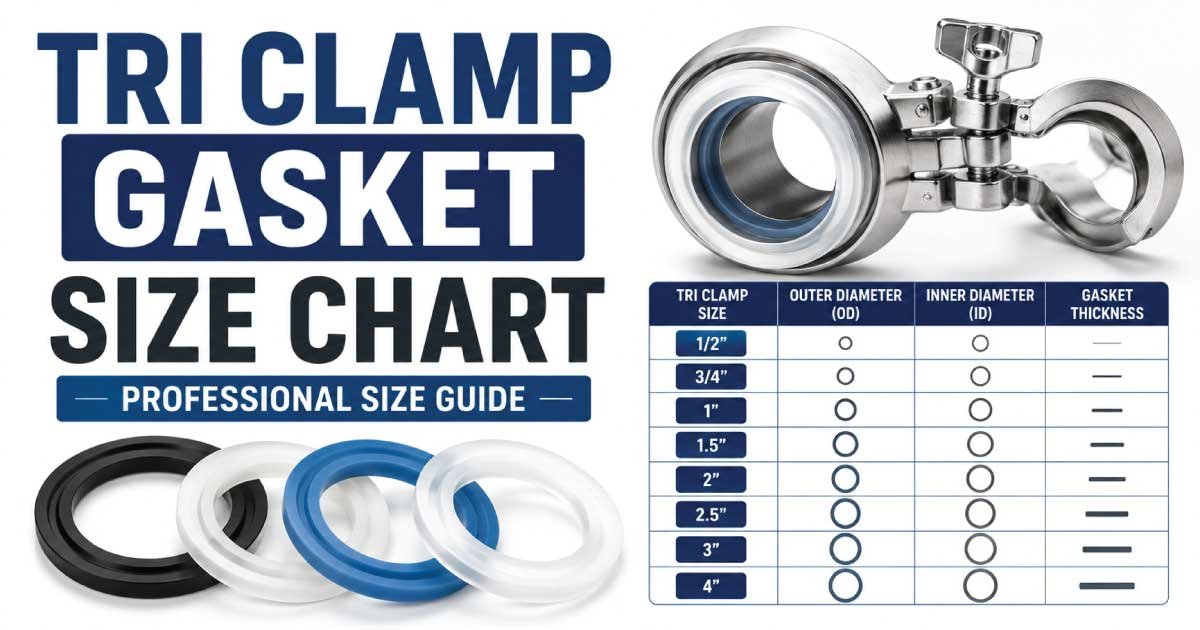
Tri clamp gaskets are one of the most important sealing components used in sanitary piping systems across food processing, dairy, beverage, pharmaceutical, and chemical industries. If the gasket size is incorrect, even a perfectly tightened tri clamp connection can leak, contaminate the system, or fail under pressure.
This detailed guide explains everything you need to know about tri clamp gasket size charts, how sizing works, how to measure correctly, and how to choose the right gasket for your application.
What Is a Tri Clamp Gasket?
A tri clamp gasket, also known as a tri-clover gasket or sanitary gasket, is a soft sealing component placed between two ferrules in sanitary piping systems. It creates a leak-proof, hygienic seal when compressed by a clamp connection under controlled pressure conditions.
These gaskets are widely used because they provide reliable sealing performance in sensitive industries such as food processing, dairy, and pharmaceuticals. They are designed for easy installation, removal, cleaning, and replacement during maintenance operations.
Proper gasket sizing is essential because even a small mismatch can lead to leakage, contamination, or system failure in sanitary applications requiring strict hygiene standards.
How Tri Clamp Sizes Work
Tri clamp sizes are based on the outside diameter (OD) of the ferrule, not the gasket itself. This is an important concept because the nominal clamp size does not directly represent the actual gasket measurement.
For example, a 1.5-inch tri clamp fitting uses a ferrule with a 1.984-inch OD. The gasket is designed to match this ferrule dimension precisely for proper sealing and alignment.
Understanding this measurement system is important because incorrect assumptions about size can lead to improper fitting, leakage issues, or system inefficiency in sanitary piping installations.
Standard Tri Clamp Gasket Size Chart
The tri clamp gasket size chart provides standardized dimensions used in sanitary piping systems to ensure compatibility, sealing accuracy, and safe operation in industrial applications such as food, beverage, and pharmaceutical processing.
🧪 Tri Clamp Gasket Size Chart (Standard)
| Tri Clamp Size (Nominal) | Ferrule Outside Diameter (OD) | Gasket Inner Diameter (ID) | Gasket Outer Diameter (OD) |
|---|---|---|---|
| 1/2″ | 0.984″ (25 mm) | 0.984″ | 1.187″ |
| 3/4″ | 1.484″ (38 mm) | 1.484″ | 1.688″ |
| 1″ | 1.984″ (50.5 mm) | 1.984″ | 2.187″ |
| 1.5″ | 1.984″ (same ferrule size) | 1.984″ | 2.187″ |
| 2″ | 2.516″ (64 mm) | 2.516″ | 2.813″ |
| 2.5″ | 2.992″ (76 mm) | 2.992″ | 3.375″ |
| 3″ | 3.614″ (91 mm) | 3.614″ | 4.000″ |
| 4″ | 4.600″ (119 mm) | 4.600″ | 5.000″ |
| 6″ | 6.600″ (167 mm) | 6.600″ | 7.000″ |
Understanding Gasket Dimensions
Tri clamp gasket performance depends on precise dimensional accuracy. Each measurement plays a specific role in sealing efficiency, flow control, and compatibility with ferrule connections in sanitary systems.
1. Inner Diameter (ID)
The inner diameter matches the ferrule opening and ensures smooth fluid flow without obstruction. Proper sizing prevents flow restriction and maintains hygienic conditions in sanitary piping systems.
2. Outer Diameter (OD)
The outer diameter ensures the gasket fits securely between ferrules. It provides stability during clamping and helps maintain a tight, leak-proof seal under pressure in operational conditions.
3. Cross Section Thickness
The cross-section thickness determines compression strength when the clamp is tightened. Proper thickness ensures effective sealing, prevents leakage, and maintains durability under pressure and temperature variations in industrial applications.
Types of Tri Clamp Gaskets
Tri clamp gaskets are manufactured in different materials to suit various industrial applications. While size ensures proper fitting, the material determines chemical resistance, temperature tolerance, flexibility, and suitability for food, pharmaceutical, or chemical processing systems.
1. Silicone Gaskets
Silicone gaskets are flexible, reusable, and widely used in food and beverage industries. They offer good temperature resistance and maintain reliable sealing performance in hygienic systems requiring frequent cleaning and safe product contact conditions.
2. EPDM Gaskets
EPDM gaskets provide excellent resistance to water, steam, and mild chemicals. They are commonly used in beverage lines and water systems due to their durability, long service life, and strong sealing performance in non-aggressive environments.
3. PTFE (Teflon) Gaskets
PTFE gaskets offer high chemical resistance and are widely used in pharmaceutical and chemical industries. Although less flexible than other materials, they provide excellent durability and perform well in highly corrosive and demanding processing conditions.
4. Viton Gaskets
Viton gaskets are designed for high-temperature and chemically aggressive environments. They are commonly used in industrial applications where exposure to harsh chemicals and extreme conditions requires strong sealing reliability and long-lasting performance.
How to Measure a Tri Clamp Gasket
Accurate measurement of a tri clamp gasket is essential for ensuring proper sealing, compatibility, and system safety. Incorrect sizing can lead to leakage, contamination, or equipment failure in sanitary piping systems.
Step 1: Measure Ferrule OD
Use a caliper to measure the outside diameter (OD) of the ferrule. This measurement is the most important factor in determining the correct gasket size for proper fitting and sealing.
Step 2: Check Nominal Size
Match the ferrule OD with standard tri clamp sizes. For example, a 1.984-inch OD typically corresponds to a 1.5-inch or 1-inch nominal fitting depending on the standard system used.
Step 3: Measure Gasket Thickness
Check the gasket thickness to ensure it compresses properly when clamped. Correct thickness is important for maintaining a tight seal and preventing leakage under pressure or vibration.
Step 4: Confirm with Clamp Size
Ensure the clamp size matches both the ferrule and gasket dimensions. Proper matching guarantees secure fitting, prevents misalignment, and ensures safe operation of the sanitary connection system.
🚀 Read Our Latest Guide 👉 Elbow Fitting Size Chart: Complete Guide + PDF
Why Correct Gasket Size Matters
Using the correct tri clamp gasket size is critical for maintaining safety, hygiene, and system performance in sanitary piping applications across food, beverage, and pharmaceutical industries.
Incorrect sizing can lead to serious operational failures and contamination risks in sensitive environments.
Common Issues Include:
- Leakage under pressure
- Contamination in food or pharma lines
- Poor sealing and vibration issues
- Equipment damage due to misalignment
Even a very small size mismatch of a few millimeters can cause sealing failure, system inefficiency, and safety hazards in industrial processing systems.
Tri Clamp Size vs Gasket Size Confusion
A common mistake in sanitary piping systems is assuming that tri clamp size and gasket size are the same. In reality, these measurements refer to different standards, which can lead to incorrect selection and sealing issues if misunderstood.
Clamp size refers to the nominal pipe size, which is a general labeling system. Gasket size, however, is based on the actual ferrule outside diameter, which determines proper sealing compatibility.
Ferrule OD is the true measurement used for sealing accuracy. For example, a “1.5 inch tri clamp” actually uses a gasket designed for a 1.984-inch ferrule OD, not 1.5 inches.
Industrial Applications of Tri Clamp Gaskets
Tri clamp gaskets are widely used in industries that require hygienic, leak-proof, and easy-to-clean piping systems. They are essential in maintaining product purity, preventing contamination, and ensuring safe fluid transfer across various processing environments.
🥛 Food & Dairy Industry
Tri clamp gaskets are commonly used in food and dairy processing systems where hygiene and safety are critical. They help maintain clean, contamination-free flow in liquid handling operations.
- Milk processing
- Yogurt and cheese production
- Beverage pipelines
🍺 Brewing Industry
In brewing systems, tri clamp gaskets ensure secure sealing during fermentation and transfer processes. They are essential for maintaining hygiene and preventing leaks in production environments.
- Beer fermentation tanks
- Keg systems
- Brewing transfer lines
💊 Pharmaceutical Industry
Pharmaceutical applications require sterile and contamination-free environments. Tri clamp gaskets provide reliable sealing for sensitive liquid handling systems in cleanroom and production facilities.
- Sterile liquid transfer
- Cleanroom piping systems
- Injection-grade processing
🧪 Chemical Industry
In chemical processing, tri clamp gaskets are used for handling aggressive substances. They provide resistance to chemicals and ensure safe, leak-free transfer in industrial pipelines.
- Acid and solvent transfer
- High-purity chemical pipelines
🚀 Read Our Latest Guide 👉 Steam Pipe Size Chart: Complete Guide + PDF
Choosing the Right Tri Clamp Gasket Size
Selecting the correct tri clamp gasket size is essential for ensuring a secure, leak-free, and hygienic sealing connection in sanitary piping systems. Proper selection improves system performance, safety, and durability in industrial applications.
Key Selection Factors
When choosing a gasket, several technical factors must be carefully considered to ensure proper fit, sealing efficiency, and long-term reliability under operating conditions.
- Ferrule OD (most important factor)
- Temperature conditions
- Chemical compatibility
- Pressure levels
- Frequency of disassembly
If unsure between two sizes, always match the ferrule OD first rather than relying on nominal pipe size, as this ensures correct sealing performance.
Installation Tips for Best Performance
Proper installation is just as important as selecting the correct gasket size. Even high-quality gaskets can fail if they are not installed correctly or if sealing surfaces are not properly prepared.
Best Installation Practices
Following correct installation procedures ensures maximum sealing efficiency, longer gasket life, and reduced risk of leakage or system failure in sanitary piping systems.
- Clean ferrule faces before installation
- Ensure gasket is seated evenly
- Avoid over-tightening clamps
- Replace worn or deformed gaskets
- Use food-grade lubricant if required
Proper installation significantly increases gasket lifespan and improves sealing reliability under pressure and temperature variations.
Common Mistakes to Avoid
Many sealing failures occur due to incorrect handling, improper selection, or poor maintenance practices. Avoiding these mistakes is essential for safe and efficient system operation.
1. Using the Wrong Material
Not all gasket materials are suitable for every environment. Chemical exposure, temperature, and application type must be considered to ensure compatibility and prevent premature failure.
2. Reusing Damaged Gaskets
Even if a gasket appears usable, compression damage can reduce sealing effectiveness. Reusing worn gaskets often leads to leakage and contamination risks in sanitary systems.
3. Mixing Sizes
Different gasket sizes are not interchangeable. Using mismatched sizes such as 1″ and 1.5″ can result in poor sealing and system failure under pressure.
4. Ignoring Pressure Ratings
High-pressure systems require stronger and more resistant gasket materials. Ignoring pressure ratings can lead to leakage, deformation, or complete sealing failure during operation.
Maintenance and Replacement Guide
Regular maintenance of tri clamp gaskets is essential for ensuring hygiene, safety, and consistent performance in industrial piping systems exposed to heat, pressure, and chemical conditions.
Inspection and Replacement Guidelines
Gaskets should be inspected frequently and replaced when signs of wear or damage appear to prevent unexpected system failure.
Replace the gasket if you notice:
- Cracks or hardening
- Loss of elasticity
- Visible deformation
- Leakage at joints
In hygienic industries, preventive replacement is preferred over failure-based replacement to maintain safety, cleanliness, and uninterrupted system operation.
Final Thoughts
Understanding the tri clamp gasket size chart is essential for anyone working with sanitary piping systems. While the sizing system may seem confusing at first, it becomes simple once you understand the relationship between nominal size, ferrule OD, and gasket dimensions.
The key takeaway is this:
👉 Always size your gasket based on ferrule outside diameter, not pipe label size.
By selecting the correct gasket size and material, you ensure leak-free performance, system safety, and long-term reliability in any sanitary application.
🚀 Read Our Latest Guide 👉 Cotter Pin Size Chart: Complete Guide + PDF