
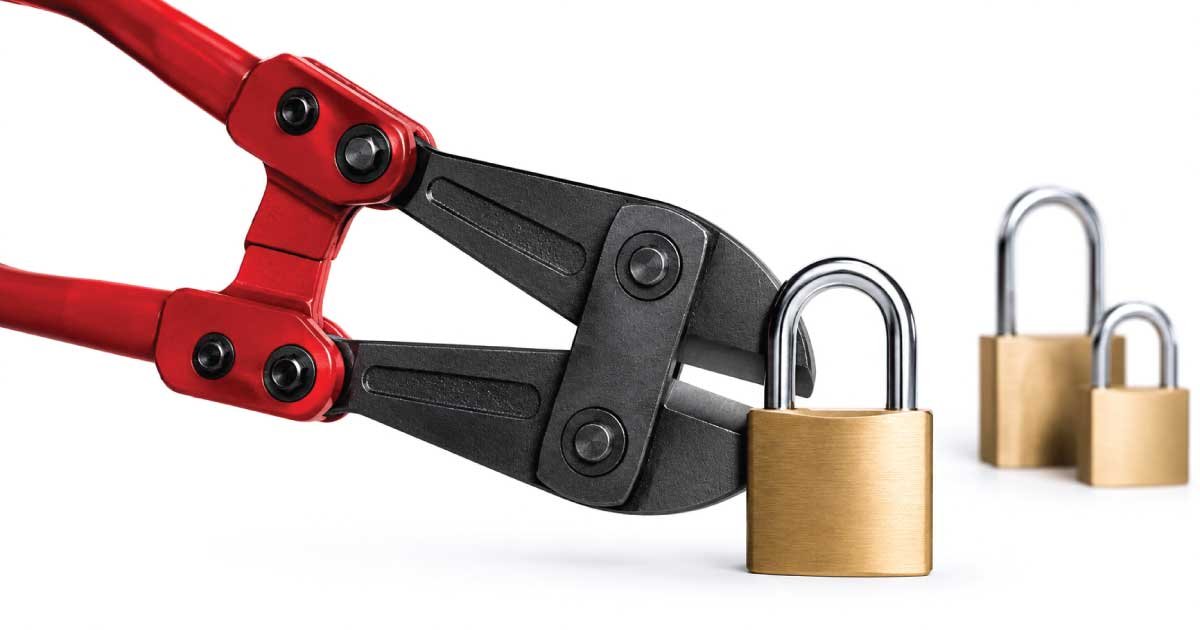
Choosing the right bolt cutter for a padlock is not as simple as grabbing the biggest tool available. The size of the padlock, the thickness of its shackle, and the material it’s made from all play an important role in determining whether a bolt cutter can cut it effectively.
Whether you’re replacing an old lock that you own, dealing with a rusted padlock that no longer opens, or simply wondering which size bolt cutters you should buy, understanding the relationship between bolt cutter size and cutting capacity can save you time, money, and frustration.
In this guide, we’ll explain what size bolt cutters are suitable for different padlocks, how bolt cutter sizes affect performance, and what other factors you should consider before making a purchase.
Important: Only use bolt cutters on padlocks that you own or have explicit permission to remove.
How Bolt Cutters Work
Bolt cutters are heavy-duty hand tools designed to cut through metal objects such as bolts, chains, wire fencing, and certain padlocks. They use long handles and compound hinge mechanisms to multiply the force you apply, allowing the cutting jaws to generate tremendous pressure.
The longer the handles, the greater the leverage. That’s why larger bolt cutters generally cut thicker and harder materials more easily than smaller ones.
However, cutting ability isn’t determined by length alone. The quality of the steel, jaw design, and the hardness of the padlock also matter.
Common Bolt Cutter Sizes
Bolt cutters come in a range of standard lengths, and each size is designed for a different level of cutting force and application. The main difference between sizes is leverage—the longer the handles, the more force you can apply to the cutting jaws with less effort.
Common bolt cutter sizes include:
8-inch: Compact and lightweight, mainly for soft wire and thin materials.
14-inch: Suitable for light-duty household work.
18-inch: Good for medium-duty cutting tasks.
24-inch: One of the most versatile sizes for homeowners and mechanics.
30-inch: Offers significantly greater leverage for thicker materials.
36-inch: Heavy-duty cutters intended for demanding industrial applications.
Each increase in length improves mechanical advantage, meaning the same amount of hand force produces much stronger cutting power at the jaws. However, larger tools are also heavier and less convenient in tight spaces.
What Size Bolt Cutters for Different Padlocks?
There is no single universal bolt cutter size that works for all padlocks because locks vary widely in material strength, shackle thickness, and security grade. The correct size depends mainly on the diameter and hardness of the shackle.
| Padlock Shackle Diameter | Recommended Bolt Cutter Size |
|---|---|
| Up to 1/4 inch (6 mm) | 14-inch to 18-inch |
| 5/16 inch (8 mm) | 18-inch to 24-inch |
| 3/8 inch (10 mm) | 24-inch to 30-inch |
| 7/16 inch (11 mm) | 30-inch to 36-inch |
| 1/2 inch (12 mm) or larger | 36-inch or specialized cutting tools |
These guidelines apply mainly to standard steel padlocks. High-security locks made from hardened steel may resist cutting even with large professional-grade bolt cutters.
Understand The Padlock Shackle Thickness
The shackle is the U-shaped metal bar that passes through the locking hasp or chain. It is the primary target when using bolt cutters, and its thickness plays a major role in determining how easily a lock can be cut.
Manufacturers typically measure shackle thickness in millimeters or inches, and even small increases in diameter significantly increase cutting resistance.
Examples include:
- Small toolbox padlock → around 6 mm shackle
- Storage unit padlock → 8–10 mm shackle
- High-security gate lock → 12 mm or thicker hardened shackle
As the shackle becomes thicker and harder, more cutting force and larger bolt cutters are required. In some cases, standard bolt cutters may not be effective at all.
Can Small Bolt Cutters Cut a Padlock?
Small bolt cutters, such as 8-inch or 14-inch models, are generally not designed for cutting padlocks. Their limited handle length means they cannot generate enough force to cut hardened or thick metal shackles.
They are best suited for:
- Soft wire
- Thin cables
- Light fencing
- Small nails
- Aluminum rods
Most standard padlocks require at least an 18-inch or 24-inch bolt cutter to achieve effective cutting performance.
Using undersized bolt cutters on a padlock can cause:
- Damage to cutting jaws
- Reduced tool lifespan
- Ineffective or incomplete cuts
Why Larger Bolt Cutters Perform Better
Bolt cutters rely on mechanical leverage. Longer handles allow you to apply greater force at the cutting jaws with less physical effort. This is similar to using a long wrench instead of a short one to loosen a tight bolt.
As handle length increases:
- Cutting force increases significantly
- Less physical effort is required
- Thicker materials can be cut more easily
For example:
- A 24-inch bolt cutter can generate much more cutting force than an 18-inch model
- A 36-inch cutter provides extremely high leverage, suitable for thick steel rods and heavy-duty applications
However, larger bolt cutters also have drawbacks:
- Heavier and harder to carry
- Less convenient in tight or confined spaces
- More fatigue during extended use
Choosing the right size depends on balancing power and portability.
Standard Steel vs. Hardened Steel Padlocks
The material of the padlock shackle is one of the most important factors affecting whether bolt cutters will work effectively.
1. Standard Steel Padlocks
Standard steel padlocks are made from relatively softer metals, making them easier to cut with the right tool.
Common uses include:
- Indoor storage units
- Toolboxes
- Lockers
- Garden sheds
In many cases, a 24-inch bolt cutter is sufficient to cut through standard steel shackles without excessive effort.
2. Hardened Steel Padlocks
Hardened steel padlocks are designed specifically for high security and resistance to cutting and forced entry. The metal is treated to increase hardness and durability.
They are resistant to:
- Cutting
- Sawing
- Drilling
- Prying
Even large 36-inch bolt cutters may struggle or fail to cut these locks. In such cases, specialized cutting tools or alternative removal methods are often required.
Because of their strength, hardened padlocks are commonly used for:
- High-security gates
- Industrial equipment
- Storage facilities
- Commercial security systems
These locks significantly increase resistance against physical attack compared to standard models.
Hardened Steel Padlocks
High-security padlocks are manufactured using hardened steel, a specially heat-treated material designed to resist cutting, drilling, and forced entry. This makes them significantly stronger than standard steel locks and much more difficult to break using manual tools.
These locks are engineered to withstand common attack methods such as:
- Bolt cutters
- Hacksaws
- Drills
- Pry tools
Even large tools like a 36-inch heavy-duty bolt cutter may fail to cut some hardened shackles due to their extreme strength and resistance.
Because of this durability, hardened steel padlocks are commonly used in high-security environments, including:
- Industrial gates
- Shipping containers
- High-security storage units
- Commercial properties
In situations where these locks cannot be removed using bolt cutters, alternative methods such as angle grinders or specialized cutting tools are often required to achieve removal safely and effectively.
Factors That Affect Cutting Performance
The ability of bolt cutters to cut through a padlock depends on several important factors. Even a powerful tool may fail if conditions are not favorable.
1. Shackle Thickness
Shackle thickness is one of the most important factors. Thicker shackles require significantly more cutting force. Even a small increase in diameter can greatly increase resistance, making cutting much more difficult.
2. Material Hardness
The hardness of the metal plays a major role in cutting success. Hardened steel is far more resistant than standard steel or aluminum alloys, often requiring specialized tools for removal.
3. Cutter Quality
Not all bolt cutters are made the same. Low-quality tools may lose sharpness quickly, bend under pressure, or fail even when properly sized. High-quality cutters provide better alignment and stronger cutting performance.
4. Jaw Design
Precision-engineered jaws improve cutting efficiency. Well-aligned cutting edges distribute force evenly, allowing smoother and cleaner cuts. Poorly manufactured jaws can slip or crush instead of cutting cleanly.
5. User Strength and Technique
Proper usage technique also affects performance. Correct positioning, stable grip, and controlled force application help maximize cutting power while reducing strain and risk of tool damage.
Safety Tips When Using Bolt Cutters
Bolt cutters are powerful tools and must always be used with caution. Improper handling can result in injury or damage to the tool or surrounding objects.
Follow these safety guidelines:
- Wear safety glasses to protect against flying metal fragments
- Keep hands and fingers clear of the cutting path
- Ensure a stable grip before applying force
- Do not attempt to cut unknown, pressurized, or dangerous materials
- Avoid using damaged, bent, or misaligned cutters
- Store tools safely after use
Safety should always take priority over speed or convenience when working with high-force cutting tools.
 Advance your research now with
  Ratchet Size Chart: Complete Guide with PDF
Choosing the Right Bolt Cutter for Your Needs
Selecting the correct bolt cutter size depends on the type of work you plan to do. Using the right balance of power and portability improves efficiency and reduces effort.
1. For Light Household Use
- 14-inch to 18-inch cutters
- Suitable for thin wires and small tasks
- Ideal for general home maintenance
These compact tools are easy to handle and store but are not suitable for heavy padlock removal.
2. For General Padlock Removal
- 24-inch cutters
- Best balance of power and portability
- Suitable for standard steel padlocks
This size is commonly used by homeowners and mechanics for everyday lock cutting tasks.
3. For Heavy-Duty or Industrial Use
- 30-inch to 36-inch cutters
- Designed for thick or tough steel materials
- Used in industrial or professional environments
These cutters provide maximum leverage but are heavier and less practical for tight spaces.
Always prioritize build quality over size alone, as a well-made smaller cutter may perform better than a poorly made larger one.
Alternatives to Bolt Cutters
In some situations, bolt cutters may not be the most effective or practical tool. Depending on the lock type and environment, alternative methods may be more suitable.
Common alternatives include:
Angle grinders – Effective for hardened steel locks and heavy-duty applications
Hacksaws – Useful for slow, controlled cutting in tight spaces
Lock picking tools – Non-destructive method for compatible locks
Lock drilling – Used when locks are damaged or seized
Each method has its own advantages and limitations. The best choice depends on the lock type, security level, and whether non-destructive removal is required.
Conclusion
Choosing the right bolt cutter size for a padlock depends on several factors, including shackle thickness, material hardness, and the level of security the lock provides. While small bolt cutters are useful for light tasks, most padlocks require at least a 24-inch to 30-inch cutter for effective removal.
However, hardened steel security padlocks may resist even the largest manual cutters, requiring specialized tools for removal.
By understanding bolt cutter sizes, leverage, and padlock construction, you can select the right tool for the job and avoid unnecessary damage or frustration. A well-chosen bolt cutter not only saves effort but also ensures safer and more efficient work.
FAQs:
What size bolt cutters do I need for a standard padlock?
Most standard padlocks can be cut using 24-inch or 30-inch bolt cutters, depending on the shackle thickness and material. A 24-inch cutter is usually sufficient for common household padlocks, while a 30-inch model provides additional leverage for thicker shackles. Always use bolt cutters only on locks you own or are authorized to remove.
Can 18-inch bolt cutters cut a padlock?
18-inch bolt cutters may cut small padlocks with thin or low-strength shackles, but they are generally not powerful enough for most standard padlocks. Their shorter handles provide less leverage, making it difficult to cut hardened or thicker steel. Larger bolt cutters are usually more effective for demanding cutting tasks.
Can bolt cutters cut hardened steel locks?
In many cases, no. Hardened steel padlocks are specifically designed to resist cutting, drilling, and other forced-entry methods. Even large manual bolt cutters may not generate enough force to cut these locks. High-security locks often require specialized removal tools when authorized and should never be tampered with unlawfully.
Is a 36-inch bolt cutter the strongest?
Yes. Among manual bolt cutters, 36-inch models provide the greatest leverage and cutting force because of their long handles. They are capable of cutting thicker materials than smaller models and are commonly used for heavy-duty applications. However, even they may struggle against high-quality hardened steel security locks.